Beneath a Turkish town lies Derinkuyu, an ancient underground city carved eighteen storeys deep that could hide twenty thousand people and seal itself with rolling stone doors
Under the plains of central Turkey, a whole city waits in the dark. Derinkuyu was carved eighteen storeys into the rock, deep enough to shelter twenty thousand people with their animals and food, and to seal itself shut from the inside. For centuries it lay forgotten, until a man knocked through his cellar wall.
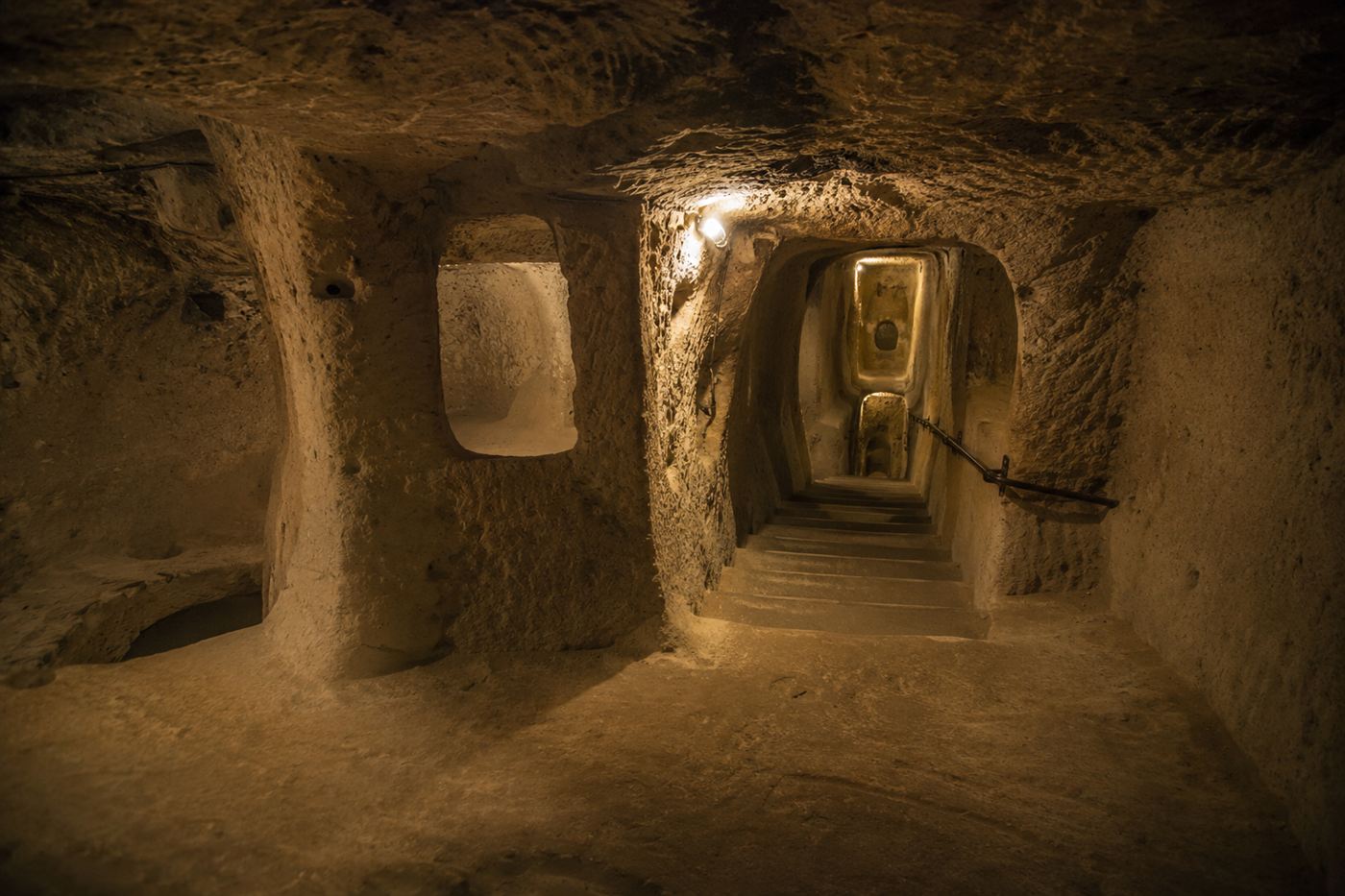
A carved chamber deep inside Derinkuyu, the underground city of Cappadocia. Illustration: Watts & Wild.
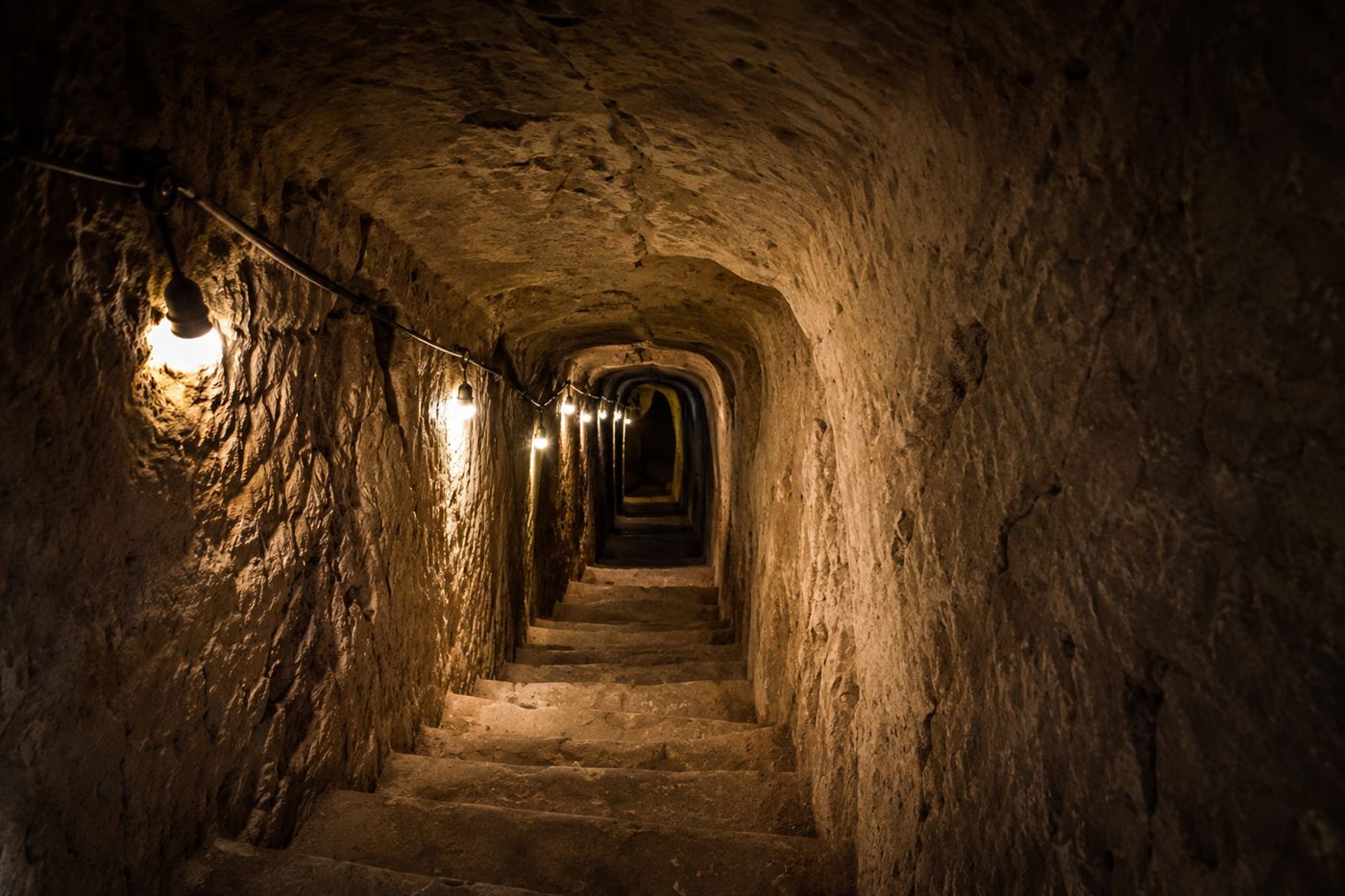
Derinkuyu does not look like much from the surface. It sits beneath an ordinary town in the Cappadocia region of central Turkey, a landscape of soft, pale volcanic rock and strange wind-carved cones. But step into one of its entrances and descend, and the ordinary town turns out to be the lid on something extraordinary: a city hollowed straight down into the earth, level after level, deep enough to lose a skyscraper in.
It is one of the most remarkable structures the ancient world left behind. As the site is documented, Derinkuyu reaches some 85 metres down through around eighteen levels, and was large enough to shelter as many as 20,000 people together with their livestock and stores of food. It was not a tomb or a mine. It was a place to live, when living above ground became too dangerous.
What is Derinkuyu? Derinkuyu is an ancient underground city in Cappadocia, Turkey, carved up to 85 metres and 18 levels deep into soft volcanic rock. It could shelter around 20,000 people with their livestock and food, had ventilation shafts and wells, and could be sealed from inside with rolling stone doors.
Derinkuyu, a city carved downward
What made Derinkuyu possible was the rock itself. Much of Cappadocia is made of tuff, a soft stone formed from ancient volcanic ash that is easy to cut with simple hand tools yet hardens on contact with air, so a chamber carved into it stays standing. Generation after generation, people dug into that rock and downward, expanding passages and rooms until the result was not a cellar or a cave but a genuine city, stacked vertically beneath the fields.
The scale is hard to take in. Eighteen storeys is the height of a substantial tower block, except that here it runs the other way, plunging down into the dark. And Derinkuyu is not even unique: Cappadocia hides dozens of these underground cities, of which Derinkuyu is simply the deepest and most famous.
Everything a town needs, underground
The astonishing thing about Derinkuyu is how complete it is. This was not a bare bunker but a working settlement, with everything a community needs to survive for weeks at a time without ever seeing the sky. There were stables for animals on the upper levels, cellars and storage rooms for food, presses for making wine and oil, communal dining halls, and chapels carved out of the rock, including a large cruciform church on one of the lower floors.
Keeping all of it liveable took clever engineering. A network of ventilation shafts ran the full depth of the city, drawing fresh air down to the lowest levels, and some of these reached all the way to underground water, giving the inhabitants wells they could use without ever surfacing. Cut off from the world above, the people of Derinkuyu could still breathe, drink, eat and pray.
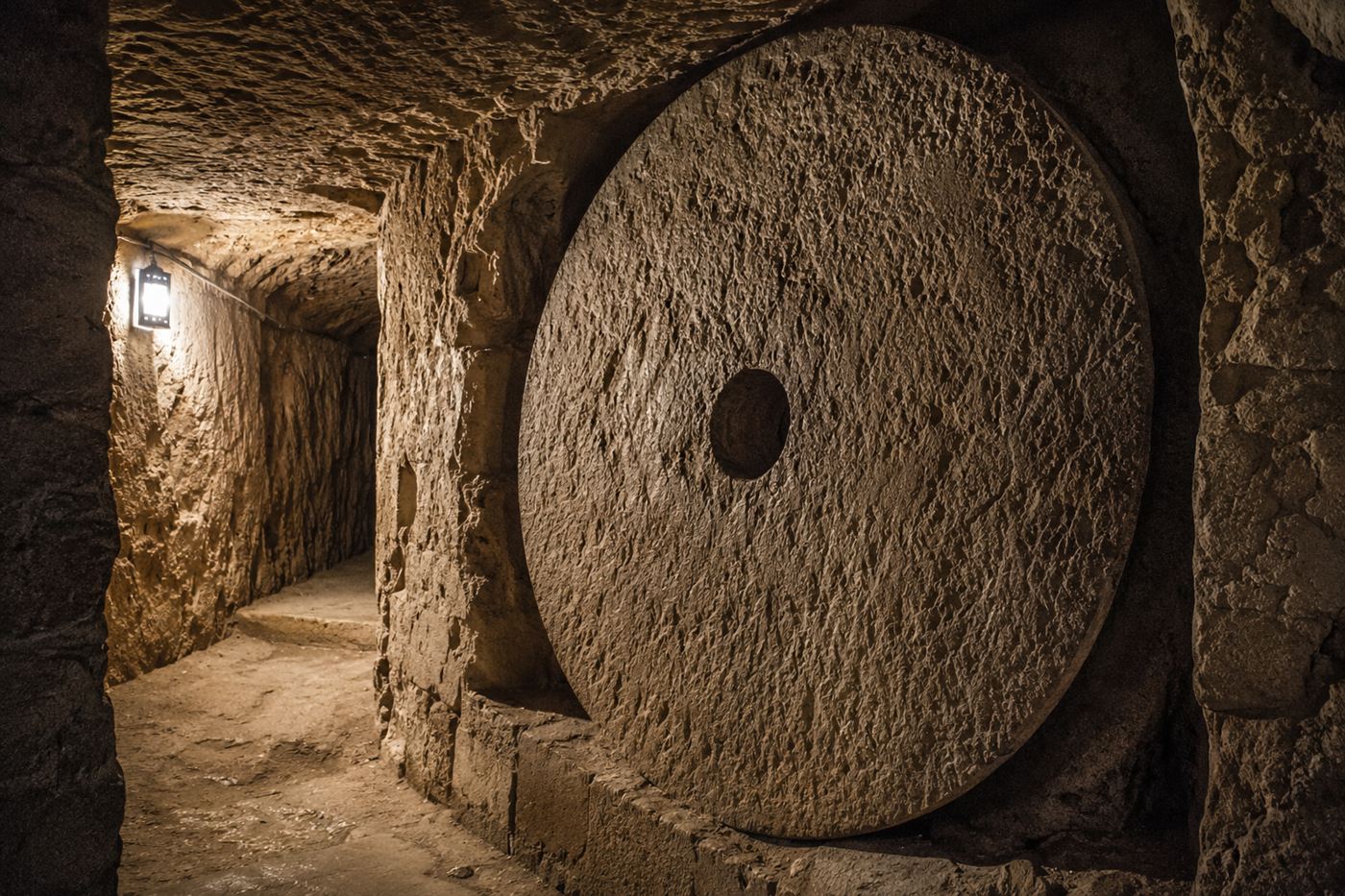
Doors of stone
The whole point of Derinkuyu was defence, and its cleverest feature was the way it could be locked. Set into the narrow passages were great round stone doors, like enormous millstones, each weighing hundreds of kilograms. When danger came, they could be rolled across the corridors to block them completely, and crucially they were designed to be moved only from the inside. An attacker in the tunnel could not shift one; the people sheltering behind it could.
Better still, each level could be sealed off separately. Even if raiders somehow forced their way past one stone door, they would find another corridor and another door beyond it, with defenders safe below. A handful of people could hold the whole city against an army, simply by closing the right stones in the dark.
Hiding from the world above
The people who built and used Derinkuyu did not live underground all the time. They lived normal lives on the surface, farming the land and working in the light, and they went down into the city only when they had to, when armies came through. Cappadocia sat for centuries on a dangerous frontier, and its underground cities were refuges from one wave of invaders after another: used by the local Christian population through the long wars between Byzantines and Arabs, and later as a hiding place from Mongol raids and from the rulers who followed. When the threat passed, the people climbed back into the sun.
Lost behind a wall
For all its size, Derinkuyu was largely forgotten, its entrances sealed and built over as the centuries passed. Its modern rediscovery, in 1963, is almost too good to be true: a local man renovating his house knocked down a wall and found a mysterious room behind it that he had never known was there. Digging further revealed a passage, and the passage led into the vast, silent network below. The city was opened to visitors in 1969, and even now only a fraction of it can be entered. Beneath the quiet town, most of the eighteen storeys still wait in the dark.
The honest catch
A few of the famous details deserve a little caution. Figures like "20,000 people" and the exact number of levels are careful estimates rather than certainties, and precisely who first began digging Derinkuyu, and when, is still debated, with dates spread across many centuries. Life down there was also nothing like a cosy hidden world; it was a cramped, dark, smoky emergency shelter, used in fear and for as short a time as possible, not a comfortable subterranean home.
And it is worth saying plainly that there is nothing mysterious about who made it. Despite the stories that drift around such places, Derinkuyu was not built by a lost civilisation or visitors from elsewhere; it was dug, patiently and ingeniously, by ordinary local people trying to keep their families alive. That is what makes it so impressive. With hand tools and hard-won knowledge of their own rock, they carved an entire city downward into the earth, gave it air and water and stone doors, and hid in it, again and again, for a thousand years.
An entire city carved eighteen floors into the earth, sealed by rolling stones, and lost behind a man's basement wall for centuries. Could you spend a week hidden that deep underground? Tell us in the comments.
Related reading: Greek fire, the Byzantine weapon from the same age of invasions and sieges. See also a modern underground world, SubTropolis, a business city dug into a Kansas City mine.