A working solar power station was already pumping water from the Nile in the Egyptian desert in 1913, decades before the world believed solar power could work
We talk about solar power as if it arrived this century. It did not. Frank Shuman's solar plant stood in the Egyptian desert in 1913, a field of mirrored troughs catching the sun and using nothing but its heat to pump the Nile across the cotton fields, more than a century before the solar boom we are living through now.
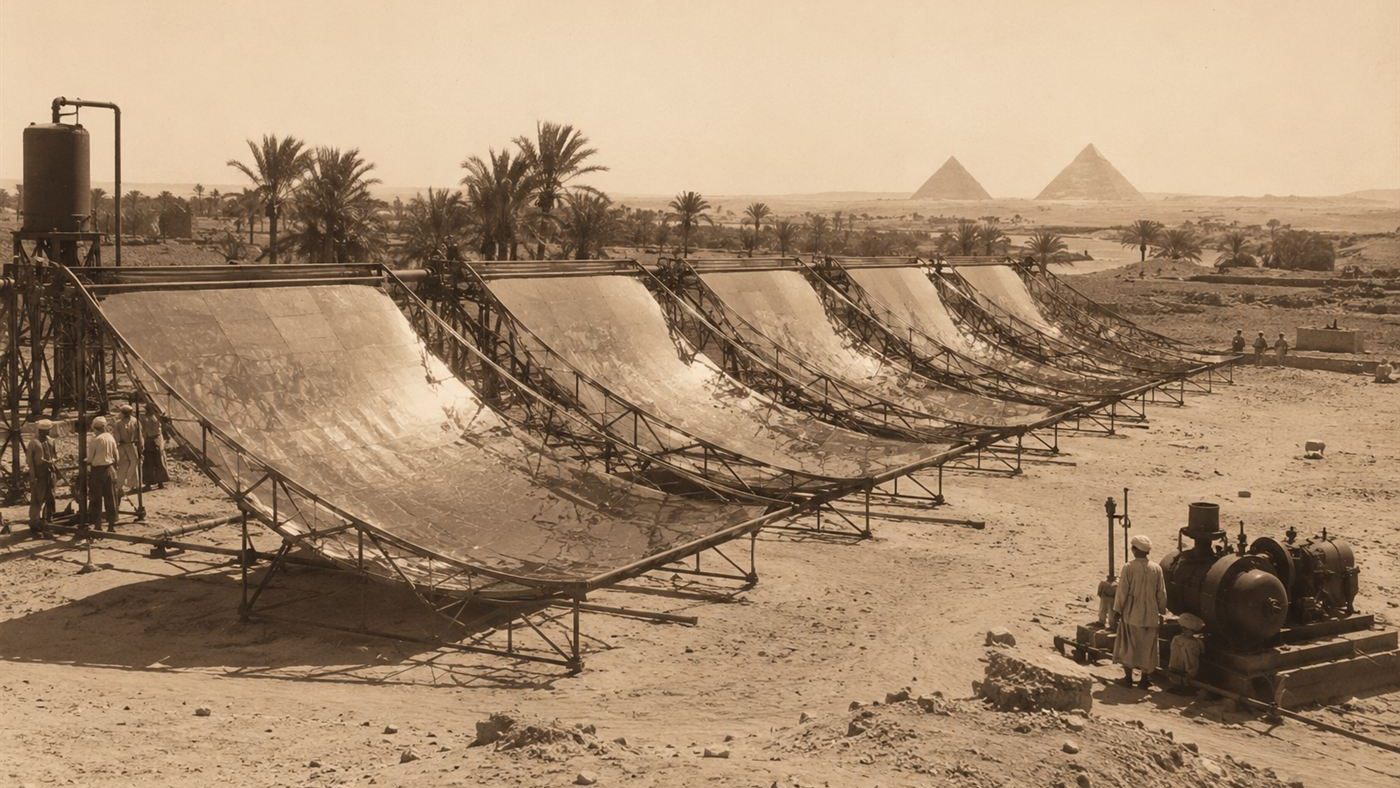
Mirrors that turned desert sun into pumped water, near Cairo in 1913. Illustration: Watts & Wild.
The man behind it was Frank Shuman, an inventor from Philadelphia who had already made a fortune from wire glass and was not short of nerve. He had spent years convinced that the sun, falling free on the world's deserts, was the largest power source humanity would ever have, and that the only real problem was building a machine to capture it. By the early 1910s he had stopped writing about it and started building.
He was not quite the first to try. A generation earlier the French teacher Augustin Mouchot had already run a solar engine and even made ice with sunlight, only to be buried by cheap coal. Shuman picked up where that earlier dream had stalled.
Egypt was the obvious place to prove the point. The sun was relentless, the British-run cotton estates needed endless water lifted from the Nile, and coal had to be shipped in at great expense. A solar engine that ran on sunshine instead of imported fuel was not just a wonder; it was a business case.
How Frank Shuman's solar plant worked
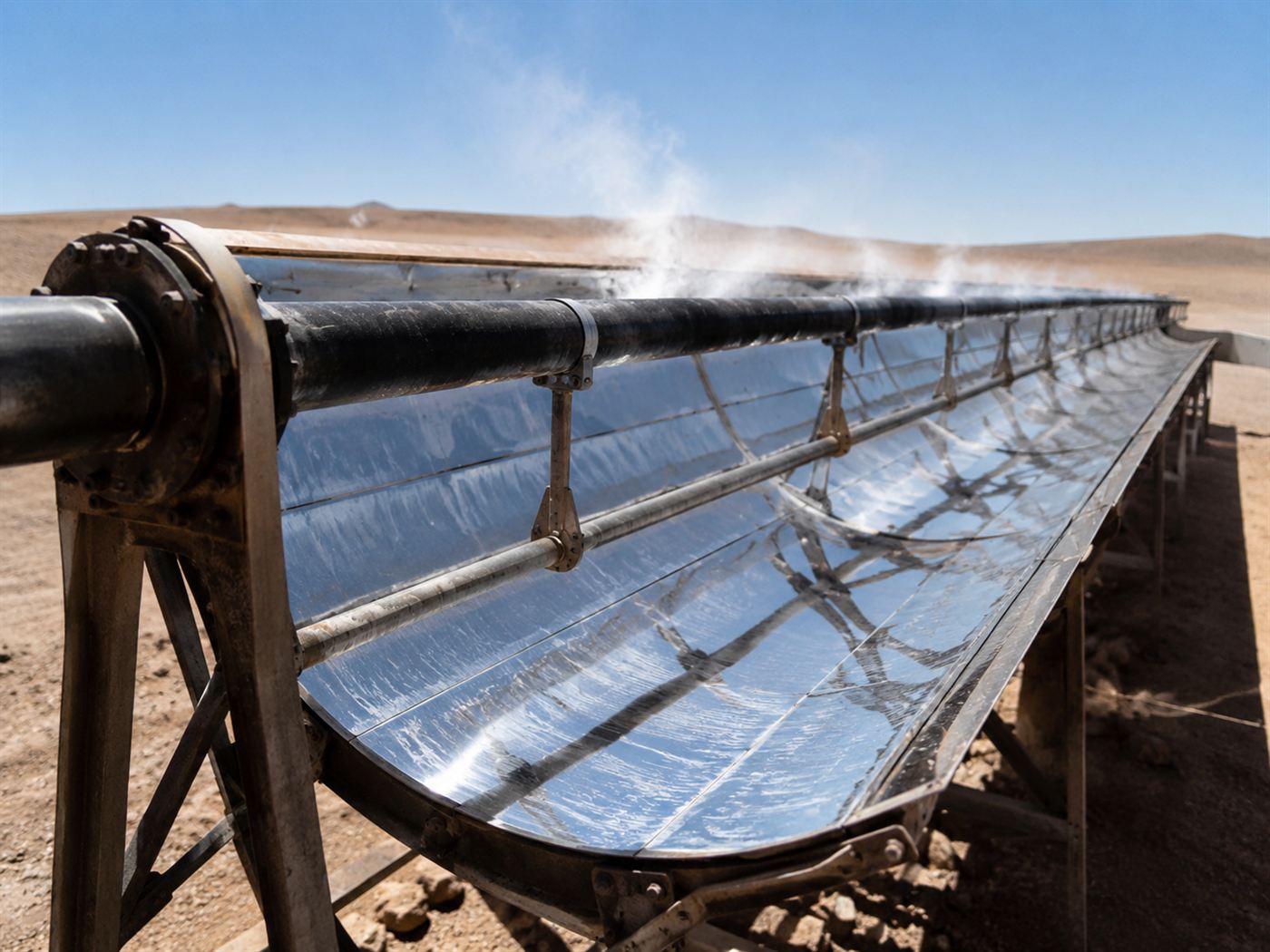
At Maadi, a few miles south of Cairo, Shuman laid out five enormous troughs lined with mirrors. As The National recounts, each trough was more than 60 metres long, shaped to focus the sun onto a blackened pipe, and the whole array tracked the sun across the sky. The concentrated heat boiled water into steam, the steam drove a low-pressure engine, and the engine turned a pump.
The numbers were serious. The plant lifted more than 20,000 litres of water a minute out of the Nile and onto the fields, work that would otherwise have needed a coal-fired engine burning fuel carried up the river. Shuman had not built a toy or a laboratory curiosity. He had built a power station, and it ran on nothing that arrived by ship.
The Saharan dream behind it
Shuman did not work alone. The British physicist C.V. Boys, a brilliant experimenter, suggested the parabolic trough shape that made the design so much more efficient, and the engineer A.S.E. Ackermann helped refine it. Together they had turned a hopeful idea into a plant that visitors could stand beside and watch pour water onto the desert.
What Shuman saw in it was far bigger than one cotton estate. He calculated that a field of these mirrors covering a modest patch of the Sahara could, in principle, supply the power of all the coal then mined in the world, and he said so openly, telling the press that the human race must eventually rely on the direct power of the sun. In 1913 that sounded like the talk of a dreamer. A century later it reads like a weather forecast. The boldest version of his dream is now being chased above the clouds, with solar power beamed down to Earth from orbit.

Why Frank Shuman's solar plant failed
The machine succeeded and the moment destroyed it. In 1914, barely a year after the plant began running, the First World War broke out. As a history of early solar power notes, the engineers were called home, the metal and money were swallowed by the war, and the project simply stopped. Shuman himself died in 1918, before there was any chance of starting again.
Then the ground shifted under the whole idea. The years after the war brought cheap, plentiful oil, and with fuel that abundant nobody needed to chase sunlight to run a pump. The Maadi mirrors were never rebuilt, and the very technology Shuman had proven, long troughs concentrating the sun to raise steam, vanished from serious use for more than sixty years, until California's solar thermal plants revived it in the 1980s.
The honest catch
It is tempting to tell this as a simple tale of a genius crushed by oil barons, and it was not quite that. Shuman's plant was expensive to build, it leaned on the cheap labour and capital of a colonial cotton economy, and it pumped water rather than making electricity for a grid, which is a far easier job. Against the coal and oil prices of its day it was not yet truly competitive, and even without the war it would have had a hard climb to commercial success.
What is fair to say is that the idea worked. As a historical review of solar thermal power records, Shuman's Maadi station is widely regarded as the first large solar engine to do real, sustained work. The physics he relied on was sound, the engineering ran, and the only thing missing was a world that needed it. He was not wrong; he was early.
Why a lost desert plant still matters
The lasting jolt of Frank Shuman's solar plant is how it resets the calendar in our heads. Solar power is not a fragile newcomer still proving it can carry a load; it carried one in 1913, in the desert, in front of witnesses. The long gap since was not a failure of the technology but a hundred-year detour through cheap fossil fuel, and we are only now returning to the road Shuman pointed down.
That is worth holding on to as mirrored troughs once again spread across the deserts of the world. Does it change how you see today's solar boom to know a working solar plant was pumping the Nile in 1913? Tell us in the comments.
Related reading: In a valley Italians called the gates of hell, an engineer lit five light bulbs from the earth's own steam in 1904.