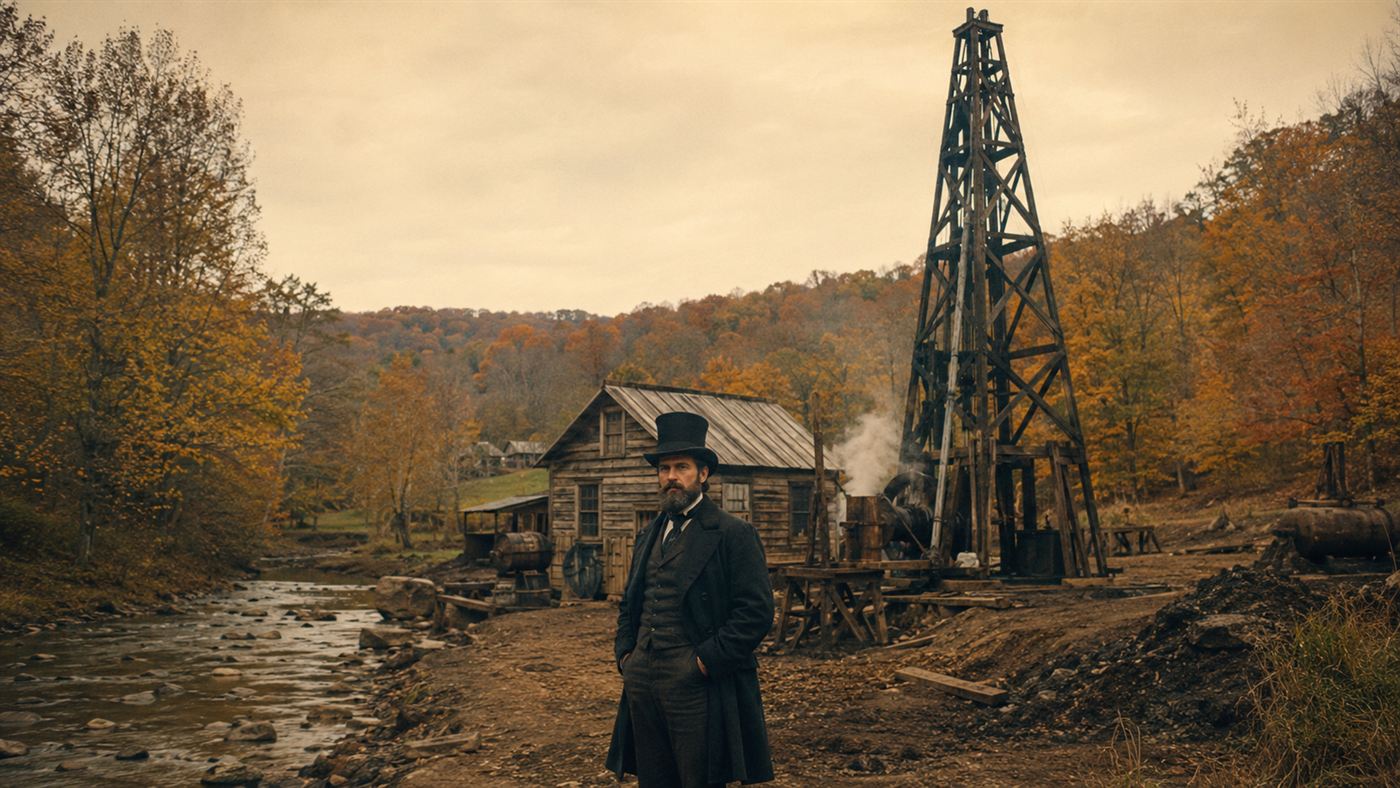
In 1878 a French teacher made a block of ice using nothing but sunshine, won a gold medal in Paris, then watched cheap coal bury his solar engine for a hundred years
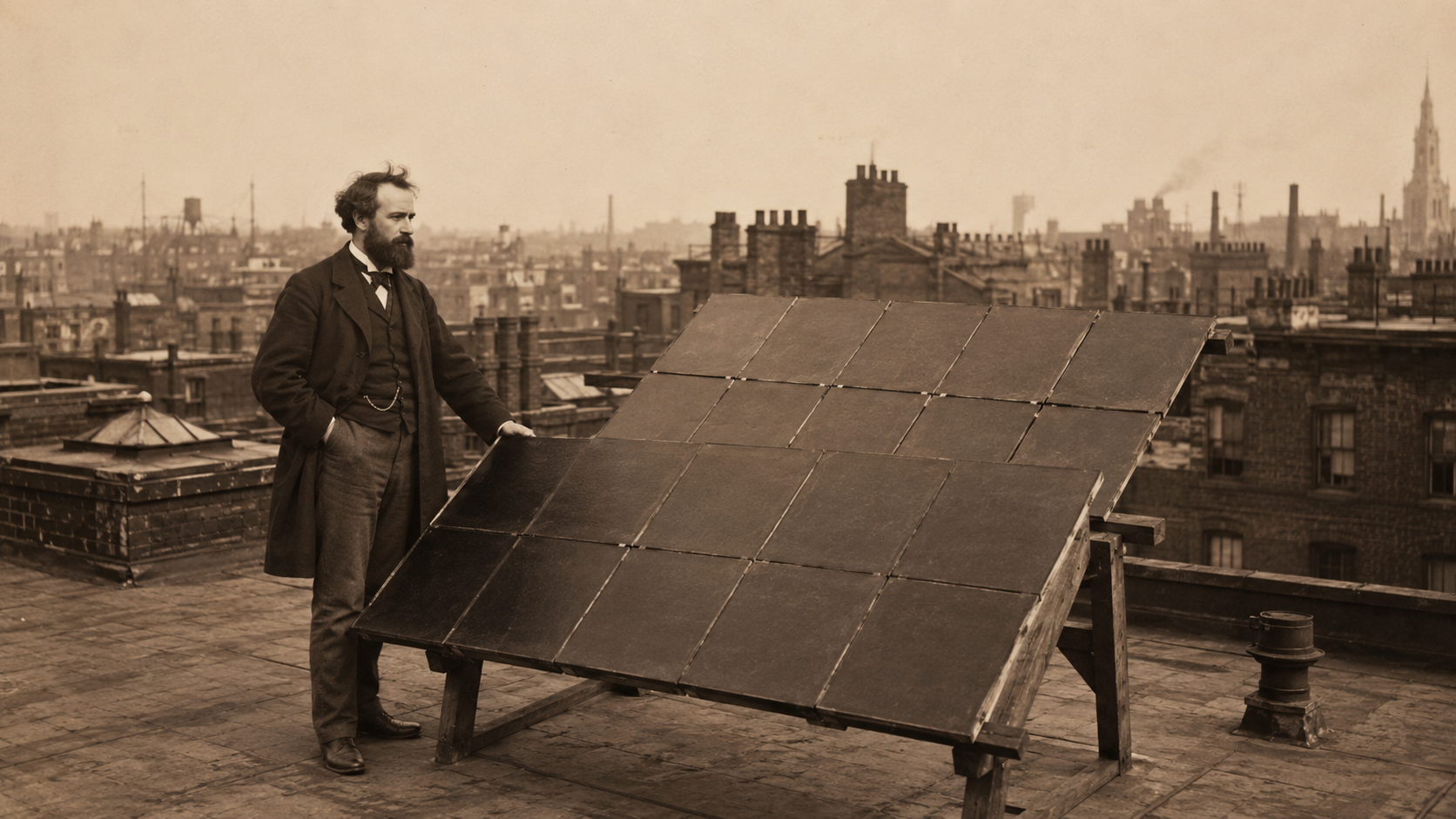
Long before anyone bolted a panel to a roof, a quiet mathematics teacher named Augustin Mouchot was boiling water with the sun and using it to run machines. At the great Paris fair of 1878 he did something that stopped the crowds cold: he made ice, in summer, powered by nothing but sunlight. Then the price of coal fell, his money dried up, and the world forgot him for a century.
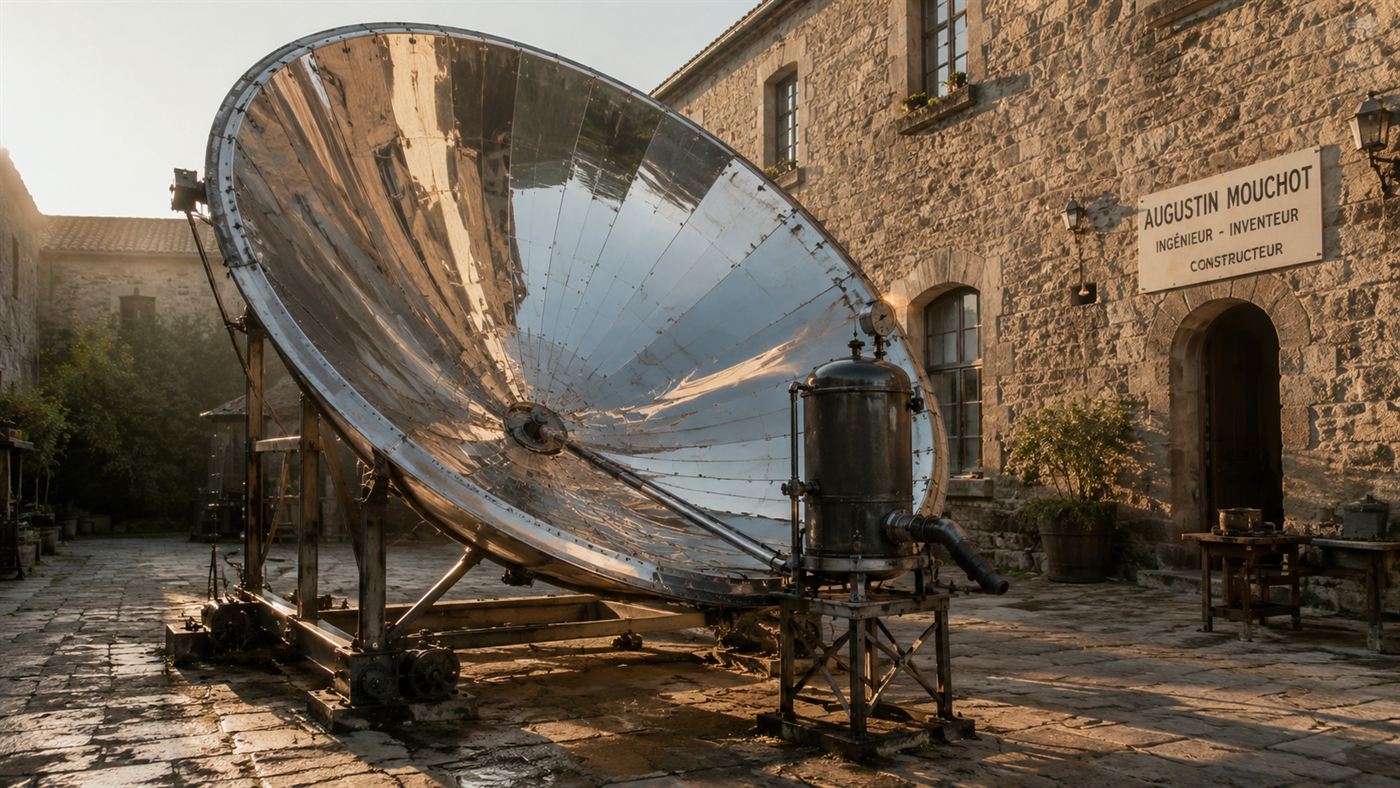
Mouchot's solar concentrator focused the sun onto a central boiler to raise steam. Illustration: Watts & Wild.
We tend to think of solar power as a modern thing, born somewhere between the space race and the climate crisis. It is a comforting story, and it is wrong. The man who first turned sunlight into useful work on a serious scale was Augustin Mouchot, a French physics and mathematics teacher who started tinkering with the idea in the 1860s, when the steam engine was king and oil had barely been pumped from the ground.
Mouchot had a worry that sounds startlingly modern. He looked at the coal-fired engines transforming Europe and asked a simple question almost nobody else was asking: what happens when the coal runs out? Convinced the mines would not last forever, he set out to prove that the sun could do the same job for free.
How Augustin Mouchot caught the sun
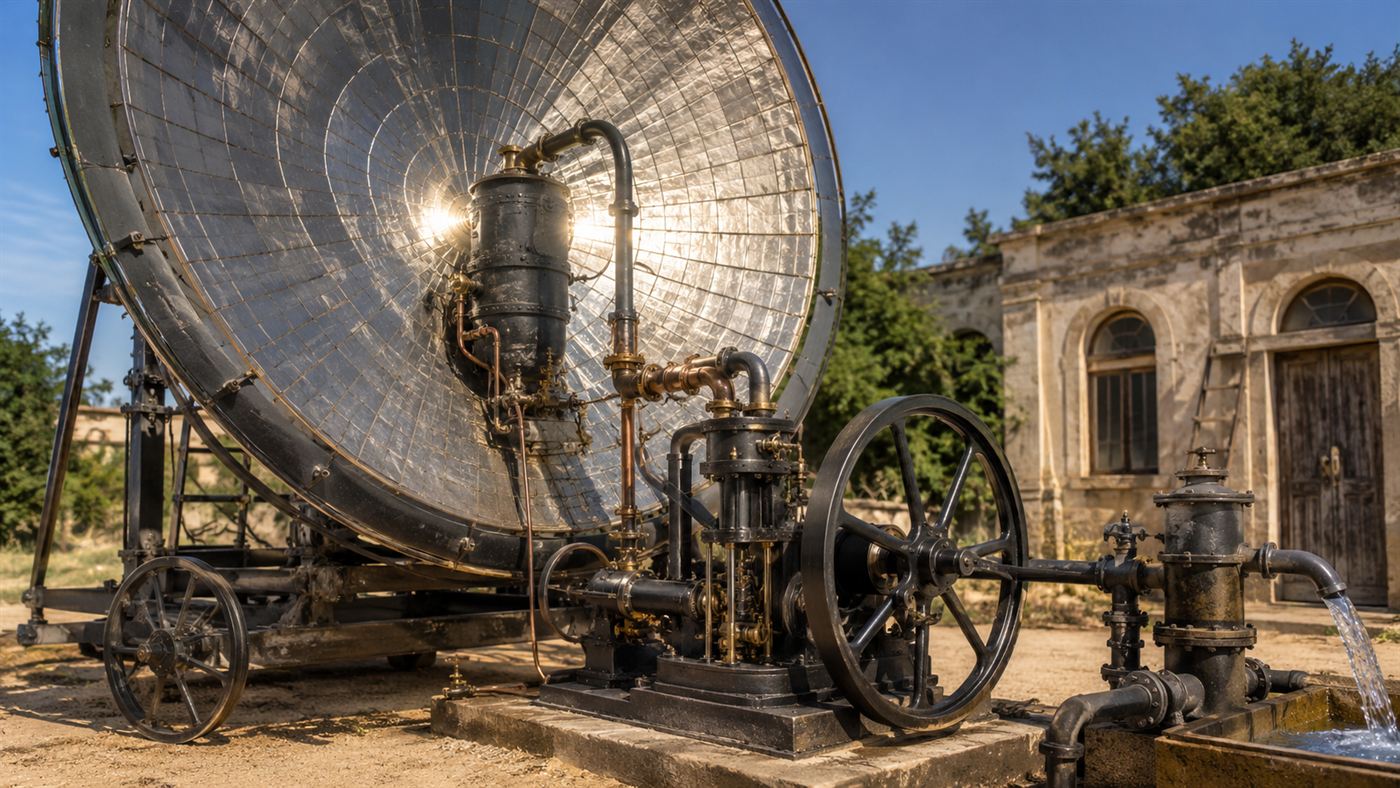
His answer was elegantly simple. In 1866 Mouchot built a device with a large polished reflector shaped like a cone, which gathered sunlight and focused it onto a blackened copper boiler at the centre. The concentrated heat boiled the water inside, and the steam drove a small steam engine. There were no exotic materials and no electricity involved, just sunlight, metal, and water arranged with great care.
The idea worked well enough to attract the attention of the French state under Napoleon III, which saw a use for it in sun-baked French Algeria, where coal had to be shipped in at painful cost. As Wikipedia records, Mouchot was given backing and sent south to develop the machine in the colony, and in the fierce North African sun his solar engine performed far better than it ever had in cloudy Paris. He pumped water, ran machinery, and even drove a small printing press, all on heat pulled straight from the sky.
The ice that amazed Paris
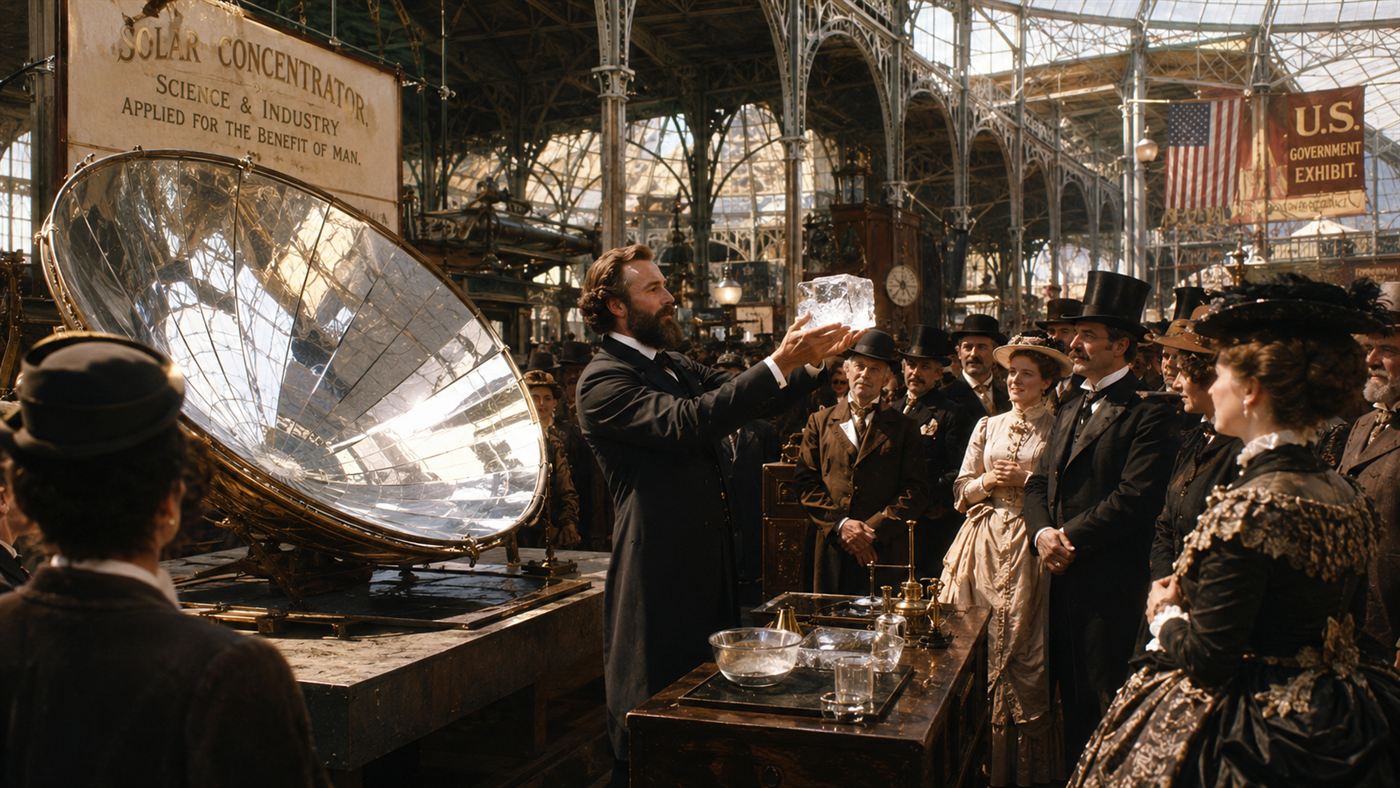
Mouchot's moment of glory came at the 1878 Universal Exhibition in Paris, one of the great world fairs of the age. There he set up his largest machine yet, a reflector spread across roughly twenty square metres, and ran it in front of the judges and the crowds. The engine worked, as expected. But then he did something that seemed to defy common sense.
He used the heat of the sun to make ice. By coupling his solar engine to a small refrigeration unit, Mouchot turned the hottest thing available, concentrated sunlight, into a block of ice on a summer's day. As CleanTechnica has chronicled in its history of forgotten solar machines, that ice trick won him a gold medal. For one shining moment, solar power looked like the future.
Why cheap coal buried the idea
And then the future quietly changed its mind. In the years after the fair, the price of coal in France fell sharply. As the Paléo-Énergétique archive explains, better railways and shipping plus a free-trade deal with Britain flooded the market with affordable coal. Against fuel that cheap, an expensive, finicky solar engine that only worked in bright sun made little economic sense.
The French government drew the obvious short-term conclusion and cut Mouchot's funding. His assistant Abel Pifre kept the flame alive for a while, even running a printing press with a solar engine at a Paris festival in 1882, but the momentum was gone. Mouchot returned to teaching and slipped into obscurity, dying in 1912 far from the limelight of his Paris triumph. The world had decided that coal was the answer, and it would not seriously revisit solar power for the better part of a hundred years.
The honest catch
It is tempting to tell this as a tale of a genius crushed by greedy fossil-fuel interests, but the truth is gentler and more interesting. Mouchot's machines really were impractical for their time. They were costly to build, they produced fairly little power for their size, and they did nothing at all when clouds rolled in or the sun went down, the same intermittency problem that storage engineers still wrestle with today.
Set against coal that was abundant, cheap, and worked rain or shine, his steam engine simply could not compete on price, and no nineteenth-century government was going to subsidise it on principle. There is also no neat unbroken line from his cone of polished metal to the modern panel on your roof. What Mouchot got right was not the hardware but the question. He saw, a century early, that a civilisation built on a finite fuel would one day need the sun, and he proved with ice and steam that the sun was up to the task.
Why a forgotten teacher still matters
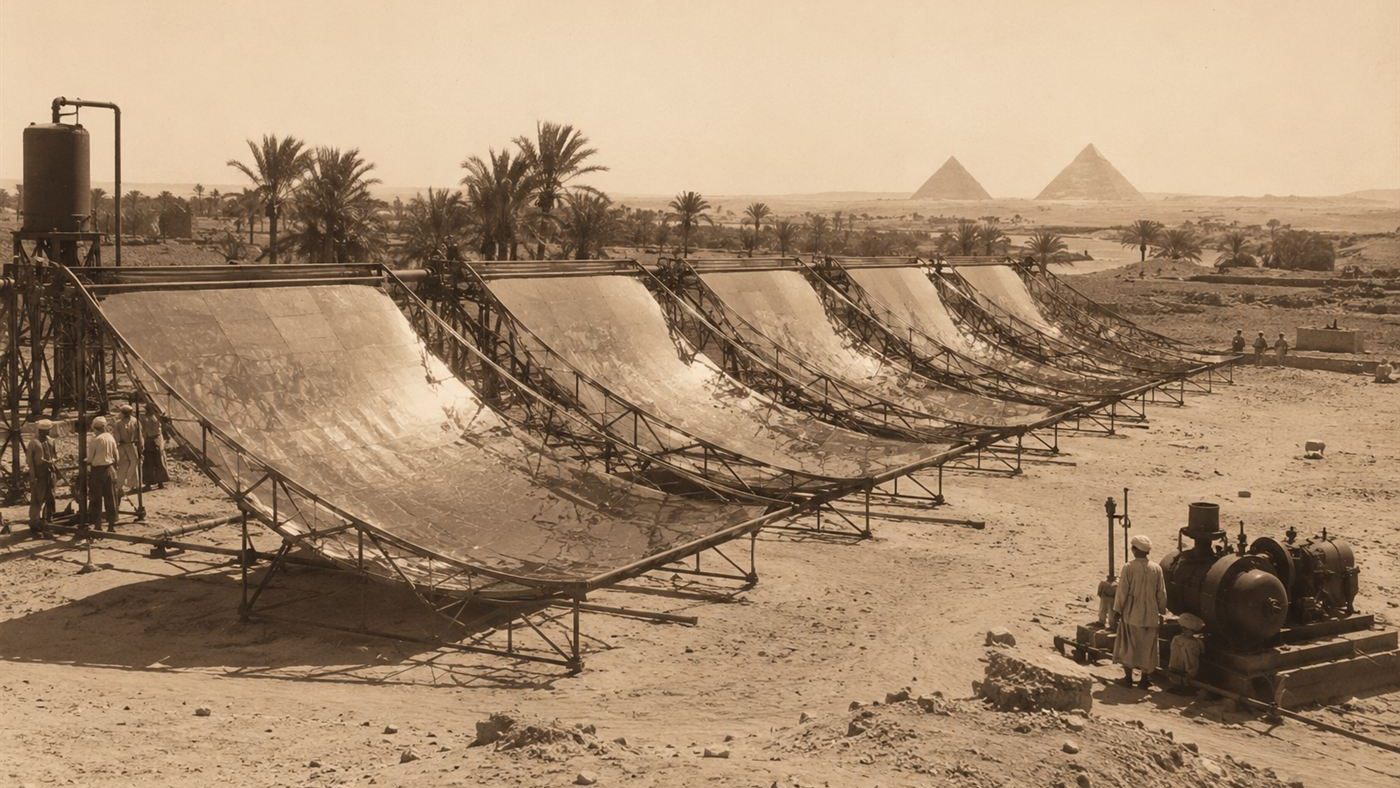
Today the descendants of Mouchot's idea are everywhere. Concentrated solar plants in deserts use fields of mirrors to boil fluid and drive turbines, which is his cone of polished metal scaled up to the size of a town. The solar power industry that now outbuilds coal for new capacity in much of the world is, in spirit, the vindication of a man who was simply too early.
His story is a useful reminder that being right is not the same as winning. Augustin Mouchot had the correct idea at the wrong price, in the wrong decade, and it cost him his place in history for generations. The sun he tried to harness in 1878 is now quietly powering the very grids that coal once owned, which is a slow, strange kind of victory for a teacher who died thinking he had failed.
A village schoolteacher proved that sunshine could run an engine and freeze water in 1878, and the world shrugged because coal was cheaper. If you had been one of the judges in Paris that summer, would you have bet on the sun or on the coal? Tell us in the comments.
Related reading: In 1913 an American built a working solar plant in the Egyptian desert, then the First World War buried solar power for fifty years.