Alexander von Humboldt watched electric eels leap from the water onto horses in Venezuela in 1800, biologists doubted the account for generations, and a Vanderbilt neuroscientist finally filmed it in his lab in 2016
When Alexander von Humboldt wrote in 1800 that electric eels in Venezuela were leaping out of rivers to attack horses, European naturalists were skeptical for generations. In 2016, a neuroscientist at Vanderbilt University set up a conductive arm in a tank to test the claim. The eels leaped.
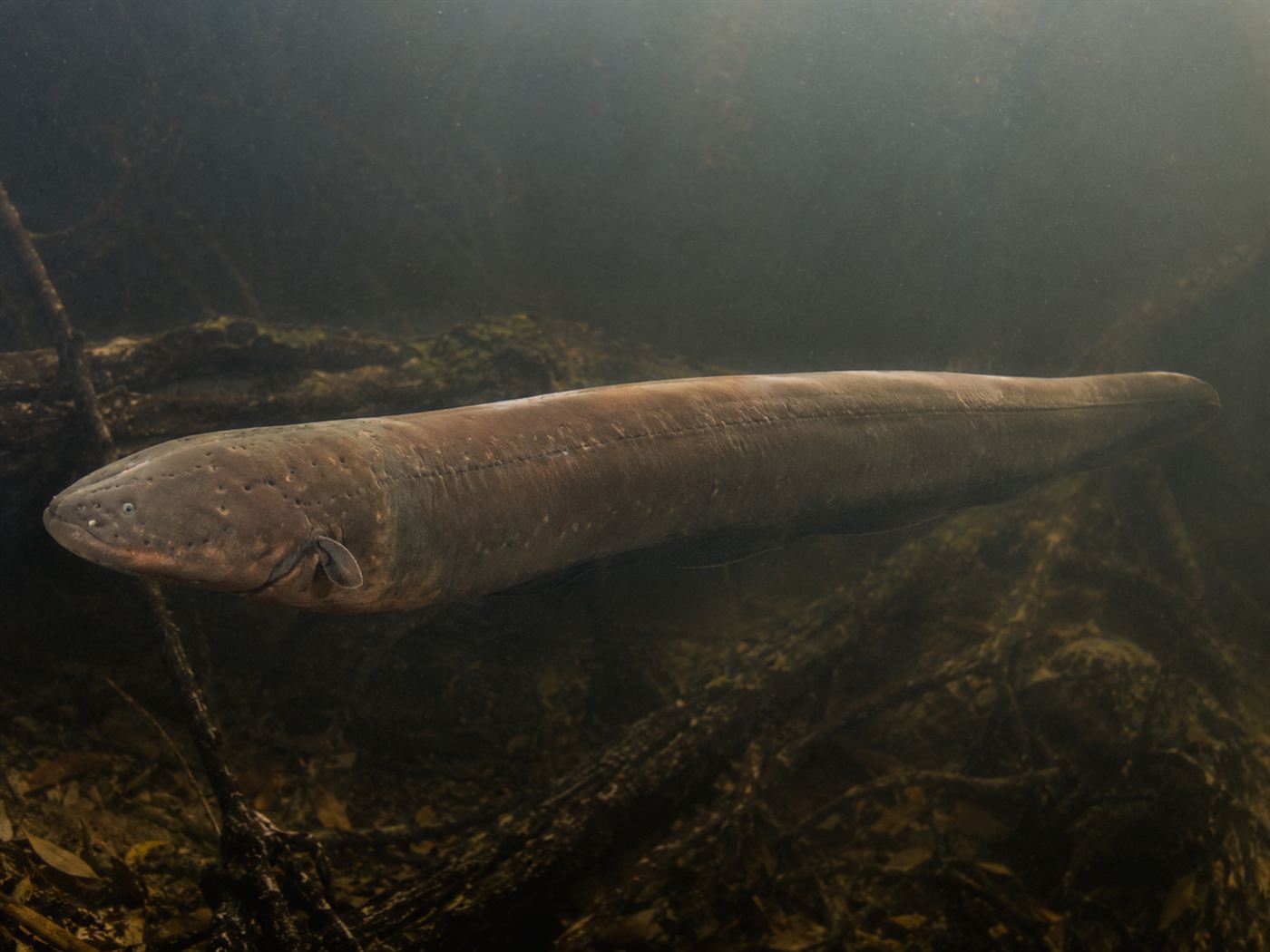
An electric eel in Amazonian water. Nearly 80 percent of its body is dedicated to generating electricity. It is not a true eel and it is not from Europe. Illustration: Watts & Wild.
The electric eel is not an eel. It is a knifefish, more closely related to catfish than to any true eel, and it lives in the slow, murky rivers of the Amazon River basin and the Orinoco in South America. In 2019, scientists described a new species, Electrophorus voltai, and measured its electrical output at just under 860 volts, the highest discharge ever recorded from a living animal. The previous record, held by the original species Electrophorus electricus, stood at around 600 volts. Electrophorus voltai gets the extra voltage partly from size: it is the largest of the three electric eel species now recognized, reaching up to 2.4 meters and found in the rocky river basins of the Brazilian highlands.
The animal that generates those 860 volts does it with a body that is almost entirely electric organ. The tail, which makes up about 80 percent of the total body length, is packed with thousands of modified muscle cells called electrocytes. Each electrocyte produces a small charge on its own. Stacked together like batteries wired in series, they can fire in synchrony to produce the pulses that have made the electric eel one of the most studied creatures in the history of bioelectricity. The fish breathes air at the surface, can generate electricity from birth, and has been doing so, in some ancestral form, for roughly 100 million years.
The fish that is not an eel
True eels belong to the order Anguilliformes, and the electric eel is not among them.
It belongs to the Gymnotiformes, the South American knifefish, an order that includes several hundred species of weakly electric fish that use low-voltage pulses to navigate and communicate in dark water.
The electric eel took that ancestral ability and amplified it: where its relatives use electricity to sense the world, Electrophorus voltai uses it to stop prey in its tracks.
The confusion with eels comes from the shape: long, scaleless, brownish, swimming with an undulating motion.
The internal anatomy is entirely different: the heart, liver, and reproductive organs are compressed into the first 20 percent of the body, right behind the head.
Everything else is the electric organ.
The animal surfaces every few minutes to breathe, absorbing oxygen directly through the lining of its mouth, a habit that evolved partly because the murky Amazon River water it inhabits can be severely oxygen-depleted.
A captive electric eel that cannot surface will drown.
How the electric eel builds 860 volts
The electric eel carries three distinct electric organs inside its body: the main organ, Hunter's organ, and Sachs' organ.
Sachs' organ is the small one, producing low-voltage pulses of around 10 volts at frequencies up to 400 cycles per second for bioelectricity-based navigation, a kind of active sonar that lets the eel sense objects and other electric fields in the dark water.
The main organ and Hunter's organ produce the high-voltage pulses used for hunting and defense.
Each of the thousands of electrocytes is a modified muscle cell that pumps ions across its membrane on one side when the nervous system fires the signal, generating a potential of about 150 millivolts per cell.
In Electrophorus voltai, the main organ can contain up to 6,000 electrocytes per centimeter of body length, stacked in series along the tail.
When they fire together, the voltages add up: 6,000 cells each producing 150 millivolts equals 900 volts in theory, with the measured peak in live animals reaching around 860 volts.
The pulses last only a few milliseconds each.
The electric eel can fire them in rapid triplets that cause its prey's muscles to contract involuntarily, a remote-control paralysis that lets the eel locate and swallow stunned fish before they can recover. Other animals reach for chemistry instead of electricity, like the bombardier beetle, which fires a boiling chemical spray at its attackers.
Humboldt's horse story and 200 years of doubt
In 1800, Alexander von Humboldt traveled through the llanos of Venezuela with Aimé Bonpland, documenting plants, animals, and landscapes that European naturalists had never formally described.
Near the town of Calabozo, Humboldt encountered a traditional fishing technique called embarbascar, in which local people drove herds of horses and mules into shallow pools known to contain electric eels.
The eels attacked the horses with electric discharges.
Humboldt described what happened next: the electric eels rose to the surface of the water and pressed themselves against the bellies of the horses, some of the horses died in the water, and a number of eels launched themselves up against the animals above the waterline.
When he published this account in his Personal Narrative, European readers were skeptical in the polite way that scientists are skeptical of accounts that do not fit their models.
The received wisdom was that electric eels attacked in water, that their shock weakened in air, and that deliberately launching out of a river to press against a target was behavior without a plausible mechanism.
The account survived in the literature as an interesting anecdote for more than two centuries without anyone testing it directly.

Kenneth Catania's fake arm
Kenneth Catania is a neuroscientist at Vanderbilt University who has spent years studying electric eels in his lab.
In 2016, he published a paper in the Proceedings of the National Academy of Sciences describing what he had filmed when he lowered a conductive artificial arm into an aquarium containing a captive Electrophorus electricus.
The arm was studded with LEDs wired to measure current, so that each pulse from the eel lit up the display proportional to the voltage it was delivering.
When the arm's conductive surface broke the water surface, the electric eel rose to investigate.
Then it reared up, pressed its lower jaw against the arm above the waterline, and delivered a jolt that was measurably stronger than anything it produced while attacking in water.
Catania's measurement showed that the higher the eel raised itself out of the Amazon River water, the stronger the discharge it delivered to the target.
The physics behind this turned out to be straightforward: when the eel attacks in water, the electricity has many parallel paths it can take through the surrounding water, diffusing the current.
When the eel presses directly against a target above the water surface, the current has no escape route except through the target's body.
The same voltage, with no alternative path, produces a far stronger effect on the target.
Humboldt's account, dismissed as impressionistic for 216 years, turned out to be mechanically correct.
In 2021, the same research group that described Electrophorus voltai published video evidence of cooperative hunting in a related species, E. varii, in a tributary of the Amazon River: groups of more than 100 electric eels herded schools of small fish into tight balls near the surface, then took turns firing synchronized high-voltage pulses that sent stunned fish flying out of the water where the eels could collect them.
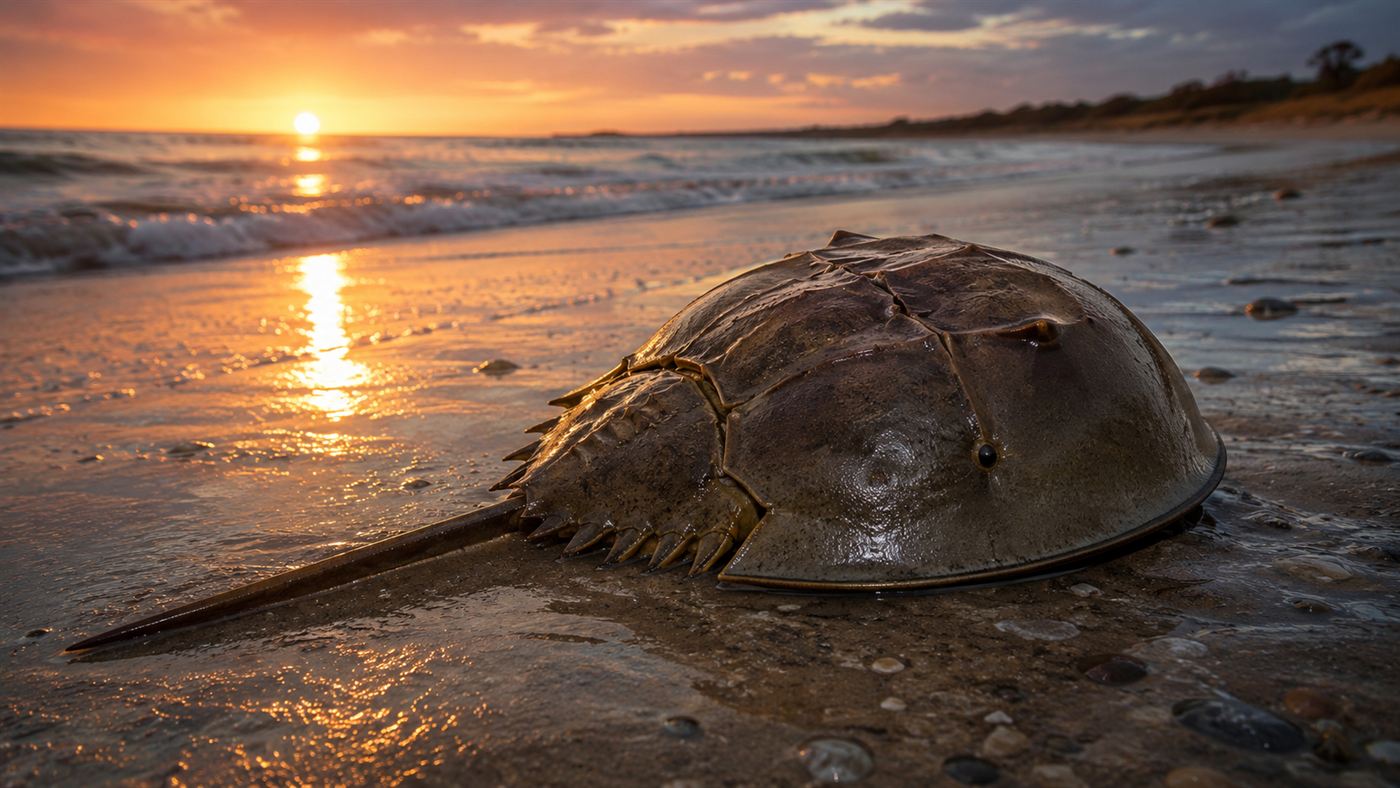
The horseshoe crab, another ancient animal that surprised 20th-century biologists with what it was quietly doing, had been serving as the world's primary test for bacterial contamination in medical products for decades before the mechanism was fully understood.
What Alessandro Volta owed to a fish
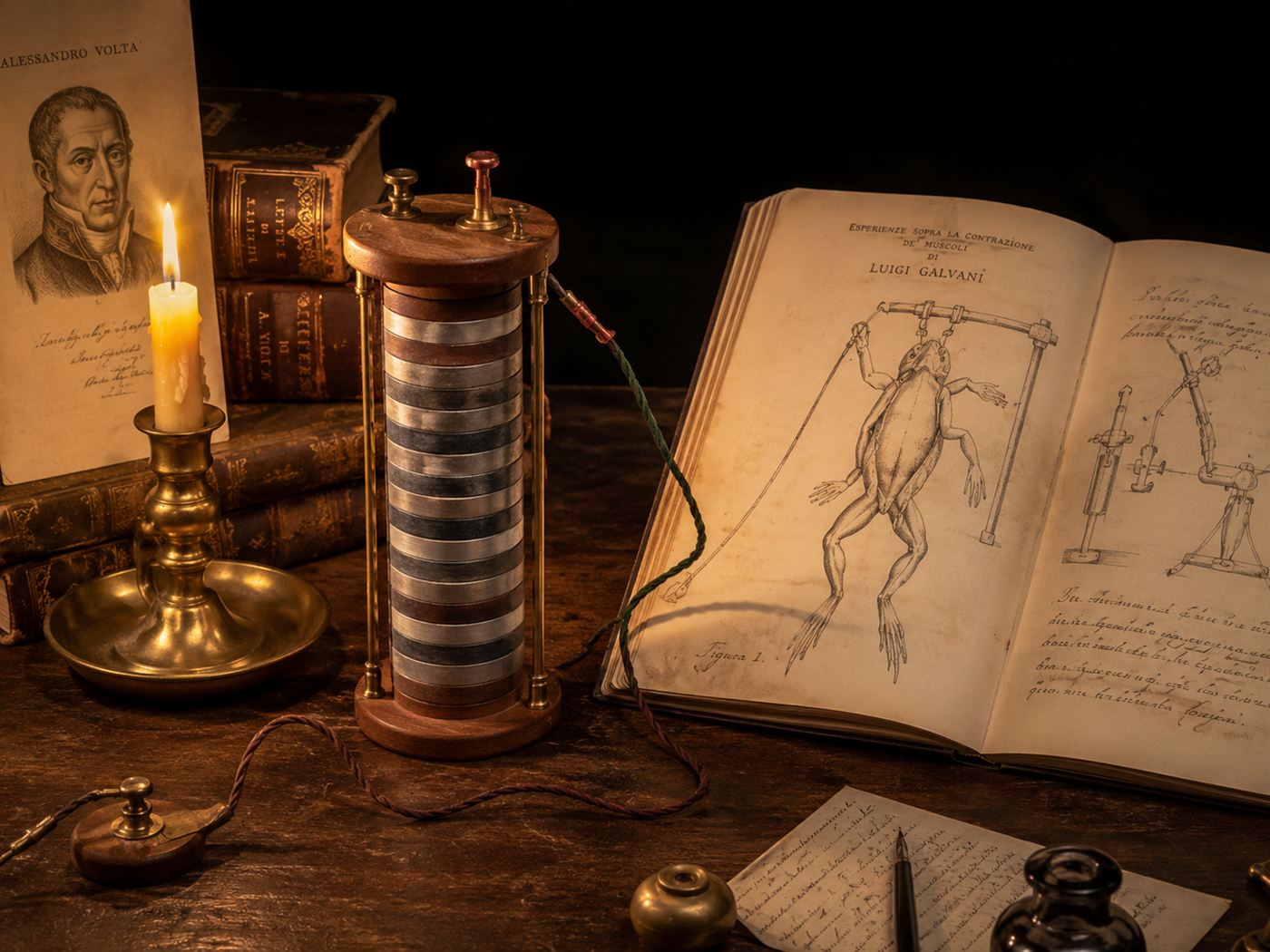
Luigi Galvani, the Italian physician, discovered "animal electricity" in 1780 when he noticed that frog legs hanging from iron hooks would twitch when touched with a brass probe, even without any external source of electricity.
Galvani concluded that the electricity originated in the muscle tissue itself, a bioelectricity he called "animal electricity."
Alessandro Volta, his colleague and rival, was unconvinced.
Volta had studied electric eels brought to him in Pavia and was certain that the animal's ability to generate current was real, but he doubted that the electricity lived in the tissue itself.
He thought the eel's electricity, like the frog leg's twitch, arose from the contact between dissimilar conducting materials, not from life itself.
To prove it, Volta stacked discs of zinc and silver separated by brine-soaked cloth and produced a continuous current without any biological tissue at all.
He announced the voltaic pile, the first true battery, in 1800, the same year Humboldt was watching horses collapse in Venezuelan pools.
The argument between Galvani and Volta turned out to be a draw: both were partly right, and the electric eel served as the existence proof that drove the debate.
In 2019, when de Santana's team formally described Electrophorus voltai in Nature Communications, they named the species after Volta explicitly, closing a circle that had been open for 219 years.
The honest catch
The viral videos of electric eels lighting Christmas trees or illuminating fish tanks are real in the sense that the pulse is real, but they misrepresent the energy involved.
An electric eel discharge lasts a few milliseconds and carries limited total energy: the 860-volt peak in Electrophorus voltai involves a current of perhaps one ampere for a fraction of a millisecond, which is enough to stun a fish but not enough to boil water or run a household appliance for any meaningful duration.
The demonstrations work because LED strips require almost no energy to light briefly, not because the eel is generating useful electrical power.
The jumping behavior documented by Catania is also more conditional than it looks: the eels rise out of water primarily when provoked by a large target breaking the surface, a behavior that evolved to address threats in shallow water, not a standard hunting technique used against fish.
The 860-volt figure refers to Electrophorus voltai specifically and represents a peak measurement.
The older species Electrophorus electricus, which most older literature treats as the only electric eel, tops out around 600 volts.
The three-species classification was only published in 2019; everything written before then about "the electric eel" is effectively about a different and less dramatic animal than the one the headlines now describe.
Leafcutter ants invented agriculture roughly 50 million years before humans did, complete with pesticides and livestock: the electric eel's prior claim on electricity is a similar kind of evolutionary priority that science took a while to appreciate at full scale.
The electric eel is dangerous to humans mainly through secondary effects: the shock from a large specimen can be painful and disorienting enough to cause drowning in deep water, and a school of hunting eels firing synchronized pulses, as documented in 2021, could theoretically injure a person who blundered into the group.
Direct electrocution fatalities from electric eels are rare in the literature, but the risk is real enough that researchers who handle them wear rubber gloves and work quickly.
Humboldt was dismissed for 200 years because his account of eels attacking horses from above the waterline described a mechanism no one had measured. What else do you think biology is dismissing right now because the mechanism seems implausible?
Related reading: The horseshoe crab has been guarding the safety of every vaccine and injectable medicine on the market for decades, and almost no one knew, or the 2,000-year mystery of where real eels are born.