The bombardier beetle brews two chemicals into an explosive reaction and fires a boiling, stinging spray from its abdomen in machine-gun pulses, aimed almost anywhere
When something tries to eat a bombardier beetle, it gets a faceful of chemistry. The beetle mixes two stored compounds in a hardened chamber, sets off a small explosion that heats the brew to boiling, and fires it out in a rapid, aimed, machine-gun spray.
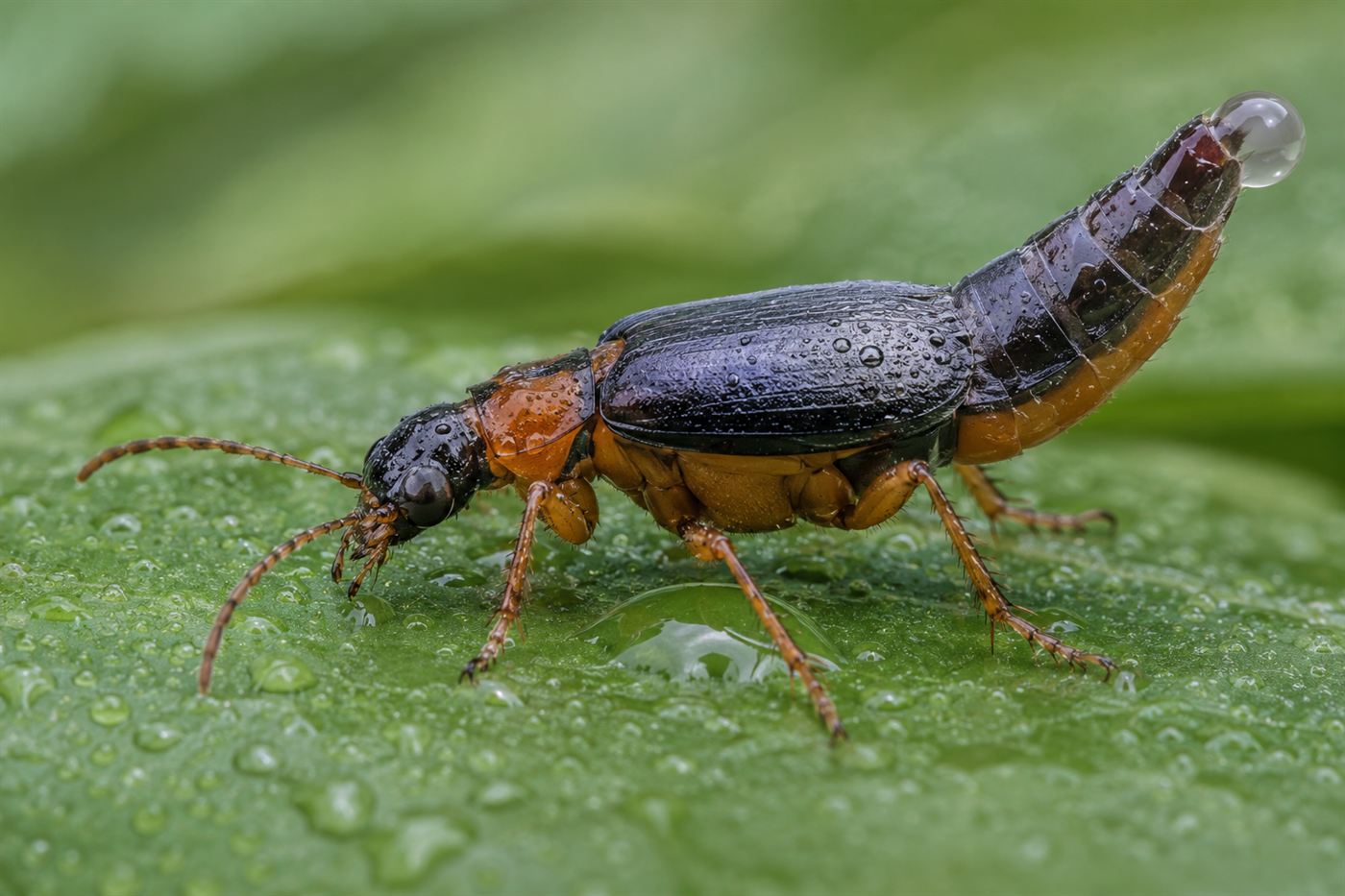
The bombardier beetle, a chemical weapon the size of a fingernail. Illustration: Watts & Wild.
The bombardier beetle is a chemical weapons factory the size of a fingernail. It is an unremarkable-looking ground beetle, the sort of thing you would walk past without a glance, and there are hundreds of species of them scattered across the world. But cornered by an ant, a spider, a frog or a hungry bird, it does something almost no other animal can: it manufactures a small, hot explosion on demand and fires the result, with a sharp audible pop, straight at whatever is threatening it.
What comes out is not just unpleasant but genuinely hot. As entomologists have documented, the beetle's spray is ejected at close to the boiling point of water, a caustic, stinging mist of chemicals that few small predators are willing to face twice. And the way it makes that spray is a small masterpiece of natural engineering.
How does the bombardier beetle spray? The bombardier beetle stores hydroquinones and hydrogen peroxide in its abdomen and, when threatened, squirts them into a reinforced chamber lined with enzymes. The reaction is explosive and heats the mix to about 100°C, firing a boiling, irritating spray out in roughly 500 pulses a second.
The bombardier beetle, a chemical weapon in miniature
The genius of the bombardier beetle is that it keeps its weapon disarmed until the last moment. Inside its abdomen are two separate stores: one holding a mixture of hydroquinones, the other holding hydrogen peroxide, the same oxidising chemical sold in pharmacies. Kept apart, the two are stable and harmless, and the beetle can carry them around safely for as long as it likes, a loaded weapon that cannot go off by accident.
The trick is in what happens when the beetle decides to fire. The two ingredients are pushed together into a second, tougher chamber, and that is where the chemistry turns violent.
Two chemicals and a spark
That tougher chamber, which the great naturalist who studied it called the reaction chamber, is lined with enzymes, catalases and peroxidases, that act as the spark. The moment the hydroquinones and hydrogen peroxide arrive, the enzymes throw the reaction into overdrive: the peroxide is broken apart into water and oxygen, and the hydroquinones are converted into irritating, foul-smelling benzoquinones. The reaction is strongly exothermic, meaning it dumps out heat, and it releases that heat so fast that the liquid is driven up to around 100 degrees Celsius, the temperature of boiling water.
All of that oxygen gas, suddenly generated in a sealed space, has nowhere to go but out. The pressure blasts the boiling, caustic spray through a nozzle at the tip of the bombardier beetle's abdomen and onto the attacker, hot, stinging, and chemically repellent all at once. The beetle has, in effect, fired a tiny cannon loaded with boiling acid, using nothing but two household chemicals and a pair of enzymes.
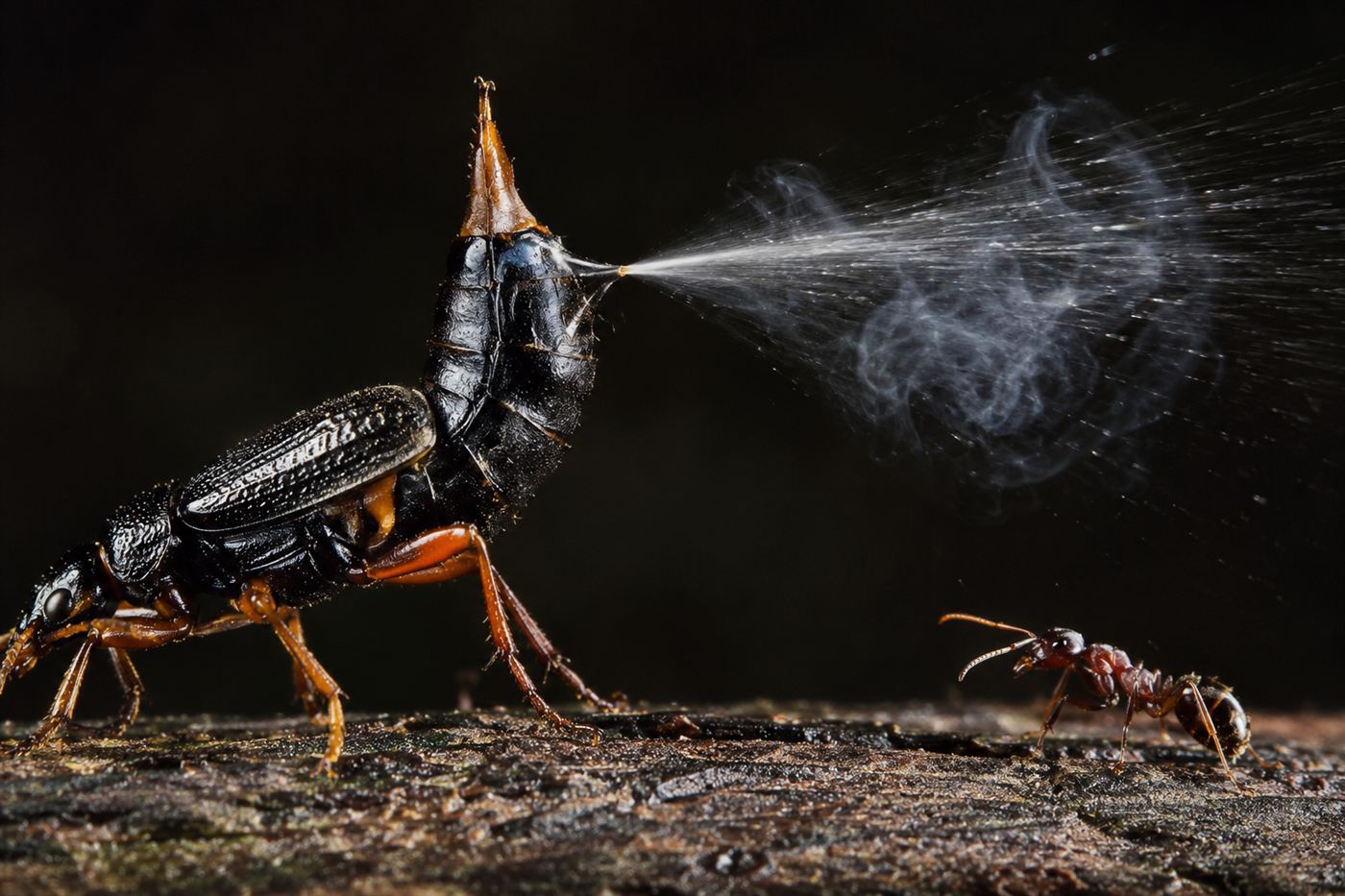
A pulse-jet on six legs
For a long time it was assumed the spray came out as a single squirt, but the truth is stranger. High-speed study of the bombardier beetle revealed that the discharge is not a steady stream at all but a rapid series of separate pulses, fired at something like 500 times a second, far too fast for the eye to separate. In other words, the beetle does not spray; it machine-guns.
That pulsing turns out to be clever rather than accidental. Each tiny explosion clears the chamber and lets it refill and fire again, and because the bursts are intermittent, the beetle can keep the process going without cooking its own insides. Engineers have compared the mechanism to a pulse-jet engine, the same on-off combustion principle used in some early jet-powered machines, running here inside a creature you could lose in the grass.
Aim it almost anywhere
A weapon is only as good as your ability to point it, and the bombardier beetle is a remarkable shot. The African species in particular can swivel the tip of its abdomen like a turret and direct the spray in almost any direction, forwards, sideways, even back over its own body. Researchers photographing the beetle found it could aim with enough precision to hit one of its own legs, or a single segment of a leg, to blast off an ant that had latched on there. It is not flailing blindly; it is targeting.
Firing from inside a toad
Much of what we know about the bombardier beetle comes from one scientist, Thomas Eisner of Cornell University, often called the father of chemical ecology, who spent a large part of his career patiently working out exactly how the beetle's weapon worked. Among the more startling things he and his colleagues documented was what happens when a predator is too quick. A toad that manages to swallow a bombardier beetle may get an unpleasant surprise: the beetle can fire its spray inside the toad, and the toad has been seen to vomit the beetle back up, alive and still kicking, some time later. Few prey animals get to detonate inside their attacker and walk away.
The honest catch
A little perspective is fair. The spray really is boiling and really does sting, but the amount is minuscule, and while it can irritate human skin or eyes if you pick the beetle up, it is no danger to a person; it is tuned for ants and frogs, not people. And you may have heard the bombardier beetle used as an argument that some things are simply too complex to have evolved gradually. That claim does not hold up: biologists have traced plausible, step-by-step paths from the ordinary defensive chemicals that many beetles already make to the beetle's full system, each stage useful on its own.
None of which makes the animal any less astonishing. A common little beetle stores rocket propellant safely in its body, mixes it on command, sets it alight with enzymes, and fires boiling chemical artillery in aimed, machine-gun bursts, all without harming itself. It is one of the most sophisticated weapons in nature, carried around on six legs, and most people will never know it is there.
A beetle that brews boiling chemical artillery in its body and machine-guns it at anything that tries to eat it. Which natural weapon impresses you more, the beetle's boiling spray or the mantis shrimp's punch? Tell us in the comments.
Related reading: The electric eel, which floors its prey with a shock of 860 volts, or the horned lizard, which fires foul blood from its eyes.