Los Angeles is finishing the world's largest wildlife crossing, a 114 million dollar bridge disguised as a hillside over 10 lanes of freeway, built so the mountain lions the road trapped and inbred can finally cross
Just off the 101 Freeway near Agoura Hills, crews are spreading soil and native seed across the top of a vast new bridge, shaping it to look like an ordinary California hillside. It is anything but ordinary. The Wallis Annenberg Wildlife Crossing is the largest structure of its kind ever built, and it exists for one reason: to give a small, cornered population of mountain lions a way out before the freeway erases them for good.
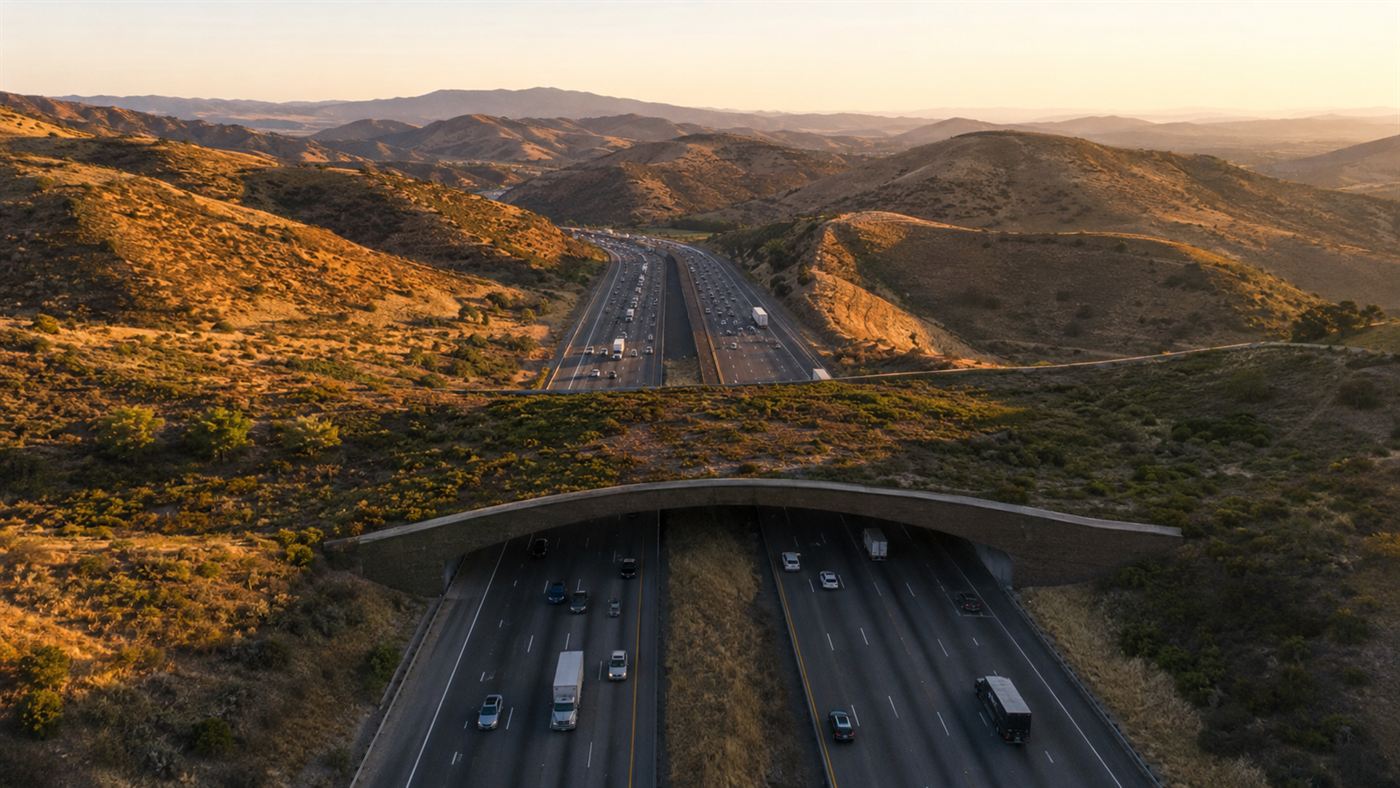
Planted to look like a hill, the crossing arches over 10 lanes of the 101 Freeway. Illustration: Watts & Wild.
For most drivers on the 101, it is just another stretch of asphalt grinding through the hills west of Los Angeles. For a mountain lion, it is a wall. Ten lanes of traffic running day and night cut straight across the animals' home range, and for decades that wall has been quietly strangling one of the last big cats clinging to the edge of a megacity.
The bridge going up at Liberty Canyon is the boldest attempt yet to undo that damage. When it opens to animals on June 25, 2026, it will not look like a bridge at all. It will look like the land simply lifted itself over the freeway and kept going, which is exactly the point.
A freeway that split a mountain range in two
The Santa Monica Mountains run right up against the Pacific and right into the western suburbs of Los Angeles. It is a surprising pocket of wild country to find pressed against a city of millions, home to bobcats, coyotes, deer, and a thin population of mountain lions. The problem is that this wild pocket has hard edges on every side. The ocean closes it off to the south. Dense development hems it in. And slicing across the top runs the 101.
For an animal that needs to roam, that geometry is a trap. A male mountain lion can patrol a territory of well over a hundred square miles, far more than the squeezed Santa Monica range can offer. To find new territory or a mate that is not a relative, a young cat has to cross the freeway, and crossing the freeway is often a death sentence. The result is a population effectively marooned on an island that happens to be made of traffic.
The cats that cannot leave
Biologists have been tracking these animals for years, and the picture they paint is grim. Hemmed in with nowhere to go, the mountain lions have been forced to breed with their own close relatives. Fathers mate with daughters, siblings with siblings, because there is simply no one else to find. As the National Park Service has documented over more than two decades of study, the Santa Monica population carries some of the lowest genetic diversity recorded for the species anywhere outside the Florida panther, and researchers have warned the local cats could vanish within decades if nothing changes.
One animal turned that slow crisis into a story the whole city could feel. A mountain lion known as P-22 somehow crossed not one but two of the busiest freeways in America, the 405 and the 101, and ended up living for years in Griffith Park, a scrap of green hemmed in by Hollywood. He became a celebrity, the cat under the Hollywood sign, but his life was also a perfect portrait of the trap. He survived the crossing, then spent the rest of his days alone in a few square miles, never finding a mate, the most famous bachelor in Los Angeles. When he was put down in late 2022, he had become the face of why something like this crossing had to be built.
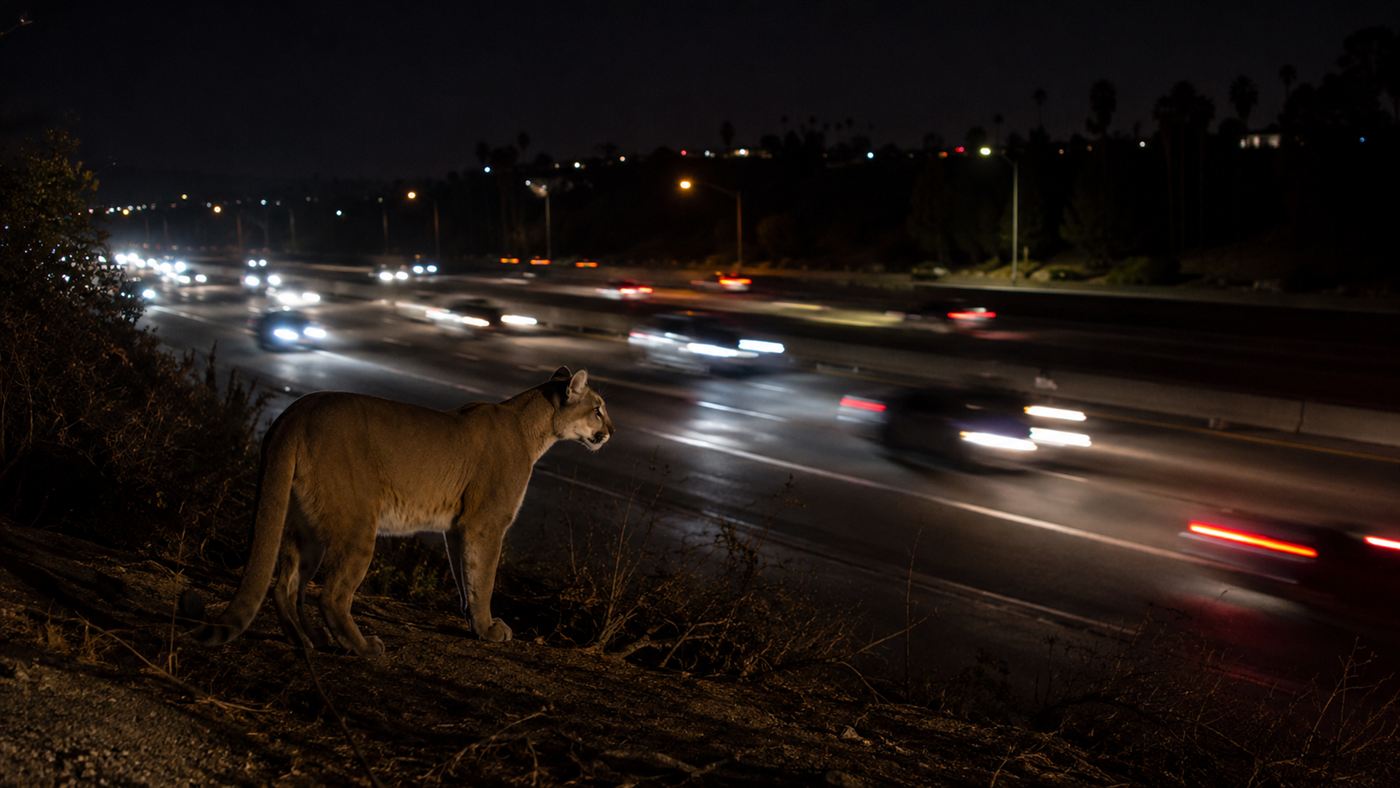
How the Wallis Annenberg Wildlife Crossing pretends to be a hill
The crossing is built to a simple but radical idea: an animal will only use a bridge it does not realise is a bridge. So instead of a bare concrete deck, the engineers built a piece of landscape. The structure stretches 200 feet across the freeway and runs 165 feet wide, a deck broad enough to carry not just a path but an entire slice of habitat on its back.
On top of that deck sits something like 6,000 cubic yards of specially engineered soil, light enough for the bridge to bear yet rich enough to grow local plants. Crews have been seeding it with more than a million native seeds and thousands of shrubs and saplings, all grown from stock collected nearby so the new hillside matches the old ones on either side. Tall walls along the edges are designed to block out the glare of headlights and muffle the roar of the traffic below, so an animal walking across feels less like it is standing on a freeway and more like it is moving through brush. Underneath it all is a genuinely heavy piece of engineering, roughly 26 million pounds of concrete holding the whole green hill in the air.
Why it has to look like nature
It would have been far cheaper to pour a plain overpass and paint some lines on it. The trouble is that mountain lions and their neighbours will not touch something that feels exposed and man-made. Wild animals read open concrete as danger, and a crossing that frightens them is just an expensive sculpture. Everything about the design, the native soil, the screen of plants, the sound walls, exists to trick a wary animal into believing the freeway is not even there.
The early signs are quietly encouraging. As AccuWeather reported as the project neared its finish line, multiple species of butterflies and birds have already been recorded on the structure even before it physically connects to the open space on either side. The hill is not finished, it is not yet linked to the wider hills, and life is already finding it. For a project betting everything on the idea that animals will accept a built landscape, butterflies showing up uninvited is exactly the vote of confidence the planners were hoping for.
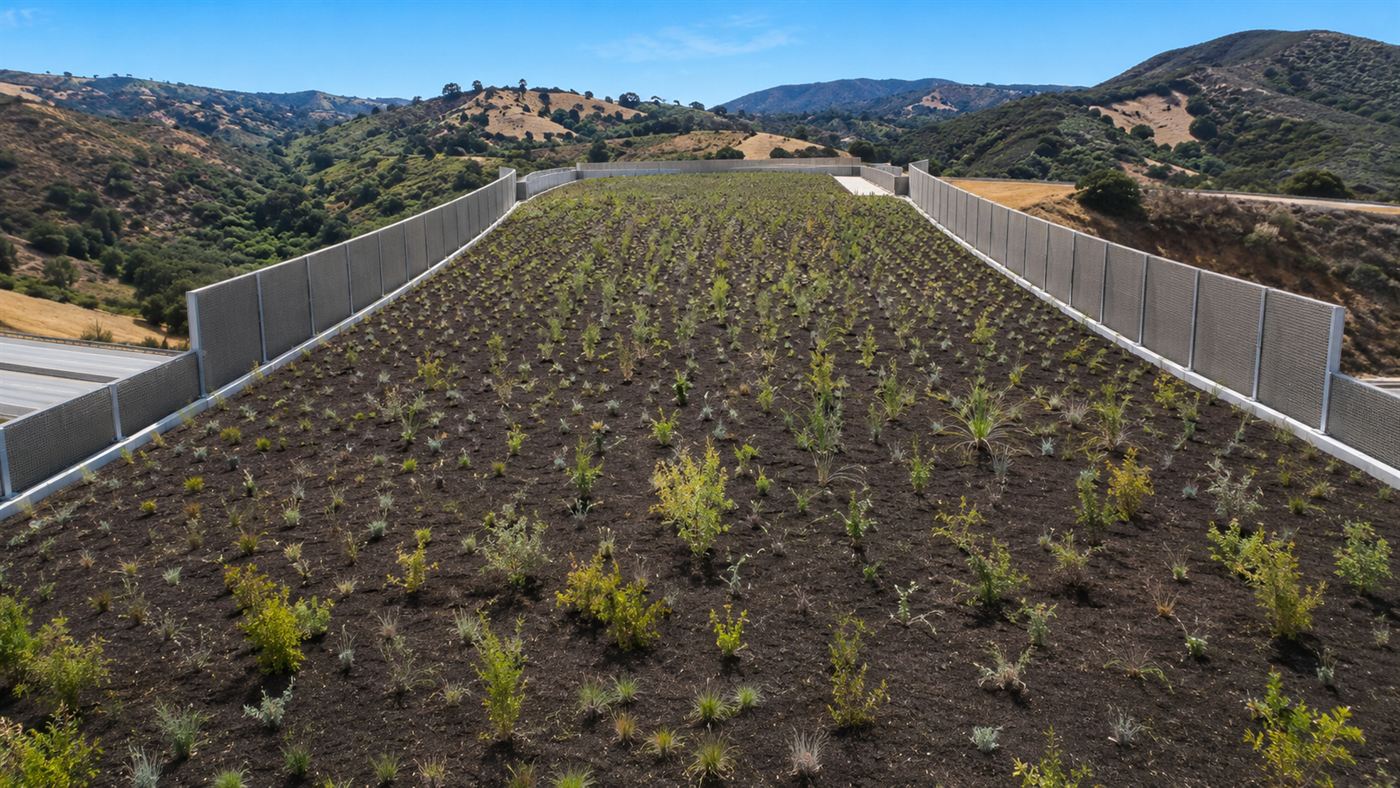
The honest catch
It is worth being clear about what this crossing is and is not. For a start, it is not finished. As KTLA reported when the opening date was announced, the bridge is set to open on June 25, 2026, and through the first half of that year the project still sat at roughly 60 percent complete, with a separate span over a side road and the final links to open land still to come. Near-record rains in 2023 and 2024 flooded the site and slowed the work, and inflation and labour costs helped push the price from an early estimate near 90 million dollars up to about 114 million.
The bigger caveat is what one bridge can actually do. The Santa Monica mountain lions are trapped by more than just the 101, and a single crossing, however large, does not knock down every wall around them. Other roads still kill cats every year, and genetic rescue takes more than one lucky animal wandering across. The crossing is best understood not as a cure but as the most important single stitch in a much larger repair, one that only works if more corridors follow it. There is also no guarantee on day one that the big cats will use it quickly; that confidence rests on evidence from smaller crossings elsewhere, where animals took to engineered passages once they felt safe.
Why a bridge for pumas matters far beyond Los Angeles
Strip away the Hollywood backdrop and the celebrity cat, and what is left is one of the defining problems of a paved world. We have carved the planet into pieces with roads, and the animals stranded inside those pieces are slowly running out of the room and the genes they need to survive. A wildlife crossing is, at heart, a needle and thread for a landscape that has been cut apart. The same idea takes a stranger form on Christmas Island, where rangers built a bridge and tunnels for tens of millions of migrating crabs.
If the largest one ever built can take a marooned population of mountain lions and quietly hand them back the rest of California, it becomes more than a local rescue. It becomes a template, proof that a city can change its mind about a road and build a way for the wild to cross it. The cats do not know any of this. They will simply find, one night, that the wall they grew up against has a soft green seam in it, and that on the far side the world finally opens up again.
A city spent 114 million dollars and a decade of effort to grow a hill over a freeway for a handful of cats. Is a single giant crossing the smartest way to save a trapped population, or does the real answer lie in many smaller ones nobody would ever put a famous name on? Tell us what you think in the comments.