The secret subway one man dug under Broadway in the dark
In 1870, New Yorkers paid a quarter to step underground near City Hall and ride something that should not have existed. A single elegant car waited in a brick tube, a great fan sighed, and it slid them smoothly beneath Broadway. The whole thing had been built in secret, at night, right under the noses of the men who would have stopped it. This was the Beach Pneumatic Transit, the city's first subway.
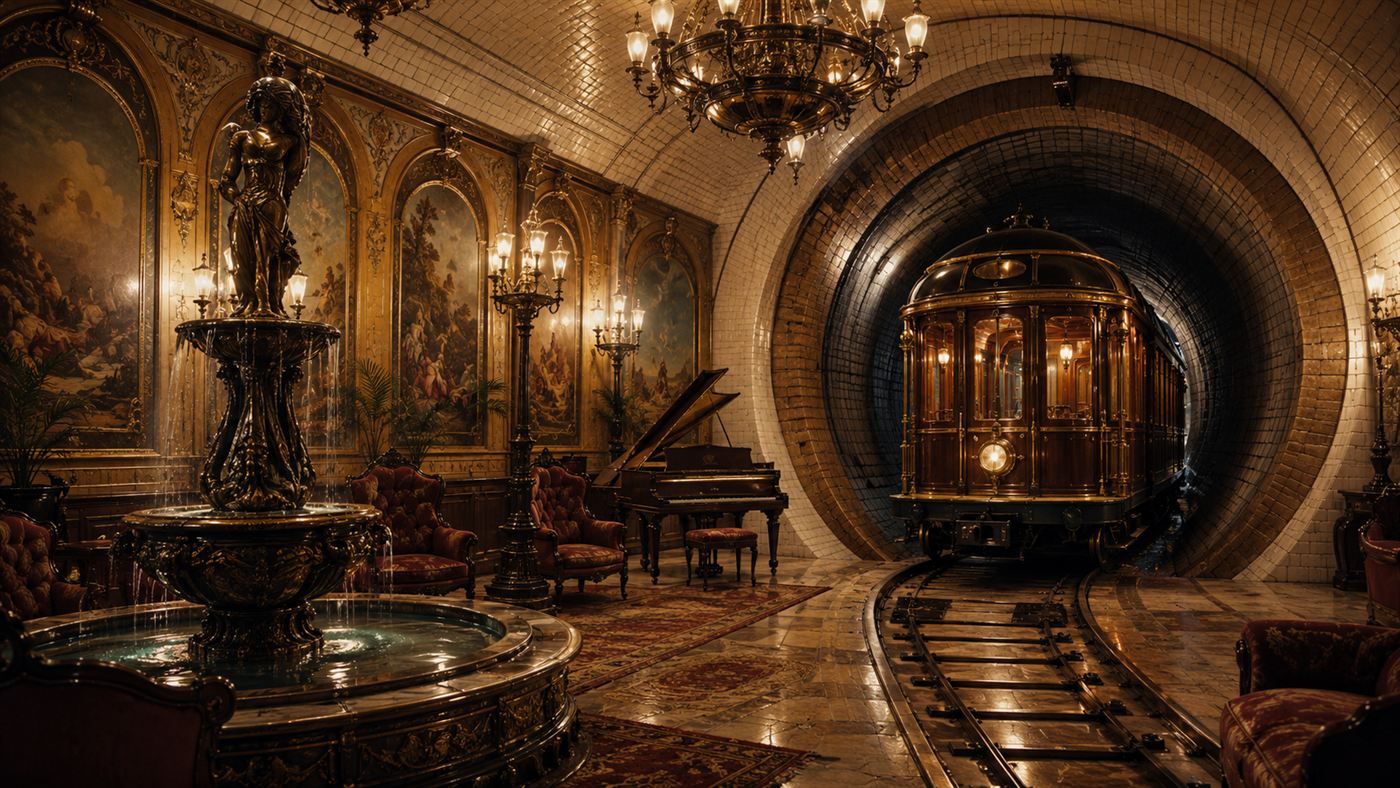
The waiting room had frescoes, a fountain of goldfish, and a grand piano. Illustration: Watts & Wild.
New York in the 1860s was choking on its own traffic. The streets were a crush of horse-drawn carts and omnibuses, and crossing town could take hours. One man was sure the answer lay underground, and he was prepared to break the rules to prove it.
His name was Alfred Ely Beach, an inventor and the editor of Scientific American, and the machine he left behind beneath Broadway is one of the strangest first chapters any city's transport ever had.
A subway built in the dark
Beach had shown off a model of a pneumatic railway at a New York fair in 1867, a tube in which air pressure simply pushed a car along like a pea through a straw. The crowds loved it. The problem was getting permission to build a real one in a city run by William "Boss" Tweed, the corrupt political machine boss who controlled what got approved and expected to be paid for it.
Tweed had his own plans for costly elevated railways he stood to profit from, and a cheap underground line threatened them. So rather than fight Tweed openly, Beach applied for a permit to build a small system of pneumatic tubes for carrying mail, and then quietly built something far bigger underneath the street instead.
How the Beach Pneumatic Transit was built in secret
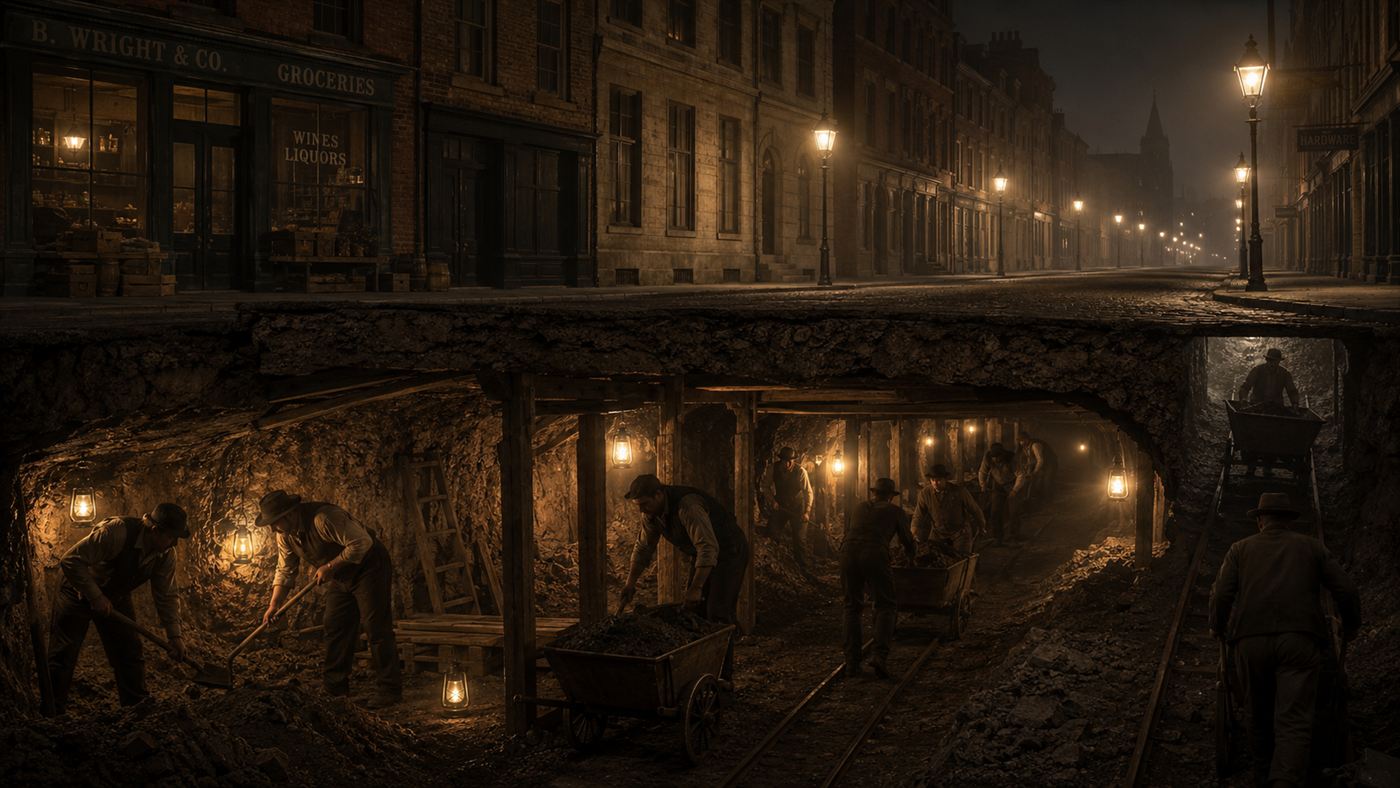
The work went on out of sight. Crews dug downward from the basement of a clothing store on Broadway and tunnelled outward, carting the loosened earth away in the dead of night so no one above would notice. In about 58 days the Beach Pneumatic Transit took shape as a single brick-lined tunnel roughly 300 feet long and 8 feet across, running under Broadway from Warren Street to Murray Street, directly opposite City Hall.
To dig it, Beach used a tunnelling shield of his own design, a circular frame that let workers excavate the soft ground ahead while bricklayers lined the tube behind them. It was a clever, careful method that pointed the way toward how real subways and tunnels would later be bored, even though almost no one knew this one was being built at all.
A blast of air under Broadway
When Beach threw open his subway on 26 February 1870, the city gasped. Instead of a grimy hole, visitors found a brightly lit, beautifully decorated waiting room with frescoes, chandeliers, a fountain stocked with goldfish, and a grand piano. The contrast between the filthy streets above and this gleaming parlour below made the little railway an overnight sensation.
The ride itself was just as novel. A single cylindrical car fitted the tube almost exactly, and an enormous rotary blower nicknamed the "Western Tornado" pushed it gently along on a cushion of air, then sucked it back the other way. The line was only one block long, but over the next year hundreds of thousands of curious New Yorkers paid twenty-five cents each, the money going to charity, just to feel the future move them through the dark.
How Boss Tweed buried it
Beach dreamed of stretching the line five miles up to Central Park, but to do that he needed the city and state to say yes. Tweed and his allies blocked the expansion, and a friendly governor vetoed Beach's transit bill twice before it finally passed in 1873.
By then it was too late. Tweed himself had fallen from power amid scandal, but the financial panic of 1873 swept away the investors Beach needed, and the grand plan ran out of money. The little subway closed, its tunnel was sealed and forgotten, and it lay undisturbed until 1912, when workers digging the modern subway broke through and found the old station still down there in the dark. New York's real underground had finally arrived, decades after one man tried to conjure it in secret.
Was the Beach Pneumatic Transit a real subway?
It was real, but only as a taste of one. The Beach Pneumatic Transit was a genuine working tunnel with a proper station and a car that carried paying passengers, yet it never grew beyond that single block beneath Broadway.
It is worth being honest about its limits. Pushing one short car with a fan is one thing; moving trains of people along miles of tunnel with air pressure would have been far harder, and the technology never had to prove it could scale. What Beach really built was less a transport system than a brilliant, beautiful argument that a city could put its railways underground.
Why did the Beach Pneumatic Transit close?
Politics started the trouble and money finished it. Boss Tweed's opposition kept the line from expanding for years, and by the time Beach won permission in 1873, the economic crash of that year had drained away the funding he needed to go on.
So the most forward-looking thing in New York was quietly bricked up and lost, a decade and more before the city built the subway it had been shown back in 1870. The story is a reminder that good engineering is rarely enough on its own. A clever tunnel still has to survive the people, and the panics, on the surface.
One man built the future under Broadway and watched it get bricked up by politics and bad luck. How many good ideas are sealed in the dark right now, waiting decades for the world to be ready? Tell us what you think in the comments.
Related reading: Hagia Sophia, the dome so daring it seemed to hang from heaven and has stood 1,500 years. See also the full Cincinnati subway that was built in the 1920s and abandoned before a single train ever ran, and the pneumatic tube mail that fired letters under city streets on the very same principle.