The axolotl can regrow its legs, spine and even parts of its brain, but it is nearly extinct in the only lake it calls home, where scientists just released lab-raised ones that survived
It is the smiling pink salamander on Mexico's 50-peso note, a star of video games, and an animal that can regrow almost any part of its body, including bits of its heart and brain. Yet in the wild the axolotl is all but gone. A study published in May 2025 on the axolotl rescue in Xochimilco offers the first real hope in years.
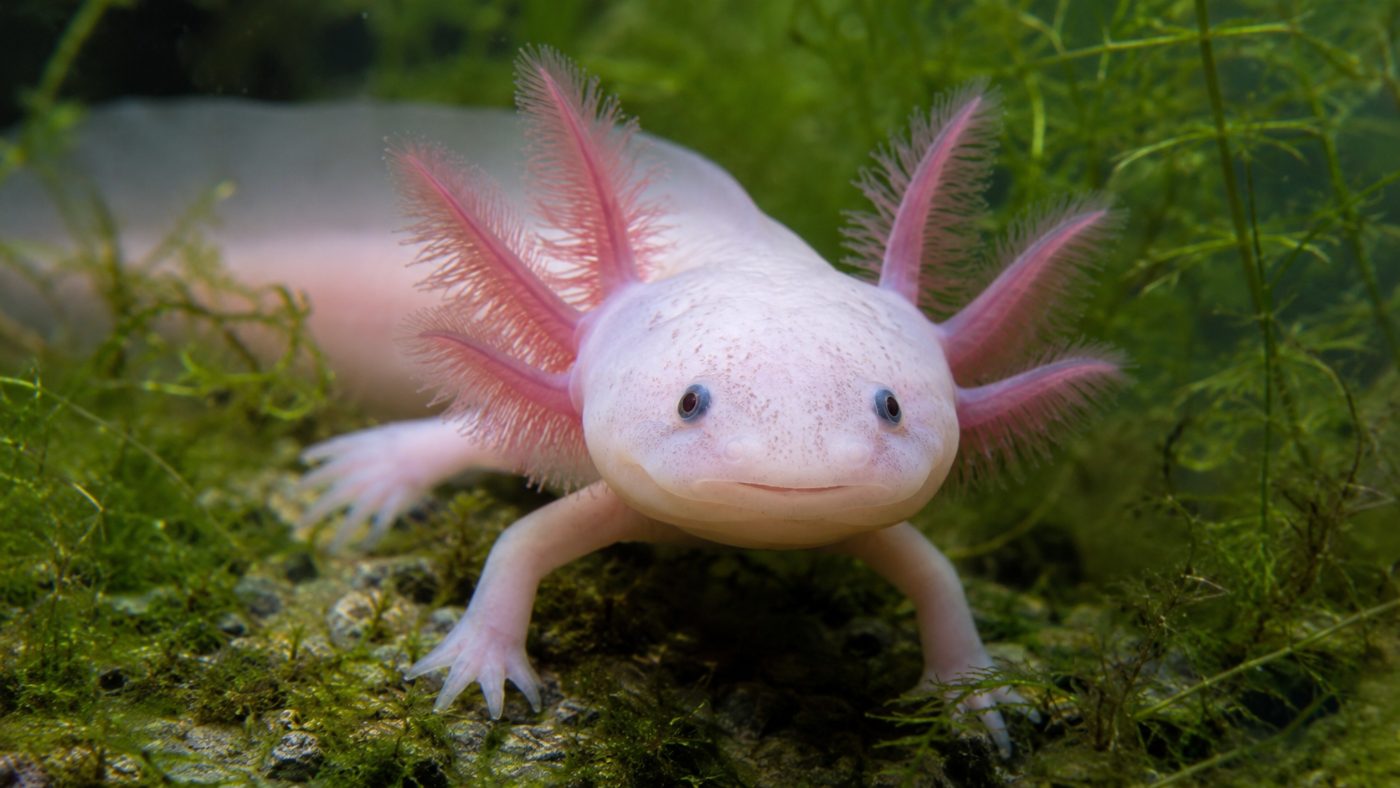
The axolotl never grows out of its larval body, keeping its feathery gills for life. Illustration: Watts & Wild.
There is something almost unfair about the axolotl. It wears a permanent smile, it keeps its frilly external gills like a feathered crown for its whole life, and if it loses a leg it simply grows a new one, bones, nerves, muscle and all, with no scar. It can do the same with parts of its spinal cord, its eyes, its heart, even pieces of its brain. Biologists study it precisely because it can do the things human medicine only dreams about. Which is why the latest axolotl rescue in Xochimilco, the one lake it still survives in, is being watched so closely.
And yet this creature, found wild in exactly one place on Earth, is sliding toward extinction there. On May 1, 2025, a team of Mexican researchers published a small but striking result: captive-bred axolotls, released back into the canals of Mexico City, did not just survive. They hunted, they put on weight, and for the first time in a long while, the people trying to save the species allowed themselves to feel hopeful.
A creature that refuses to grow up
Most amphibians live a double life: born in water as larvae, then changing into air-breathing adults. The axolotl skips the second act. It stays in its larval form forever, a condition called neoteny, breathing through those feathery gills and never leaving the water. It is, in a sense, a salamander that stays a baby for life.
That refusal to transform is tangled up with its superpower. As Science News has reported, the axolotl is one of biology's most important models for regeneration, able to rebuild whole limbs and organs from scratch. Laboratories around the world keep colonies of them for exactly this reason, which is part of why the next fact is so strange.
Famous everywhere except home
Ask a child today and they probably know the axolotl, even if they have never heard of Mexico City. It became a playable creature in Minecraft in 2021, it inspired Pokémon, and it sells as plush toys and emoji and aquarium pets by the million. Mexico put it on the redesigned 50-peso banknote. By almost any measure, the axolotl is a global celebrity.
The cruel twist is the gap between that fame and the reality at home. As CNN put it, axolotls seem to be everywhere except the one lake they actually come from. There may be millions living in tanks and labs across the planet, while the wild population that all of them descend from has collapsed to somewhere between a few dozen and a couple of thousand animals.
The lake that is its whole world
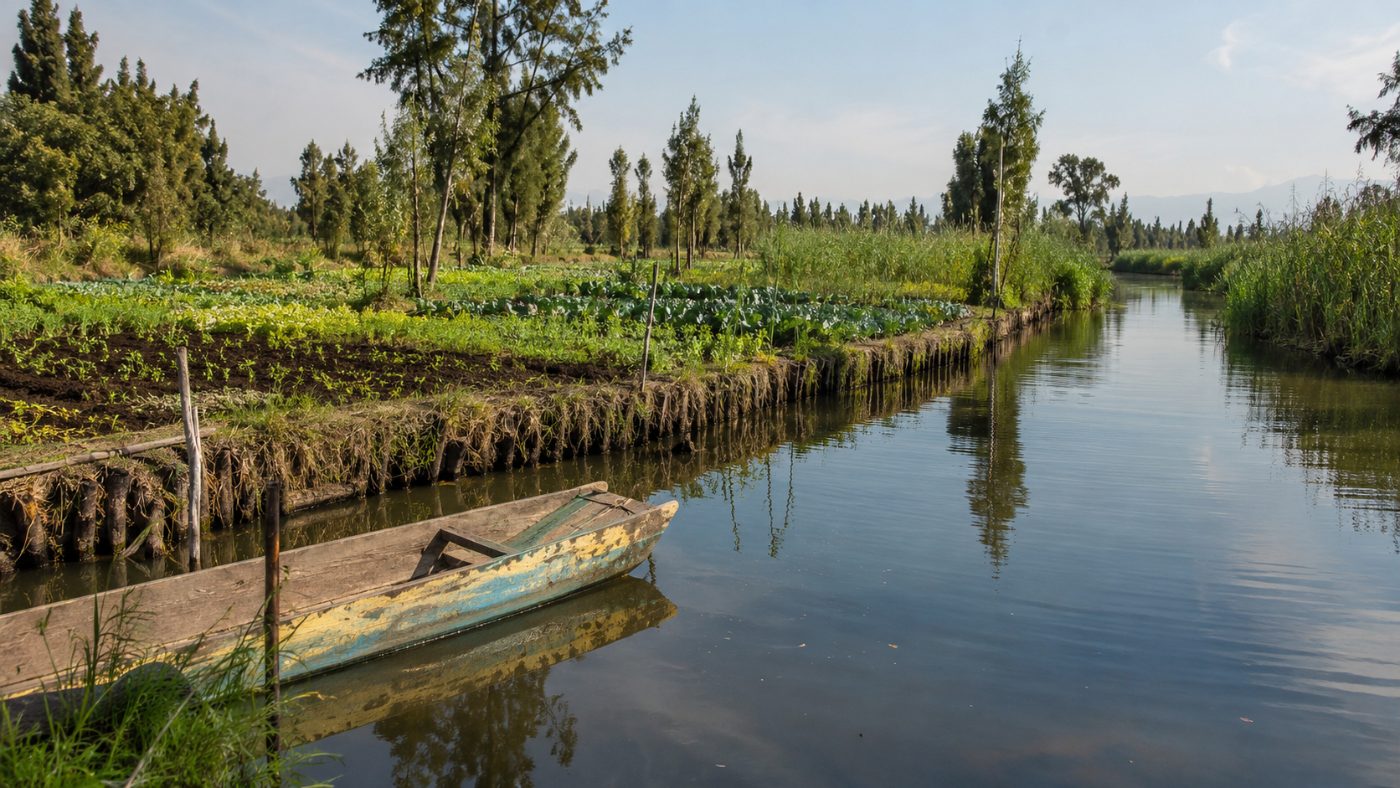
That home is Xochimilco, a maze of canals and artificial islands in the south of Mexico City. The islands are chinampas, the floating-garden farm plots the Aztecs built up from lake mud more than 700 years ago, and the canals are the last surviving fragment of the great lake system that the capital was founded on and then almost entirely drained.
It is a hard place to be a sensitive amphibian. Around it presses a metropolis of more than 20 million people, and into the water go sewage, farm chemicals, and non-native carp and tilapia that hoover up axolotl eggs and young. The result has been a freefall. By the count most often cited, the wild population dropped by about 99 percent between 1998 and 2014, leaving the axolotl listed as critically endangered in the only waters it has ever known.
The May 2025 axolotl rescue in Xochimilco
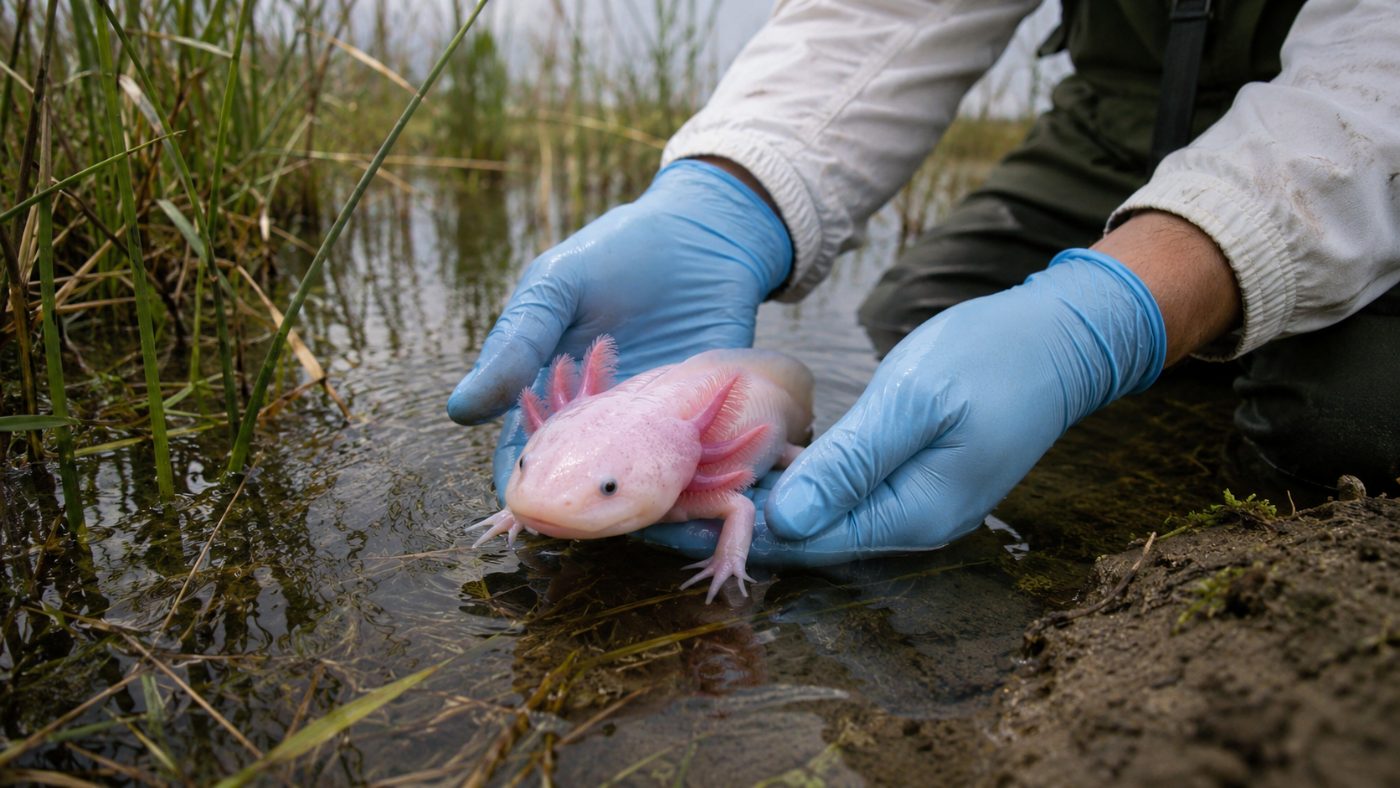
This is what makes the new study matter. Writing in the journal PLOS One, biologists Alejandra Ramos of the Autonomous University of Baja California and Luis Zambrano of Mexico's National Autonomous University described releasing 18 captive-bred axolotls into two sites: a restored chinampa refuge in Xochimilco, fitted with filters to clean the water, and a separate artificial wetland nearby.
They tracked the animals with tiny radio tags for forty days, and the result beat expectations. As Mongabay reported, every single released axolotl survived the monitoring period, and the ones the team recaptured had gained weight, proof they were catching live prey rather than slowly starving. "The amazing news is that they all survived," Ramos said. For a captive-bred animal dropped into the wild, that is not a given at all.
Why a salamander matters to a megacity
Zambrano has spent years arguing that you cannot save the axolotl without saving Xochimilco, and the reverse may be just as true. The wetland filters the city's water, grows food on its chinampas, and carries a thread of identity that runs back to the Aztec capital. The axolotl is its mascot and its warning light at once.
That is why the researchers frame this as more than a wildlife story. "If we lose this species, we lose part of our Mexican identity," Zambrano has said, and he has also called the restoration work a reason to feel "hope for humanity" in a city of more than 20 million. Save the smiling salamander, the logic goes, and you save the last living piece of the lake that Mexico City forgot it was built on.
The honest catch
It would be easy to oversell this, so it is worth being careful. The study followed just 18 animals, and two of those were picked off by great egrets, a reminder that captive-bred axolotls have never learned to fear a predator. The authors themselves suggest that future releases may need a kind of predator-awareness training before the animals go in the water.
The bigger problem is the water itself. A handful of filtered refuges is not the same as a clean lake, and as long as Xochimilco keeps taking in sewage, farm runoff and invasive fish, no number of releases will rebuild a self-sustaining wild population. The May 2025 result proves the animals can survive if the habitat is good enough. The far harder, slower job is making enough of the habitat good enough, and that is a fight over a megacity's water, not just one endearing salamander.
A creature that can regrow its own brain is hanging on in a few filtered canals, kept alive by scientists and the farmers who tend the old Aztec gardens. Should we pour effort into saving a single salamander in one city lake, or is the axolotl worth it precisely because saving it means saving the water too? Tell us what you think in the comments.
Related reading: Only two northern white rhinos are left on Earth, both female, and a team of scientists is racing to bring the species back with IVF.
See also: the olm, the other salamander that never grows up, a blind cave dragon that lives a century.
See also: the immortal jellyfish that reverses its own aging.