Only two northern white rhinos are left on Earth, both female, so scientists are racing to bring the subspecies back from extinction with frozen sperm, test-tube embryos and a surrogate mother
There are exactly two northern white rhinos left in the world, a mother and her daughter, both female, guarded around the clock by armed rangers in Kenya. Their subspecies is, biologically, already finished. A team of scientists refuses to accept that, and is trying to bring it back from the dead.
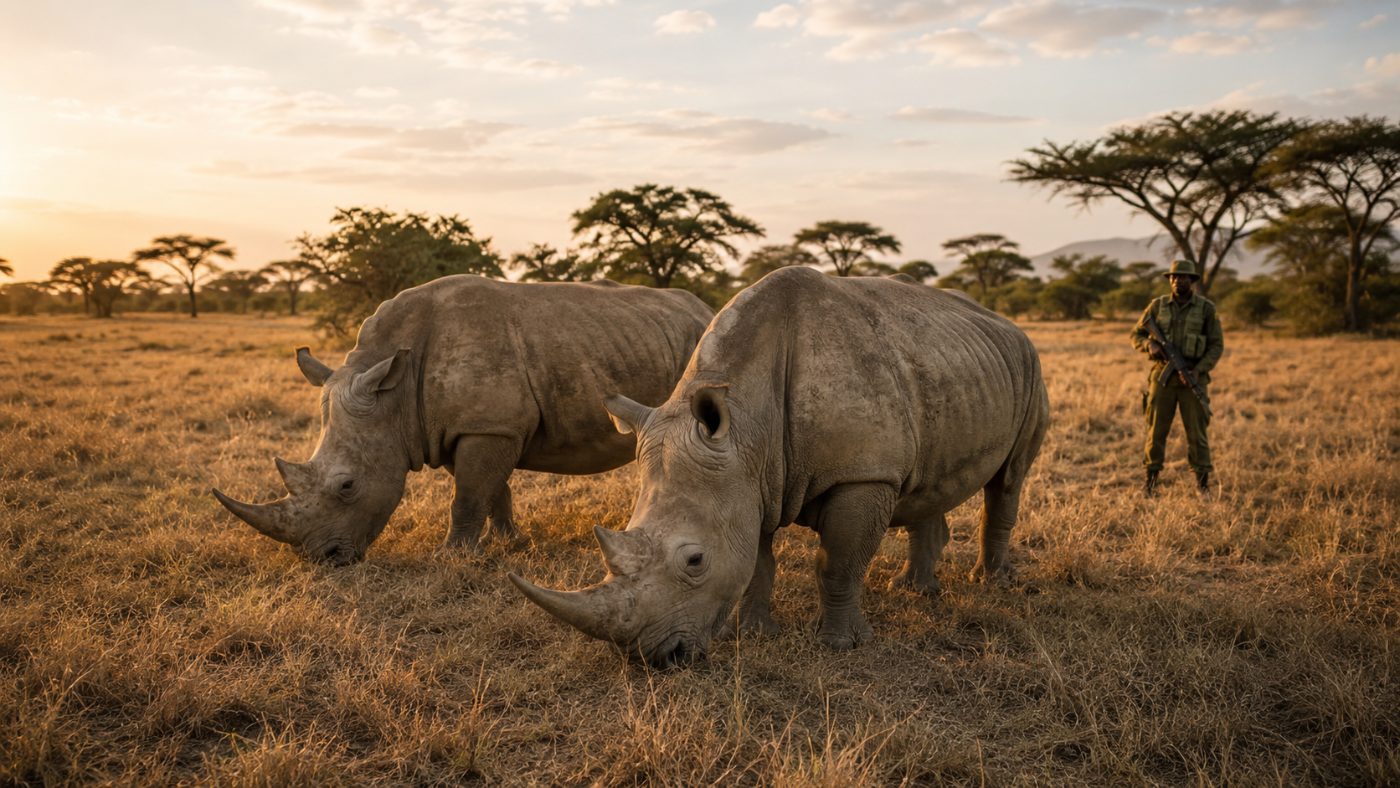
Najin and Fatu, the last two northern white rhinos, are guarded day and night at Ol Pejeta in Kenya. Illustration: Watts & Wild.
At the Ol Pejeta Conservancy in Kenya, two rhinos named Najin and Fatu spend their days grazing under the watch of guards who never leave their side. They are the last two northern white rhinos on Earth, mother and daughter, and both are female. When the last male, a gentle giant called Sudan, was put down in 2018 at the age of 45, the subspecies effectively ended. There was simply no way left for it to breed, and the only remaining hope is northern white rhino IVF.
Or so it seemed. A consortium of scientists called BioRescue decided the species was not quite finished, only stuck, and set out to attempt something never done with a rhino. The plan is to take eggs from Fatu, fertilise them in a laboratory with frozen sperm saved from males that are now dead, and grow the resulting northern white rhino embryos inside surrogate mothers of a different, far more common subspecies. As CNN reported, by early 2024 the team had achieved the first rhino pregnancy ever created through IVF, proof that the impossible part might be possible.
How a species ends, and a lab tries to restart it
The northern white rhino did not fade away gently. For decades it was hunted across central Africa for its horn, and war and poaching finished off the last wild animals in places like the Democratic Republic of Congo and South Sudan. By the 2000s only a tiny handful survived in captivity, and the maths of extinction closed in. Najin, now old and weak in the legs, and Fatu, who has a problem with her uterus, cannot safely carry a calf, so even the frozen sperm of the dead males was no use the natural way.
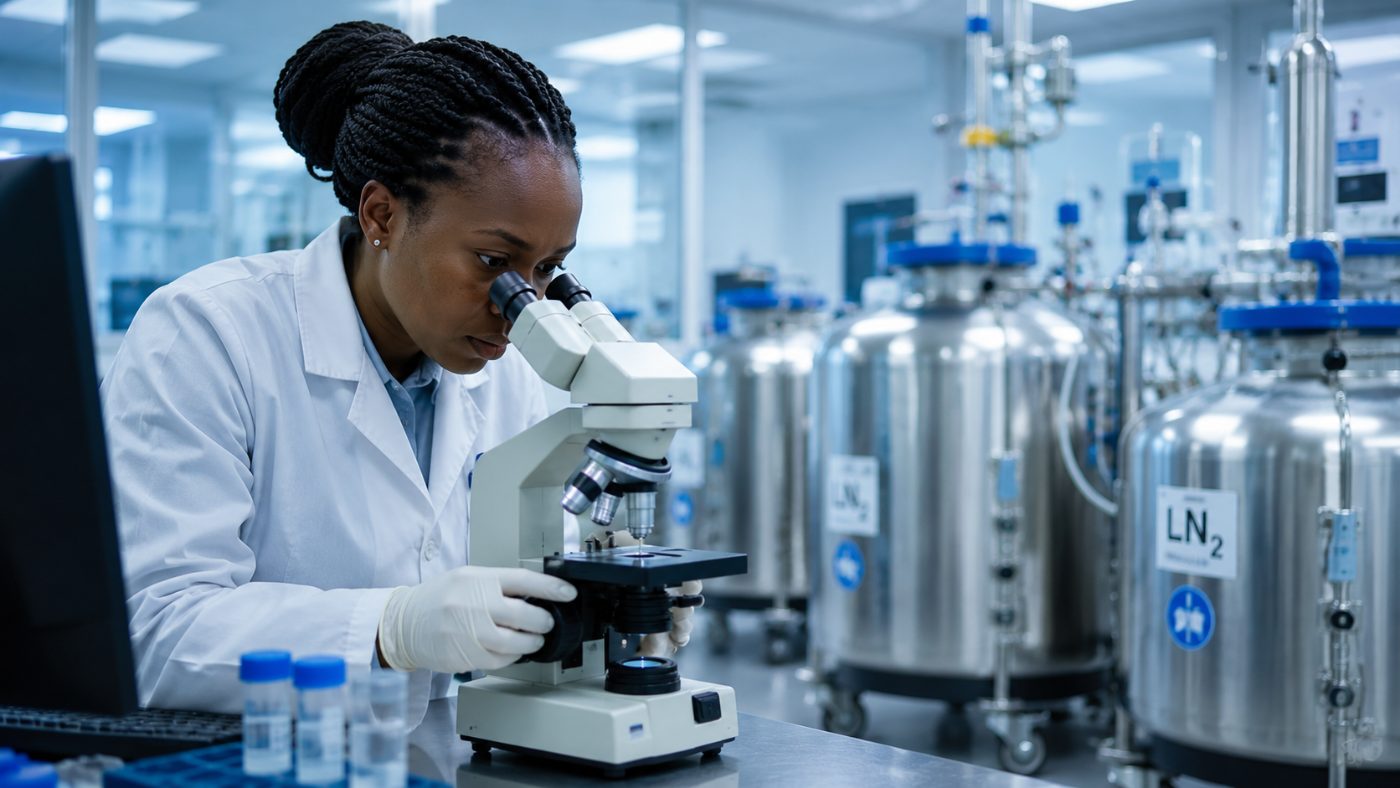
That left the laboratory. Under anaesthesia, vets harvest immature eggs from Fatu, which are matured and fertilised with thawed sperm, and the embryos that survive are frozen in liquid nitrogen. It is slow and delicate work, but it has steadily built a strange kind of ark. By 2025 the team had produced around 38 pure northern white rhino embryos, an entire subspecies waiting in suspended animation in a tank.
The surrogate problem in northern white rhino IVF
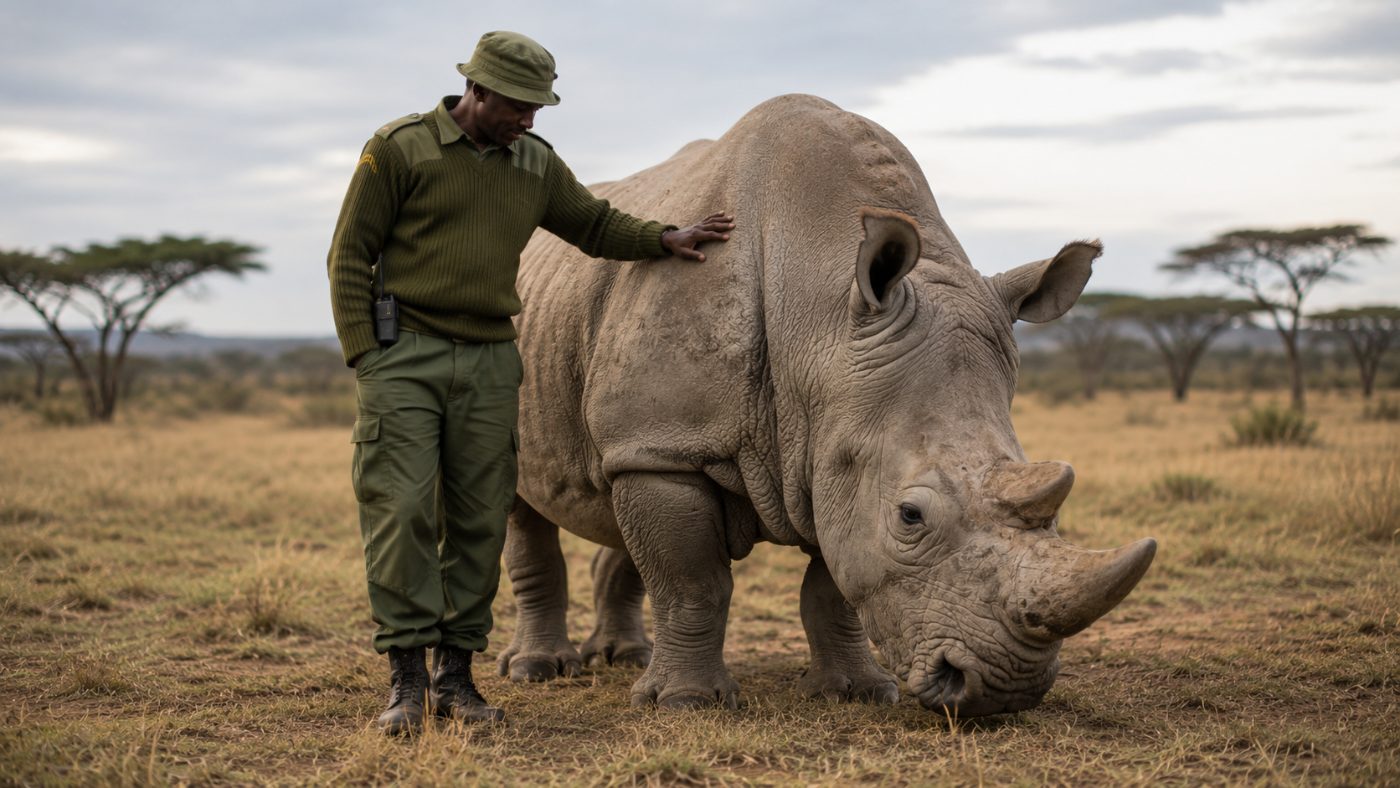
Embryos in a freezer are not a rhino. To turn one into a living animal, BioRescue turned to the southern white rhino, a close relative that itself recovered from near-extinction to around 20,000 animals and can carry a pregnancy to term. At the end of 2023, two southern white embryos were placed in a surrogate named Curra at Ol Pejeta, and the team confirmed a 70-day pregnancy carrying a well-formed male embryo, the first rhino IVF pregnancy in history.
Then it turned heartbreaking. Curra died about 70 days in, killed by a bacterial infection that had nothing to do with the pregnancy, before the embryo could grow further. The proof of concept had worked, and it had cost a life. Since then the team has moved on to transferring the real prize, pure northern white rhino embryos, into surrogates in mid-2024, late 2024 and 2025. As reported through 2025, none of those transfers has yet produced a lasting pregnancy.
The people behind the rescue
The effort is led by Professor Thomas Hildebrandt of the Leibniz Institute for Zoo and Wildlife Research in Berlin, working with reproduction specialists in Italy, a zoo in the Czech Republic that once kept these rhinos, and the Kenyan teams on the ground. They talk about the project less as a science experiment than as a debt. Humans pushed this animal off the edge, and a small group of humans is now spending years of their lives, and a great deal of money, trying to reach back over it.
The honest catch: you cannot rebuild a species from two animals
Even a healthy calf would not save the northern white rhino, and it is important to say so plainly. With effectively one egg donor, Fatu, and sperm from a few dead males, the genetic base is far too narrow for a population that could ever stand on its own. That is why BioRescue is also trying to turn preserved skin and tissue cells into new eggs and sperm, a stem-cell route that could widen the gene pool but is still unproven and years away.
There is a harder question underneath. The work is enormously expensive, every embryo transfer so far has failed, and a surrogate has already died. Critics ask whether that money would save more life if it went to protecting the roughly 20,000 southern white rhinos still alive, and the habitats of countless other species sliding toward the same cliff. And even if a calf is one day born, there is the matter of where a herd of northern white rhinos could ever safely live, in a region still scarred by conflict.
Najin and Fatu may live out their lives without ever meeting a calf of their own kind. But the attempt to save them is quietly rewriting what extinction even means, and the techniques being invented for two rhinos in Kenya may yet pull other species back from the same edge. If we can build the technology to undo an extinction we caused, should we spend a fortune trying, or put every cent into saving the species we still have? Tell us what you think in the comments.