The peacock mantis shrimp throws the fastest punch in nature, so fast it boils the water into a flash of light briefly hotter than the surface of the sun
The peacock mantis shrimp is a finger-sized reef animal with a punch from another world. Its club accelerates like a bullet, fast enough to boil the water around it, and the collapsing bubbles it leaves flash with heat briefly rivaling the surface of the sun. It can smash glass.
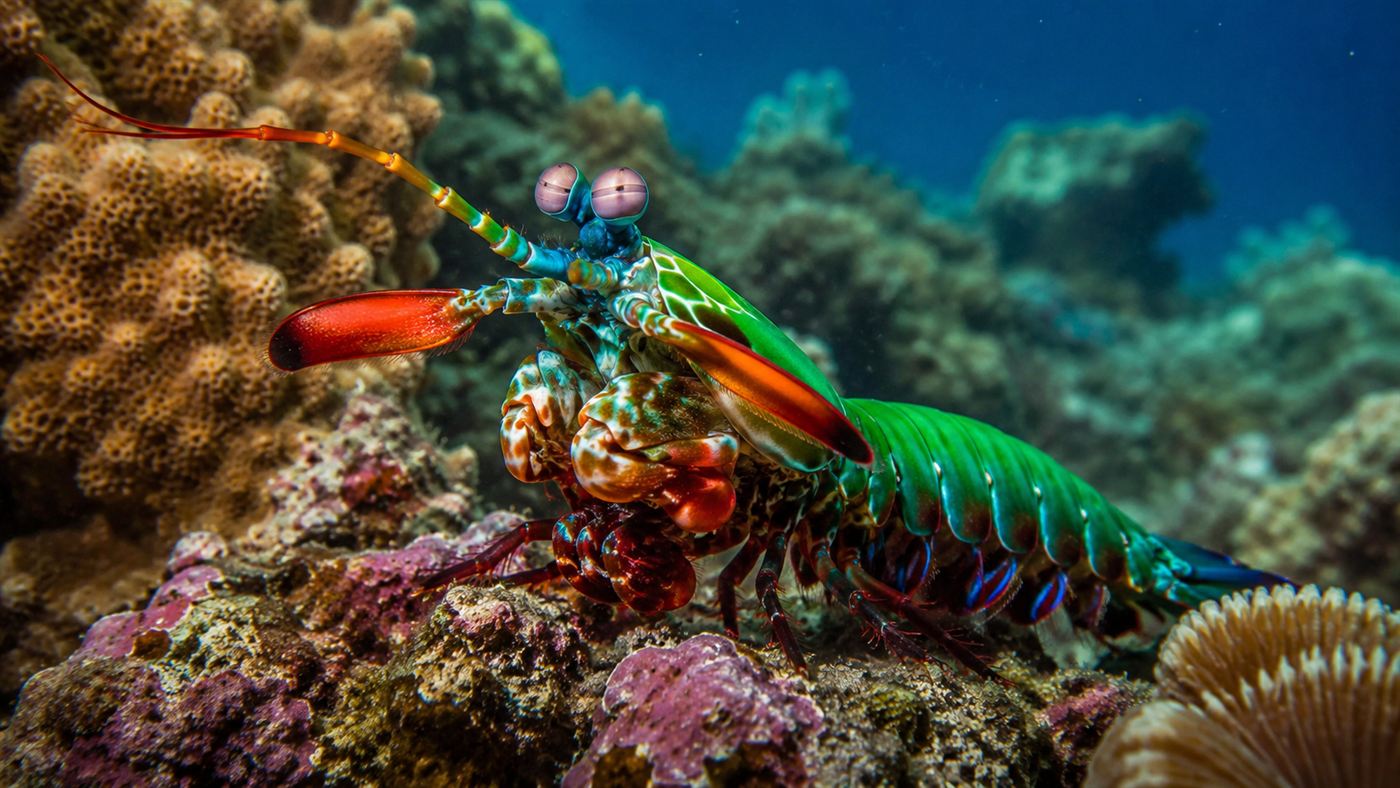
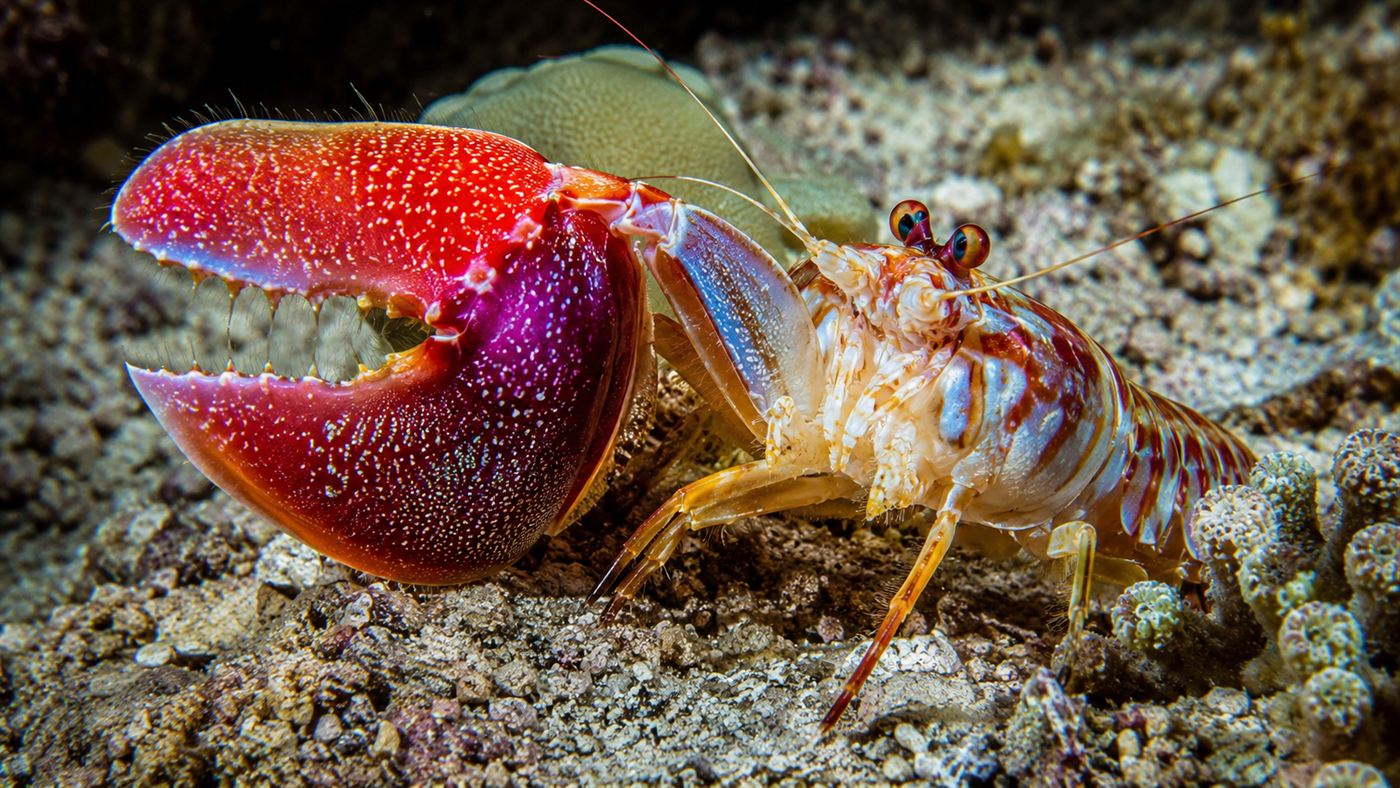
The peacock mantis shrimp, a small reef animal with the fastest punch in nature. Illustration: Watts & Wild.
The mantis shrimp does not look like a record-breaker. It is a small, gaudily coloured crustacean, rarely longer than your hand, that lives in burrows on tropical reefs. But folded under its body are two club-like limbs that deliver, gram for gram, one of the most violent movements in the entire animal kingdom, a punch so fast and so powerful that physics, not just biology, has to be invoked to explain it.
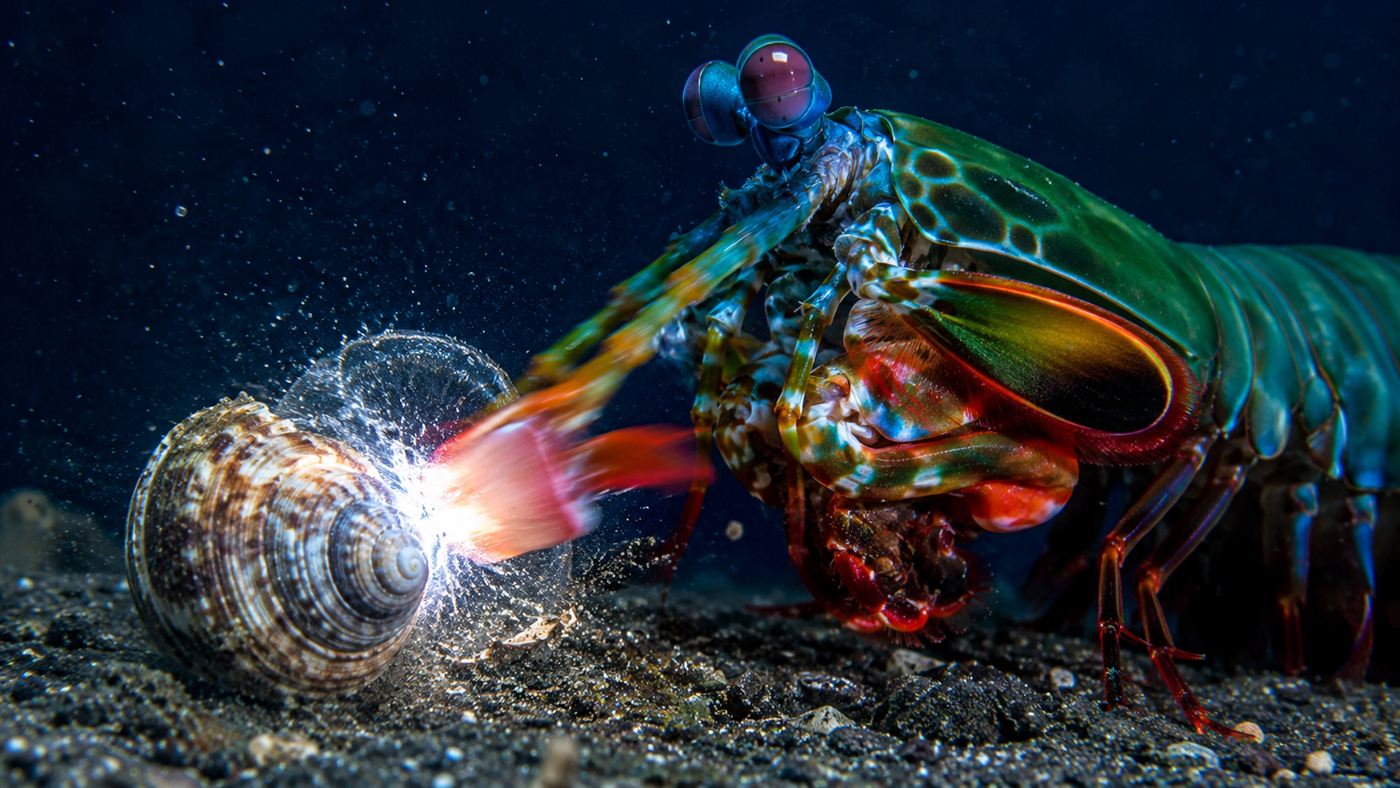
When a peacock mantis shrimp strikes, its club accelerates through the water at up to around 23 metres per second, with the kind of acceleration you would expect from a fired bullet, and the whole blow is over in well under a thousandth of a second, far quicker than you can blink. As the biologist Sheila Patek's lab at Duke University has measured, it hits with hundreds of times the force of its own weight, enough to shatter the shell of a snail or a crab in a single blow, and aquarium keepers have learned, the hard way, that it can crack the glass of a tank.
How does the mantis shrimp punch so hard? The mantis shrimp stores energy in a saddle-shaped spring in its limb, held by a latch like a loaded crossbow. Releasing it fires the club at up to 23 metres per second. The blow is so fast it vaporizes the water into cavitation bubbles that implode with a second, almost equal strike.
The mantis shrimp and the fastest punch in the sea
No muscle could move that fast on its own, and that is the first secret of the mantis shrimp. A muscle pulling directly on a limb is far too slow for this, so the animal does not punch with muscle power at all in the moment of the strike. Instead it spends a fraction of a second beforehand slowly compressing a spring, and then lets that spring go all at once, releasing the stored energy in a burst no muscle could ever match.
The result is a movement at the very edge of what living tissue can survive. The club experiences accelerations thousands of times that of gravity, and the animal has to armour both the weapon and its own body to keep from being damaged by its own blow. For a creature you could hold in your palm, it is a staggering amount of concentrated power, aimed, over and over, at the hard-shelled animals it likes to eat.
A crossbow built into its arm
The spring at the heart of it has a beautiful shape. Sheila Patek, the biologist who has done much to unpick the mechanics, describes a saddle-shaped structure in the limb, curved like a Pringle, that can be bent to store enormous elastic energy without snapping. A small muscle slowly loads this saddle, a latch holds it cocked like the catch of a crossbow, and when the latch releases, the saddle springs straight and flings the club forward.
This trick, storing energy slowly and releasing it instantly, is called power amplification, and the mantis shrimp is one of its champions. The same principle lets a click beetle leap or a chameleon's tongue shoot out, but few animals push it as far. The shrimp has, in effect, evolved a loaded weapon, complete with spring and trigger, built directly into its arm.
Boiling the water into tiny stars
The strangest part happens in the water itself. The club moves so fast that the water behind it cannot keep up, and the pressure drops so sharply that the liquid briefly boils, forming pockets of vapour called cavitation bubbles. A fraction of a second later those bubbles collapse, imploding with such violence that they release a burst of heat, sound and even light, a faint flash known as sonoluminescence. Inside one of those collapsing bubbles, for a few millionths of a second, temperatures can spike to tens of thousands of degrees, hotter than the surface of the sun.
This gives the mantis shrimp a second weapon for free. The collapsing cavitation bubble delivers a blow almost as strong as the strike that created it, so even if the shrimp's club misses, the shockwave alone can stun or kill its prey. A snail does not have to be hit cleanly to be finished; the boiling water around the punch does much of the work. The reef is full of such tricks, but so is the freshwater pond, where the diving bell spider lives its whole life underwater inside a bubble that breathes like a gill.
The most complicated eyes on Earth
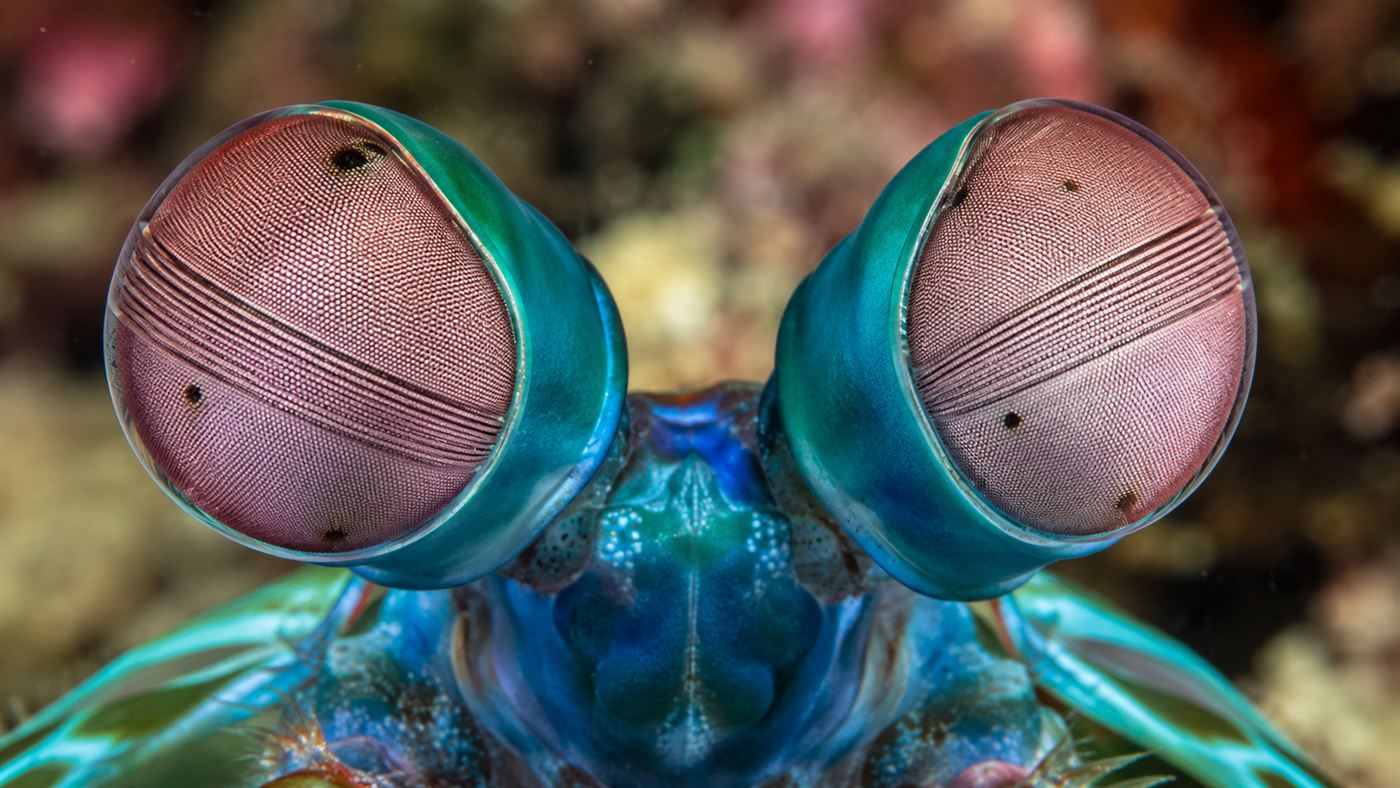
As if a sun-hot punch were not enough, the mantis shrimp also carries some of the most extraordinary eyes in the animal kingdom. Where human eyes have three kinds of colour photoreceptors, a mantis shrimp's can have twelve to sixteen, along with the ability to detect ultraviolet light and even circularly polarized light, a form of light no other animal is known to see. Its eyes move independently and scan the world in strips, like a pair of living spectrometers.
And here is a lovely twist: all that hardware does not seem to make it better at telling colours apart than we are. Experiments suggest the shrimp's brain does not compare its many receptors the way ours does; instead of finely mixing colours, it appears to recognise them quickly and coarsely, as simple labels. The most complicated eyes on Earth may see the world less richly, but far faster, than your own.
The honest catch
It is worth keeping the wonder accurate. The "hotter than the sun" line is true but tiny: it describes the core of a collapsing bubble for a few millionths of a second, not a beam of heat the shrimp can aim, and it is the very same cavitation physics that powers the snapping claw of its relative, the pistol shrimp. The flash is real, but it is a spark, not a furnace.
The famous "super-vision" deserves the same care. The line that a mantis shrimp sees a vastly richer rainbow than we do has been quietly overturned by research; its dozen-plus receptors trade colour discrimination for speed, not the other way round. None of this makes the animal less remarkable. A palm-sized reef shrimp really does throw the fastest punch in nature, boil the water into momentary stars, and watch the reef through the strangest eyes alive. The truth is astonishing enough without the exaggerations.
A reef shrimp you could hold in one hand throws a punch fast enough to boil the sea into a flash of light, and finishes its prey with the shockwave even when it misses. What impresses you more, the sun-hot punch or the strangest eyes in the animal kingdom? Tell us what you think in the comments.
Related reading: The pistol shrimp, whose snapping claw fires a bubble nearly as hot as the sun.