A zombie ant fungus marches carpenter ants to a precise leaf to bite down and die, and the strangest part is that it never even touches the brain it seems to control
The zombie ant fungus is the closest thing nature has to mind control. It infects a carpenter ant, steers it out of the nest to a precise spot on a leaf, locks its jaws shut, and erupts from its corpse, all without ever invading the brain it appears to command.
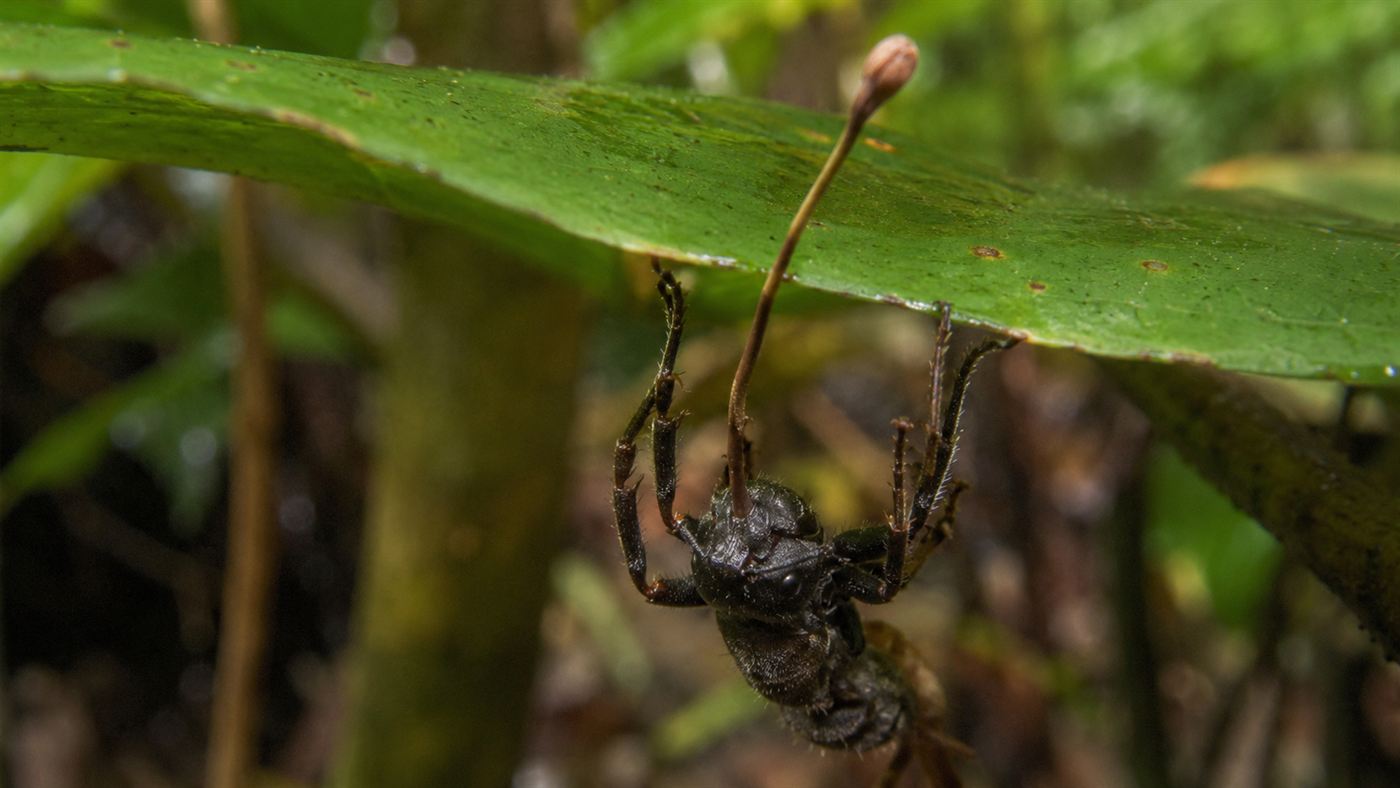
A fungal stalk sprouts from the head of an ant frozen in its death grip. Illustration: Watts & Wild.
The zombie ant fungus does something that sounds invented. In the warm forests of Brazil and Southeast Asia, a fungus called Ophiocordyceps unilateralis infects a foraging carpenter ant, grows quietly inside it for days, and then takes the wheel. The ant, still alive, stops behaving like an ant at all and becomes a vehicle for the fungus to spread.
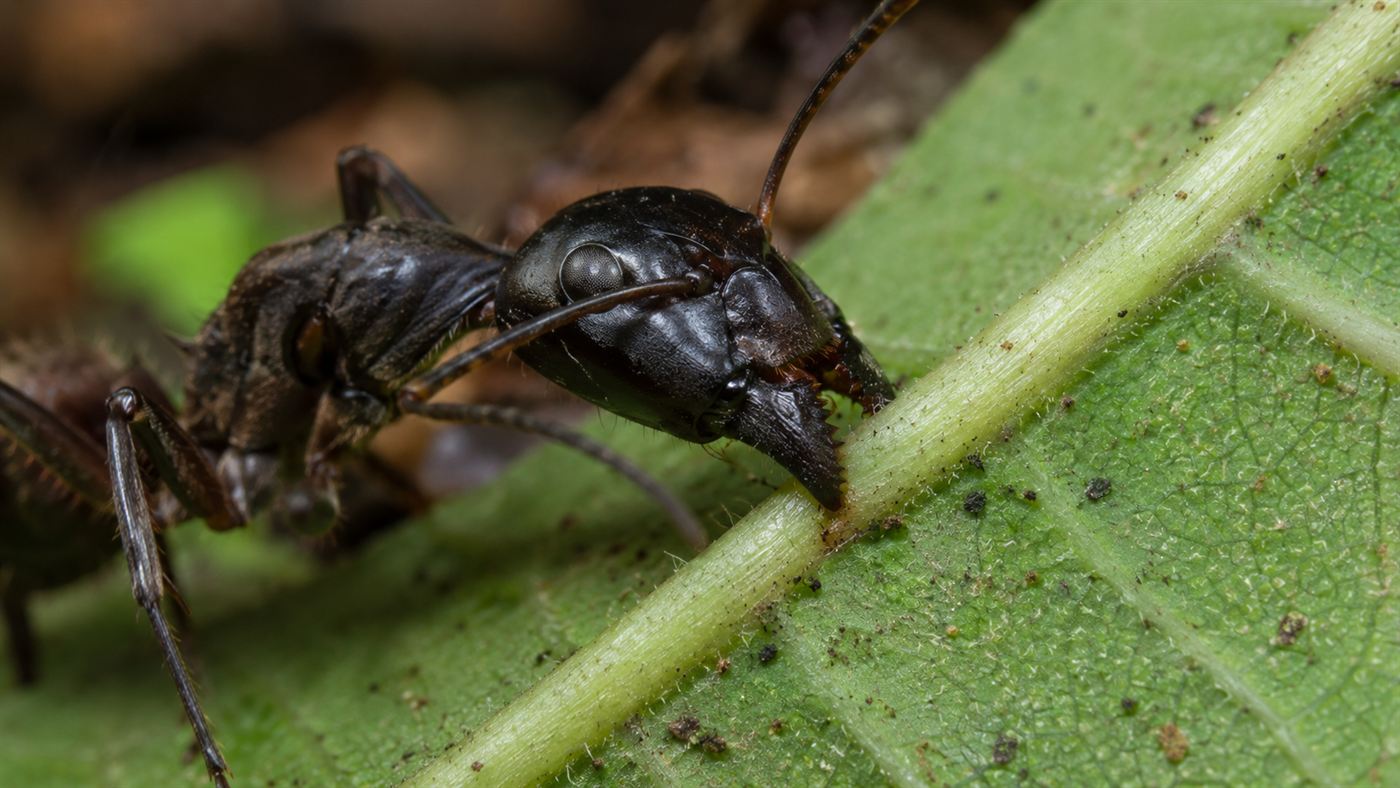
What follows is unnervingly precise. The infected ant abandons its colony and the safe highways of the canopy, climbs down into the cooler, damper understory, and clamps its jaws around the main vein on the underside of a leaf, usually at a set height above the forest floor. As researchers at Penn State have documented, its jaw muscles then waste away, locking it in place for good. This is the death grip, and the ant dies in it.
How does the zombie ant fungus control ants? The fungus does not infect the ant's brain. It spreads through the body and wraps around the muscle fibers directly, forming a network of fungal cells that move the ant like a puppet. At the death grip, about half the cells in the ant's head are fungal, not its own.
What the zombie ant fungus actually does
The full sequence reads like a horror script written by evolution. A microscopic spore lands on a passing carpenter ant and bores through its outer shell. Over the next days the fungus threads through the ant's body, feeding on its insides while keeping it alive and walking. Then, near the end, it triggers the manipulation: the ant grows restless, wanders away from its nestmates, and begins to convulse and stagger, falling from the branches as if drunk.
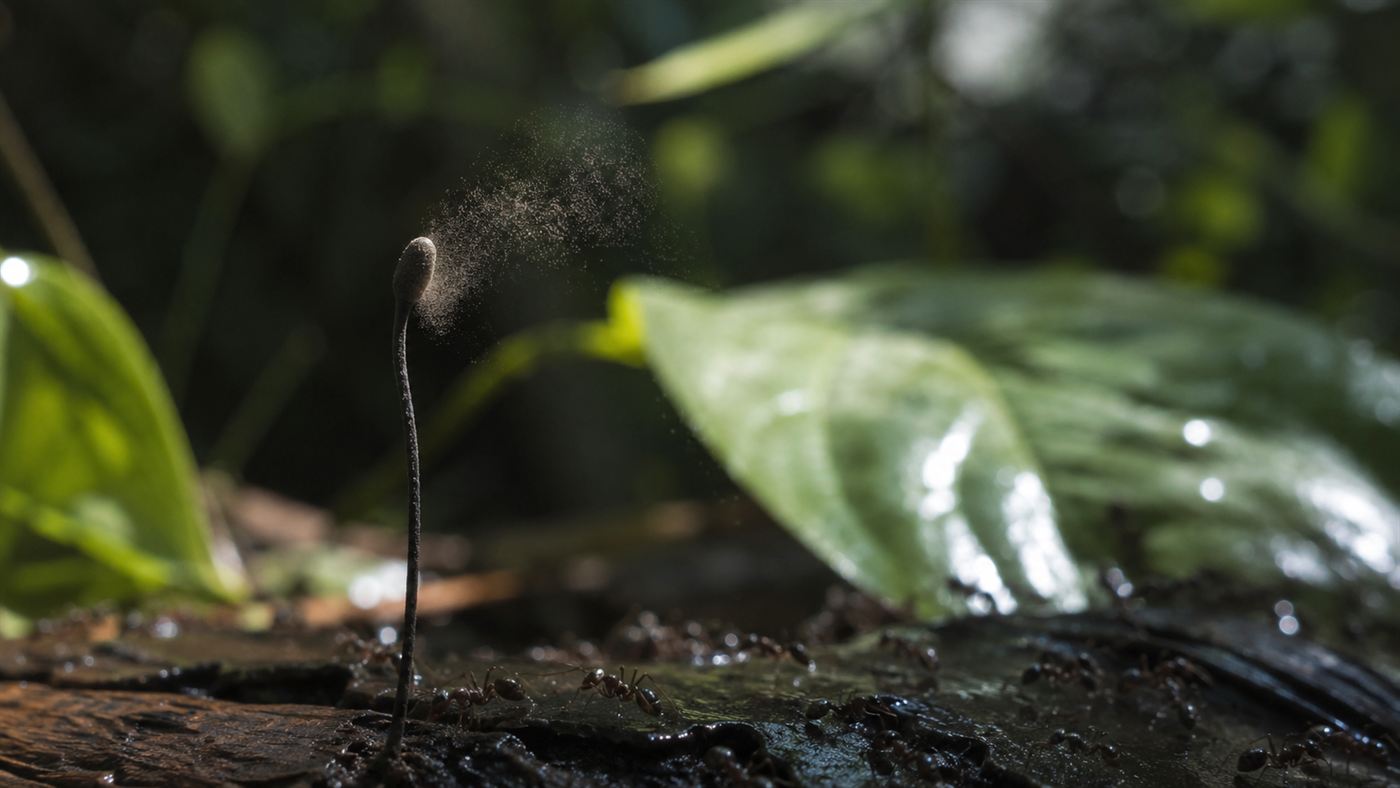
Driven down to the understory, the ant performs the final act it was hijacked to perform. It bites down, hard, into a leaf vein and never lets go. Days after the ant is dead, a long stalk pushes out from the back of its head, and from the tip a fine rain of spores drifts down onto the trails below, where the next generation of ants is marching. The zombie ant fungus has turned one ant into a spore cannon aimed at its own colony.
Does the fungus control the ant's brain?
This is where the story turns from gruesome to genuinely strange. The obvious guess is that the fungus eats into the brain and rewires it, but the team led by David Hughes at Penn State found the opposite. When they reconstructed an infected ant in fine detail, the brain was left intact. Instead the fungus had spread through the body and wrapped itself around the individual muscle fibers, forming a connected three-dimensional network of fungal cells laced through the ant's flesh.
In other words, the fungus skips the mind and seizes the body directly, working the muscles like a puppeteer pulling strings. At the moment of the death grip, the scientists estimated that around half of the cells inside the ant's head were fungal rather than the ant's own. The brain may even be kept deliberately alive, so the doomed ant still senses when and where to clamp down. It is behavioral manipulation without ever taking the controls people assume it must.
Why the fungus is so precise
None of the choreography is for the ant's benefit; every step serves the fungus's reproduction. The spot the ant is steered to, often a particular height, on the shaded underside of a leaf, in humid air, is close to ideal for a fungus that needs to grow a stalk and release spores without drying out. The timing is tuned too, with the fatal bite tending to happen around midday and death following by sunset, giving the fungus the cool, moist night to begin its work.
Position the corpse just above a busy foraging trail and the falling spores land exactly where new victims pass. This is the cold logic behind the horror: the manipulation is a reproductive strategy, sculpted over millions of years, that treats the ant's final hours as real estate. Fossil leaves bearing the telltale scars of death-grip bites show the zombie ant fungus has been doing this for some 48 million years.
How the ants fight back
The ants are not defenseless, and the result is a slow evolutionary arms race. Carpenter ant colonies appear to recognize when a nestmate has been infected and acting strangely, and will carry the doomed ant far away from the nest before it can climb and bite, a kind of social quarantine. Colonies also seem to avoid the dense "graveyards" where infected corpses cluster on the leaves above.
That pressure pushes the fungus to be ever more surgical, and the ants to be ever more vigilant, neither side ever quite winning. It is a reminder that the zombie ant fungus is not some unstoppable force but one player in an ordinary, if grisly, ecological contest, locked in balance with the insects it preys on.
Could it ever infect humans like in The Last of Us?
The fungus owes much of its fame to fiction. The video game and television series The Last of Us built its apocalypse on a cordyceps that leaps to humans and turns them into monsters, and it borrowed the death grip and the head-sprouting stalk straight from the real thing. The imagery is accurate. The threat is not.
Ophiocordyceps is exquisitely specialized, so finely tuned to its particular ant hosts that a fungus adapted to one ant species struggles even with a close relative. It also cannot cope with the heat of a mammal's body; the warmth that makes us feverish when we fight infection is, conveniently, a wall most such fungi cannot climb. There is no version of this that controls a human, now or in any plausible future.
The honest catch
It is worth keeping the wonder and the accuracy in balance. The word zombie is a useful headline, but it oversells the drama: the ant is not undead, it is a living insect being driven by a parasite, and then a corpse being farmed by one. Calling it mind control is almost the opposite of what happens, since the mind is the one part the fungus seems to leave alone.
And for all that scientists have learned, the deepest question is still open. Nobody has fully pinned down the exact chemical signals the fungus uses to make an ant climb, stop and bite at just the right place and moment. The behavioral manipulation is real, photographed and dissected, but the precise instructions passing from fungus to muscle remain, for now, one of biology's better unsolved puzzles.
A fungus has been turning ants into precision-guided spore launchers for 48 million years, steering their bodies while leaving their brains untouched. Is the real zombie ant fungus more disturbing than the fictional one, or less? Tell us what you think in the comments.
Related reading: The leafcutter ants that have farmed their own fungus for tens of millions of years, the other side of the ant and fungus story. And in the Amazon, a spider that disguises itself as a spider-killing fungus.