A famine pulled 14-year-old William Kamkwamba out of school in Malawi, so he taught himself from a library book and built a windmill out of scrapyard junk to light his family's home
When drought and famine forced him out of secondary school, a teenager in the village of Wimbe refused to stop learning. With a library book, a bicycle dynamo and a pile of scrap, he built a windmill that brought the first electric light his family had ever owned. In 2025, he is building the mentor he never had.
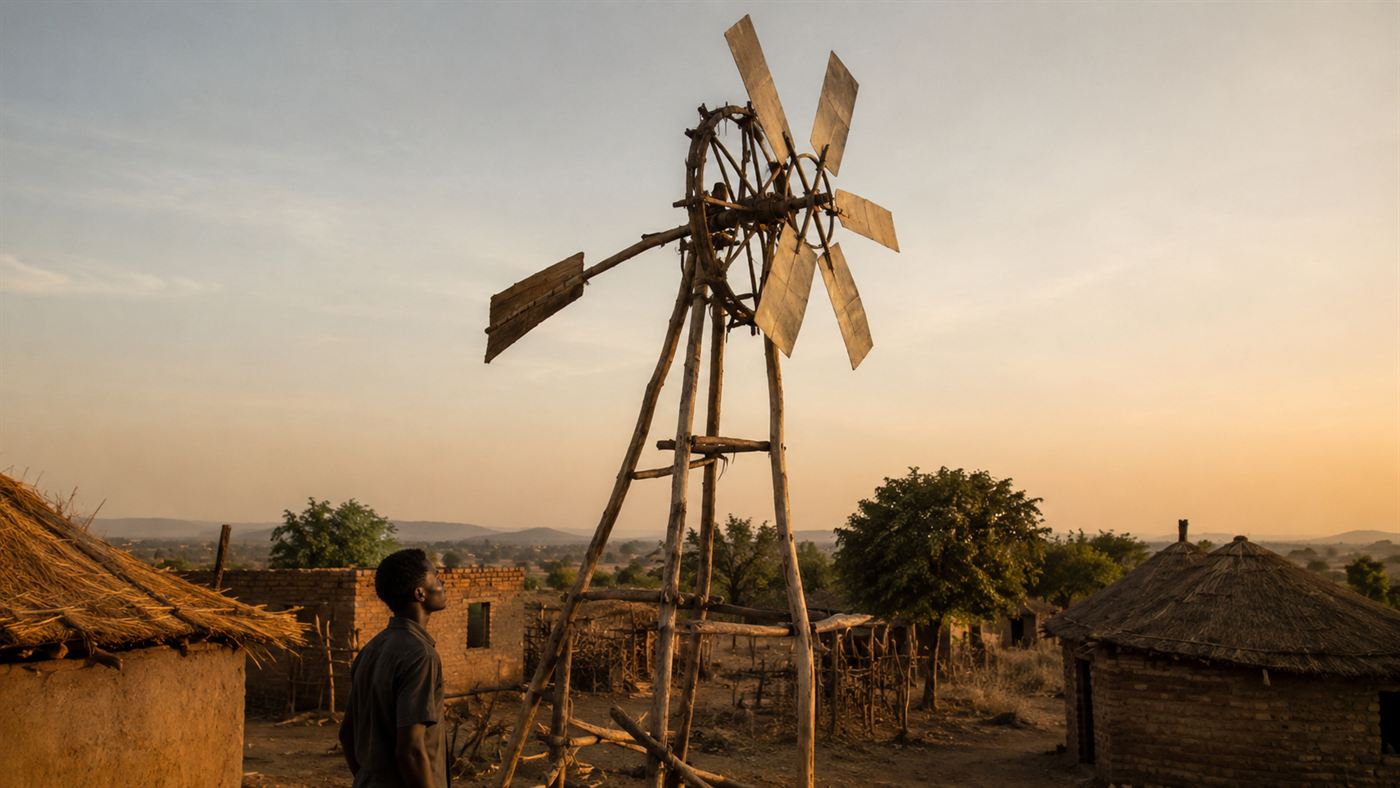
A windmill bolted together from a bicycle, blue gum poles and scrapyard parts, raised over a village in Malawi. Illustration: Watts & Wild.
When the rains failed across Malawi in 2001, the hunger came for William Kamkwamba's schooling first, long before he ever dreamed up a windmill. He was 14, his family had been cut down to a single small meal a day, and there was simply no money left for the roughly 2,000 kwacha it cost to keep him in secondary school. As he told The National in 2025, "a lot of people were starving to death in that time. My parents couldn't afford to pay for my education because they used the money to buy food to feed us." So he was sent home.
What he did with that empty, hungry time is the reason the world knows his name. More than two decades later, in 2025, Kamkwamba is back in Malawi raising something he says he wishes he had owned as a boy: a center to mentor the next generation of village inventors. To understand why that matters, you have to start with the strange machine he bolted together from a bicycle and a scrapyard.
The year the rains failed
The 2001 to 2002 famine was one of the worst Malawi had seen in living memory. Crops withered, prices soared, and people in rural districts died of hunger. For a farming family like the Kamkwambas, the maize harvest was the difference between school fees and food, and that year there was barely any harvest at all.
Dropping out at 14 could easily have been the end of the story, the quiet closing of a door that swallows millions of bright kids in poor countries every year. The fees were small, a few thousand kwacha, and yet completely out of reach. That gap between a tiny sum of money and a child's whole future is the real engine of this story, and Kamkwamba refused to let it decide his.
A library, a book, and a diagram he could read
Instead of vanishing, he started haunting a small community library stocked with donated books. There he pulled an American textbook called Using Energy off a shelf and found, in its pages, a photograph of a windmill. English was not his first language, but a diagram needs no translation. The picture showed something that landed like a revelation: that wind could be turned into electricity.
For most people that would be a passing curiosity. For a teenager in a village with no power grid, where night fell hard at six and homework died with the daylight, it was a plan. "I was interested in fact that wind can generate electricity," he later said. He decided he would build one, even though he had never seen a working windmill in his life.
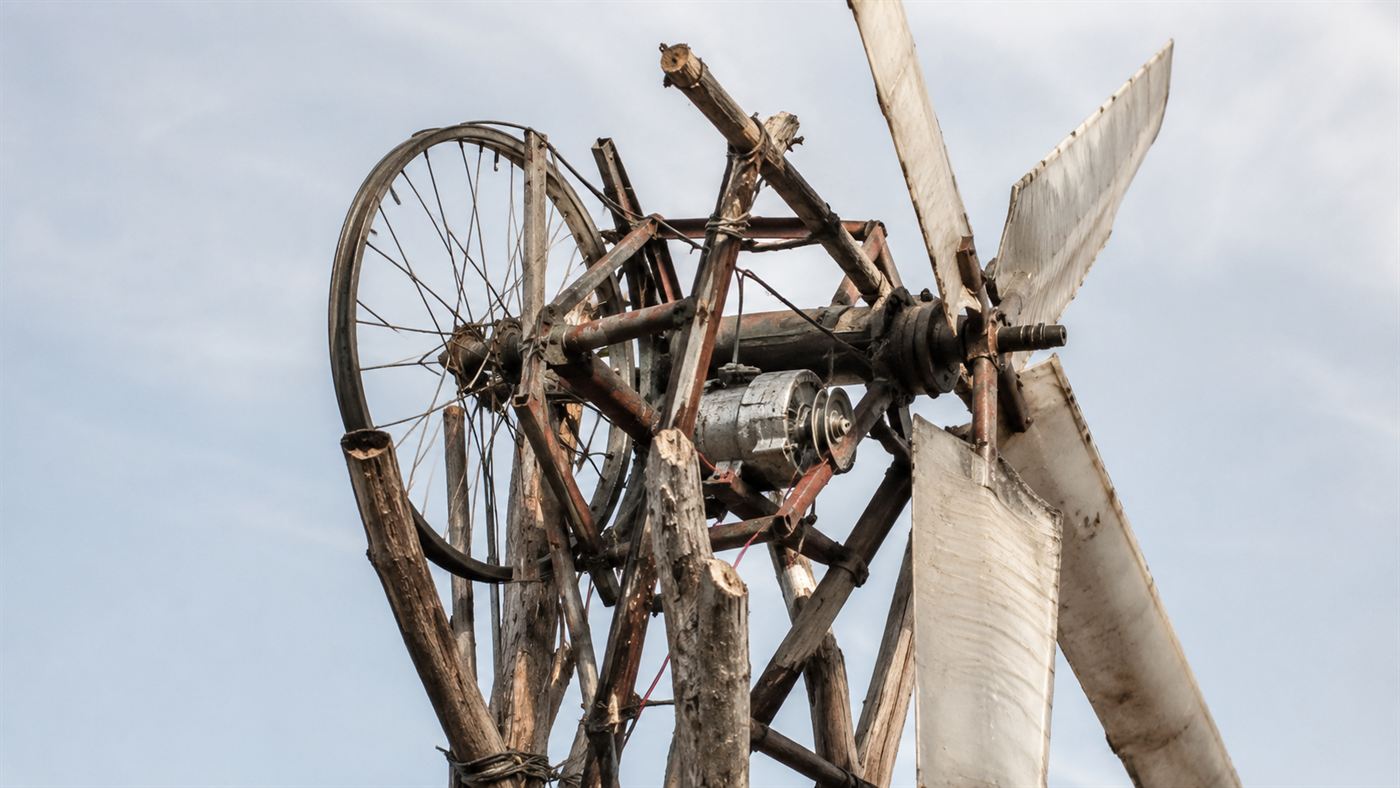
How the William Kamkwamba windmill was built from a scrapyard
He had no parts, so he went looking for them in the dirt. "I didn't have money so I went to the garage yard searching for materials to build a windmill," he recalled. The blades he made from plastic pipe, softened over a fire and flattened. The tower was cut from blue gum trees. The spinning heart of it was a bicycle, its frame and its small dynamo, the little generator that normally powers a bike lamp.
Neighbours watched a teenager climb a rickety wooden tower with a bicycle bolted to the top and decided he had lost his mind. Then the blades caught the wind, the dynamo turned, and a single light bulb in his hand glowed. He kept building. The windmill grew until it could light several bulbs in his family's house and charge the neighbours' mobile phones, and he later rigged a pump to draw water for the fields, aiming the whole thing at the drought that had started it all.
The talk that changed everything
Word of the boy with the windmill spread to education officials, then to journalists, and the story climbed fast. As his public record lays out, in 2007 he was invited to give a TEDGlobal talk in Arusha, Tanzania, in 2009 he co-wrote the bestselling memoir "The Boy Who Harnessed the Wind" with the journalist Bryan Mealer, he graduated from Dartmouth College in 2014, and in 2019 his life became a Netflix film directed by Chiwetel Ejiofor.
It is a dizzying arc, from a village written off by a famine to a stage in front of the world's engineers. But Kamkwamba has spent years pushing back on the fairy-tale version, the one where a lone genius simply willed his way out. He keeps pointing instead at the things that made it possible, a library that happened to exist, a book that happened to be on the shelf, and a stubborn belief that he was allowed to learn.
Now he wants to be the mentor he never had
That is what his current work is really about. Through his Moving Windmills Project, Kamkwamba is building the Moving Windmills Innovation Center near Kasungu, a hands-on residential campus where young Malawians can find the tools and mentorship to invent their own answers to local problems. He frames it as closing the exact gap he fell into.
"I wish I had a mentor when I started creating the windmill," he told The National. "I want to help young people and guiding them in their path from early stages." His message to kids facing the same walls he did is blunt and earned: "don't allow those challenges to take away your goals and dreams." The boy who needed one library is trying to build a whole building full of them.
The honest catch
It would be easy, and wrong, to read this as proof that talent alone beats poverty. Kamkwamba is exceptional precisely because so many equally clever children never get the library, the book or the lucky break, and their windmills never get built. One inspiring inventor does not fix a country where a large share of people still have no mains electricity at all.
The windmill itself, it is worth being honest, was a modest machine. It generated a small amount of power, enough for a few bulbs and a radio, not enough to run a town. Its real output was never measured in watts. It was proof of concept, both for a village and for a boy, that the materials to change your own conditions might already be lying in the scrapyard. The hard, unfinished work is making sure the next William does not need a famine and a miracle to be noticed.
A 14-year-old who could not afford school fees taught himself from a library book and pulled electricity out of the wind with a bicycle and a pile of scrap, and now he is trying to hand that chance to thousands more. How many inventors like William are we losing right now for the price of a few thousand kwacha in school fees? Tell us what you think in the comments.
Related reading: Africa's Great Green Wall was meant to be one 8,000 kilometre line of trees across the Sahel, until it quietly turned into something smarter.