Thousands blasted a railroad through the mountains, then were written out of the story they built
When the last spike was driven in 1869 and America was joined coast to coast by rail, the country celebrated a triumph of engineering and grit. But the men who had done the hardest and deadliest work were largely missing from the photographs and the praise. The Transcontinental Railroad was built in great part by Chinese workers, and history spent a century trying to forget them.
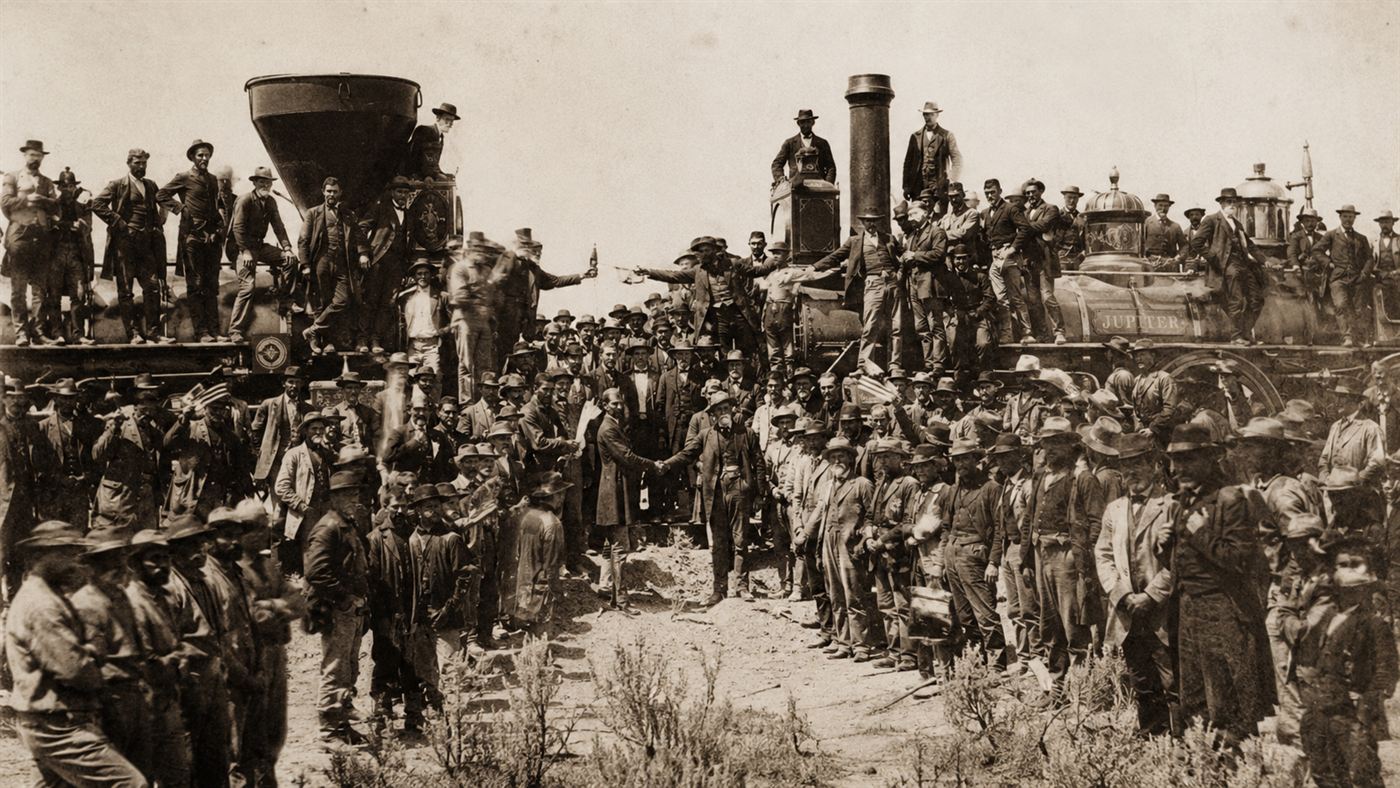
Two locomotives met at Promontory in 1869, but the men who made the moment possible were mostly elsewhere. Illustration: Watts & Wild.
The story of the Transcontinental Railroad is usually told as a tale of bold companies and visionary financiers racing to bind a continent together. That race was real and astonishing. But underneath it is a second story, of the tens of thousands of labourers who actually swung the hammers and lit the fuses, and of how easily a society can celebrate a wonder while forgetting who built it.
It is a story about the gap between the people in the photograph and the people who did the work.
Joining a continent
The plan was to link the existing railways of the eastern United States to the Pacific coast, crossing nearly two thousand miles of plains, deserts and mountains that had taken settlers months to traverse. Two companies built toward each other: the Union Pacific pushing west from Nebraska, and the Central Pacific pushing east from California, straight into the wall of the Sierra Nevada.
They met on 10 May 1869 at Promontory Summit in Utah, where a ceremonial golden spike was driven to mark the joining of the rails. In an instant, a journey that had once taken half a year could be made in about a week. It remade trade, travel and the very shape of the country.
Who really built the Transcontinental Railroad
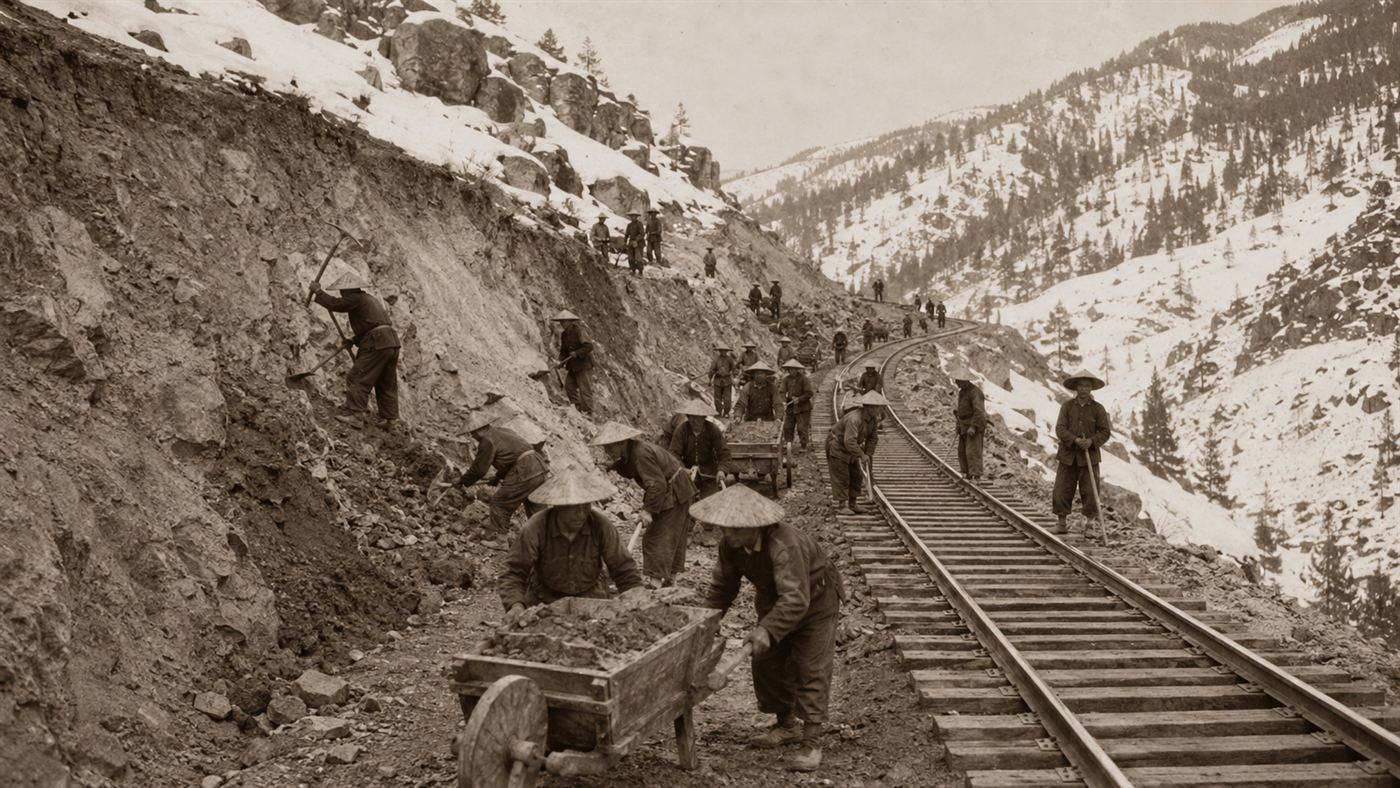
The hardest stretch by far was the Central Pacific's climb over the Sierra Nevada, and that was built overwhelmingly by Chinese immigrants. At the height of construction, somewhere between ten and fifteen thousand Chinese labourers were at work on the line, making up as much as ninety per cent of the Central Pacific's workforce.
They had crossed the Pacific in search of opportunity, and they found gruelling, often deadly labour instead. On the eastern half, the Union Pacific leaned on Irish immigrants, veterans of the recently ended Civil War and formerly enslaved men. But it was the Chinese crews, in the high mountains, who faced the worst the project had to offer, and who carried the railroad over its most impossible ground.
The deadliest work
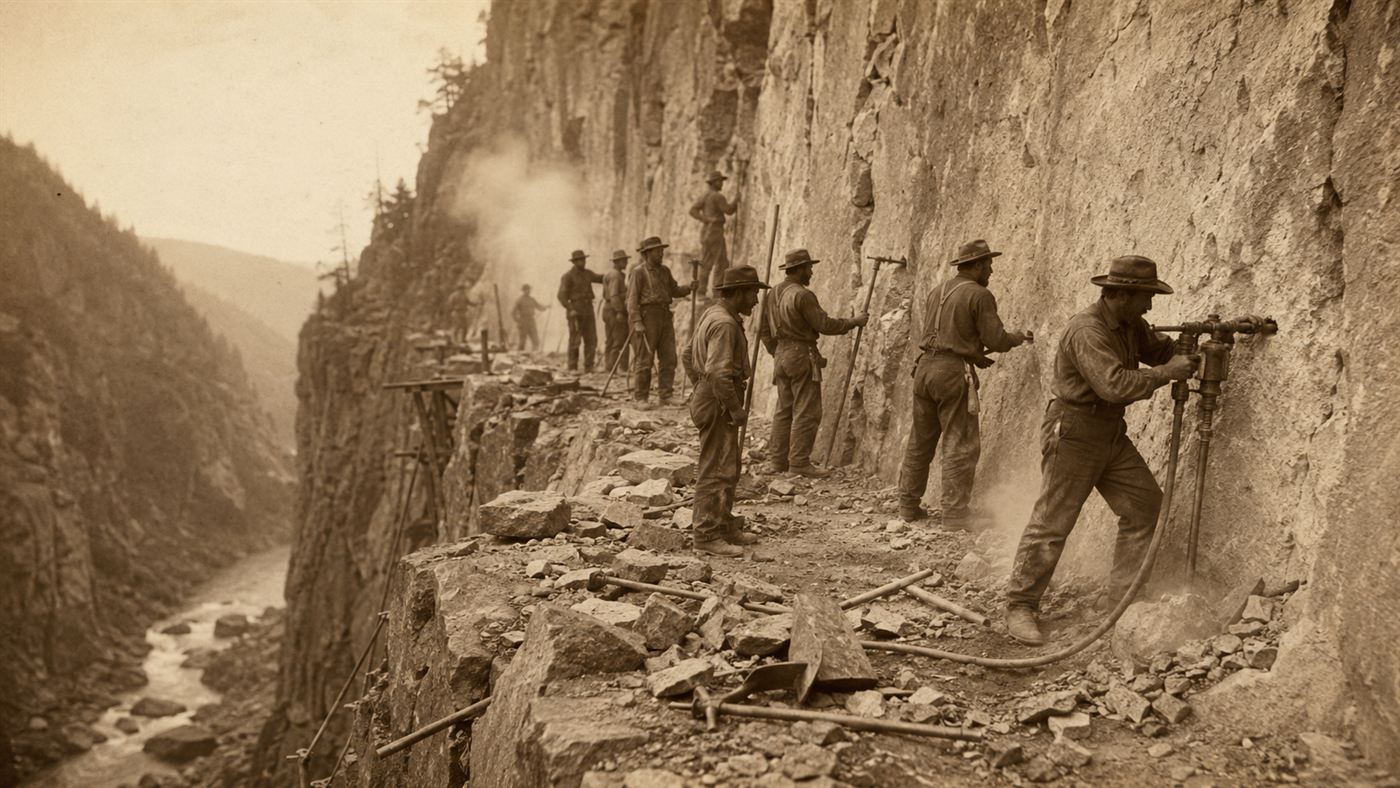
To get through the Sierra Nevada, the workers had to carve eleven tunnels straight through solid granite, drilling holes by hand and packing them with black powder and unstable nitroglycerin to blast the rock apart inch by inch. In winter they tunnelled through snow as well as stone, living in camps beneath the drifts, where avalanches could and did sweep entire work gangs to their deaths.
Some were lowered over sheer cliffs in baskets to set charges in the rock face, then hauled up before the blast, or not. No one kept careful count of the dead. Estimates of how many workers lost their lives range from around 150 to as many as 2,000, and the great majority of them were Chinese. They were paid less than white workers, slept in tents rather than railroad cars, and had to buy and cook their own food.
Written out of the story
For all that effort, the Chinese workers were strikingly absent from the famous celebration. The iconic photograph of the golden spike ceremony, with its crowd of cheering men and clinking champagne, shows almost none of them. For generations it was assumed they had been deliberately shut out of the picture, a snub that came to symbolise how thoroughly their role had been erased.
The truth is a little more tangled, and worth telling honestly. Researchers have since spotted a couple of Chinese workers in the crowd, and the near-absence may have owed as much to the scattered layout of the work camps as to deliberate exclusion. But the deeper erasure is not in doubt: for a hundred years their contribution went largely unrecorded and uncredited, and within a few years of finishing the railroad, the country passed laws to keep more Chinese immigrants out altogether.
Who built the Transcontinental Railroad?
So the honest answer is that it was built by many hands, but that the men who did its most dangerous work, in the mountains where the project nearly failed, were overwhelmingly Chinese. They were not a footnote to the achievement; on the hardest stretch, they were the achievement, and only recently has that begun to be properly acknowledged.
Their descendants and historians have worked hard to recover the names, the camps and the stories, turning a blank space in the record back into people. It is a reminder that behind every famous monument there is usually a crowd of the unfamous, and that who we choose to remember says as much about us as about them.
How many workers died building the Transcontinental Railroad?
Nobody can say for sure, which is itself part of the injustice. The deaths of the Chinese workers were not carefully recorded, so the figure is left to estimate, somewhere between a couple of hundred and a couple of thousand. Each one was a young man who had travelled across an ocean and died on a freezing mountainside so that a country he was barely allowed to belong to could be stitched together.
There is one more shadow over the triumph worth naming. The railroad that knit the settlers' country together also drove a wedge through the lands and lives of Native American nations, speeding the loss of their territory and the slaughter of the bison they depended on. Like so many great works, the Transcontinental Railroad was a marvel and a wound at the same time, and an honest account has to hold both.
A continent was joined in a single decade by men who blasted a path through granite and snow, then were nearly forgotten by the country they connected. When we celebrate the great works of the past, how hard should we work to remember the people who actually built them? Tell us what you think in the comments.
Related reading: the Suez Canal, another world-changing shortcut dug largely by forced and uncredited labour. See also how a railroad tycoon's model town exploded into the Pullman Strike of 1894.