Jimmy Carter was the naval lieutenant who crawled into Canada's first melted nuclear reactor in 1952, and twenty-seven years later he was the president who handled Three Mile Island
On December 12, 1952, a chain of operator errors at the NRX nuclear reactor at Chalk River, Ontario, triggered the first major nuclear accident in history. Among the men sent in to help dismantle the damaged core was a 28-year-old US Navy lieutenant named Jimmy Carter. The story of the Jimmy Carter Chalk River reactor cleanup follows him to the day he became the president standing inside Three Mile Island.
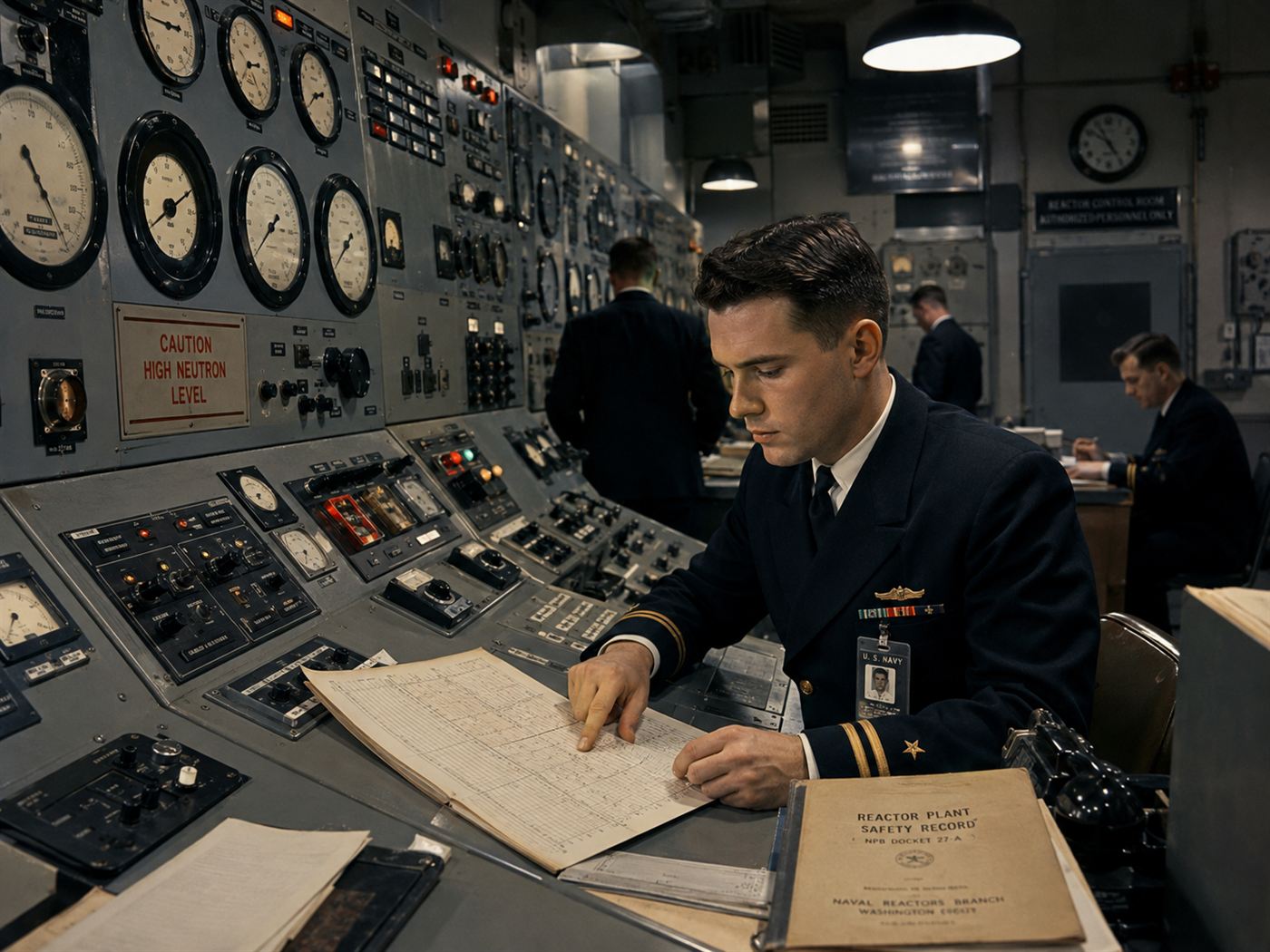
The NRX reactor at Chalk River, Ontario, was one of the world's most powerful research reactors when a series of operator errors in December 1952 caused the first major nuclear reactor accident in history. Illustration: Watts & Wild.
On December 12, 1952, operators at the NRX nuclear reactor at Chalk River Laboratories in Ontario, Canada, made a series of mistakes during a low-power experiment. A valve released accidentally, coolant was lost, and the reactor's power surged uncontrolled to several times its operating limit before the core partly melted and roughly 4,500 cubic metres of radioactive water flooded the basement.
The Canadian and American governments sent emergency teams to contain the damage. One of the American team leaders was Lieutenant Jimmy Carter, then 28 years old and a rising officer in the US Navy's nuclear submarine program under Admiral Hyman Rickover. Jimmy Carter would go on to become the 39th President of the United States. And in March 1979, he would face the worst nuclear accident in American history at Three Mile Island in Pennsylvania. He had been inside a melted nuclear reactor before.
Jimmy Carter was a young US Navy lieutenant when Admiral Hyman Rickover assigned him to help clean up the NRX reactor accident at Chalk River, Ontario, in December 1952. Each worker on his team had roughly ninety seconds inside the damaged nuclear reactor before absorbing their daily radiation limit. That experience, gained inside a wrecked reactor core, became the most unusual entry in any American president's biography.
How did the NRX reactor accident at Chalk River actually happen?
The NRX nuclear reactor at Chalk River Laboratories was Canada's premier research facility for atomic science, operated by Atomic Energy of Canada Limited.
It had come online in 1947 and was, at the time, one of the most powerful research reactors in the world.
On December 12, 1952, a technician conducting a low-power experiment accidentally triggered four control rods to rise simultaneously out of the reactor core instead of the one rod he intended.
A supervisor in the control room then pushed a button that released a fifth rod, compounding the error.
The reactor's power spiked to several times its designed maximum within seconds.
The fuel rods ruptured.
Radioactive gas and cooling water surged through the building, and roughly a million gallons of radioactive water flooded the reactor's basement.
Nobody was killed in the nuclear accident, and there was no fire or explosion in the usual sense.
But the Chalk River reactor core was a contaminated wreck, and cleaning it up would take months and expose hundreds of workers to radiation doses that had no peacetime precedent.
The Chalk River nuclear accident was the first major reactor accident anywhere in the world.
Why did Hyman Rickover send Jimmy Carter into the damaged nuclear reactor?
Hyman Rickover was the father of America's nuclear submarine fleet, a brilliant and demanding admiral who insisted his officers understand reactor physics from the inside out, not just from diagrams.
Jimmy Carter had caught Rickover's eye and was part of the Navy's nuclear submarine program, one of a small cohort of officers being trained to command the reactors that would power America's fleet of nuclear submarines.
When the Chalk River nuclear accident occurred, the Canadian government needed experienced help, and Rickover dispatched American officers who had worked around reactor systems.
Jimmy Carter was put in charge of a team of 23 other American sailors.
Their job was to work alongside Canadian scientists to dismantle and decontaminate the damaged Chalk River nuclear reactor.
Because the reactor was still highly radioactive, each worker could spend only a very short time inside before reaching his permissible radiation limit.
The team built a full-scale wooden mock-up of the damaged section of the Chalk River reactor at a nearby site.
They rehearsed their assigned tasks in the replica until each man could complete his role in under ninety seconds.
Then they entered the real nuclear reactor, one at a time, completed their task, and came back out.
Jimmy Carter later described feeling a slight warming sensation during his brief time inside.
He estimated he had absorbed roughly a year's worth of the then-permissible radiation dose in those ninety seconds.
For months afterward, he said, he could detect radioactive isotopes in his urine samples.
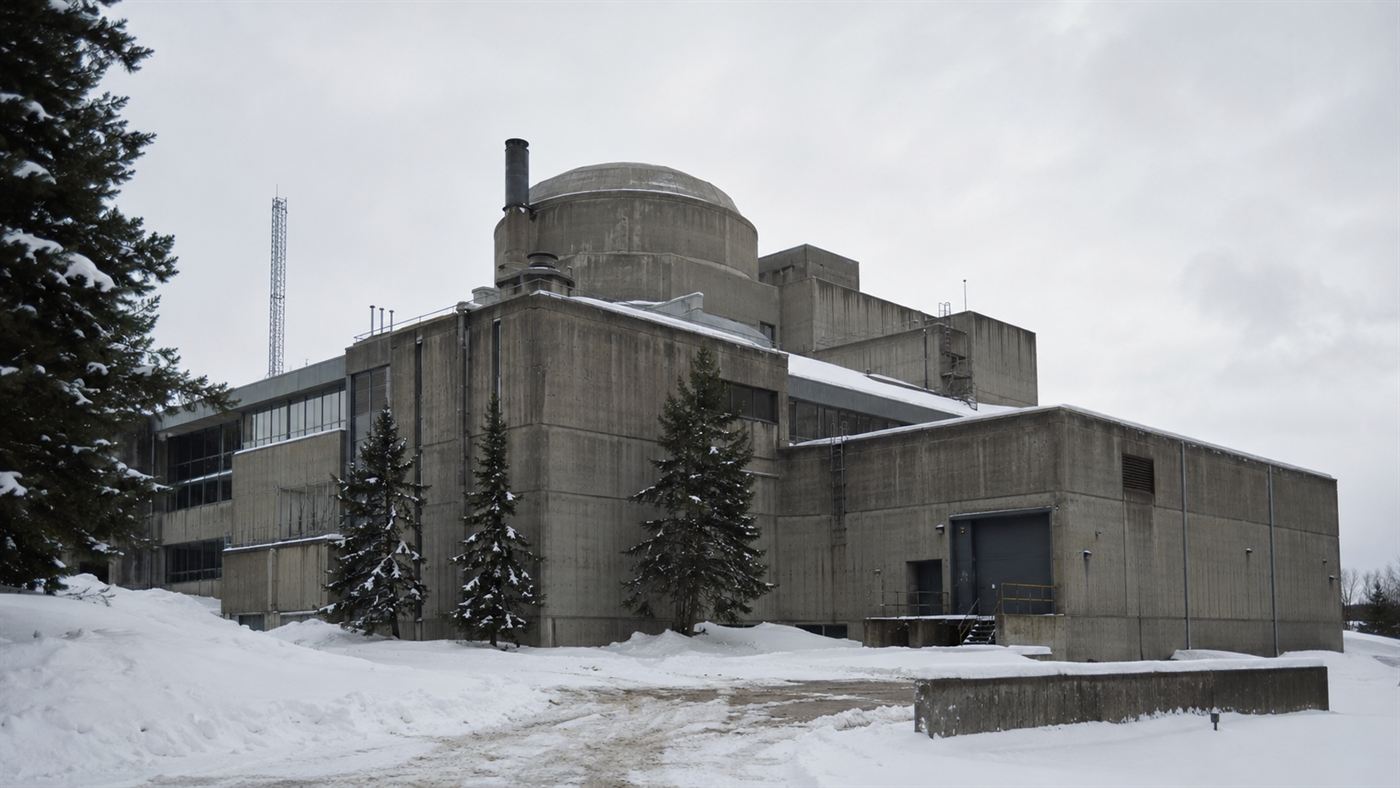
What did Jimmy Carter's time inside the Chalk River reactor actually do to him?
The experience marked Jimmy Carter in a way that is easy to sentimentalise and important not to.
He was not frightened by the reactor.
He was interested in it.
Jimmy Carter had studied nuclear physics under Rickover's demanding program, and he understood the machinery he was stepping into better than almost any non-scientist of his generation.
He knew what the radiation was doing inside those walls, what the numbers on his dosimeter represented, and what the difference was between a contaminated basement and an uncontrolled chain reaction.
That technical literacy, built by working inside a place most people would not enter, proved consequential decades later.
Carter left the Navy in 1953 after his father's death called him back to Georgia.
He became a peanut farmer, then a state senator, then governor of Georgia, and then, in January 1977, the 39th President of the United States.
He carried the education from Chalk River across every role.
For Jimmy Carter, nuclear accidents were not abstractions to be managed through press releases.
He had been inside one.
That shaped everything from his approach to nuclear reactor technology to his position on nuclear weapons, which Carter considered with a technical seriousness that most of his predecessors had not brought to the question.
What did the Chalk River nuclear accident change about reactor safety worldwide?
The Chalk River nuclear accident was not a secret, but it was managed carefully.
Atomic energy in 1952 was surrounded by Cold War optimism and government messaging about the peaceful atom, and no government was eager to publicise the first major reactor accident as evidence that the technology had problems.
The Chalk River cleanup did prompt the first serious technical conversations among nuclear engineers about what safety systems a research nuclear reactor actually required, as opposed to what had seemed adequate on paper.
Canada redesigned significant parts of the NRX cooling system as a direct result of the nuclear accident.
The US Atomic Energy Commission reviewed its own reactor safety procedures.
Most importantly, the incident established that nuclear accidents could happen at elite facilities staffed by skilled, trained professionals, not just in hypothetical scenarios.
The dominant assumption in 1952 was that a major reactor accident was a theoretical risk, unlikely in practice and manageable if it occurred.
Chalk River was the first proof otherwise.
Cleanup crews removed and buried around 800 tonnes of radioactive soil and reactor debris.
The NRX nuclear reactor was repaired and returned to service in 1954.
It ran until 1993, contributing to discoveries in nuclear physics and to the development of medical isotopes used in cancer treatment worldwide, including the cobalt-60 and technetium-99m that still underpin nuclear medicine.
The safety lessons that came out of Chalk River fed directly into the international debates that shaped reactor design for the next generation, including the question of which reactor designs were inherently safer and which required the most rigorous human oversight to avoid catastrophic failure.
What happened at Three Mile Island in 1979, and how did Jimmy Carter respond?
On March 28, 1979, cooling water stopped flowing properly to the reactor core at Unit 2 of the Three Mile Island nuclear power plant near Harrisburg, Pennsylvania.
A stuck-open valve and a cascade of instrumentation errors led the operators to make decisions that worsened the situation.
The nuclear reactor partially melted.
It was the worst nuclear accident in US history.
The initial communications from the plant's operator and from state and federal officials were confused and sometimes contradictory.
Pennsylvania's governor recommended that pregnant women and young children within five miles of the plant evacuate as a precaution.
About 140,000 people left the area voluntarily.
Jimmy Carter arrived at Three Mile Island on April 1, 1979, four days after the nuclear accident began.
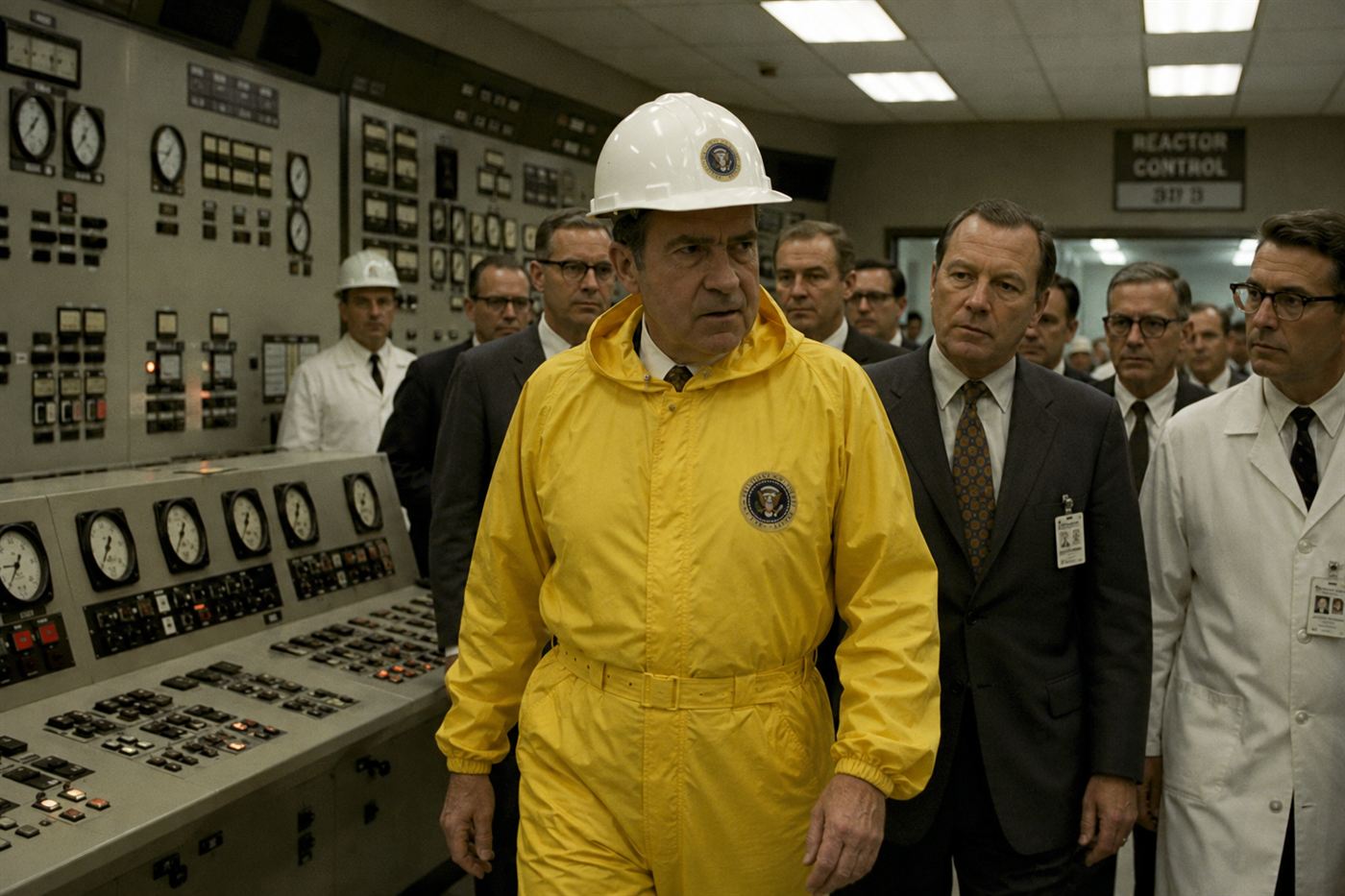
He walked through the Unit 2 reactor building wearing protective booties and carrying a dosimeter, accompanied by his wife Rosalynn and Pennsylvania Governor Richard Thornburgh.
The photograph of Jimmy Carter stepping calmly through the damaged facility communicated something the words of officials had failed to convey: the situation was serious and required respect, but it was not the end of the world.
Carter later said that his time at Chalk River had given him a clear-eyed understanding of what a nuclear accident actually felt like from the inside.
He understood the physics, the dosimetry, the real meaning of the numbers coming out of Three Mile Island, and the distance between a partial meltdown and a catastrophic uncontrolled release.
His calm reflected genuine competence, not political theatre.
The Three Mile Island nuclear accident eventually stabilised without a catastrophic release of radiation.
Unit 2 never reopened.
Unit 1 continued to operate until 2019.
For more on the nuclear technologies that followed, see our Energy section.
The honest catch
The story of Jimmy Carter and Chalk River is real, but some details have grown in the telling.
Carter's memoir describes absorbing roughly a year's worth of permissible radiation in ninety seconds.
Later analyses by health physicists suggest the actual doses received by Chalk River cleanup workers were considerably lower than a full year's limit by modern standards, partly because the permissible limits of 1952 were set conservatively and partly because radiation measurement at the time was imprecise.
The ninety-second time constraint was real.
The radiation quantification is murkier than the memoir suggests.
Carter himself acknowledged in interviews that his estimate was based on the instruments of the day, not a precise reading.
It is also true that Chalk River did not make Jimmy Carter's presidency a success story in nuclear communication.
The Three Mile Island response was confused in its early hours, and the communication failures that sent 140,000 Pennsylvanians fleeing their homes happened on his watch, not his predecessor's.
His personal presence inside the nuclear reactor building was a genuine act of credible leadership.
But it did not prevent the Three Mile Island nuclear accident from becoming the event that effectively halted new nuclear reactor construction in the United States for a generation.
The last new nuclear reactor ordered in the US before Three Mile Island was ordered in 1978.
It was never built.
The accident accelerated a retreat from nuclear energy that lasted three decades.
Jimmy Carter's nuclear literacy, earned in ninety-second bursts inside the Chalk River reactor in 1952, gave him something almost no political leader has: a body-level understanding of what he was managing.
It helped.
It did not solve everything.
Does knowing that a US president had personally crawled into a melted nuclear reactor change how you think about the decisions he made at Three Mile Island twenty-seven years later, or does it just make a compelling story?
Tell us in the comments.
Also see: In the same week Carter's team was cleaning up Chalk River, a killer smog was choking London.
More from Watts & Wild
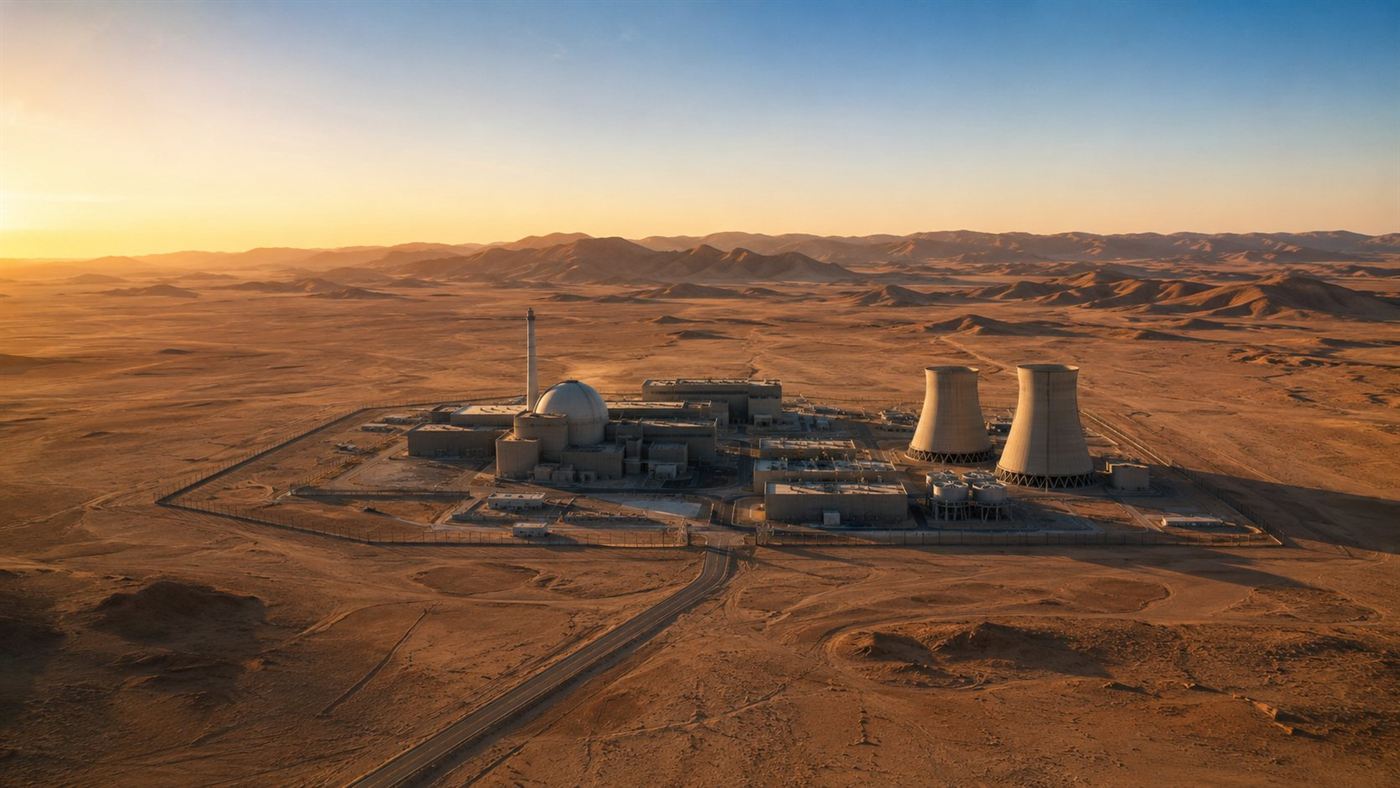 In the Gobi Desert, China just turned on the world's first thorium reactor, six decades after the US built the idea and walked away
 Bill Gates is building a liquid-sodium nuclear reactor on a retiring coal site in Wyoming
 In the 1950s, American scientists seriously planned to ride nuclear explosions all the way into space
 A factory told young women to lick their radium paintbrushes; the men upstairs wore lead aprons