The star-nosed mole is nearly blind, but a ring of twenty-two fleshy tentacles lets it feel out and eat a meal in a tenth of a second, the fastest forager known
The star-nosed mole wears the strangest face in nature: a ring of twenty-two pink, fleshy tentacles around its nose. They are not for smelling or grabbing but for touching, and they make this nearly blind animal the fastest forager on Earth, able to decide a meal is food in eight thousandths of a second.
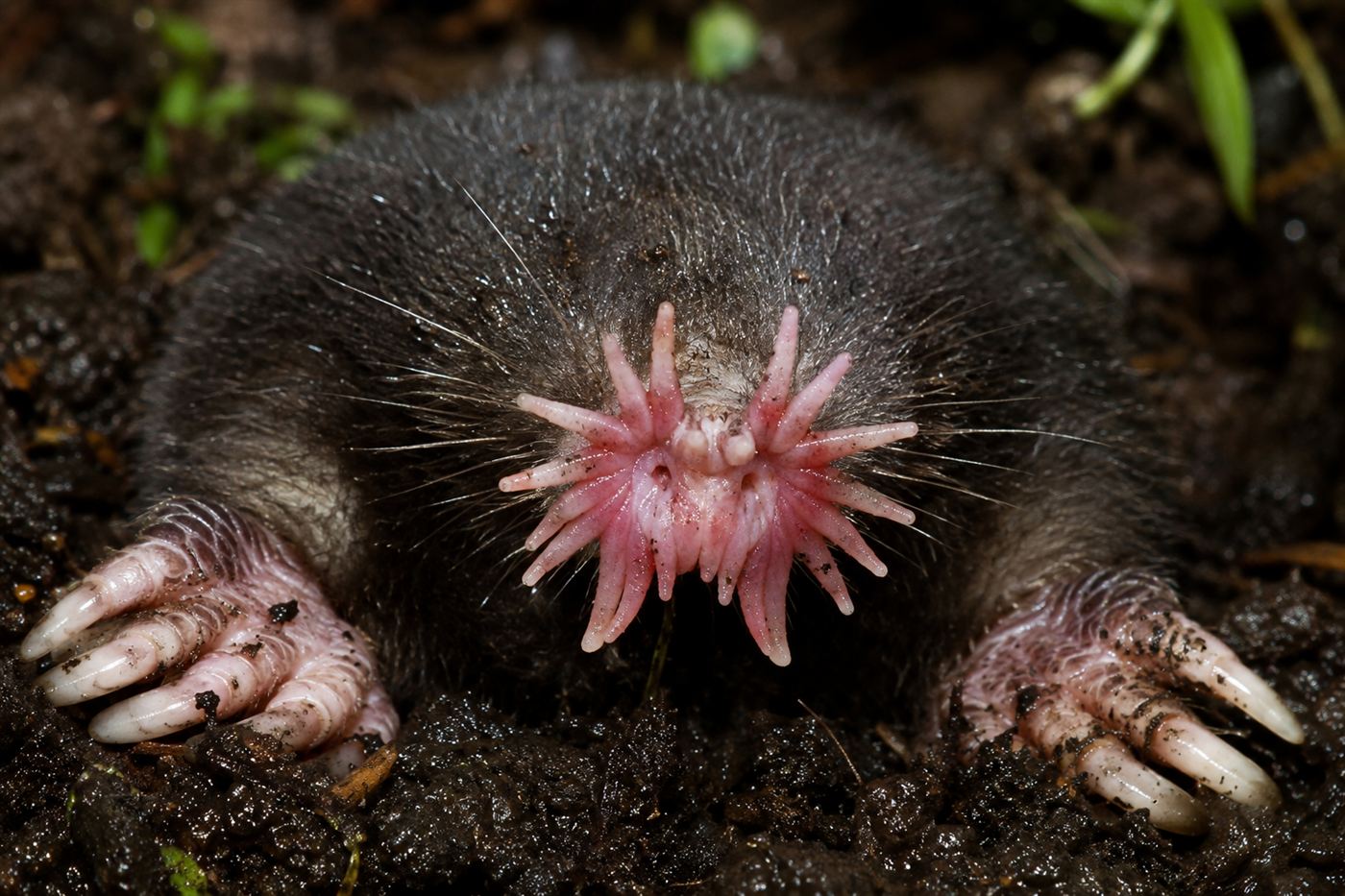
The star-nosed mole's ring of twenty-two fleshy tentacles is an organ of touch. Illustration: Watts & Wild.
The star-nosed mole has a face only a neuroscientist could love. It is a small, dark, almost blind animal that lives in the wet soils and marshes of eastern North America, tunnelling through mud in near-total darkness, and where its nose should be there is instead a fleshy pink star: a ring of twenty-two finger-like appendages, constantly twitching and feeling at the world. To us it looks grotesque, even alien. To the mole, it is the most important sense organ it has.
The crucial thing to understand is that the star is not a nose in the usual sense. As researchers have shown, the twenty-two appendages are covered with about 25,000 tiny sensory domes called Eimer's organs, and the whole structure is an instrument of touch, not smell. The star is, in effect, how the mole sees.
What is the star-nosed mole's star for? The star is a touch organ, not a nose for smelling. Its twenty-two appendages carry around 25,000 tiny sensory receptors, letting the nearly blind mole feel out its surroundings in extraordinary detail and find, identify and eat prey in about a tenth of a second.
The strangest face in nature
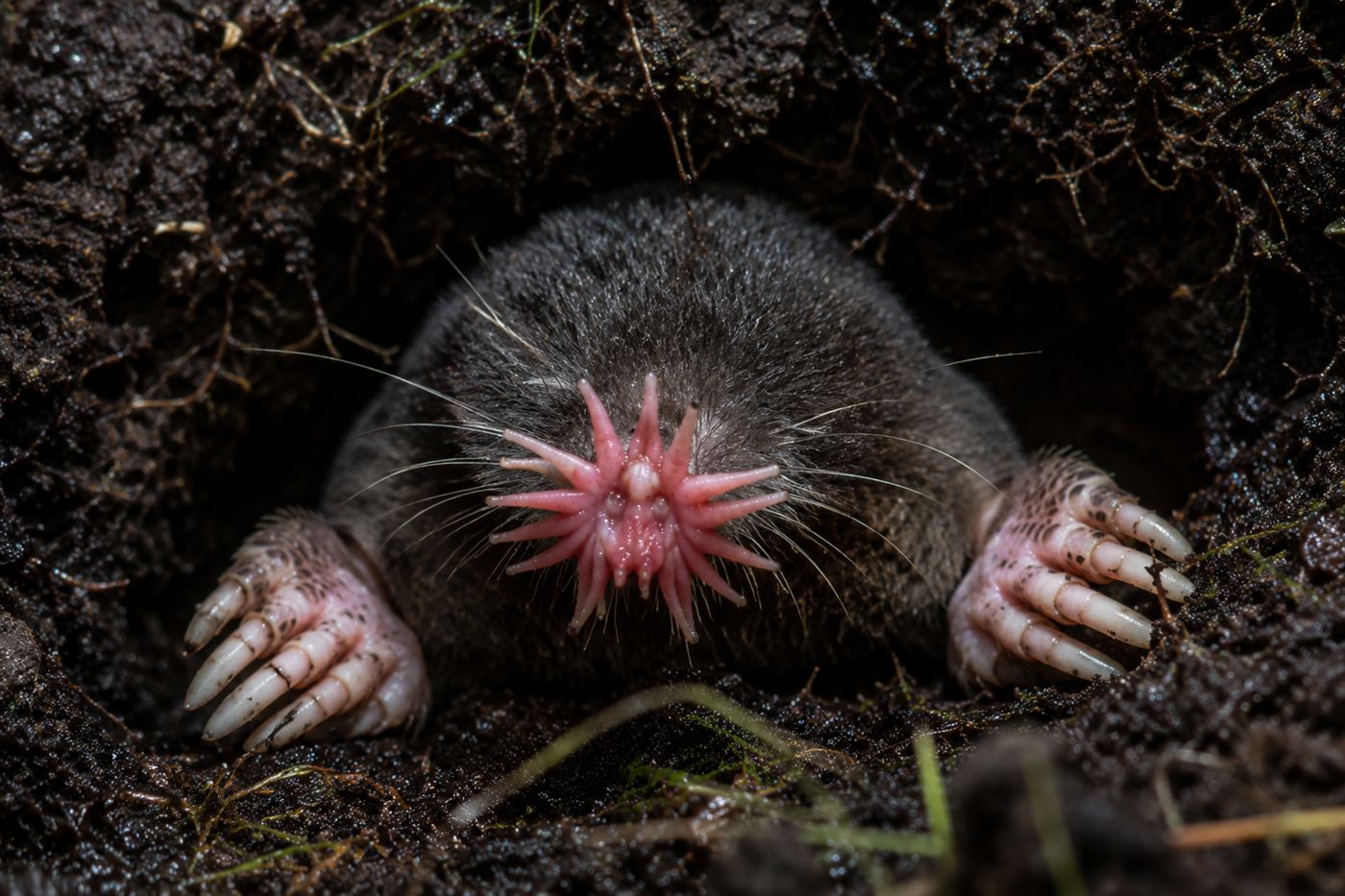
Living underground in the dark, the star-nosed mole has little use for eyes, and its eyes are indeed tiny and weak. What it has instead is touch, raised to an extraordinary degree. The twenty-two rays of the star are in constant motion, brushing the walls of its tunnels and the mud ahead of it dozens of times a second, building a picture of the world out of pure contact. It is one of the clearest examples in nature of an animal that experiences its surroundings through a sense we usually treat as secondary.
And the star is not just sensitive; it is dense with nerves. Packed with tens of thousands of receptors and well over a hundred thousand nerve fibres, it sends a torrent of touch information to the brain, far more than our own most sensitive fingertips manage. The mole feels its world in high resolution. Other animals turn a different physics problem into a hunting skill, like the archerfish, which shoots down prey by correcting for the bending of light.
An eye made of touch
The most beautiful detail is how the star-nosed mole uses its star like an eye. Of the twenty-two appendages, the small lower pair acts as a kind of fovea, the high-detail centre that our own eyes use when we look straight at something. As the mole sweeps the outer rays across the ground and one of them brushes something promising, it instantly swings the whole star around to touch that spot with the foveal pair, examining it in fine detail.
It is, remarkably, the same trick our eyes perform when they flick to look directly at a movement we caught from the corner of our vision. The mole does it with touch instead of sight, redirecting its star to inspect anything interesting, and it does it many times a second, building up a detailed feel of everything around it as it moves.
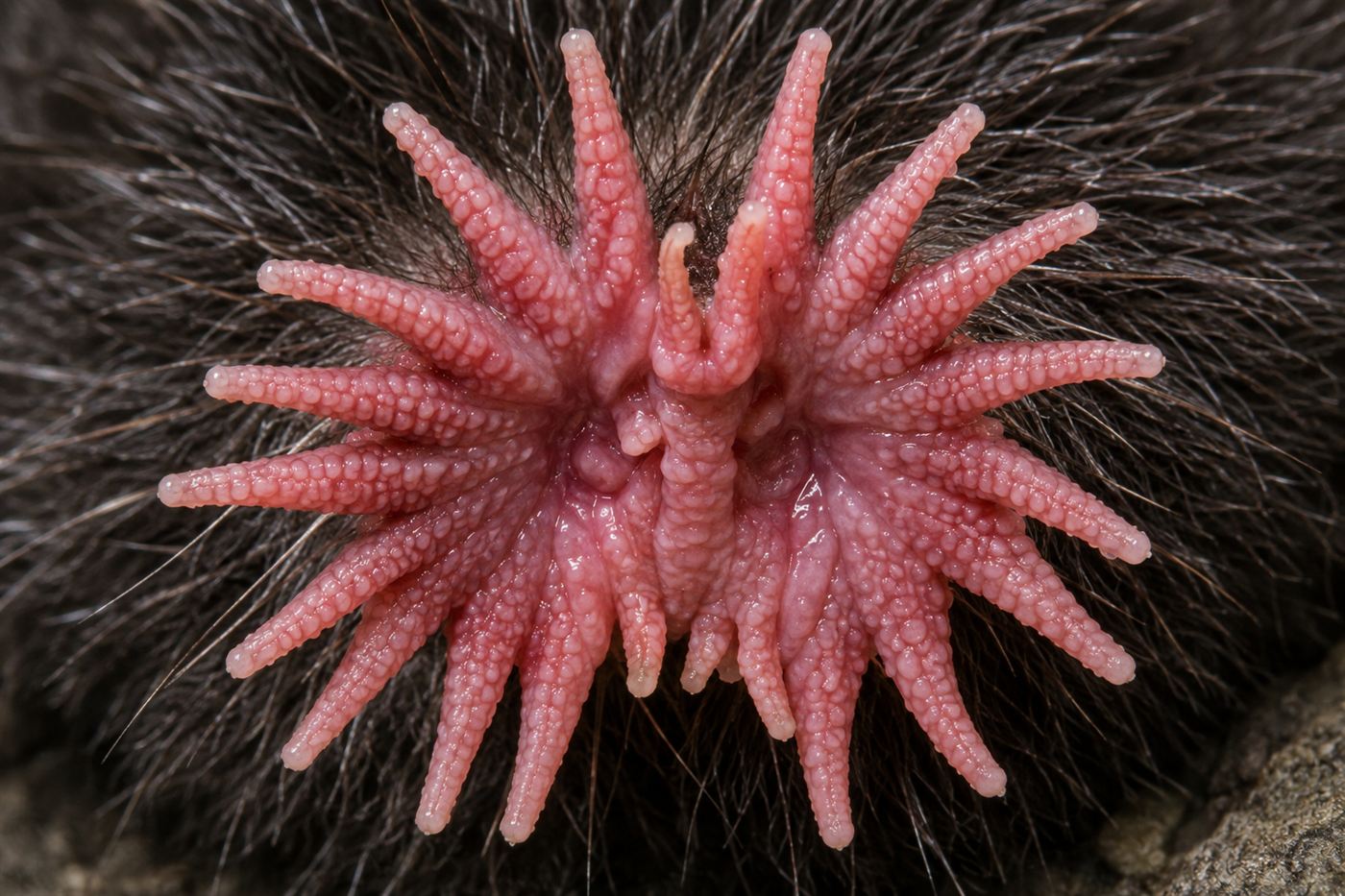
The star-nosed mole, the fastest eater on Earth
All this sensitivity adds up to speed, and here the star-nosed mole holds a genuine record. It is the fastest forager known among mammals. As it searches the muddy dark, it touches between ten and thirteen separate spots every second, each touch lasting only a few hundredths of a second, and when it finds a worm or an insect it can locate, identify and swallow that prey in around a tenth of a second, faster than you can blink.
The most astonishing number is the decision itself. Tests have shown the mole can work out whether something its star has touched is edible in as little as eight thousandths of a second. That is close to the absolute speed limit set by how fast nerve signals can travel and brains can respond; the mole is, in effect, foraging at the physical edge of what a nervous system can do.
Smelling underwater with bubbles
As if a touch-driven speed record were not enough, the star-nosed mole has one more trick, and it overturned a piece of textbook biology. The mole is a good swimmer and hunts underwater as well as in the soil, and scientists watching it found that it can smell while submerged. It does this by breathing out a small bubble of air onto an object or a scent trail and then immediately sucking the bubble back in, sampling the smell the bubble has picked up. Blowing and re-inhaling several bubbles a second, it can follow a scent underwater, the first time any mammal was shown to smell beneath the surface at all.
The mole that mapped the brain
Much of what we know about the star-nosed mole comes from one scientist, Kenneth Catania of Vanderbilt University, who has spent a career studying it. Among his findings is that the mole's brain contains a precise map of the star, with a large area of its sensory cortex devoted to processing touch from the rays, and a magnified patch dedicated to the all-important foveal pair, exactly as our own brains devote outsized space to our hands and lips. Catania's work on this strange little animal, which earned him a MacArthur "genius" award, has become a window into the bigger question of how any brain turns a flood of sensation into a map of the world.
The honest catch
It is worth resisting the urge to treat the star-nosed mole as a freak or a monster; it is a tiny, harmless insect-eater, and its bizarre face is simply a touch organ evolved to do underground what eyes do in the light. The speed records, too, are precise scientific measurements rather than loose superlatives: it is the fastest mammalian forager yet measured, and its eight-millisecond decisions really do brush against the speed limit of neural signalling.
But none of the precision makes it any less wonderful. Here is an animal that is almost blind, lives in mud, and yet perceives its surroundings as a rich, high-speed map of touch built by a twenty-two-fingered star, decides what is food faster than a human can react to anything at all, and can even follow a smell underwater by blowing bubbles. The star-nosed mole is a reminder that the senses we happen to rely on are only one way of knowing the world, and not always the fastest.
A nearly blind animal that sees the world by touch, eats faster than you can blink, and smells underwater by blowing bubbles. Which would you rather have, the mole's touch-star or the platypus's electric sense? Tell us in the comments.
Related reading: The platypus, another animal that hunts with a sense we do not have.