The archerfish hunts by spitting a precise jet of water to knock insects off leaves above the surface, solving the bending of light that should make the shot impossible
The archerfish has a weapon no other fish has: a water gun built into its mouth. It shoots insects clean off overhanging leaves with a jet of water, hitting targets metres away on the first try, and to do it, it has to outsmart the way light bends at the surface.
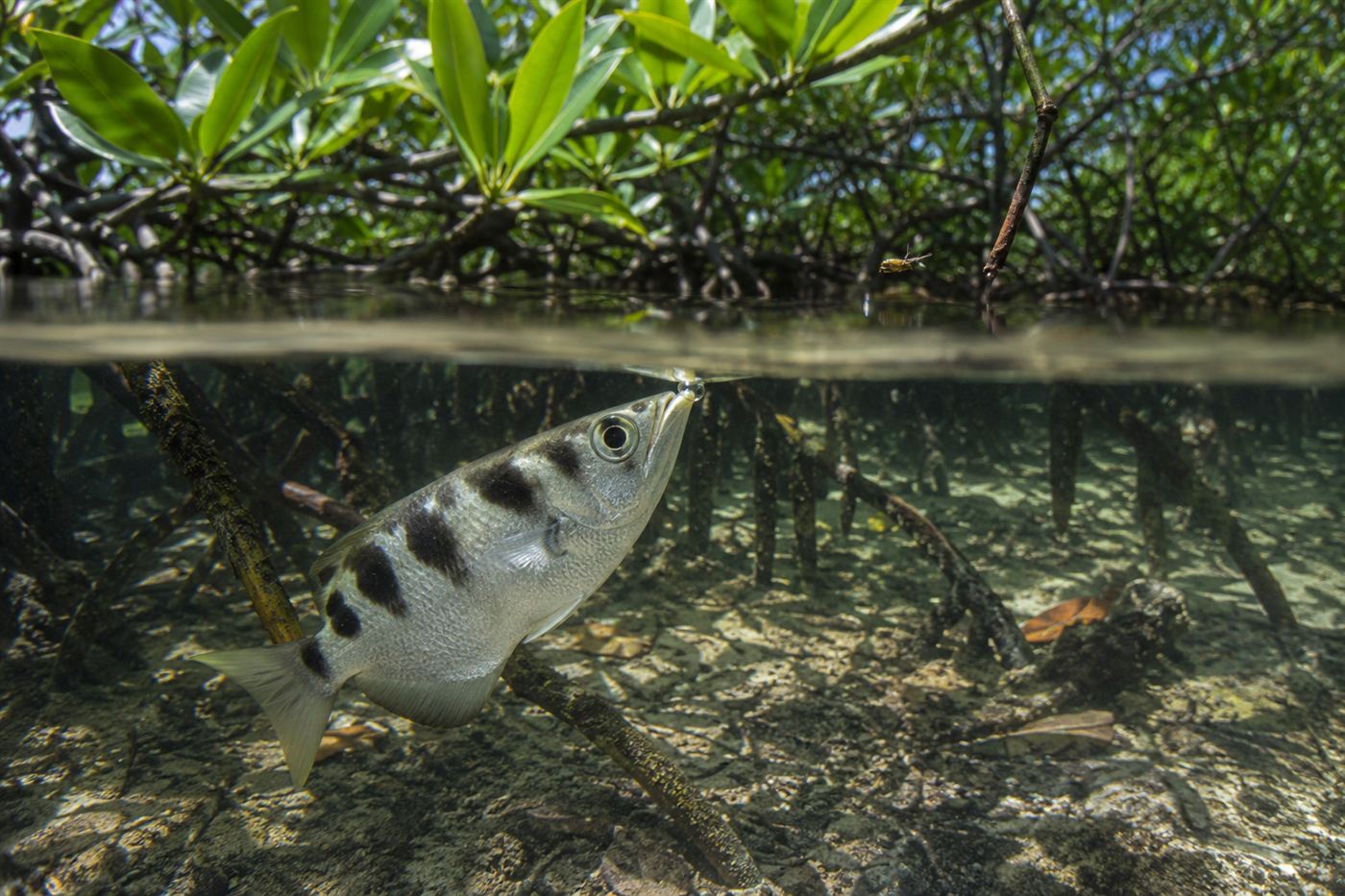
The archerfish, the sharpshooter of the mangroves. Illustration: Watts & Wild.
The archerfish is the sharpshooter of the mangroves. It is a modest-looking fish, silver with bold dark bands, that lives in the brackish creeks and estuaries of Southeast Asia and northern Australia, and it has solved a problem that should be far beyond it. Much of the food it wants, insects and spiders, sits on leaves and twigs just above the water, out of reach of an ordinary fish. The archerfish reaches them anyway, by shooting them down.
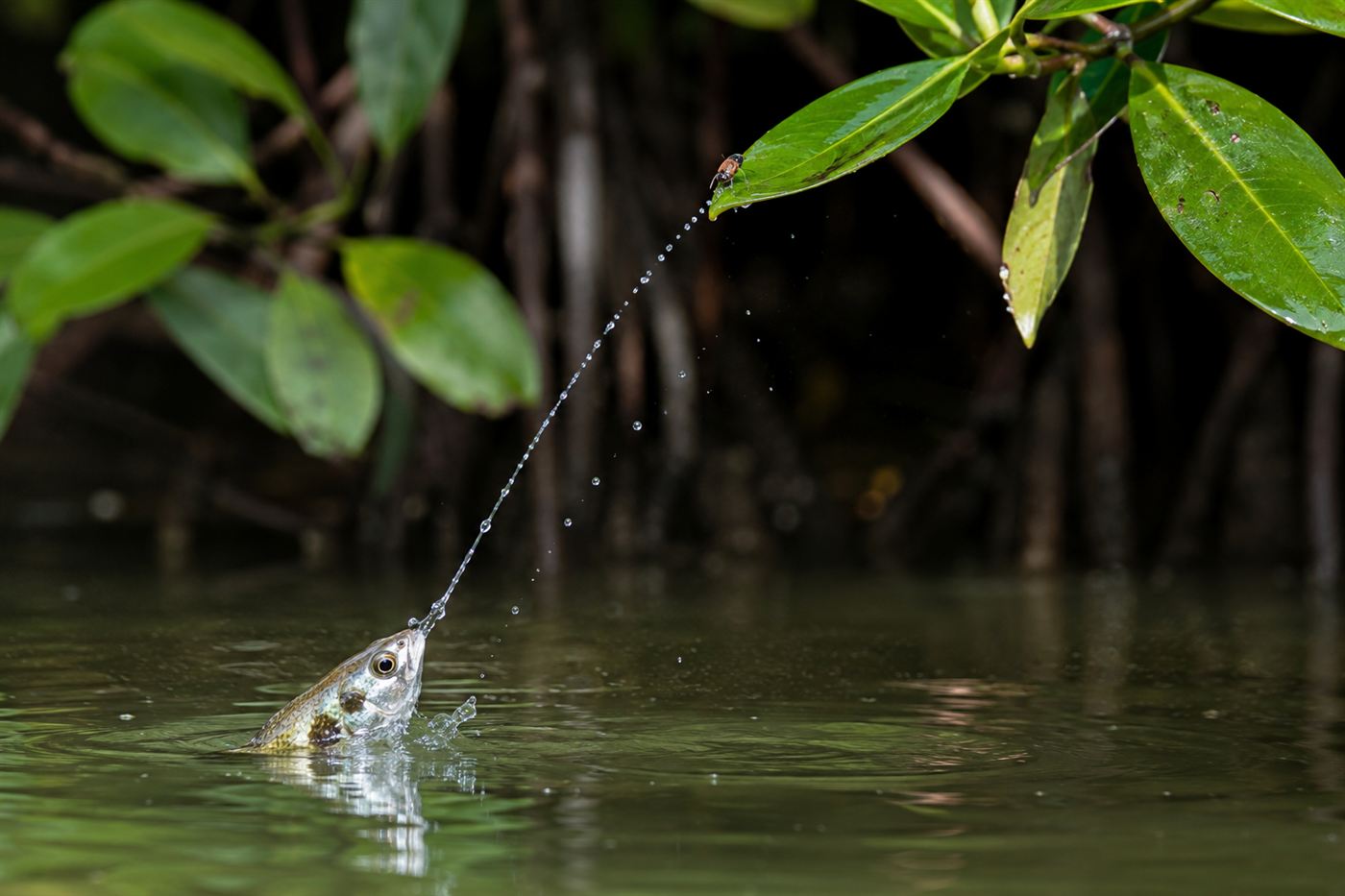
Its method is genuinely startling to watch. As documented, the archerfish fires a jet of water from its mouth that can knock prey from up to about three metres above the surface, sending the insect tumbling into the water, where the fish is waiting to snap it up. And it does this with an accuracy that, for a creature aiming through the surface of a pond, should not be possible at all.
How does an archerfish hunt? The archerfish shoots a jet of water from its mouth to knock insects and small prey off leaves above the water, then eats them as they fall. It can hit targets up to about three metres away, almost always on the first shot, compensating for the way light bends at the surface.
The archerfish and its water gun
The archerfish's gun is a piece of natural plumbing. It presses its tongue up against a groove in the roof of its mouth to form a narrow barrel, then suddenly clamps its gill covers shut, driving a pulse of water down that barrel and out through its lips as a tight jet. The fish can even shape the stream so that the water bunches up into a heavier blob right at the front just as it reaches the target, so the shot lands with a concentrated punch rather than a soft spray. A small insect hit by that blob is knocked clean off its perch.
It is, in effect, a fish that has evolved a squirt gun and learned to use it as a hunting weapon, turning a mouthful of water into a precise tool for reaching food the water itself keeps out of reach.
Solving the bending of light
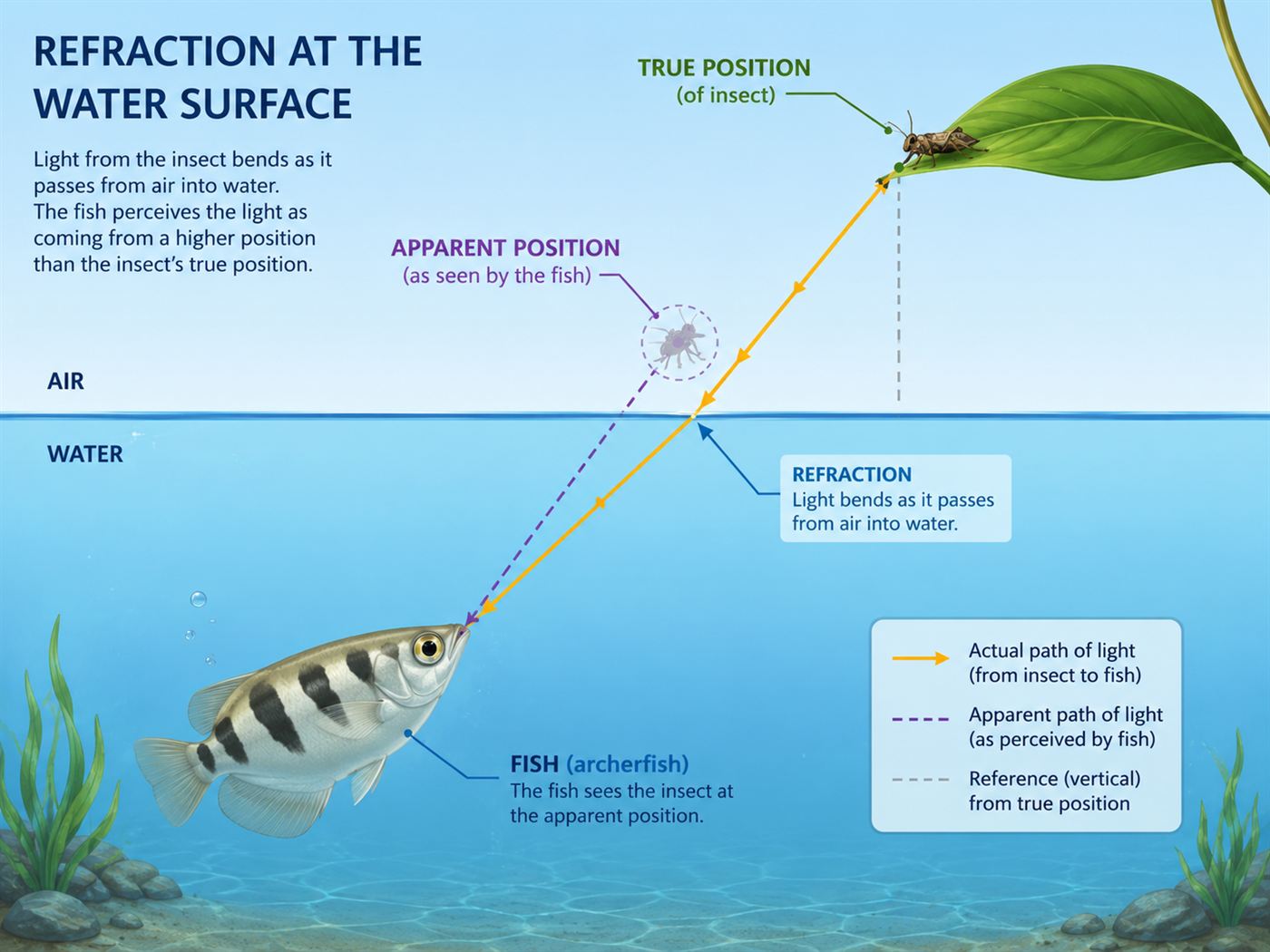
The truly impressive part of what the archerfish does is hidden in the physics. The fish is below the surface, looking up and out at prey that is above the surface, in the air, and light bends as it passes between water and air. That bending, called refraction, means the insect is not quite where it appears to be from underwater; its image is shifted, so a fish that simply aimed at what it saw would miss every time. To hit, the archerfish has to correct for this distortion, working out where the target really is rather than where it looks, and adjusting the angle of its shot accordingly.
On top of that, the jet of water arcs and falls under gravity on its way up, and if the prey is moving the fish has to lead it, firing slightly ahead. Putting all of that together, an experienced archerfish lands its first shot the great majority of the time, solving an optics-and-ballistics problem in a fraction of a second that would have a human reaching for a calculator.
A shot it has to learn
What makes the archerfish even more interesting is that this skill is not simply built in at birth. Young archerfish are clumsy shots, missing and misjudging, and they get better with practice, refining their aim through trial and error in a way that looks a lot like learning. The fish are tuning their own behaviour, gradually mastering the correction for refraction and distance by doing it again and again.
They are also smarter than a fish has any right to be. Experiments have shown that an archerfish can learn simply by watching another fish shoot, and can predict where a knocked-down insect will fall so as to be first to the prize, and they have even been trained to tell human faces apart. For a small fish in a muddy creek, that is a startling amount of brainpower, much of it apparently devoted to the difficult art of the shot.
Why a fish became a marksman
The archerfish's strange talent makes sense once you picture its world. In a mangrove, a great deal of food is just out of reach: insects basking on leaves, spiders in their webs, all of it sitting tantalisingly above a fish that cannot leave the water. The water jet is the archerfish's answer, a way to reach up out of its own element and bring that food down to where it can be eaten. Scientists, led by researchers such as Stefan Schuster, have spent years studying exactly how the fish manages it, because a small brain solving a hard targeting problem so well has a lot to teach us about how nervous systems learn to aim.
The honest catch
A little care keeps the marvel accurate. The archerfish is not doing conscious mathematics; it is not calculating refraction indices in its head. What it has is a behaviour, shaped by evolution and sharpened by practice, that produces the right answer without any awareness of the physics behind it, much as you can catch a ball without solving equations for its flight. And the headline figures, three metres of range and near-perfect first shots, describe a skilled adult in good conditions; plenty of real shots fall short or miss.
But the core of it survives every qualification, and it is remarkable. A small fish in a muddy creek really has evolved a water gun, really does fire it with great precision, and really does correct for the bending of light at the surface in order to hit a target it cannot see in its true position. The archerfish turns the very barrier that hides its prey, the surface of the water, into something it has learned to shoot straight through.
A fish that shoots down its dinner with a jet of water, correcting for the bending of light as it aims. What is the cleverest piece of hunting you have ever seen an animal pull off? Tell us in the comments.
Related reading: The star-nosed mole, another small animal that solves a hard problem at astonishing speed.