A navy engineer accidentally knocked a spring off his desk in 1943, watched it stroll away across the floor, and turned it into a toy that sold hundreds of millions before it tore his own family apart
It is one of the simplest toys ever made: a coil of metal that walks down stairs by itself. What almost nobody remembers is that it was never meant to be a toy at all, and that behind its cheerful jingle lies a genuinely heartbreaking family drama.
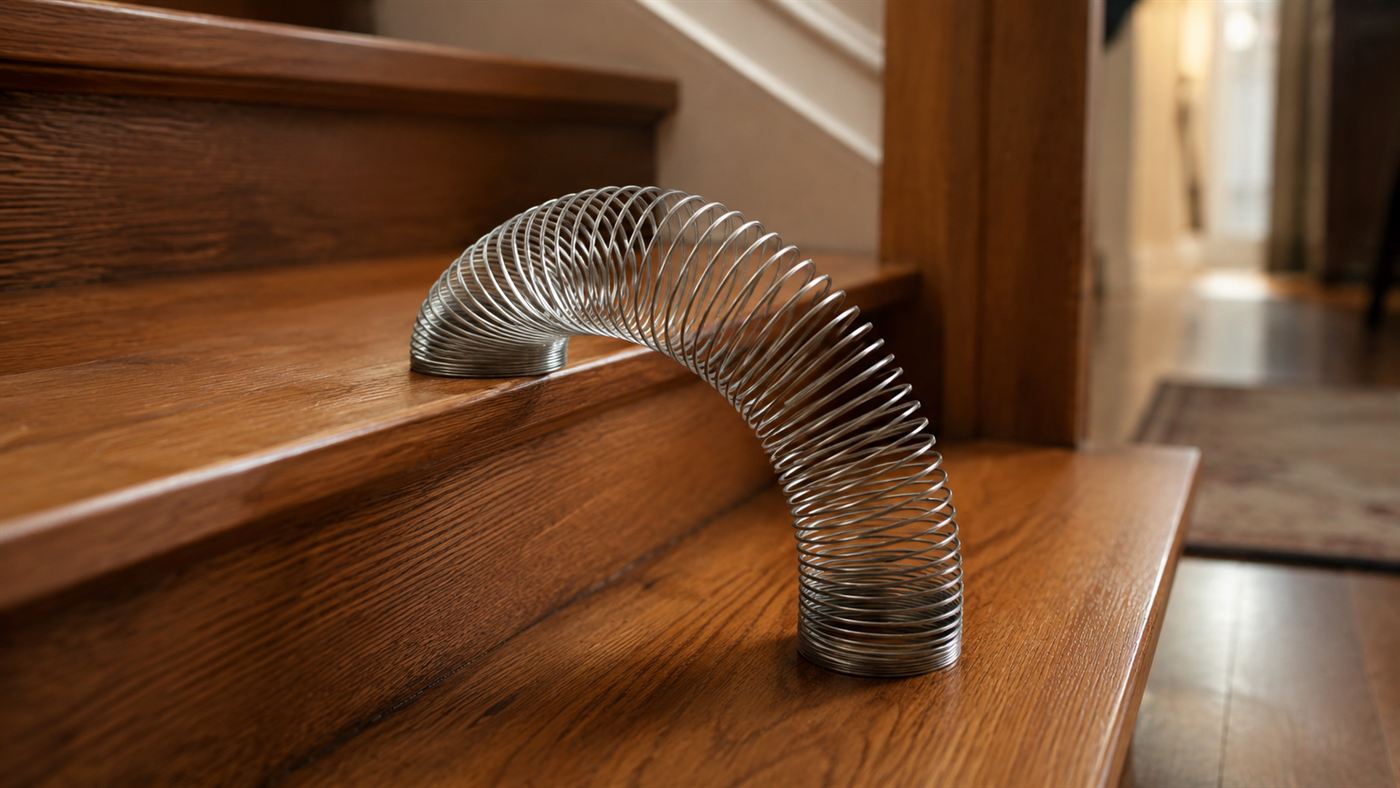
The whole magic of the toy is a spring that seems to walk on its own. Illustration: Watts & Wild.
In 1943, in a shipyard in Philadelphia, a naval engineer named Richard James was wrestling with a very serious problem. He was trying to design springs delicate enough to keep sensitive instruments steady aboard ships as they pitched and rolled on rough seas. It was wartime work, and there was nothing playful about it.
Then he knocked one of his sample springs off a shelf, and instead of clattering to the floor it did something extraordinary. The coil tipped end over end, stepping down from the shelf to a stack of books, to a tabletop, to the floor, in a smooth walking motion. Richard James stood there and realised he had just watched a toy invent itself.
The short version: a dropped tension spring gave an engineer the idea for the Slinky, his wife found the name, and it became one of the best-selling toys in history. But the man who made it would later walk away from everything, and it took his wife to save what he left behind.
The spring that walked off the shelf
The idea was instant, but making it work was not. A spring that merely fell was easy. A spring engineered to walk gracefully down a staircase, step after step, without tangling or stopping, was a real technical challenge. It came down to getting the exact steel, tension and number of coils right.
Richard James spent about a year experimenting before he settled on the recipe: roughly 80 feet of flat steel wire wound into a compact coil. That precise tension spring was what gave the toy its uncanny, almost alive quality, letting it pour itself downward under its own weight in that famous, hypnotic tumble.
How did a spring become the Slinky?
A clever toy still needs a good name, and that job fell to the engineer's wife, Betty James. She sat down with a dictionary and hunted for the right word, finally landing on a term that meant sleek and sinuous. The name she chose was Slinky, and it fit the sinuous, flowing little coil perfectly.
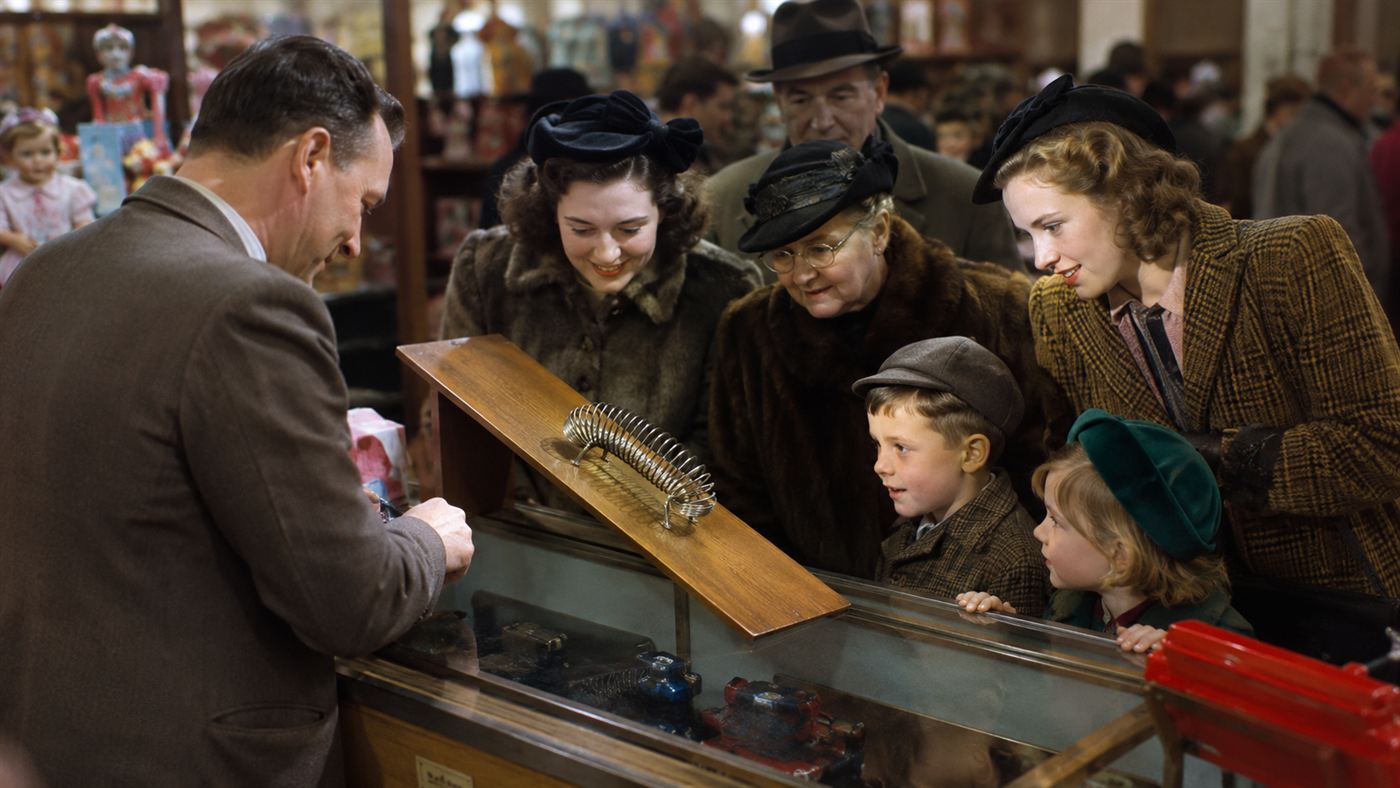
Getting it into shops was another gamble. In late 1945 a Philadelphia department store agreed to let them demonstrate it during the Christmas season, and the couple nervously set up a small ramp. They need not have worried. The entire first batch of 400 units sold out in about 90 minutes, and the Slinky was on its way.
A toy that conquered the world
From that first ramp, the little coil went everywhere. It was cheap, it needed no batteries, and it did one simple thing perfectly, which turned out to be a recipe for staying power that flashier toys never matched. Over the decades it has sold hundreds of millions of units around the world.
It also escaped the toy box entirely. Physics teachers use it to show how waves travel along a coil, and soldiers in Vietnam reportedly tossed Slinkys over tree branches to use as makeshift radio antennas. Few objects that simple have proven so genuinely, weirdly useful far beyond the purpose their maker imagined.
The honest catch
The tidy legend says a spring fell and a fortune followed, but that shortchanges two things. First, it was not a lucky accident so much as a year of careful engineering to turn a falling coil into one that walks reliably, which is much harder than it looks. The naval engineer did real work to get there.
Second, and more importantly, the story credits the wrong James for the toy's survival. The invention was Richard's, but the business that carried the Slinky through decades was built and rescued by Betty. Treating it as one man's happy accident erases the person who actually kept it alive.

The dark turn behind the cheerful jingle
By the late 1950s Richard James had changed. He became deeply involved with a religious sect and began pouring the company's money into it, so much that the once-thriving business slid toward ruin. The man who had invented a symbol of childhood joy was quietly dismantling his own family's future.
In 1960 he left entirely, abandoning his wife and their six children to move to Bolivia with the group, and he never really returned. Betty James was left with a failing company and a houseful of kids, and she made a decision that saved the whole story: she took over the business herself.
The woman who saved the Slinky
Betty moved the company to a small town in Pennsylvania, cut costs, leaned on that unforgettable television jingle, and slowly nursed the Slinky back to health. Under her leadership it became a stable, enduring success again, and she ran it for decades before selling it, earning a place in the toy industry's hall of fame.
So the next time you watch a coil of metal tumble hypnotically down a flight of stairs, remember it carries two stories at once. It is a monument to a lucky little accident, and just as much a monument to the woman who refused to let that accident be thrown away.
A dropped spring became a toy loved by hundreds of millions, and the woman who saved it is barely remembered next to the accident that started it. When an invention outlives a broken family like this, who really deserves to be called its maker, the person who thought of it or the one who kept it alive? Tell us what you think in the comments.
Related reading: the rooster that lived for 18 months without its head and became a sideshow star. See also the day raw meat rained from a clear Kentucky sky, and the houses Americans built out of nothing but revenge.