America's first atomic power station was really a submarine engine on land, and its greatest achievement was learning how to make it disappear again
Everyone remembers the ribbon-cutting: the dawn of the atomic age, cheap power for all, a president turning a symbolic key. What almost no one remembers is the far harder trick this little plant pulled off at the end of its life, when it proved a reactor could be completely taken back.
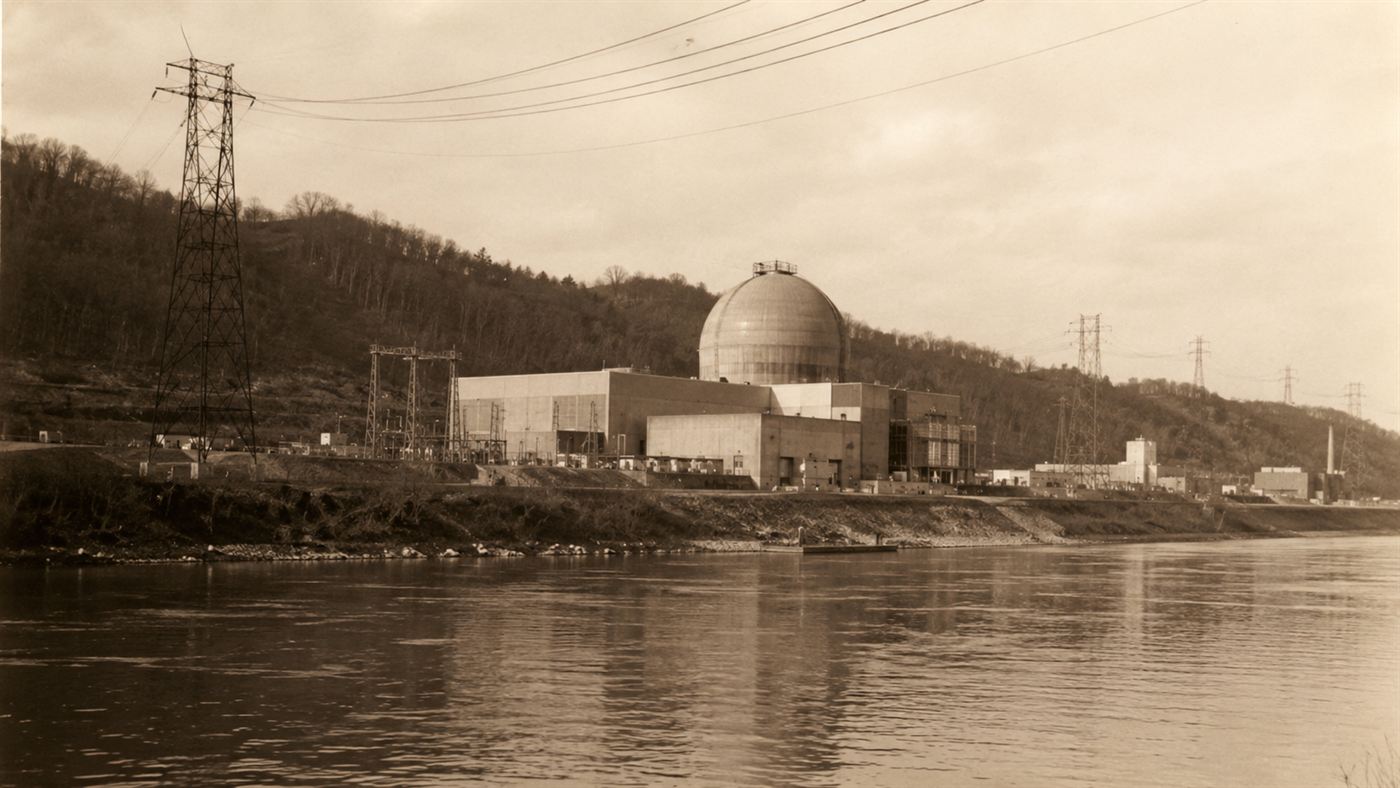
Shippingport, on the Ohio River, was the first full-scale US atomic power station. Illustration: Watts & Wild.
On the bank of the Ohio River, about twenty-five miles from Pittsburgh, a small town called Shippingport gave its name to a machine that switched on in December 1957. It was the first full-scale atomic power station in the United States built for one purpose only: to turn nuclear heat into ordinary household electricity.
It arrived wrapped in the language of a new era. This was the age of Atoms for Peace, President Eisenhower's promise that the same science behind the bomb could light cities instead of levelling them, and Shippingport was meant to be the proof made of steel and concrete.
The short version is that the plant did work, and did light homes, but almost nothing about it was quite what the public story implied. Its real parentage was military, its economics were never the point, and its most important lesson would not be taught until the day they switched it off for good.
A submarine reactor hauled onto dry land
The driving force behind Shippingport was Admiral Hyman Rickover, the famously relentless officer who had built the nuclear navy. He had already put a reactor inside the submarine Nautilus, and what he installed on the Ohio River was essentially that same idea scaled up, a pressurized water reactor lifted almost straight out of a warship.
That heritage shaped everything. A pressurized water reactor was compact, well understood by Hyman Rickover's team and quick to build, which suited a Cold War in a hurry. The United States wanted a civilian atomic plant running before its rivals, and reaching for a proven naval design was the fastest way to plant a flag in the new territory.
Why Shippingport was never really about cheap power
For all the talk of electricity too cheap to meter, Shippingport was tiny and expensive. It produced only a modest amount of power for the cost, far less economically than the coal plants all around it, and it was heavily supported rather than run as a going concern. It was a demonstration, not a bargain.
What it demonstrated was simply that the thing could be done, that a reactor could sit beside a river and feed a normal grid year after year without drama. In its later life it even ran a remarkable experiment, quietly proving that a reactor could breed more nuclear fuel than it consumed, a genuinely surprising result buried in the technical reports.
The harder trick at the end
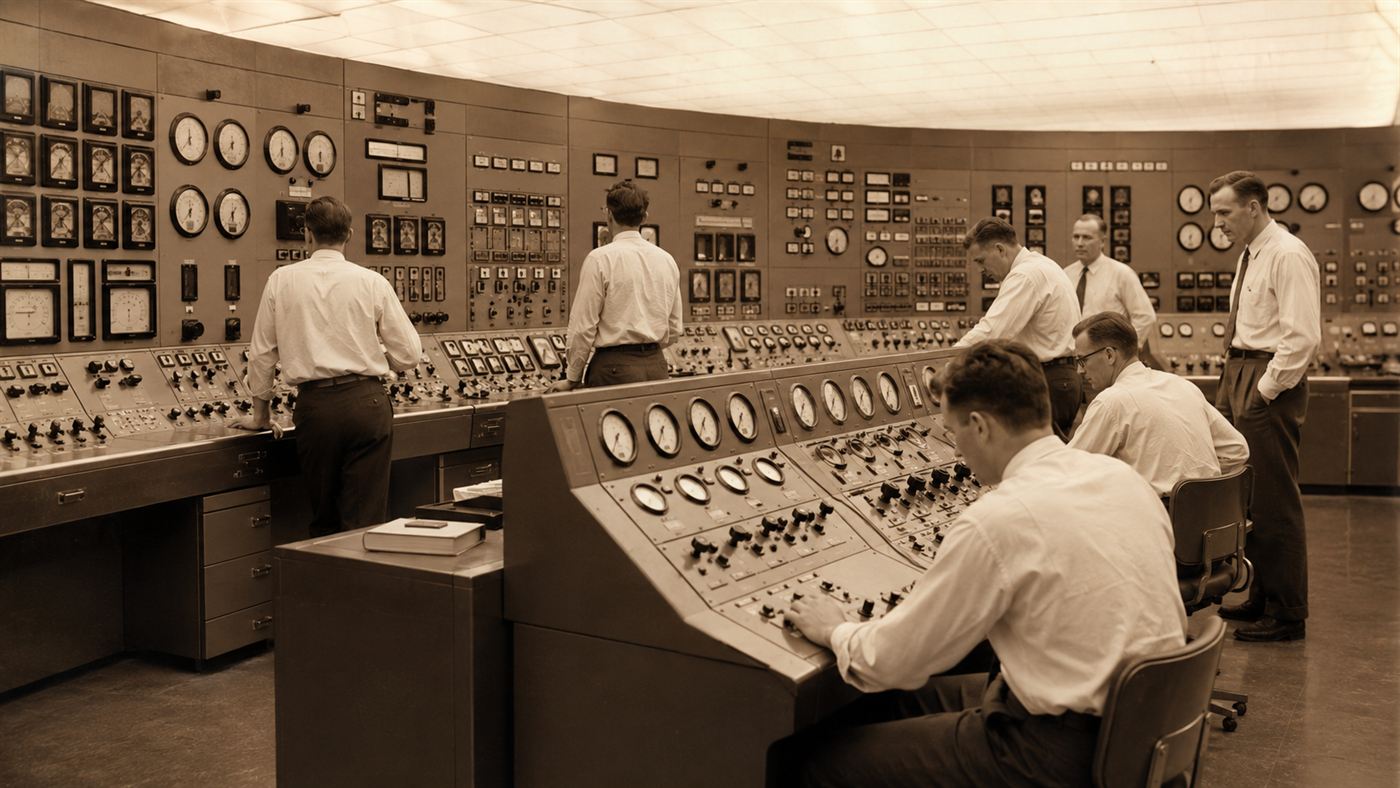
Shippingport made power until 1982, and then its most valuable chapter began. Building a reactor is one thing; taking one apart safely, once its guts are radioactive, is a problem the early atomic dreamers mostly waved away. Someone had to prove it could actually be done.
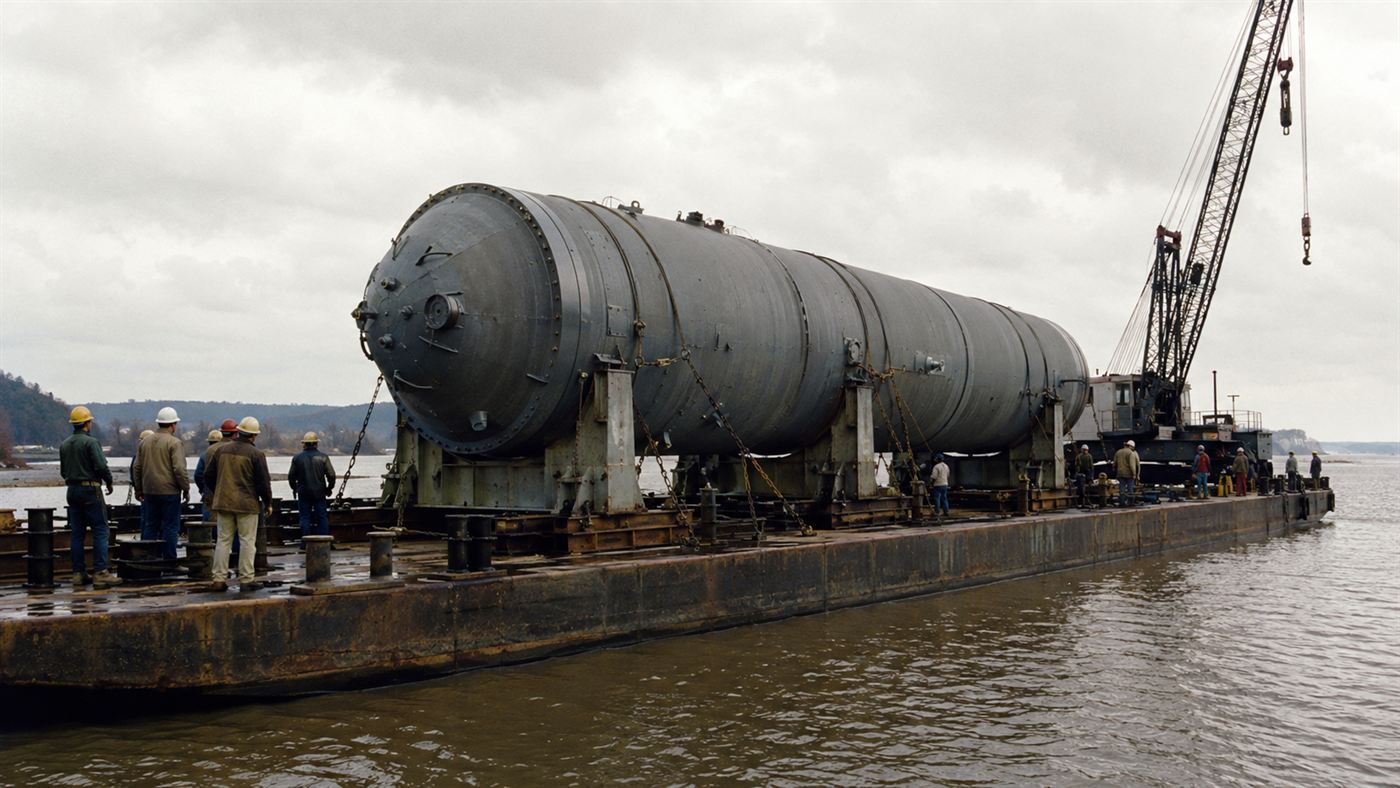
Between the mid and late 1980s, Shippingport became the first commercial-scale reactor in the country to be completely dismantled. The whole reactor pressure vessel was lifted out in one piece and sent on an extraordinary journey by barge, down rivers and around the coast, to be buried far away. When the crews finished, the site was cleared and released for ordinary use, as if the atom had never lived there.
How do you prove a reactor can be undone?
The decommissioning mattered far beyond one small plant. Every reactor ever built will one day have to be retired, and for decades that ending was a vague promise nobody had tested at full scale. Shippingport turned the promise into a finished job with a cost, a schedule and a cleared field at the end of it.
It made the whole life cycle of a reactor feel complete for the first time, birth to burial, rather than a machine that switches on and then becomes someone else's problem forever. For an industry haunted by the question of what it leaves behind, that quiet success may matter more than the famous switching-on ever did.
The honest catch
The heroic version calls Shippingport the birthplace of atomic power, and that needs trimming. Reactors in the Soviet Union and Britain were feeding civilian grids before it, so its true claim is narrower: the first full-scale station in the United States built purely for civilian power. And its DNA was a warship engine, driven as much by Cold War prestige as by the Atoms for Peace dream of cheap light.
Even the ending deserves an asterisk. Shippingport was small and relatively simple, so cleaning it up was never proof that any giant modern reactor can be erased as neatly. Still, the shape of the story is worth holding onto. We remember the plant for the morning it came alive, when the part that really moved the future forward was the unglamorous decades-later work of taking it cleanly away.
We celebrate the day the atomic age switched on, but the quieter miracle may be that we learned to switch it off and clean up after it. Does knowing a reactor can be fully removed change how you feel about building new ones? Tell us what you think in the comments.
Related reading: Three Mile Island, the accident that froze American nuclear power. See also the Hanford site, where the atom left a mess we are still cleaning, and the Niagara plant that first proved a new kind of power could work. See also Fermi 1, the breeder reactor that partly melted down near Detroit.