The Nebra sky disc is a 3,600-year-old bronze map of the heavens, a Bronze Age astronomical calendar found by looters and recovered in a police sting
A green-and-gold bronze disc the size of a dinner plate is the oldest known image of the cosmos, made in Europe some 3,600 years ago. The Nebra sky disc shows the sun, moon and stars, works as a calendar, and was dug up illegally before police recovered it in a sting.
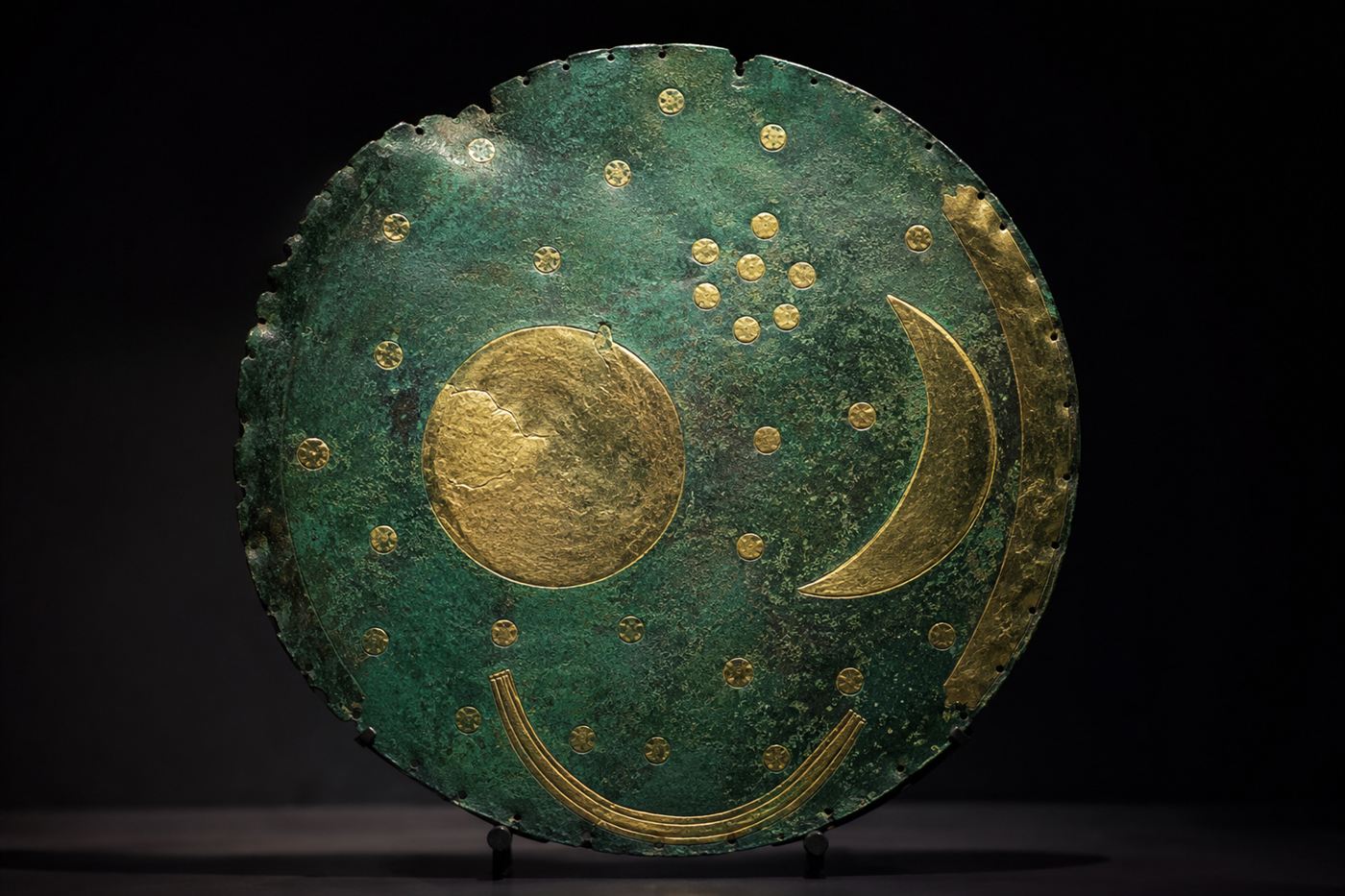
The Nebra sky disc, the oldest known depiction of the cosmos. Illustration: Watts & Wild.
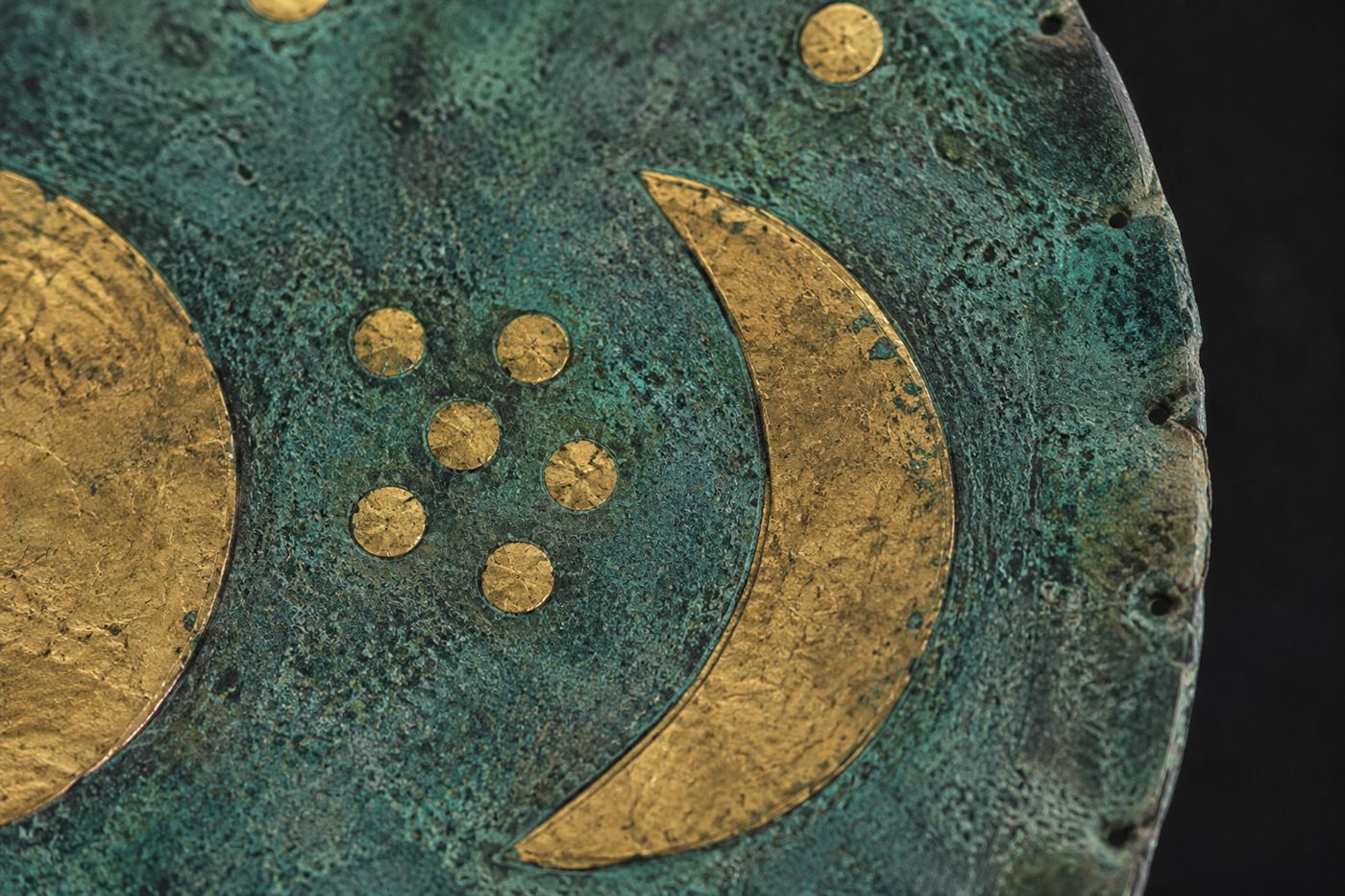
The Nebra sky disc does not look like much at first, until you realise how old it is and what it shows. It is a disc of bronze, about thirty centimetres across, its surface a deep blue-green from thousands of years in the ground, and scattered across that dark face are symbols cut from gold leaf: a large round disc, a crescent, and a sprinkling of small dots. It is, plainly, a picture of the night sky. And it was made around 1600 BCE, in the Early Bronze Age, which makes it the oldest known concrete image of the cosmos anywhere in the world.
That alone would make it precious, but the disc is more than a picture. As recognised by UNESCO, which placed it on its Memory of the World register, the Nebra sky disc is regarded as one of the most important archaeological finds of the twentieth century, because it seems to be not just art but a working astronomical instrument.
What is the Nebra sky disc? The Nebra sky disc is a bronze disc about 30 cm across, made around 1600 BCE in what is now Germany, and the oldest known realistic depiction of the cosmos. Its gold symbols show the sun or moon, a crescent, and stars including the Pleiades, and it worked as an astronomical calendar.
The Nebra sky disc, the oldest picture of the sky
Look closely at the Nebra sky disc and the night sky resolves out of the gold. There is a large circle, taken to be either the full moon or the sun, and beside it a clear crescent moon. Around them are dots representing stars, thirty-two of them visible today, and among those one tight little cluster of seven is almost certainly the Pleiades, the small knot of stars that has been one of the most recognised features of the night sky in nearly every human culture. Whoever made the disc was not inventing a decoration; they were recording specific things they had watched in the heavens.
That is what sets it apart from the abstract patterns and symbols of so much ancient art. The Nebra sky disc is a deliberate, accurate map of real celestial objects, laid down in gold by people who clearly studied the sky with care.
A calendar in bronze
The deeper marvel of the Nebra sky disc is that it appears to work as a calendar. Bronze Age people lived by two clocks that do not match: the year of the sun, which governs the seasons and runs to about 365 days, and the month of the moon, which runs to about 29 and a half. Twelve lunar months fall short of a solar year, so any calendar based on the moon slowly drifts out of step with the seasons unless it is corrected.
The disc seems to encode the rule for that correction. The way the slim crescent moon sits next to the Pleiades is thought to be a signal: when the real moon and the real Pleiades lined up in that particular way, it was time to add an extra, thirteenth month to the year to bring the lunar calendar back into line with the sun. Two gold arcs later added to the left and right edges mark how far along the horizon the sun moves between midsummer and midwinter, fixing the solstices. In a single hand-sized object, Bronze Age farmers had a tool for keeping their calendar honest and knowing when to plant and harvest.
Made in phases, traded across a continent
The Nebra sky disc was not made all at once. Study of it shows the symbols were added in stages over time, the horizon arcs and a curved band along the bottom coming later than the original sun, moon and stars, as if the instrument was updated and refined across generations. And the materials tell a story of their own: analysis suggests the gold came from Cornwall, in distant Britain, and the copper for the bronze from the Alps. A small object buried on a German hilltop turns out to connect a large slice of Bronze Age Europe through long trade routes, carrying gold and metal across a continent that supposedly had no writing and no maps.
Dug up by looters
For all its importance, the Nebra sky disc very nearly vanished into a private collection. It was found in 1999, not by archaeologists but by two treasure hunters using a metal detector illegally on the Mittelberg hill near the town of Nebra, who unearthed it alongside a hoard of Bronze Age swords, axes and ornaments. Rather than report the find, they sold it on the black market, and over the next few years it passed quietly from one dealer to another, its origins blurred and its scientific context lost.
Recovered in a sting
The disc was saved by something closer to a crime thriller than an excavation. In 2002, the state archaeologist Harald Meller arranged to meet sellers in a hotel in Basel, Switzerland, posing as a private buyer prepared to pay a fortune for the Nebra sky disc. When the artefact was produced, police moved in and seized it. The finders and dealers were prosecuted, and the disc went where it belonged, to the State Museum of Prehistory in Halle, Germany, where it is now the centrepiece. The oldest map of the sky in the world had been recovered in an undercover sting.

The honest catch
Some caution is fair. A good deal of what is said about the Nebra sky disc, especially the detail of how it worked as a calendar, is careful interpretation rather than certainty, and scholars still argue over it; a few have even suggested the disc could be centuries younger than the standard date, though metallurgical studies and most experts continue to place it in the Early Bronze Age. And because it was looted rather than properly excavated, the precise context that would help settle these questions was damaged, a real loss caused by the way it came to light. Authenticity questions are a constant in archaeology, as the notorious Piltdown Man fossil hoax showed.
But strip away the uncertainties and the heart of it stands firm. More than three and a half thousand years ago, people in central Europe looked up, understood enough about the movements of the sun, moon and stars to keep a calendar by them, and pressed that knowledge into gold and bronze. The Nebra sky disc is the moment humanity's long conversation with the night sky first becomes a thing you can hold in your hand.
A 3,600-year-old map of the night sky in gold and bronze, almost lost to looters and saved by a sting. What would you most want to ask the person who made it? Tell us in the comments.
Related reading: The Antikythera mechanism, a later and even more intricate machine for tracking the heavens.