The diving bell spider lives its entire life underwater, breathing from a bubble of air it spins into a silk bell that works like a gill
The diving bell spider is the only spider on Earth that spends its whole life beneath the water. It builds a dome of silk, fills it with air carried down from the surface, and lives inside this glittering bubble, which quietly pulls fresh oxygen from the water like a gill.
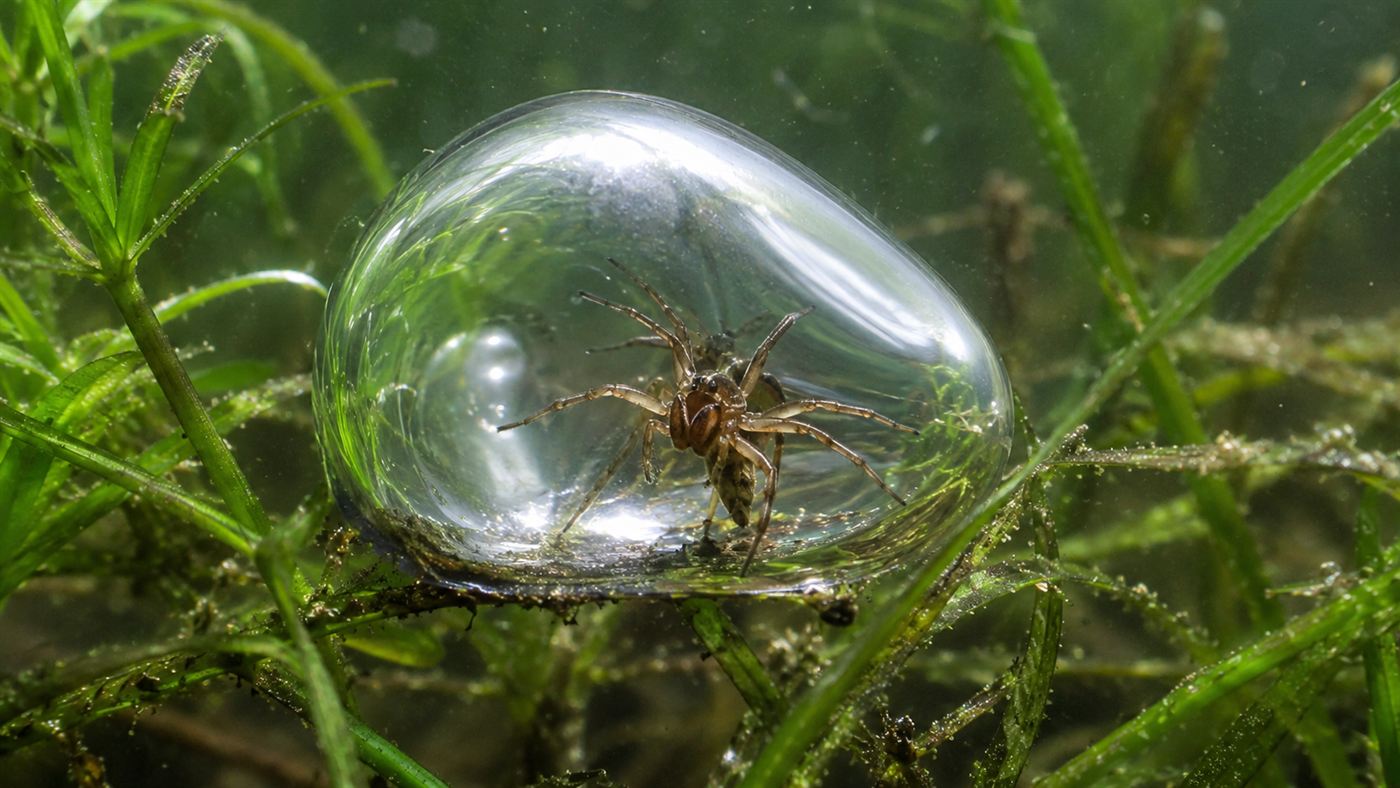
A diving bell spider in its silvery dome of air beneath the water. Illustration: Watts & Wild.
The diving bell spider should not really be possible. Spiders breathe air, like us; they have no gills, and drowning is as much a danger to them as it is to any land animal. And yet there is one spider, found in the cool freshwater ponds and slow streams of Europe and Asia, that has solved the problem so completely that it spends its entire life submerged, coming to the surface only to fetch the one thing it cannot make underwater: a fresh breath of air.
Its scientific name, Argyroneta aquatica, hints at how it looks down there. As Britannica describes, the spider traps a silvery film of air against its body, so that underwater it gleams like a droplet of mercury moving among the weeds. That trapped air is the secret to everything it does, and the spider has learned to turn it into a home.
How does the diving bell spider breathe underwater? The diving bell spider builds a dome of silk underwater and fills it with air carried down from the surface. The bubble works as a physical gill: oxygen from the water diffuses in as the spider breathes, letting it stay submerged for over a day before topping up the air.
The diving bell spider, the only one that lives in water
Plenty of spiders can tolerate a dunking, and a few hunt at the water's edge, but only the diving bell spider has made the water its permanent home. It hunts there, eating aquatic insects, larvae and tiny crustaceans. It mates there. The female lays her eggs there and guards them there, and the young grow up beneath the surface. For this one species, the pond is not a hazard to be survived but the whole of the world.
That makes it unique among the roughly fifty thousand known kinds of spider. All the others are, in the end, creatures of the air and the land. This one quietly broke the rule, and it did so not by growing gills or learning to breathe water, but by becoming, in effect, a tiny engineer.
Building a bubble to live in
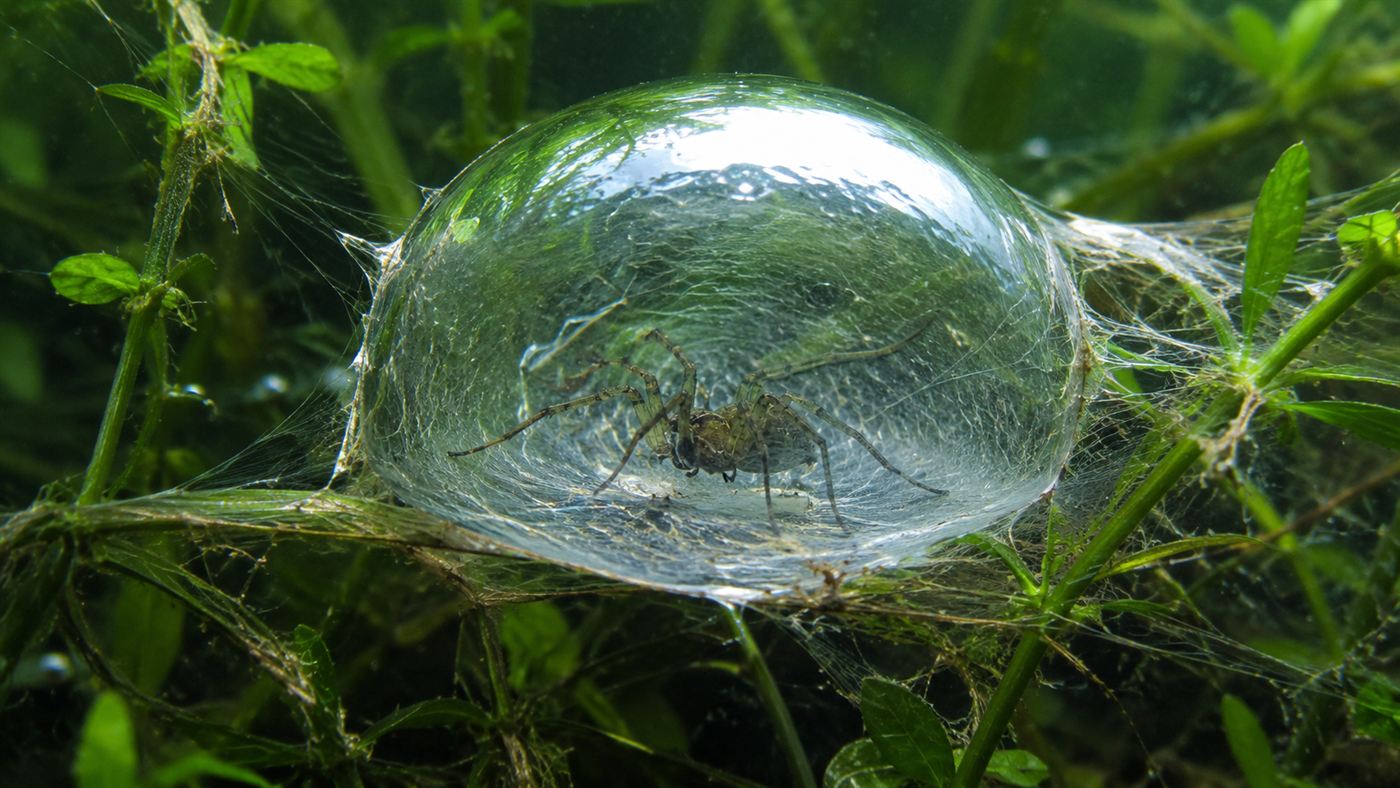
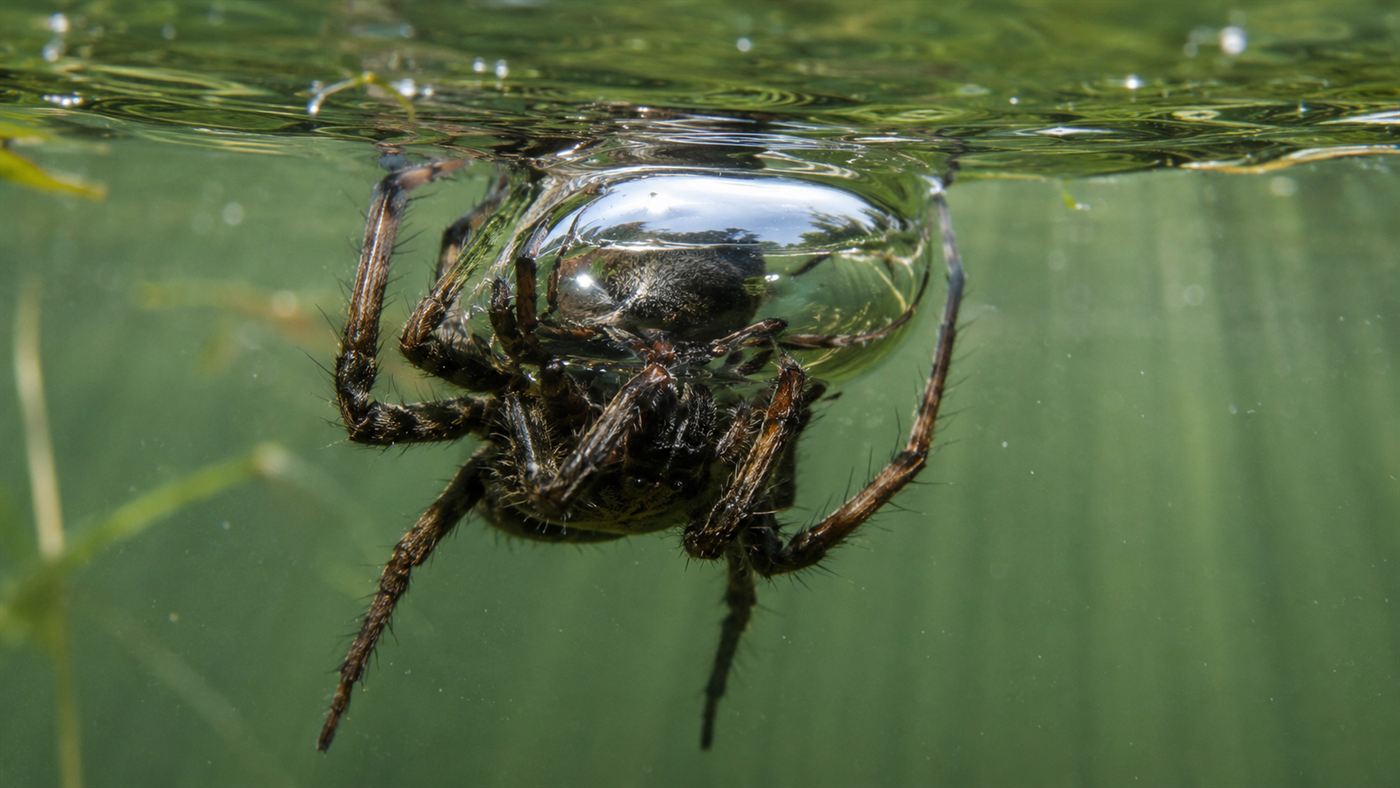
The structure that gives the spider its name is a small dome of silk, spun among underwater plants and anchored to their stems. On its own this dome is just an empty net. To make it a home, the diving bell spider swims up to the surface, pokes through, and traps a glistening pocket of air against the dense hairs on its abdomen and legs. Then it carries that stolen bubble back down, slips beneath the silk dome, and releases it, so the air rises and collects under the roof of the web.
Trip after trip, the spider ferries air down from above until the dome swells into a shining bell of trapped atmosphere, a pocket of breathable air held underwater by nothing more than silk and surface tension. Inside it, the spider can sit in the dry, breathing comfortably, completely surrounded by water. It is a diving bell in the most literal sense, built by an animal smaller than a coin.
A bubble that breathes
Here is where the story turns from charming to genuinely remarkable. You might assume the bell is simply a tank, a finite store of air that runs down until the spider must refill it. It is far cleverer than that. The bubble behaves as a physical gill. As the spider uses up the oxygen inside, the oxygen level in the bell drops below the level dissolved in the surrounding water, and so fresh oxygen diffuses inward, out of the pond and into the bubble, while the carbon dioxide the spider breathes out diffuses away into the water.
In other words, the bell quietly recharges itself with oxygen straight from the pond, the same way a fish's gill does. The spider still has to renew the bubble now and then, because the nitrogen in it slowly leaks away and the dome shrinks, but the oxygen supply is largely self-sustaining. In well-oxygenated water it can stay sealed inside for more than a full day before it needs to visit the surface at all.
How we know: oxygen sensors in a bubble
For a long time this was suspected but hard to prove, until two scientists, Roger Seymour and Stefan Hetz, decided to measure it directly. Working with diving bell spiders in the laboratory, they slid tiny oxygen sensors into the bells themselves and watched the gas levels rise and fall as the spiders breathed.
What they found confirmed the bubble was a working gill. Even in warm, stagnant water, the conditions in which dissolved oxygen is scarcest and a physical gill works least well, the bell pulled in enough oxygen to cover a resting spider's needs, and the animal only had to rebuild it about once a day. A pocket of air, a roof of silk, and the simple physics of diffusion added up to a life-support system good enough to live in.
Living upside down beneath the surface
Life in the bell has its own quiet logic. The diving bell spider waits in or near its dome, alert to the vibrations of passing prey, then darts out to seize an insect or a larva and drags it back inside to eat in the dry. Unusually for spiders, the males tend to be larger than the females, probably because they roam and hunt more actively through the water and a bigger body helps them swim. The whole drama of a spider's life, the hunting and feeding and courtship, plays out in this upside-down world of bubbles and silk, just below a surface most of us would never think to look beneath.
The honest catch
A little realism keeps the wonder grounded. The bell's gill trick depends on there being oxygen in the water to draw on, so in foul, warm, stagnant ponds where the water itself is starved of oxygen, the spider has to surface far more often, and life gets harder. And it is worth being clear that the spider is not breathing water; it is still an air-breather, and the bubble simply tops itself up with oxygen by diffusion. It has not escaped its lungs, only outsmarted them.
But none of that diminishes the achievement. Out of fifty thousand spiders, exactly one has worked out how to live a full life underwater, and it did it with the oldest tools a spider has, silk and patience, plus a quiet understanding of how gases move. The diving bell spider turned a bubble into a house, a diving suit and a gill all at once, and then moved in for good. It is one of the neatest pieces of engineering in the animal world, and it is happening, right now, in a pond near you.
A spider that builds a bubble, breathes from it like a gill, and lives its whole life underwater. Would you call that creepy or brilliant, or a little of both? Tell us in the comments.
Related reading: The mantis shrimp, whose punch boils the water into a flash of light.