Florida's endangered manatees survive winter only by huddling in a power plant's warm wastewater, and the clean-energy switch could leave them out in the cold
Every cold snap, hundreds of manatees abandon the open bay and pile into the warm water gushing out of Florida's power stations. It is one of the strangest alliances in American wildlife: an endangered animal that now depends on a fossil-fuel plant to live through the night, and a wildlife agency that once broke its own oldest rule to keep them fed.
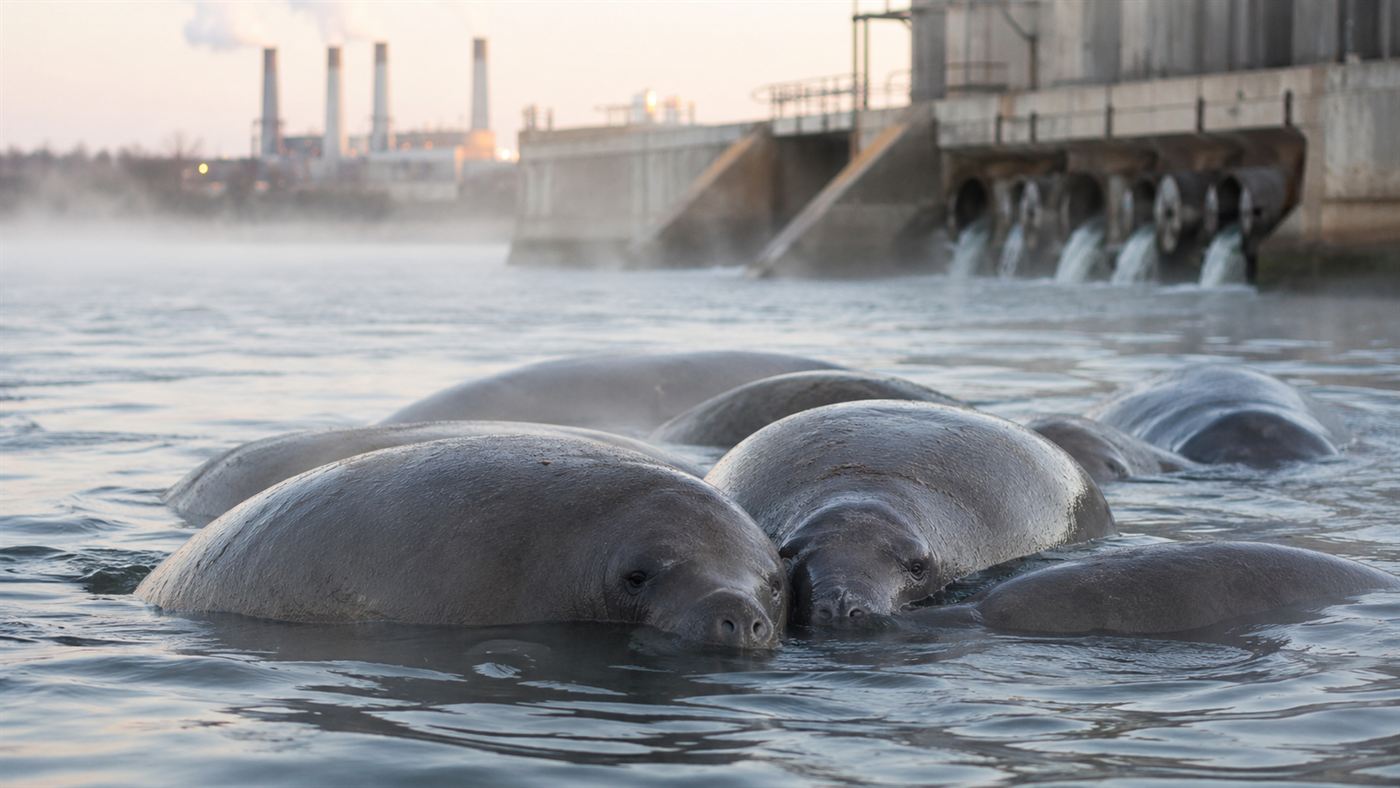
When the bay turns cold, manatees crowd into the warm discharge canal of a power plant. Illustration: Watts & Wild.
For a few weeks each winter, the canal beside the Big Bend Power Station near Tampa fills with rounded gray backs. The link between these manatees and the power plant is no accident of scenery. The animals are there because the water is warm, and the water is warm because a generating station is dumping its cooling heat straight into the sea.
The bond is now so deep that more than half of Florida's manatees rely on it. According to Florida's wildlife agency, during the coldest spells about 60% of all manatees in the state gather at roughly ten power plants, while another 15% crowd into four natural springs. Take the plants away and you take away winter shelter for thousands of an endangered species.
How manatees got hooked on a power plant
Manatees are tropical animals living at the cold edge of their range. They have almost no body fat for insulation, and once water drops below roughly 68 degrees Fahrenheit they start to suffer cold stress, a slow, miserable failure of the gut and immune system that can kill them over days or weeks.
Before the grid existed, they survived Florida winters by retreating to natural springs that bubble up at a constant 72 degrees. Then, through the 1950s and 60s, utilities began building coastal plants that spat out warm water all year. As National Geographic has reported, manatees found these artificial warm pockets and never left, and over generations the herds learned to treat a chimney and a discharge pipe as home.
At Big Bend the outflow can run as hot as 109 degrees, far above the mid-80s of the surrounding bay. The utility leaned into it, opening a Manatee Viewing Center in 1986 that has since drawn around six million visitors who come to watch wild sea cows loaf in the industrial runoff.
The winter biologists broke their oldest rule
The fragility of all this showed up in the worst way starting in late 2020. Pollution had triggered enormous algae blooms in the Indian River Lagoon on Florida's Atlantic coast, and the seagrass that manatees graze on simply died off across huge stretches of water. The animals kept coming to their warm-water refuges in winter, but there was nothing left to eat.
What followed was declared an Unusual Mortality Event. Between December 2020 and April 2022, Florida documented 1,255 manatee deaths, roughly a tenth of the entire state population, most of them starved. Necropsies found animals that had burned through their own muscle.
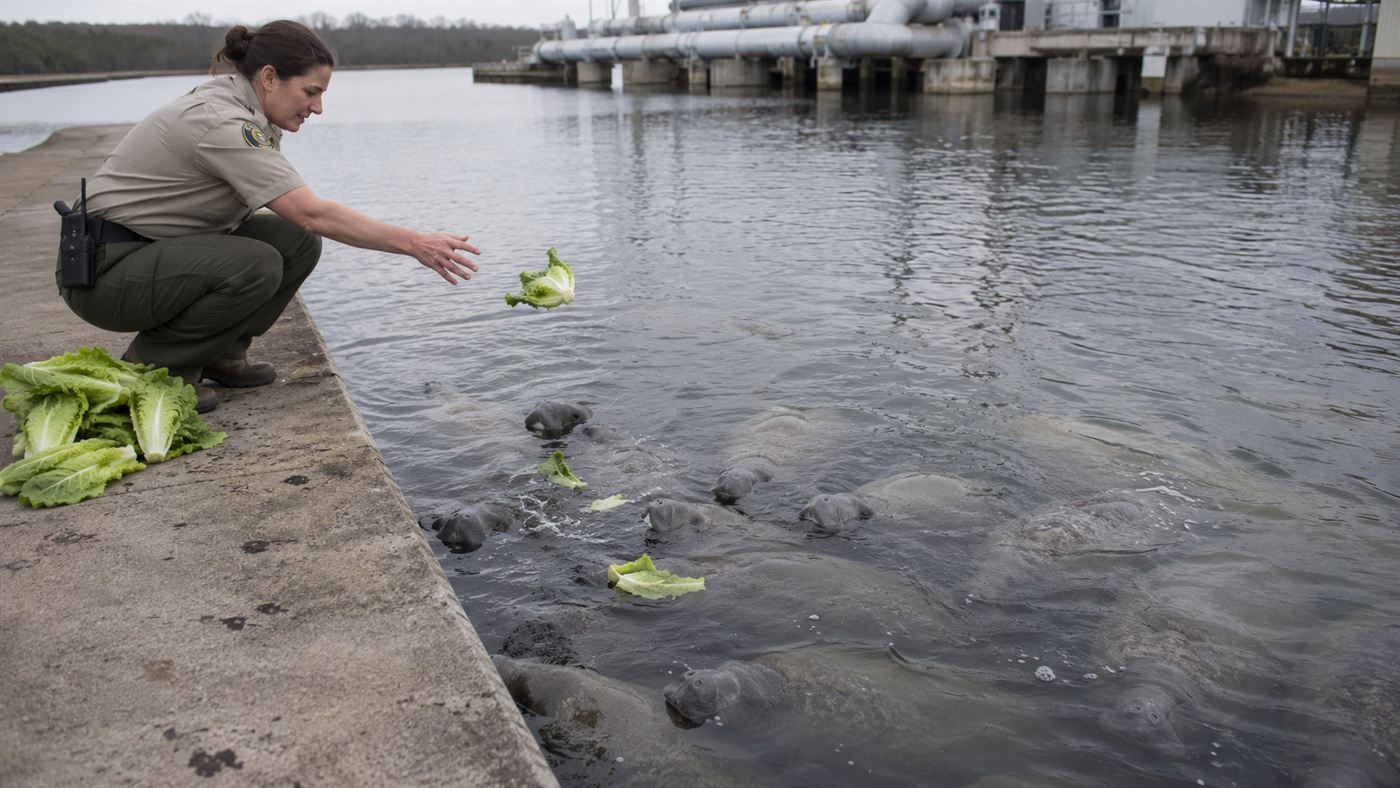
So state and federal biologists did something they had spent their whole careers warning the public never to do: they fed wild animals by hand. From a pier beside a Florida Power & Light plant they threw in tons of romaine and butterleaf lettuce, an emergency soup kitchen for a starving species. It cut against every instinct of wildlife management, and they did it anyway because the alternative was watching the herd die in the warm water that was supposed to save it.
What happens when the power plants switch off
Here is the twist that keeps Florida's biologists up at night. The same fossil-fuel plants that warm the climate are the only thing keeping these manatees warm in winter, and the state is now trying to retire them. Big Bend has been shutting down its coal units, and over the coming decades cleaner generation and more efficient cooling will mean less waste heat poured into the sea.
That is good for the planet and potentially fatal for an animal that forgot how to find a spring. Many of the natural warm-water sites manatees once used have been drained, paved over, or pumped dry for drinking water. You cannot simply switch off a power plant in January and trust thousands of manatees to remember a refuge their great-grandparents abandoned sixty years ago.
Wildlife managers are trying to thread the needle: protecting and reconnecting natural springs, studying ways to provide warm water without a smokestack, and timing any shutdowns around the cold months. Nobody has solved it. The manatee is, in a very literal sense, an endangered species that the energy transition has to plan around.
Why do manatees gather at power plants in winter?
Because they cannot survive the cold. Manatees suffer potentially lethal cold stress once water falls below about 68 degrees, and a working power plant pumps out warm cooling water all winter long. That warm discharge becomes a lifeboat, and the animals pack into it whenever a cold front sweeps down the peninsula.
How many manatees died in the 2021 die-off
Florida recorded 1,255 manatee deaths during the Unusual Mortality Event between December 2020 and April 2022, around 10% of the population. As the Tampa Bay Times has reported in its coverage of the warm-water crisis, the deaths were driven by starvation after seagrass collapsed, a separate problem from the warm water, but one that exposed how thin the margin has become.
The honest catch
It would be neat to say the power plants alone are villain or savior, and they are neither. The 2021 starvation crisis was caused by water pollution and seagrass loss, not by the plants themselves, and feeding lettuce was an emergency stopgap that officials stress is not a long-term fix. Florida's wildlife commission is candid that the dependence on industrial warm water is a problem to be managed, not celebrated. The deeper truth is uncomfortable: a wild animal has been quietly bent around human infrastructure, and untangling it without killing the animal is genuinely hard.
An endangered animal that now leans on a power plant to live through winter is a strange, fragile thing to build a recovery on. Should Florida keep some warm-water plants running just for the manatees, or work harder to wean them back onto wild springs? Tell us what you think in the comments.
Related reading: In California, a different animal is quietly rebuilding wetlands that engineers struggled to fix.