An engineer saved the Leaning Tower of Pisa from collapse by doing the one thing that sounds insane, digging soil out from under its higher side until it leaned back
For 800 years the Leaning Tower of Pisa had been tipping a little further each decade, and by 1990 it was closed to the public, judged to be on the edge of falling over. The man asked to save it chose a fix that sounded like madness.
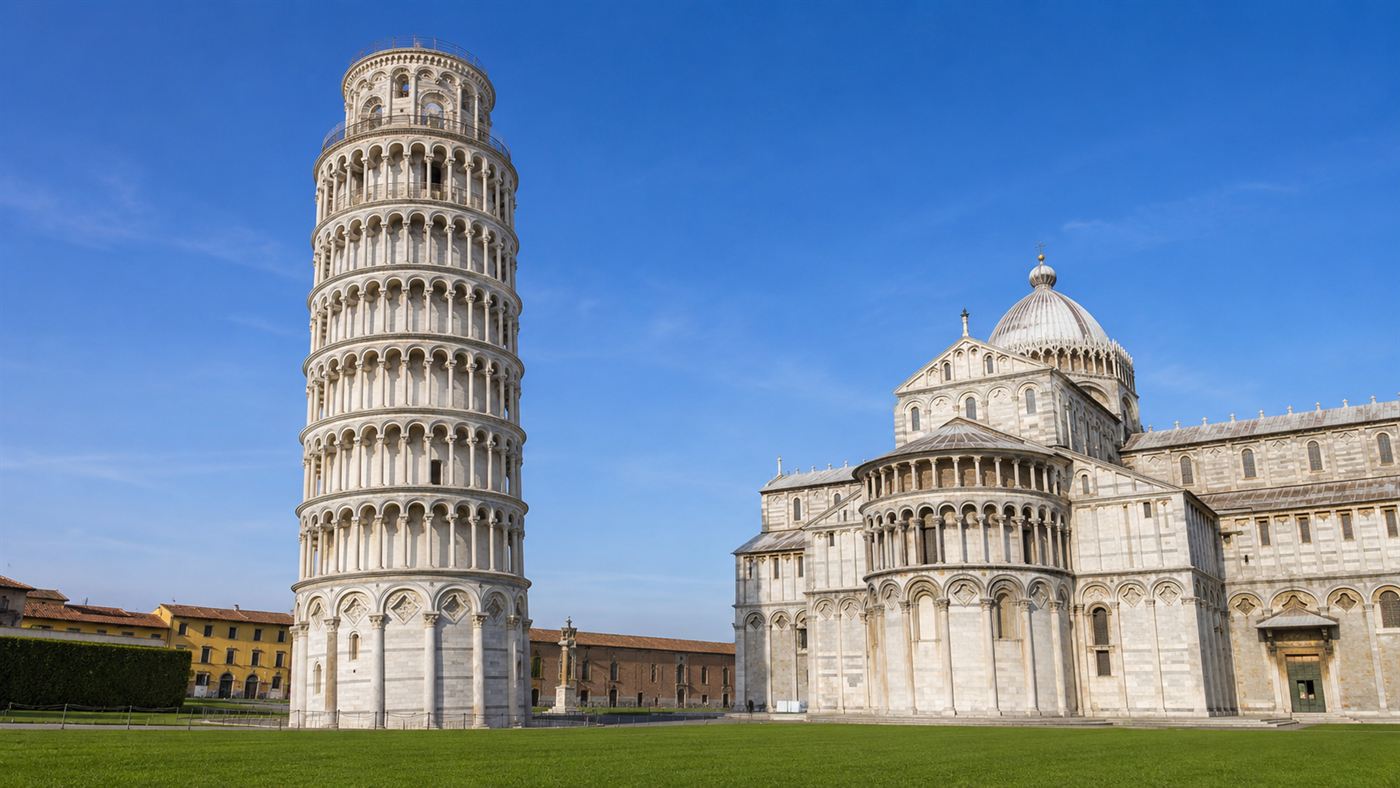
The most famous mistake in architecture, tilting over the Piazza dei Miracoli. Illustration: Watts & Wild.
The Leaning Tower of Pisa is famous for being wrong. It was never meant to lean at all. The white marble bell tower started tilting almost as soon as builders began stacking it in 1173, because the soft, soggy ground beneath Pisa could not carry its weight evenly. Eight centuries later, that charming flaw had quietly turned into a slow-motion emergency.
By 1990 the tilt had reached about 5.5 degrees and was still creeping a little more every year. Italian authorities closed the tower to visitors, genuinely afraid it could one day topple and kill someone in the crowded square below. To stop that, they turned to a British geotechnical engineer named John Burland and a commission of 13 experts. As Burland later wrote in the engineering journal Ingenia, the goal was never to straighten the tower, only to pull it back just enough to make it safe without ruining the very thing that makes it famous.
How was the Leaning Tower of Pisa saved? Engineers led by John Burland slowly removed small amounts of soil from beneath the higher north side of the foundation, letting the tower settle gently back toward vertical. The method, called soil extraction or underexcavation, recovered about 50 centimeters of lean and made the tower stable for centuries.
Why is the Leaning Tower of Pisa leaning?
The fault was in the ground, not the design. Pisa sits on layers of soft clay and fine sand laid down by old rivers, soaked with water and easily squeezed. The tower's foundation was barely three meters deep, far too shallow for a structure that would eventually weigh some 14,500 tonnes, and as the masons added each new storey the south side sank faster than the north. The tower was tilting before it was even half built.
Oddly, the thing that saved it for 800 years was war. Construction stopped twice for decades at a time while Pisa fought its neighbors, and those long pauses let the squeezed clay slowly settle and strengthen before more weight went on. The medieval builders also tried to correct the lean as they went, making the upper floors slightly taller on the low side, which is why the Leaning Tower of Pisa is not straight even as a stack: it is faintly banana-shaped.
The fixes that only made it worse
Pisa's tilt has tempted meddlers for centuries, and most made things worse. In 1934, on Mussolini's orders, workers drilled holes in the base and pumped in tonnes of cement grout to lock the foundation in place. Instead of steadying the tower, the injection disturbed the ground and the tower lurched further over. It was a lesson later engineers took to heart: the soil under Pisa punishes anything sudden.
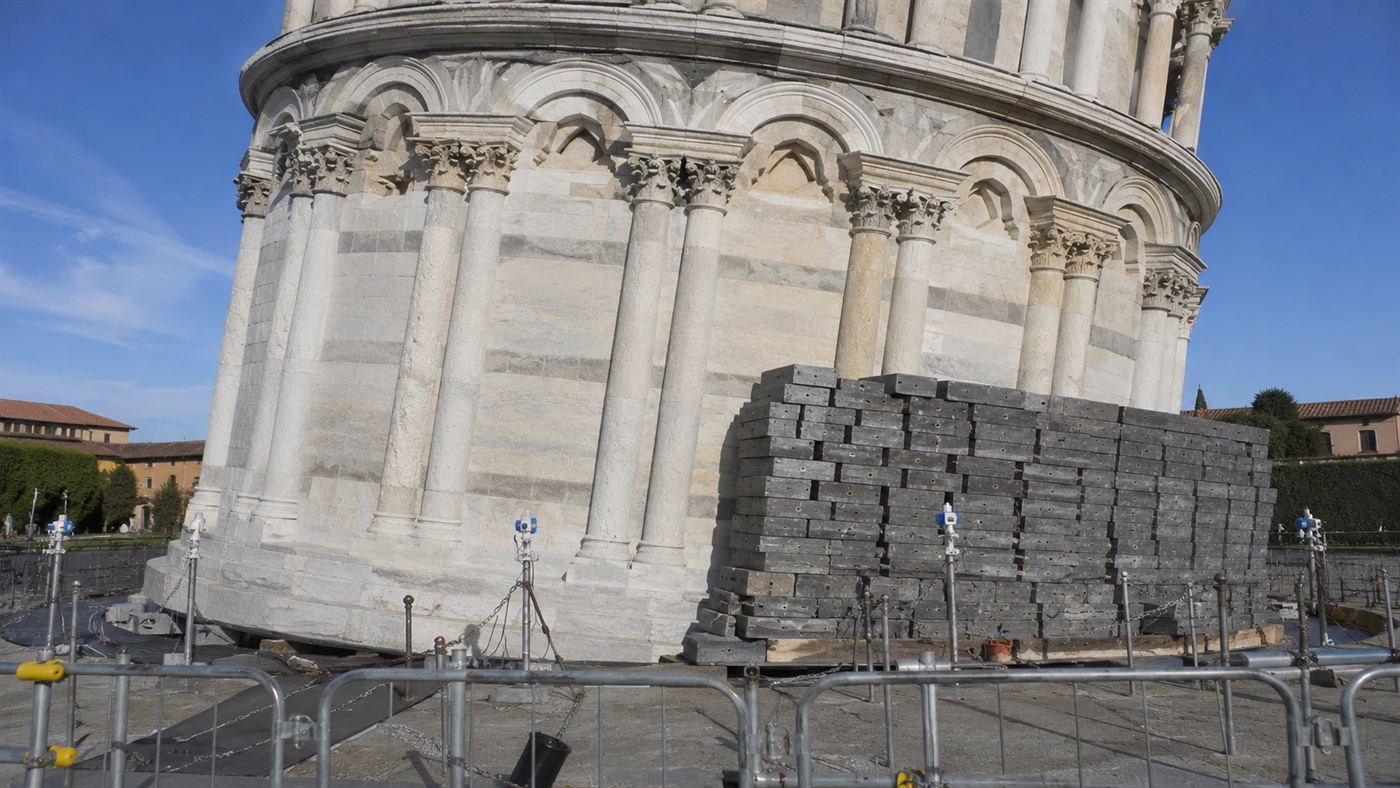
When Burland's commission began its work, the tower was so close to the edge that they needed an emergency brake before they could attempt any real cure. Their answer was almost comically blunt: they stacked around 600 tonnes of lead ingots on the high north side of the base, a giant counterweight to hold the lean in check. It was ugly, and it was never the plan, but it bought the time the team needed to test something far more delicate.
John Burland and the idea that sounded insane
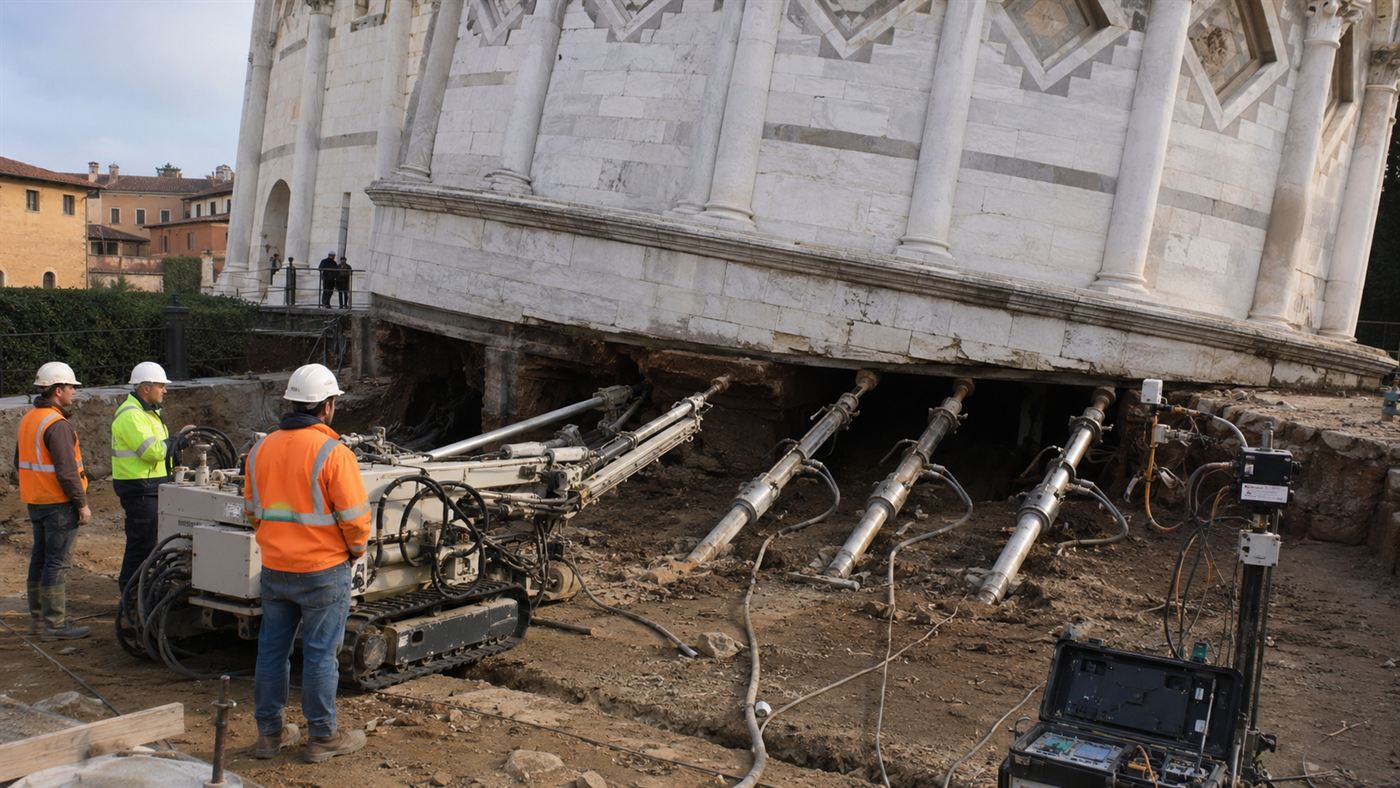
The real cure was the opposite of force. John Burland championed a method called soil extraction, and on paper it sounds backwards. To stop a tower from falling toward the south, you very gently dig ground out from underneath its north side. Long drilling tubes were angled in beneath the high edge of the foundation, and an auger pulled out small scoops of soil, a few liters at a time, leaving tiny cavities. The ground above slowly sagged into them, and the whole tower followed it, settling back toward upright by a hair.
Everything about it was deliberate and painfully slow. The soil was removed millimeter by millimeter over months, while hundreds of sensors watched the tower's every twitch and the team stood ready to stop at the first sign of trouble. It was the gentlest possible way to nudge 14,500 tonnes of marble. Where Mussolini's men had attacked the problem, Burland's coaxed it, working with the soft ground instead of against it.
How much did they straighten it?
Not much, and that was the point. The work recovered roughly 50 centimeters at the top of the tower and cut the lean by about 10 percent, bringing it back to around 4 degrees, near where it had stood two centuries earlier. To a tourist standing in the square, the tower looks exactly as crooked as it always did. The commission handed the Leaning Tower of Pisa back to the city in 2001, and it reopened to visitors that December after 11 years closed.
Crucially, nobody tried to make it straight. The lean is the whole reason millions of people travel to Pisa, prop their hands against the sky in photographs, and keep the city's economy alive. Burland's team only needed to buy safety, not symmetry, and their tower stabilization is expected to hold for at least 200 years. They saved a mistake on purpose, because the mistake was the masterpiece.
The honest catch
It is worth being honest that the tower was stabilized, not permanently fixed. The soft clay that started the problem is still down there, and Pisa will keep monitoring the tower with sensors for the rest of its life, ready to extract a little more soil if the lean ever resumes. Stable for two centuries is a triumph, but it is not forever.
The deeper lesson is about humility in front of old ground. The smartest move of the whole project was knowing what not to do: not to inject, not to anchor, not to wrench a fragile 800-year-old structure into line. The fix that worked was the slowest, softest, least dramatic one available, which is rarely the instinct on a job where the world is watching and the thing might fall down tomorrow. Engineers faced the same glare of publicity when London's Millennium Bridge began to sway and had to close two days after it opened.
A team of engineers stopped one of the world's most famous buildings from falling, not by propping it up, but by quietly digging the ground out from under its high side. Would you have trusted a plan that fixes a falling tower by removing its support? Tell us what you think in the comments.
Related reading: The Japanese airport built on an artificial island that engineers always knew would keep sinking into the sea.