Dubai is about to launch the world's first electric air taxi service, flying four passengers across the city in a quiet six-rotor aircraft that turns a 45 minute drive into a 12 minute flight
The flying car has been five years away for about fifty years. Now, after piloted test flights over Dubai in 2025, the American company Joby plans to start carrying passengers across the city in 2026, in an electric air taxi that lifts straight off the ground and makes almost no noise.
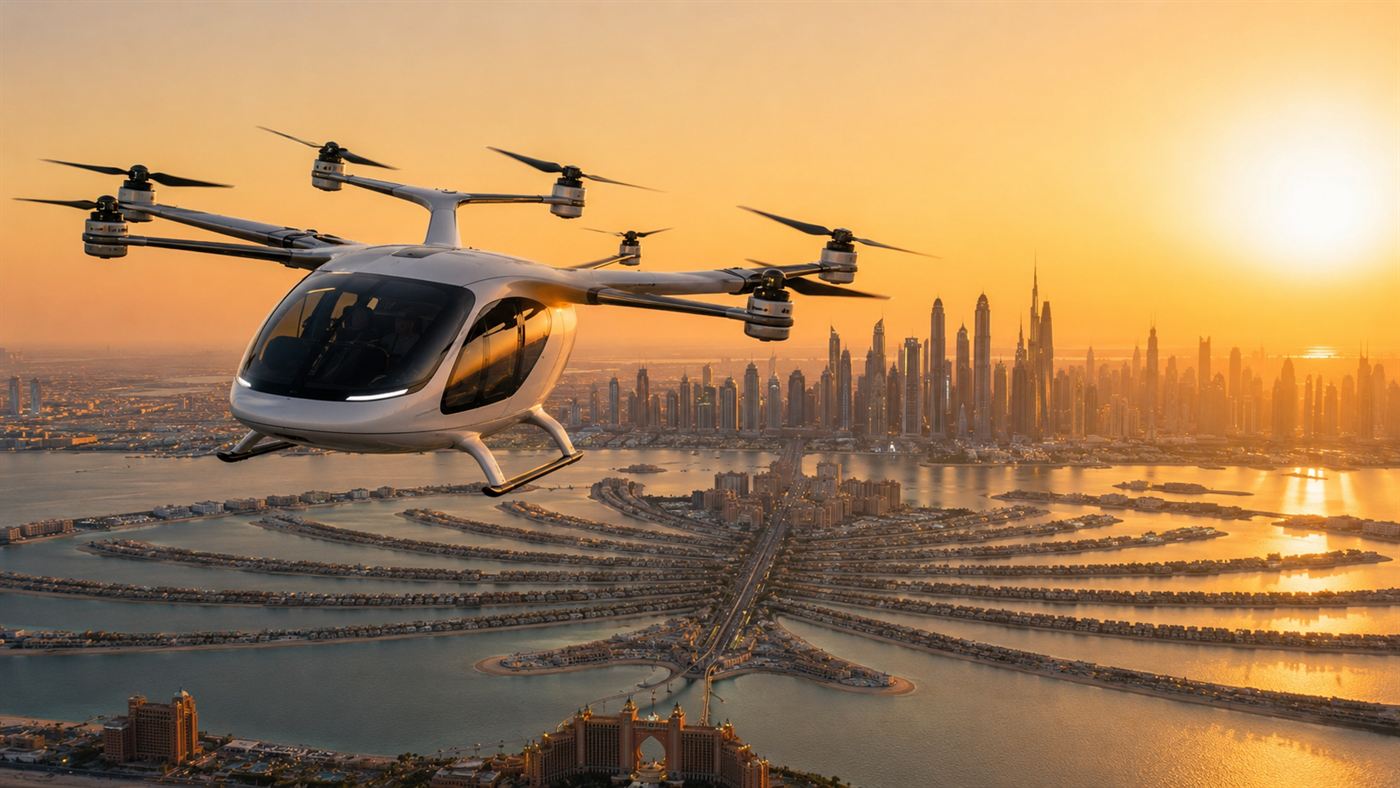
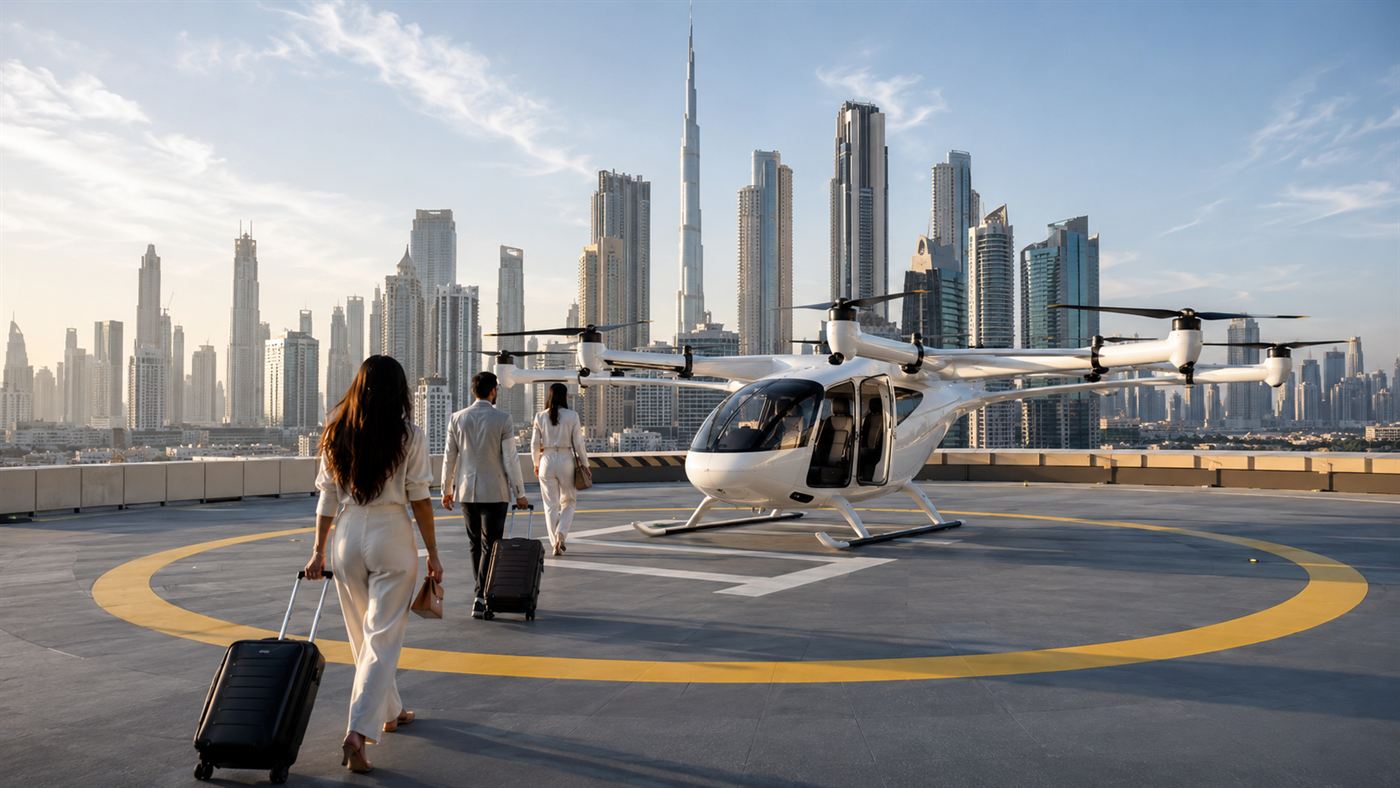
Joby's electric air taxi is built to cross a city in minutes, not an hour. Illustration: Watts & Wild.
For as long as there have been cars, people have been promised the flying kind, and for just as long it has stayed a cartoon fantasy. What changed is the battery. Cheap, powerful electric motors and dense battery packs, the same technology now in millions of cars, have quietly made a small aircraft possible that can take off like a helicopter, fly like a plane, and do it on electricity alone. That machine is called an eVTOL, for electric vertical take-off and landing, and one of them is about to start work over Dubai.
The company behind it is Joby Aviation, and in 2025 it crossed a line that the whole industry had been chasing. As Joby announced after its flights in the emirate, it became the first company to fly a piloted electric air taxi on a real point-to-point route in the United Arab Emirates, a 17 minute hop from its test base to Dubai's second airport. The next step is passengers.
Half helicopter, half drone, all electric
Joby's aircraft looks like something between a small plane and an oversized drone. It carries a pilot and up to four passengers, and it flies on six electric rotors that tilt. For take-off and landing the rotors point up, so the aircraft rises straight off a pad with no runway. Once it is in the air, they swivel forward and it cruises like a fixed-wing plane at speeds of up to about 320 kilometres per hour.
Because it runs on electric motors rather than a screaming turbine, it is strikingly quiet, which is the whole point for a machine meant to fly over rooftops. It produces no exhaust in flight, and with far fewer moving parts than a helicopter it should be cheaper to maintain. This is the same logic that drove the electric car, simply lifted into the sky: replace the noisy, fuel-hungry engine with quiet motors and a battery, and a lot of old problems fall away.
Why Dubai gets the first electric air taxi
It is no accident that the first electric air taxi network is launching in Dubai rather than New York or London. The city has gone all in. According to IEEE Spectrum's report on the rollout, Joby has signed an exclusive six-year agreement with Dubai's Roads and Transport Authority and is working with the firm Skyports to build four vertiports, the small airports these aircraft need, at Dubai International Airport, Dubai Mall, the Atlantis resort on the Palm, and a university campus.
The promise that makes people pay attention is time. The trip from Dubai International Airport to the Palm Jumeirah, which can crawl past 45 minutes by car in traffic, is meant to take about 12 minutes by air. Anthony Khoury, Joby's general manager in the UAE, said Dubai is "on track to be the first city in the world to offer a fully integrated, premium air taxi network." A flat, sprawling, wealthy city with brutal road congestion and a government willing to move fast is close to the ideal first customer.
The honest catch
It is worth slowing down before declaring the age of the flying taxi has arrived. For all the test flights, Joby still does not have full type certification from America's aviation regulator, the FAA, which it needs before it can fly paying passengers at home. It has reached an advanced stage of that process, but certifying a brand-new kind of aircraft as safe is slow and unforgiving work, and the timelines have slipped before.
There is also the question of who this is really for. At launch these flights will be a premium product, closer to a helicopter charter than a bus fare, so the first riders will be paying for speed and novelty, not commuting cheaply. And a handful of aircraft hopping between four pads is a long way from rebuilding how a whole city moves. The technology is real and the Dubai launch is genuine, but a quiet revolution in the sky will be measured in years, not in a single ribbon-cutting.
Why a flying taxi finally matters
Strip away the science-fiction shine and the interesting part of the eVTOL is what it shares with the electric car. The same falling battery costs and quiet, reliable motors that put electric cars on the road are now cheap and good enough to lift a small aircraft, which is why a fantasy that never worked with petrol engines suddenly works with batteries. The flying taxi is not a break from the electric revolution. It is the electric revolution leaving the ground.
Whether you will ever ride one depends on a lot of things still unproven, the cost, the certification, the public's nerve about flying without a runway. But the picture of a quiet electric aircraft lifting off a rooftop and crossing Dubai in 12 minutes is no longer a render or a promise. In 2026, with real passengers aboard, we will find out whether the flying car was always just waiting for a better battery. Would you climb into a pilot-flown electric air taxi over a city, or does the idea still feel a step too far? Tell us what you think in the comments.
Related reading: The world's largest electric ship is a passenger ferry built to carry 2,100 people across the river between Argentina and Uruguay on 250 tonnes of batteries instead of a drop of diesel. For another bold bet on how we fly, see Concorde, the supersonic airliner the world built and then gave up.