Crossing to central Stockholm by boat once ate an hour of the day, so Sweden put commuters on an electric ferry that rises onto underwater wings and flies above the water, halving the trip on 80 percent less power
Since late 2024 a strange-looking white ferry has carried commuters across the water into central Stockholm on the world's first electric hydrofoil ferry line. It lifts clear of the surface on computer-controlled wings, crosses in about 30 minutes instead of an hour, and burns a fraction of the energy an ordinary ferry would.
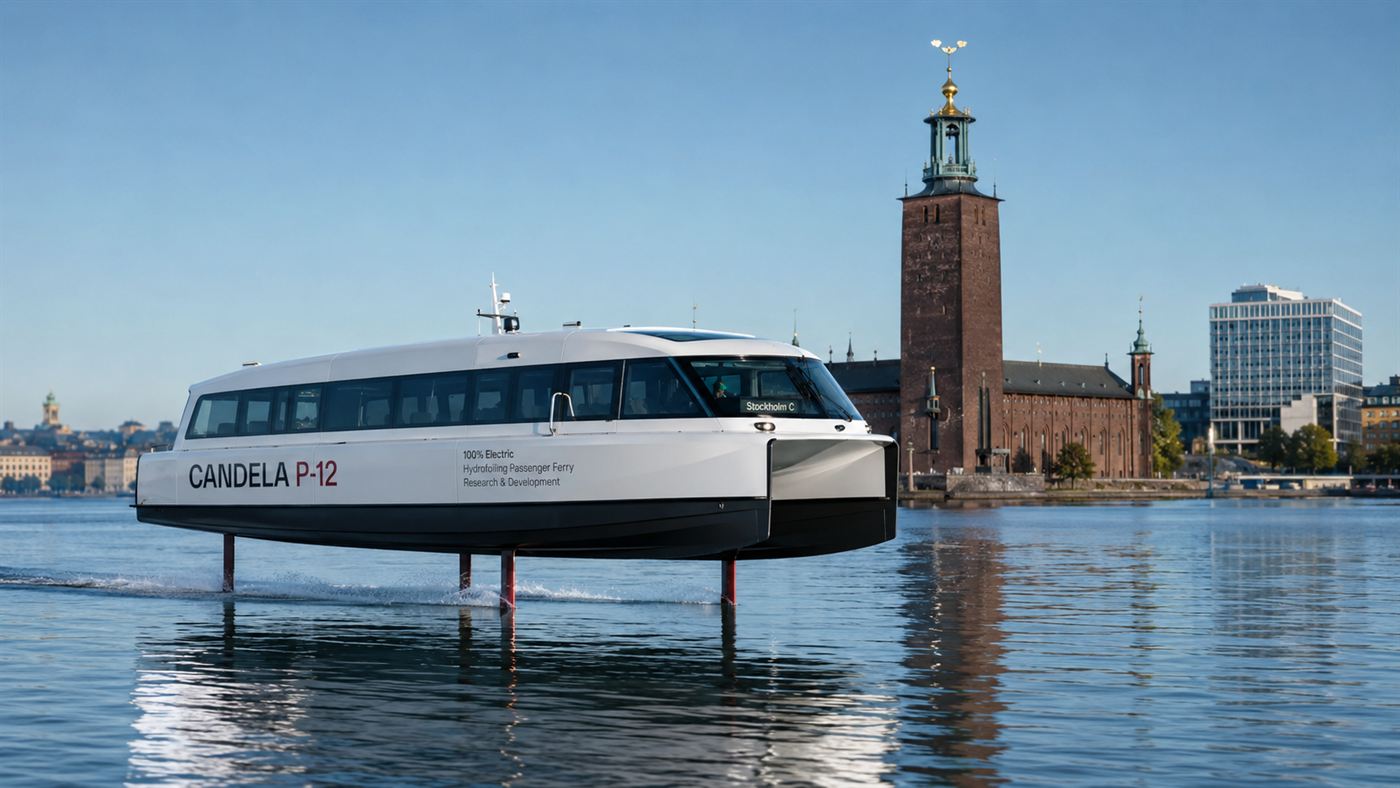
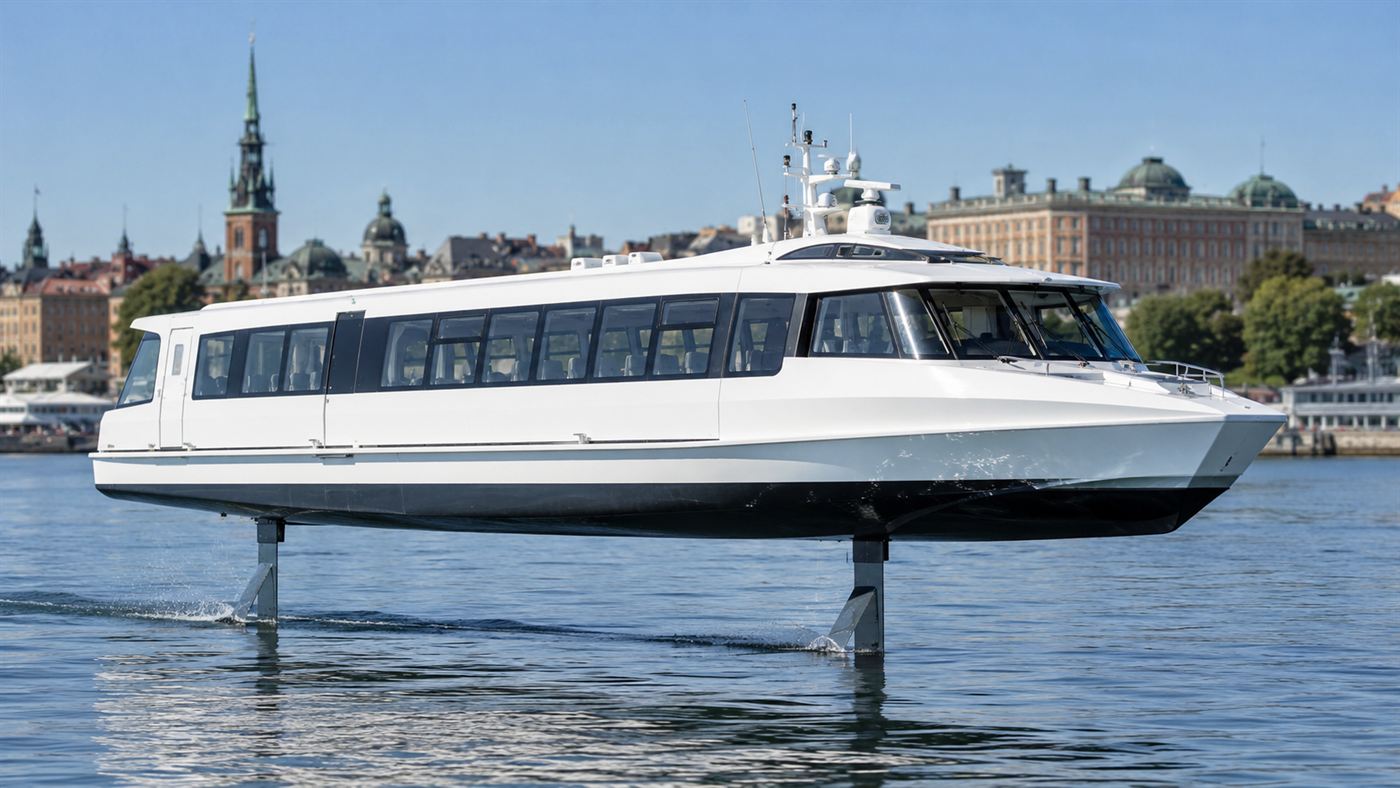
The Candela P-12 lifts its hull clear of the water on hydrofoils and skims above the surface, leaving almost no wake. Illustration: Watts & Wild.
For years, getting from the island suburb of Ekerö into the middle of Stockholm meant the better part of an hour, either crawling around the water by bus or sitting in a car on the same slow road. The shortest line between the two runs straight across the water, and yet the water was the slow way. Then the city put a boat on that route that does not really sail. It flies.
The vessel is the Candela P-12, a sleek white ferry that lifts its whole hull clear of the surface on a pair of underwater wings and skims above the waves. Since late 2024 it has run as route 89 between Tappström, in the centre of Ekerö, and Stockholm City Hall, the world's first electric hydrofoil ferry in regular public service. As Euronews reported in February 2026, after Stockholm finished evaluating the pilot, it had cut the crossing to about half an hour and won over almost everyone who stepped aboard.
The boat that flies to work
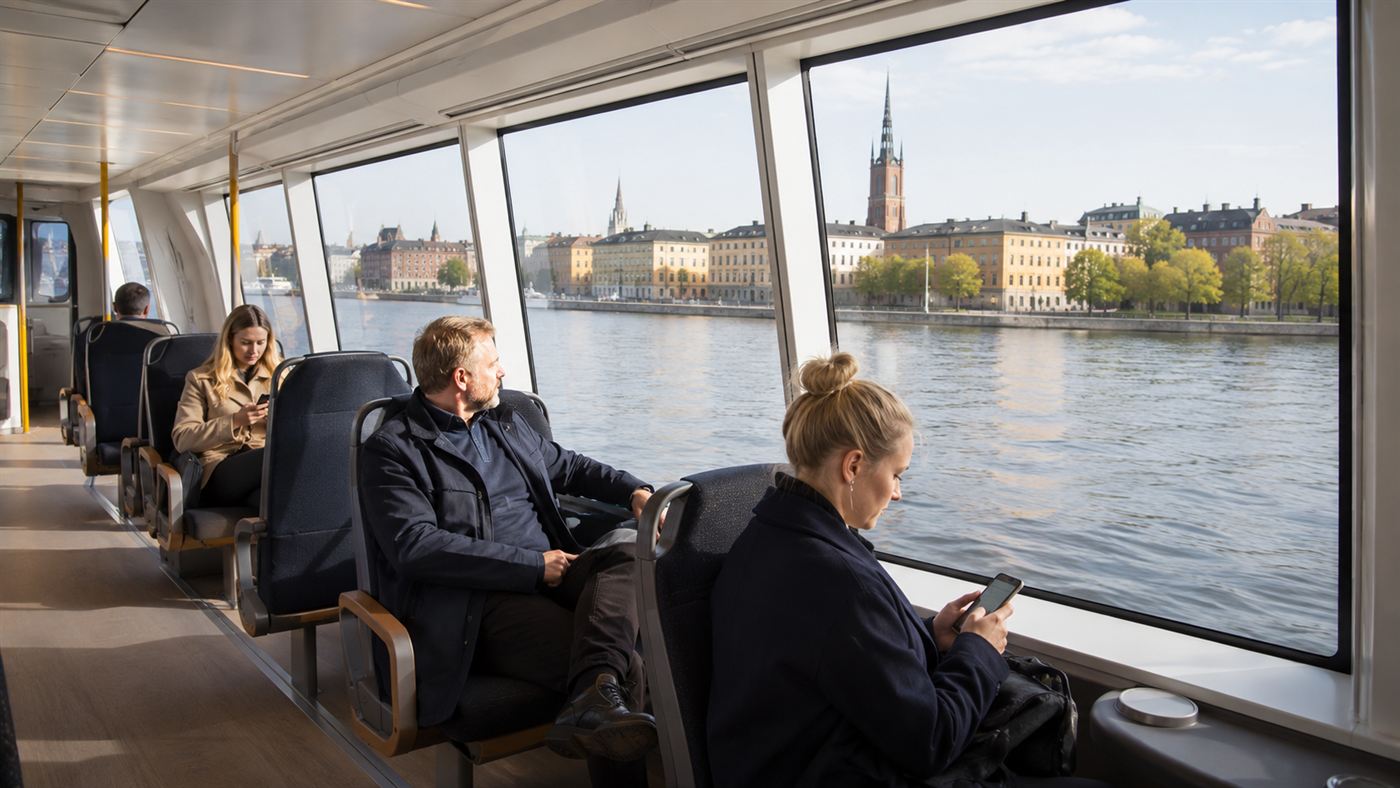
On the Ekerö run, the P-12 makes the trip in around 30 minutes, against roughly 55 minutes by car or bus around the shoreline.
For a daily commuter, that is most of an hour handed back every day.
The ride is also strangely quiet.
Candela puts the cabin noise at about that of a car doing 45 km/h, and says the boat is barely audible from 25 metres away, because it glides over the waves instead of pounding through them.
The people on board noticed.
In Stockholm's evaluation, 95 percent of passengers rated the experience positive or very positive, and ridership on the route climbed by more than a fifth.
After the pilot, the region expanded the service from five days a week to daily, and most departures now leave fully booked, often with a queue waiting on the dock.
It charges much the way a car does, plugging into an ordinary fast charger at the City Hall quay during gaps in the timetable.
Why a boat wastes most of its energy
To see why this matters, it helps to know where a normal boat's energy actually goes.
Water is around 800 times denser than air, so a hull does not slip through it so much as shove it aside, throwing up a bow wave and dragging a wake behind it the whole way.
At speed, most of the power a conventional ferry burns goes into making those waves, not into moving people forward.
A hydrofoil cheats the problem by getting the hull out of the water entirely.
Once the boat is moving fast enough, the small wings on struts beneath it generate lift, exactly like an aircraft wing, and the heavy hull rises into the air where there is almost nothing left to push against.
Only the thin foils stay wet.
The Stockholm pilot found that the foiling design used about 80 percent less energy per passenger-kilometre than a conventional diesel ferry, and Euronews put the cut in carbon emissions against a diesel vessel at roughly 94 percent.
The man who got fed up with his own boat
Candela exists because one engineer got annoyed with his weekend boat.
Gustav Hasselskog, a Swedish physicist and engineer, founded the company in 2014, at the age of 40, after deciding he wanted to build products again instead of managing them.
He has said the spark was realising that his own 1967 motorboat burned about 15 times more fuel per kilometre than a car, a figure he found absurd for something that mostly carried him around a lake.
The obvious fix, an electric motor, ran straight into the wall every electric boat hits, which is that fighting water drag drains a battery fast and leaves you with almost no range.
So he went after the drag instead of the battery, and that pointed him at hydrofoils.
The idea was a hard sell at first.
In his first fundraising round he approached more than 90 investors, landed two meetings, and both of those ended in a no, with the company finally getting going on money from a Swedish rare-book dealer based in London.
A decade on, Hasselskog calls the Stockholm line a paradigm shift for urban transport and a revival of the city's waterways.
Wings the computer trims a hundred times a second
Flying a boat is harder than floating one, which is why hydrofoils never caught on for everyday ferries until computers got good enough to fly them.
Candela's system reads the water with sensors and adjusts the angle of the foils up to 100 times a second, holding the hull steady about a metre above the surface even as the wind and the waves shift.
The passenger feels none of that constant correction, only an oddly smooth ride.
Lifted clear of the water, the P-12 cruises at 25 knots, which makes it the fastest electric passenger vessel in service anywhere.
That is roughly twice the speed of the diesel commuter boats it shares the water with.
The trick that lets it race through a no-wake city
Speed on Stockholm's inner waterways is normally capped, and for a good reason.
A fast boat throws a big wake, and that wake eats away at shorelines, rocks moored boats and endangers smaller craft, so much of the city sits under a strict limit of around 12 knots.
The P-12 barely makes a wake at all, because a hull flying above the water displaces almost nothing as it goes.
So Stockholm granted it an exemption.
The flying ferry is allowed to run at its full 25 knots through zones where every ordinary boat has to crawl, and that exemption, as much as the motor, is what makes the commute so much shorter.
It is a neat bit of logic: the boat is allowed to go faster precisely because it does so little harm to the water it crosses.
The honest catch
None of this makes the P-12 a finished answer to city transport, and the limits are real.
The biggest is size: the shuttle version seats just 30 passengers, a tiny number beside the diesel ferries and the big electric catamarans that move thousands.
The queues on the Ekerö dock are a sign of success, but also a sign that one small flying boat cannot, on its own, carry a city.
It is not cheap either.
The P-12 starts at around 1.7 million euros, and the Stockholm line runs as a subsidised pilot backed by the region and the Swedish Transport Administration, not yet as a service that pays for itself.
Winter is a hard stop, too.
When the waterways freeze over, the foils are useless and the service simply pauses until spring, which is why the pilot has run in seasons rather than year round.
And the headline efficiency figures are measured per passenger-kilometre, which means they lean on the seats being full, since a half-empty flying ferry is far less impressive than a packed one.
Why this 30-seat electric hydrofoil ferry is a bigger deal than it looks
It would be easy to file the P-12 under novelty, a clever toy for a rich Nordic city with a lot of water and a tidy pilot budget.
That misses what it actually proves.
For a century, taking to the water in a city has meant choosing the slow, dirty option, a diesel boat that loses every race to the road.
The flying ferry turns that around, making the water the fast lane and doing it on a fraction of the energy.
Other cities have noticed.
Euronews reports that operators in Berlin, Mumbai, the Maldives and Thailand have ordered or announced similar craft for 2026, eyeing the rivers and harbours they have spent decades ignoring.
Stockholm's little boat will not move millions by itself, but it has shown that a clean boat can beat the car into the city centre, and that is the part that travels.
A boat that flies to work on a fraction of the power, and beats the road doing it, has just proved itself on a real commute. Would you swap your road commute for a half-hour flight just above the water, if your city had the rivers for it? Tell us what you think in the comments.
Related reading: At the other end of the scale, the world's largest electric ship is a battery ferry built to carry 2,100 people across the river between Argentina and Uruguay.

Bruno Teles is an energy and industry journalist at Watts & Wild, covering power, batteries, and electric mobility seen through the battery and the range. More from Bruno Teles.