James Watt did not invent the steam engine, but the fix he dreamed up while repairing a broken model made steam power efficient enough to drive the Industrial Revolution
His name is now a unit of power, printed on every light bulb and appliance you own. But the real achievement of James Watt was not inventing the steam engine, it was rescuing a hopelessly wasteful one with a single elegant idea, and in doing so handing the modern world its engine.
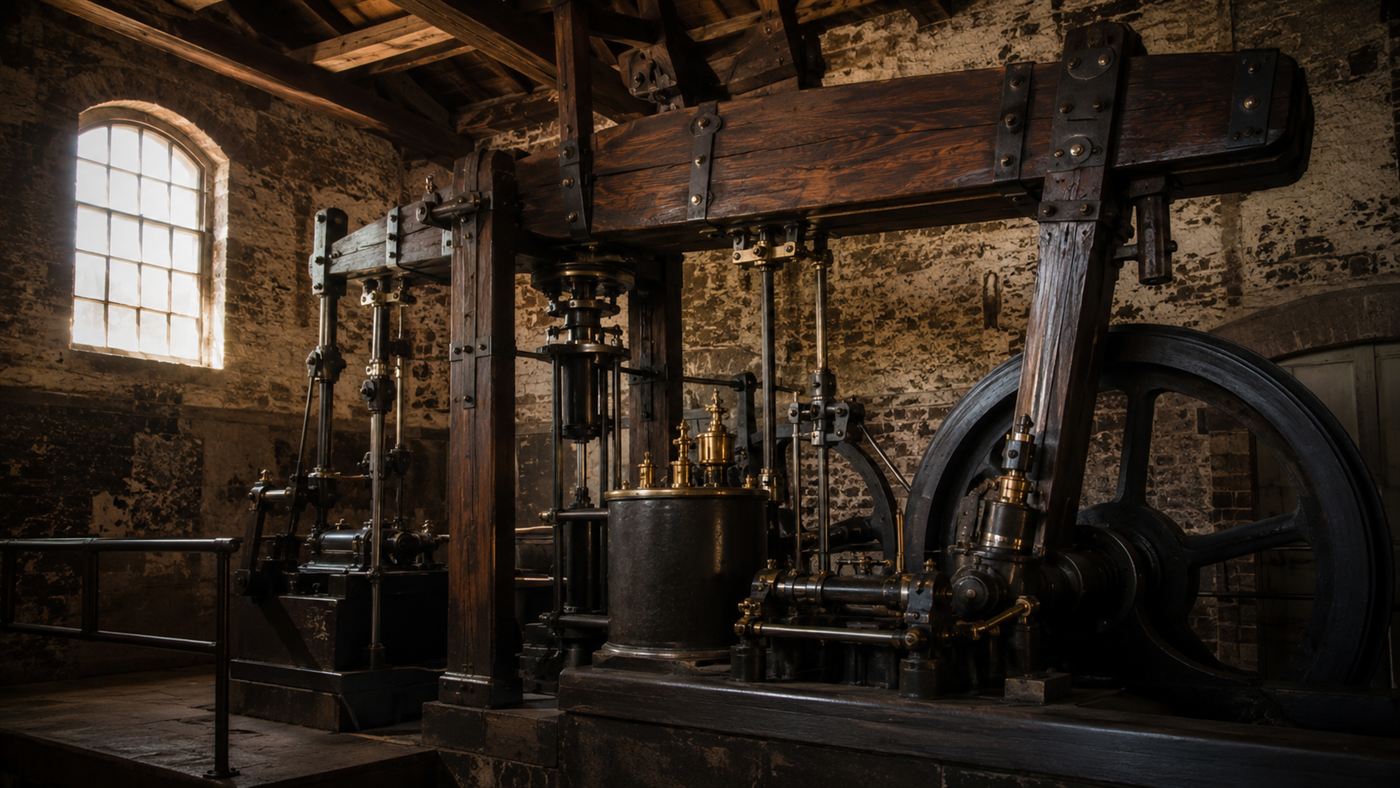
A beam steam engine, the kind of machine James Watt made efficient and practical. Illustration: Watts & Wild.
James Watt occupies a strange place in history. Nearly everyone has heard his name, because it is stamped on the world as a unit of power, the watt. Yet what he actually did is widely misunderstood. He is often called the inventor of the steam engine, and he was not. Steam engines were chugging away in British mines before he was born. What Watt did was more subtle and, in the end, more important: he took a machine that barely worked and made it good enough to change everything.
As Britannica records, James Watt was a Scottish instrument maker whose improvements to the steam engine were fundamental to the changes brought by the Industrial Revolution. The key word is improvements. His genius was not in the blank-page invention of steam power, but in seeing exactly why the existing engines were so terrible, and fixing it. That fix is one of the most consequential ideas in the history of technology.
The short version: Early steam engines existed but wasted enormous amounts of coal. Around 1765 James Watt realised why, and invented the separate condenser, which kept the engine's cylinder permanently hot and slashed its fuel use. With his partner Matthew Boulton he built efficient, versatile engines that could power factories anywhere, helping to launch the Industrial Revolution and reshape the modern world.
An engine that wasted almost everything
The engine Watt would transform was the atmospheric engine, built by Thomas Newcomen in 1712. It was a real, working machine, used to pump floodwater out of deep coal and tin mines, and for its time it was a marvel. It filled a cylinder with steam, then sprayed cold water inside to condense that steam into a vacuum, and the pressure of the atmosphere pushed the piston down to do the work.
The problem was staggering waste. Because the same cylinder was heated with steam and then chilled with cold water on every single stroke, most of the fuel went into simply reheating the metal over and over. A Newcomen engine devoured coal at a ruinous rate. That was tolerable at a coal mine, where fuel was cheap and close, but it made the steam engine far too expensive to use anywhere else. Steam power was possible, but only just, and only in one place.
The fix on Glasgow Green
Watt collided with the problem by chance. As an instrument maker at the University of Glasgow, he was asked to repair a small model of a Newcomen engine, and he was struck by how much steam, and therefore fuel, it wasted. He became obsessed with the inefficiency, and after months of thought the answer came to him during a Sunday walk on Glasgow Green in 1765, a moment he remembered for the rest of his life.
The insight was beautifully simple. Instead of cooling the working cylinder to condense the steam, why not draw the steam off into a completely separate condenser, a second chamber kept permanently cold, while the main cylinder stayed permanently hot? That way the engine never had to waste fuel reheating its cylinder. This one change cut the engine's coal consumption by roughly two-thirds or more. At a stroke, steam power became cheap enough to use almost anywhere.
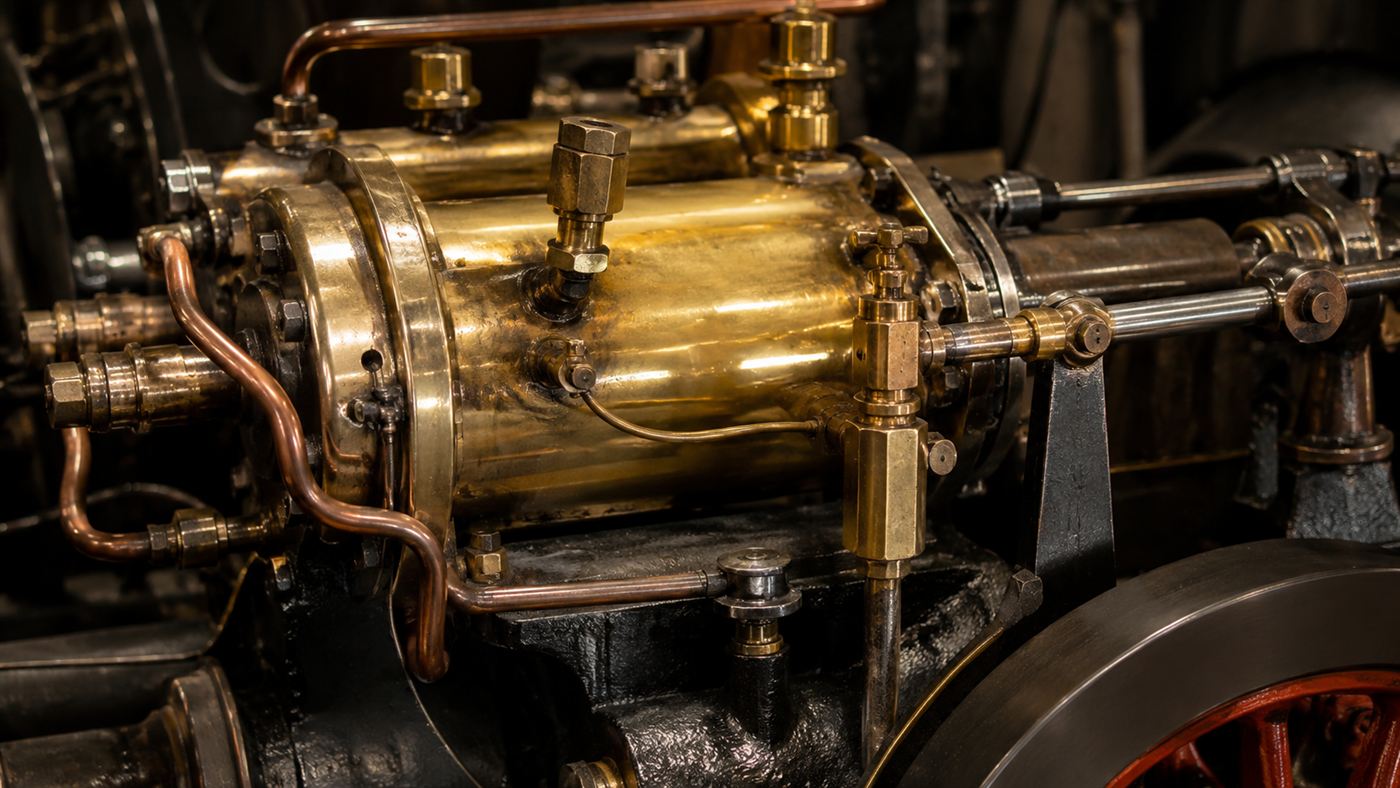
From pump to prime mover
An idea is not the same as a business, and turning his invention into reliable, sellable engines took Watt years and the help of a crucial partner. In 1775 he joined forces with Matthew Boulton, a shrewd Birmingham manufacturer, and the firm of Boulton and Watt began building engines that were the envy of Europe. Boulton supplied the capital, the workshop and the salesmanship that the cautious, perfectionist Watt lacked.
Just as important, Watt kept improving the machine. He worked out how to convert the engine's back-and-forth motion into smooth rotary motion, so that it could turn a shaft and drive machinery, not merely pump water up and down. He added a governor to keep its speed steady and made it double-acting for more power. With these changes the steam engine stopped being a specialised mine pump and became a universal source of mechanical power, one that could spin the machines of a cotton mill or a flour mill as easily as it drained a pit.
How James Watt powered the modern age
That versatility is what makes James Watt a hinge of history. As long as factories depended on water wheels, they had to be built beside fast-flowing rivers, which limited where industry could grow. A good steam engine changed that completely. Now a mill could be built anywhere, in the middle of a city, next to a coal supply, wherever it made sense, and it would run day and night regardless of the weather or the season.
Freed from the river, industry exploded. Steam-powered factories multiplied, towns swelled into industrial cities, and the same engine, put on wheels and rails, would soon become the locomotive, and on water the steamship. This flood of cheap, portable, reliable power was a driving force of the Industrial Revolution, the great transformation that pulled humanity from a world of muscle and water into a world of machines. It is only fitting that the unit of power itself now bears Watt's name, and that his term horsepower, coined to sell his engines, is still with us too.

The world the engine built
Stand back and the scale of it is dizzying. Almost every feature of modern industrial life, mass production, the factory city, mechanised transport, the sheer abundance of manufactured goods, can be traced back through a chain of machines to that one improvement in a Glasgow workshop. Watt did not build the world we live in single-handedly, but he supplied the engine that made building it possible.
It is a reminder that revolutions do not always begin with a brand new invention. Sometimes they begin with someone looking hard at an old, broken, taken-for-granted machine and asking why it works so badly. Watt's contribution was not a bolt from the blue but a deep, patient understanding of an existing device, and the modest-sounding act of making it far less wasteful. That understanding rearranged the world.
The honest catch
The tidy story of a lone genius needs a few honest edges. First, and most importantly, Watt did not invent the steam engine, and it does him no favours to pretend he did. He improved Newcomen's design, which in turn built on still earlier work, so his triumph belongs inside a long chain of engineers, not on a pedestal of its own. Second, there is a real argument that Watt's business held progress back as much as it pushed it forward. His patents were so broad, and so aggressively defended and extended, that for around a quarter of a century they discouraged rivals and even blocked promising ideas like high-pressure steam, which others developed only after his grip loosened.
And then there is the largest catch of all. The engine that lifted humanity into abundance ran on coal, and it taught the world to burn fossil fuel on an industrial scale for the first time. From Watt's efficient engine flows not only the wealth of the modern age but also its darker inheritance, the grinding conditions of the early factories and, over the long run, the mass burning of coal and oil whose carbon is now heating the planet. You can draw a line, faint but real, from a walk on Glasgow Green to the climate crisis. That does not diminish Watt's brilliance. It just means the engine he perfected, like most world-changing machines, came with a bill that later generations are still paying.
A repairman's fix on a Sunday walk ended up powering the industrial world, for better and worse. Was James Watt the great enabler of modern prosperity, or the man who first taught us to burn coal on a scale that would one day threaten the planet? Tell us what you think in the comments.
Related reading: The Bessemer process, another quiet breakthrough that helped build the industrial world, or the Corliss engine, the steam giant that crowned the age Watt began.
More from Watts & Wild
More in Energy →




Bruno writes about energy history, industrial disasters, and the people who shaped the technologies we take for granted. He is based in Brazil.