Critics mocked the Erie Canal as Clinton's Folly, a mad ditch dug across 363 miles of wilderness, and then it opened the American interior and made New York the nation's greatest city
In the early 1800s, moving goods from the American coast to the interior was so slow and costly that the young country was almost two nations, east and west, barely connected. Then New York dug a ditch. The Erie Canal was ridiculed as lunacy, and it changed the shape of a continent's economy.
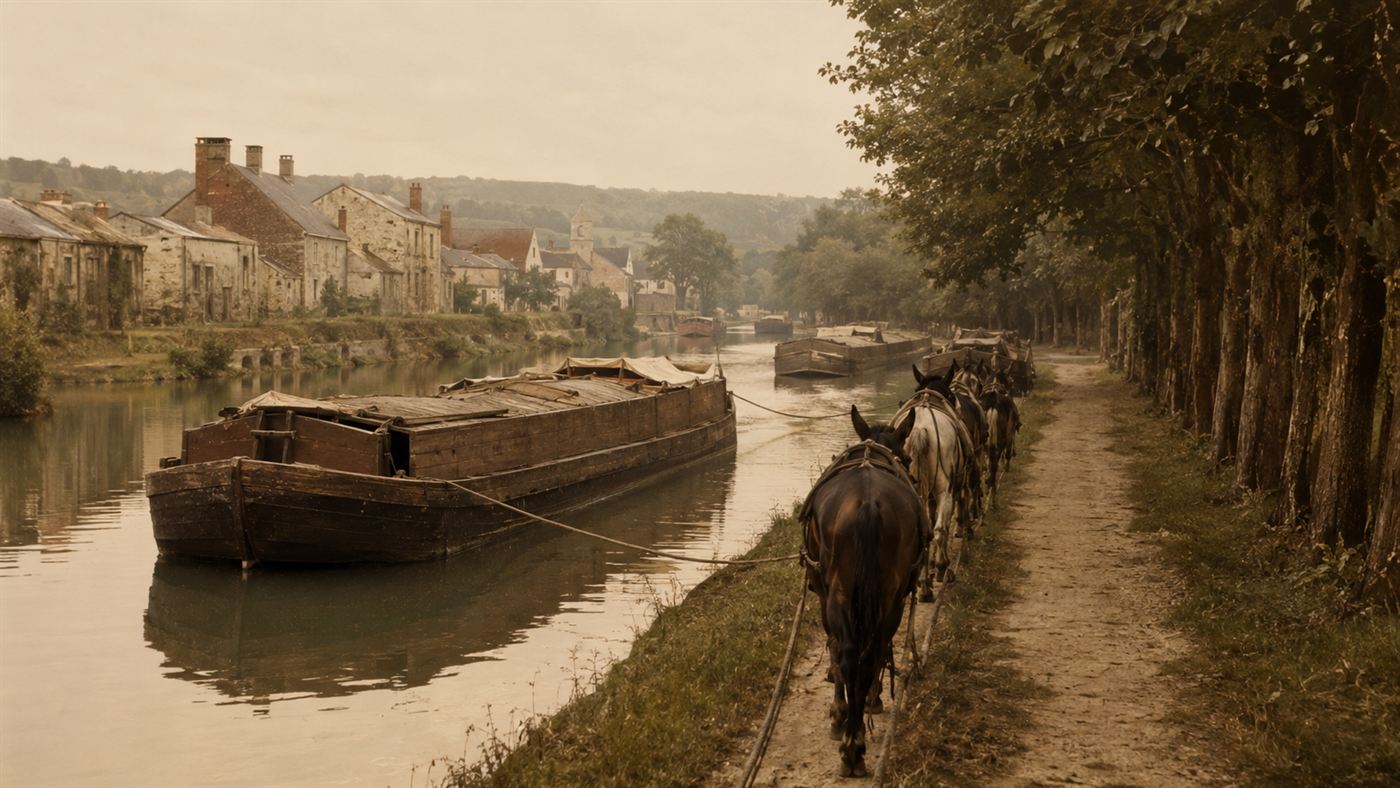
Mule-drawn boats on a 19th-century canal, the kind of traffic that transformed America. Illustration: Watts & Wild.
The Erie Canal does not look like the sort of thing that reshapes history. It was, in the end, a long, narrow trench of water with boats pulled along by mules. But when it opened in 1825, it solved a problem that had been strangling the growth of the United States, and it did so with such force that it turned a modest port town into the greatest city in the country and flung the door to the American interior wide open.
As History has documented, the Erie Canal ran 363 miles across New York State and became one of the most important public works in American history. Yet almost no one believed it could work. For years the whole idea was treated as a joke, a rich man's fantasy, a ditch to nowhere. The story of how a punchline became a lifeline is one of the great reversals of the age.
The short version: The Erie Canal, finished in 1825, linked the Hudson River and New York City to Lake Erie and the Great Lakes across 363 miles. Mocked as Clinton's Folly, it slashed the cost and time of shipping goods between coast and interior, opened the Midwest to settlement and trade, and made New York City the leading port and business capital of the United States.
A canal called folly
The problem it set out to solve was geography. Between the Atlantic coast and the fertile lands around the Great Lakes stood the Appalachian mountains, and hauling goods over them by wagon was so slow and expensive that farmers in the interior could barely sell their crops to the east at all. The obvious fix, a water route through the one gap in the mountains, meant digging a canal across the entire width of New York State.
To most people that sounded impossible. The distance was enormous, the country was young and poor, and America had almost no trained engineers. The plan's great champion was DeWitt Clinton, a New York politician who staked his career on it, and the doubters were merciless, calling the scheme Clinton's Folly and Clinton's Ditch. Thomas Jefferson himself reportedly dismissed the idea as little short of madness. Clinton pushed it through anyway, and New York State agreed to pay for it alone.
Digging across a wilderness
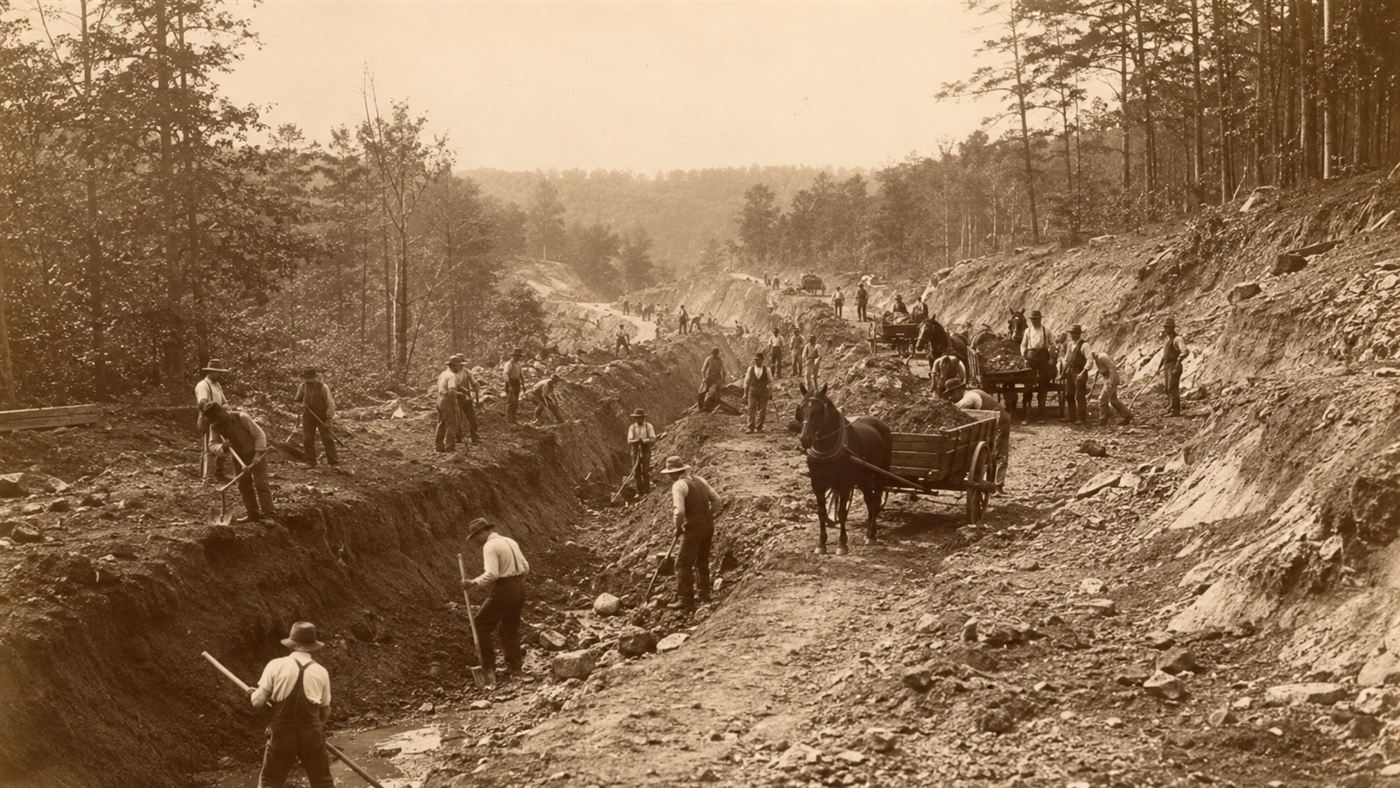
Construction began in 1817, and it was brutal. The canal was dug largely by hand, by thousands of labourers, many of them immigrants, hacking a channel forty feet wide through forest, rock and swamp in all weather. There was no manual for a project this big, so the men in charge, mostly self-taught amateurs, had to invent the engineering as they went.
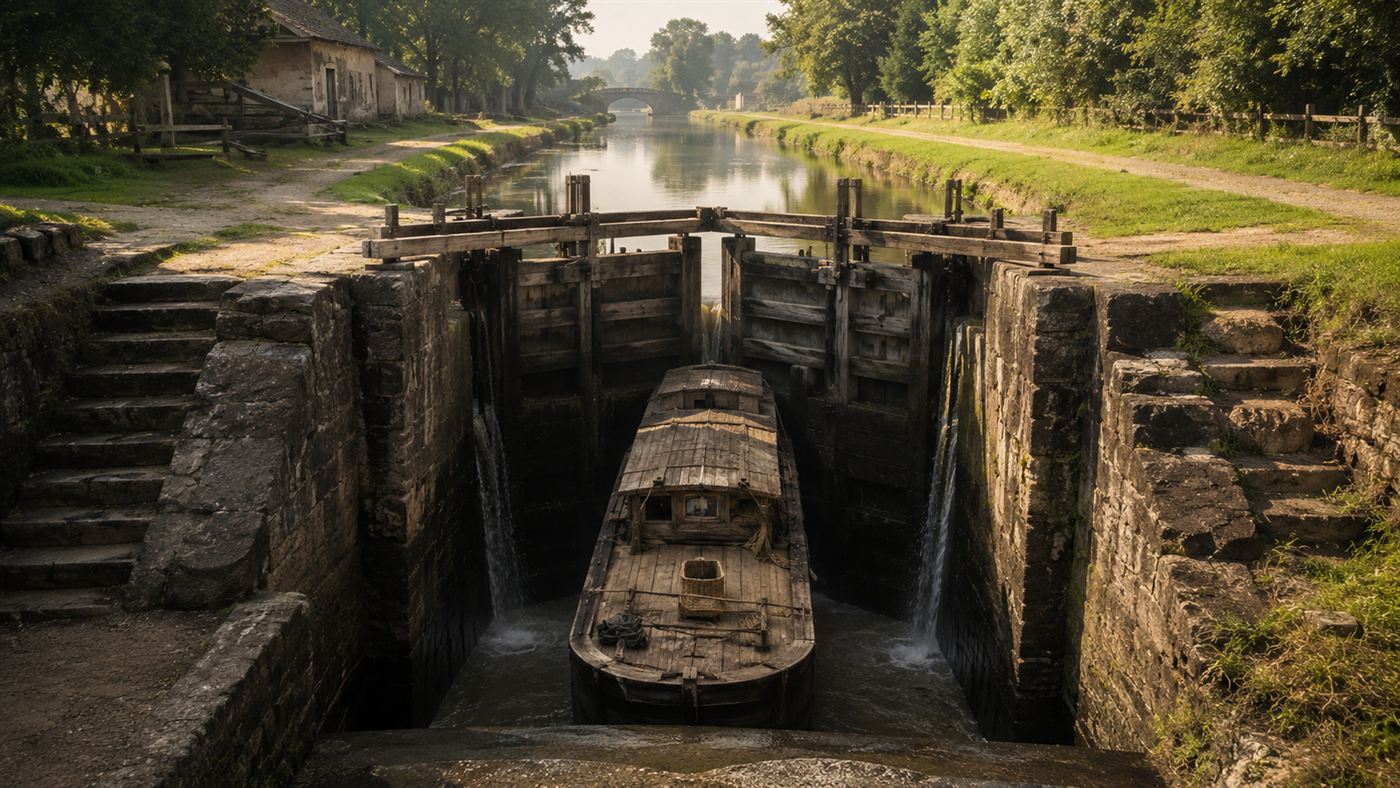
And invent they did. They devised new machines to yank out tree stumps, worked out a workable waterproof cement, and built dozens of locks to lift boats up and over the changing land, along with great stone aqueducts to carry the canal across rivers. By the time it was done, the route climbed and descended hundreds of feet through more than eighty locks. The Erie project became, in effect, the country's first great school of engineering, training a generation who would go on to build America's railroads and bridges.
The Wedding of the Waters
When the canal was finally completed in the autumn of 1825, the celebration matched the scale of the achievement. DeWitt Clinton travelled the whole length of the canal by boat from Lake Erie to New York City, and there, in a ceremony called the Wedding of the Waters, he poured a barrel of water from Lake Erie into the Atlantic Ocean to mark the two now being joined.
It was a grand piece of theatre, but it stood for something real. For the first time, a boat could travel from the middle of the continent all the way to the sea on a continuous ribbon of water. The ditch that everyone had laughed at was open, it worked, and almost immediately it began to pay for itself many times over.
How the Erie Canal remade the map
The economic effect was staggering and fast. Before the canal, shipping a ton of goods from Buffalo to New York City cost around a hundred dollars and took weeks. After it, the same journey cost roughly ten dollars and took days. Slashing transport costs that dramatically did not just help existing trade, it created entirely new trade, letting the grain and timber of the interior flood east and manufactured goods flow west.
The consequences rippled outward. Towns along the route, like Rochester, Syracuse and Buffalo, boomed into cities. The farmlands around the Great Lakes filled with settlers who now had a way to sell what they grew. And above all, the canal funnelled the wealth of half a continent through one seaport, so that New York City rocketed past its rivals to become the busiest port and the financial heart of the United States, a position it has never given up. A single canal had rewired the commerce of a nation.
The ditch that built a nation, then faded
The Erie Canal did more than make money. By tying the eastern seaboard firmly to the western interior, it helped knit a loose collection of states into a single national economy at a moment when the country could easily have drifted apart. It pulled settlement westward, spread ideas and people along its banks, and gave New York its lasting nickname, the Empire State.
Its reign as the great artery, though, was surprisingly short. Within a couple of decades the railroad arrived, faster and unbound by ice or terrain, and it gradually took over the long-distance traffic the canal had pioneered. But that does not diminish what the canal did. It proved that a big, bold public work could transform a country, it launched New York's dominance, and it opened the West. The railroads that replaced it were, in a sense, only finishing a journey the Erie Canal had started.
The honest catch
The triumphant version leaves things out, as triumphant versions do. The canal was built on the backs of poorly paid labourers who worked in dangerous conditions, and many fell sick or died, especially digging through disease-ridden swamps. The heroism of the engineers came with a real human toll among the men holding the shovels.
There is a larger shadow, too. Opening the interior meant opening the lands of the Haudenosaunee, the Iroquois nations, and other Native peoples to a flood of settlers, accelerating their dispossession. The same canal that Americans celebrate as the road to national greatness was, for the people already living along that road, the road that took their homes. None of this cancels the engineering marvel or the economic transformation. But an honest account of the ditch that built New York has to admit that it was built over someone else's country, and by hands that got little of the reward.
A ditch everyone called madness quietly built the richest city in America. Is the Erie Canal the greatest infrastructure bet in US history, or a reminder that we celebrate the winners of such projects and forget who paid for them? Tell us what you think in the comments.
Related reading: How Chicago reversed an entire river, another audacious American waterway gamble.
More from Watts & Wild
More in Industry & Mega-Builds →

Bruno writes about energy history, industrial disasters, and the people who shaped the technologies we take for granted. He is based in Brazil.