Ignaz Semmelweis found a way to stop mothers dying in childbirth simply by washing hands, and for telling the truth too soon he was mocked, broken and locked away
Every time you scrub your hands before a meal or a hospital lets a surgeon nowhere near a patient without sterile gloves, you are living inside an idea a young doctor proved in 1847. It cost Ignaz Semmelweis his career, his mind and, in a cruel twist, his life.
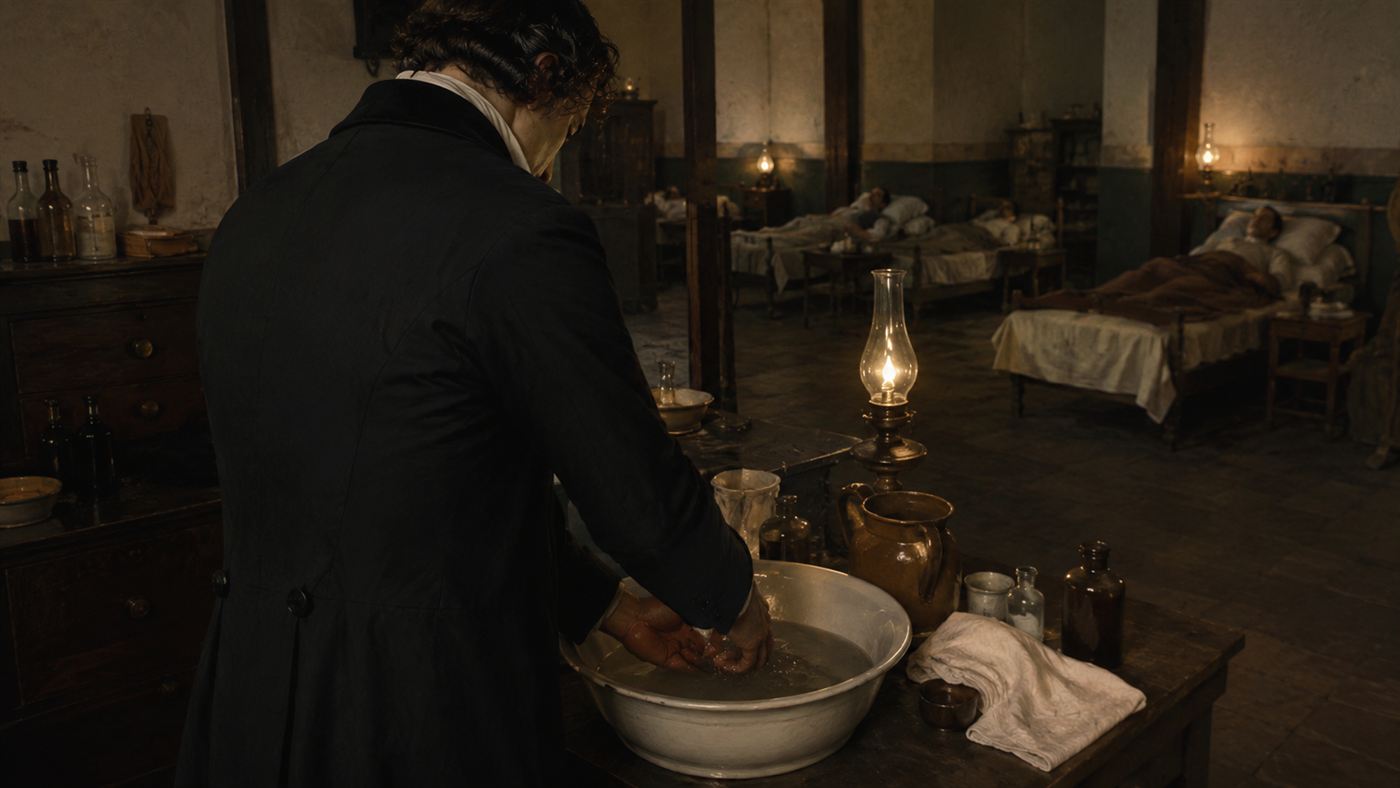
Handwashing, obvious to us now, was a radical and unwelcome idea in the 1840s. Illustration: Watts & Wild.
The story of Ignaz Semmelweis is one of the most quietly devastating in the history of medicine. He was right about something enormous, right in a way that could have saved countless lives immediately, and the world not only refused to listen but punished him for saying it. His tale is a warning about how hard it is for people to accept a truth they are not ready to hear.
As the Science History Institute recounts, Semmelweis discovered a simple measure that dramatically reduced deaths from childbed fever, only to be rejected by the medical establishment of his day. He had the evidence. What he did not have, yet, was any way to explain why it worked, and that gap would help destroy him.
The short version: In 1847, Ignaz Semmelweis found that doctors in a Vienna maternity ward were carrying deadly infection from the morgue to mothers on their unwashed hands. He ordered handwashing with chlorinated lime, and deaths plunged from over 18 percent to under 1 percent. But germ theory did not exist yet, doctors resented the idea, and he was ridiculed, dismissed, and died in an asylum in 1865, only later proved right.
The deadliest ward in the hospital
In the 1840s, Semmelweis worked at the great General Hospital in Vienna, in a maternity clinic that harbored a horror. In his ward, staffed by doctors and medical students, more than one in eight women who came in to give birth died soon after, killed by a raging infection called childbed fever. It was so notorious that women begged not to be sent there.
What haunted Semmelweis was a clue hiding in plain sight. The hospital had a second maternity ward, staffed by midwives rather than doctors, and there the death rate was a fraction of his own. Same building, same city, same women, wildly different odds of survival. Something about the doctors' ward was killing mothers, and he became obsessed with finding out what.
A death that solved the mystery
The answer came from a tragedy. A colleague and friend of Semmelweis cut his finger during an autopsy, fell ill, and died, and his symptoms looked exactly like the childbed fever that was killing the mothers. That connection lit up everything. The doctors in his ward spent their mornings dissecting corpses in the morgue, then walked straight to the delivery beds, often without properly washing.
Semmelweis concluded that some invisible deadly material, what he called cadaverous particles, was being carried on the doctors' hands from the dead to the living. The midwives, who did no autopsies, carried no such thing, which is why their mothers lived. He could not see the killer, but he was sure the hands were the road it traveled.

Wash your hands, and the dying stopped
So he acted. Semmelweis ordered every doctor and student to scrub their hands in a solution of chlorinated lime before touching a patient, a harsh wash meant to strip away whatever the corpses had left behind. It was a small, cheap, almost absurdly simple rule.
The effect was staggering. The death rate in his ward collapsed, falling from around 18 percent in the spring of 1847 to a fraction of one percent by the end of the year. Later, running a clinic in Pest, he drove the handwashing results even lower. The mothers simply stopped dying in the numbers they had before. By any measure that should matter, Semmelweis had won, decisively and repeatedly.
Why the world turned on Ignaz Semmelweis
And yet he lost. The problem was that Semmelweis could show that handwashing worked but could not say why, because germ theory, the understanding that tiny living organisms cause disease, was still years away. To doctors steeped in older theories of illness, an unexplained rule about invisible particles on their hands sounded like superstition.
Worse, the idea was insulting. Semmelweis was effectively telling respected physicians that their own hands had been killing their patients, and many of them were offended rather than persuaded. His own manner did not help, growing more furious and accusatory as he was ignored. Instead of spreading, his life-saving rule was dismissed, and the man himself was pushed to the margins of his profession.

Broken before he was believed
The rejection wore him down. Over the following years Semmelweis grew bitter and unwell, his behaviour increasingly erratic as he raged against a profession that would not save its own patients. In 1865, in a state of breakdown, he was committed to an asylum. There he was confined and beaten by the guards, and just two weeks later he died, at only 47, from a gangrenous infected wound.
The irony is almost too much to bear. The man who had fought his whole career against deadly infection was killed by exactly that, an infected wound of the very kind his handwashing was meant to prevent. Only about two decades later, when Louis Pasteur established that germs cause disease and Joseph Lister built antiseptic surgery on the idea, was Semmelweis finally proved right. Today he is remembered as a savior of mothers, honored by the world that once broke him.
The honest catch
It is tempting to tell this purely as noble genius versus wicked fools, and that is not quite fair. Semmelweis, for all his brilliance, was a poor advocate for his own idea. For years he published little solid proof, relying on others to spread the word, and when he finally did write, he lashed out at critics as murderers, which hardened them against him. He also genuinely could not explain the mechanism, so doctors who wanted a reason before overturning their practice were not simply being stupid.
None of that lets the establishment off the hook, because the evidence was there in the falling body count for anyone willing to look. But the deepest lesson is not about heroes and villains. It is about a very human failing that psychologists now call the Semmelweis reflex, the reflex to reject new evidence because it clashes with what we already believe. His critics had it, and the uncomfortable truth is that all of us can, which is exactly why his sad story is still worth telling.
A doctor saved mothers' lives with soap and water, and his colleagues destroyed him for it. Would we recognize the next Semmelweis if they appeared today, or are we just as quick to reject an inconvenient truth that arrives before its explanation? Tell us what you think in the comments.
Related reading: The doctor who drank a beaker of bacteria to prove his own rejected theory about ulcers. See also how geologist J Harlen Bretz was mocked for 40 years for reading a giant flood in the rocks of Washington.
More from Watts & Wild
More in Science & Tech →




Maria writes about wildlife, ecology, and the strange places where nature and human history collide. She is based in Brazil.