A tent full of children went to the circus on a summer afternoon in 1944, and the canvas over their heads had been waterproofed with gasoline
It was meant to be the safest kind of day: a matinee, a big striped tent, thousands of families with their children in their best clothes. Then a small flame touched the roof, and the whole sky above them turned to fire in a matter of seconds.
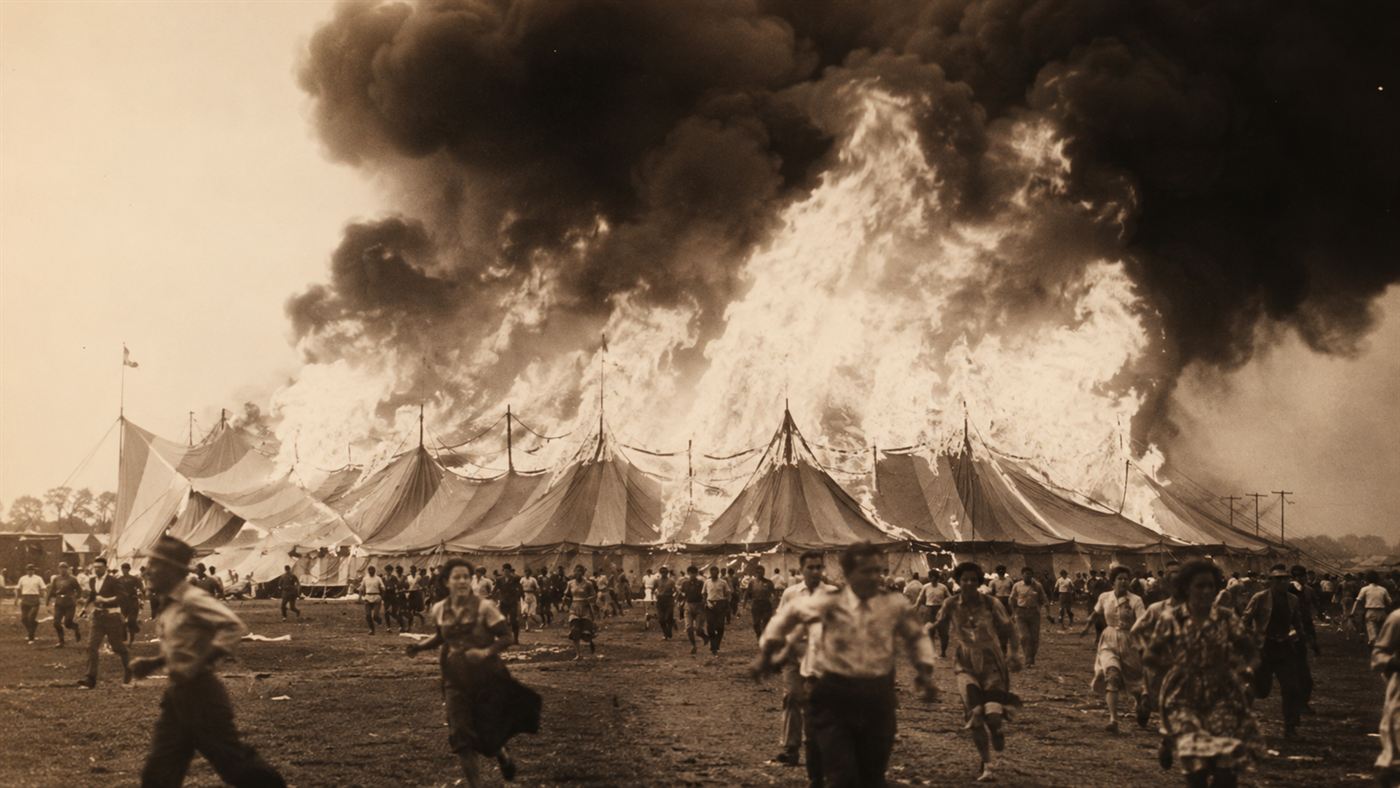
The Hartford circus fire consumed the big top in minutes on July 6, 1944. Illustration: Watts & Wild.
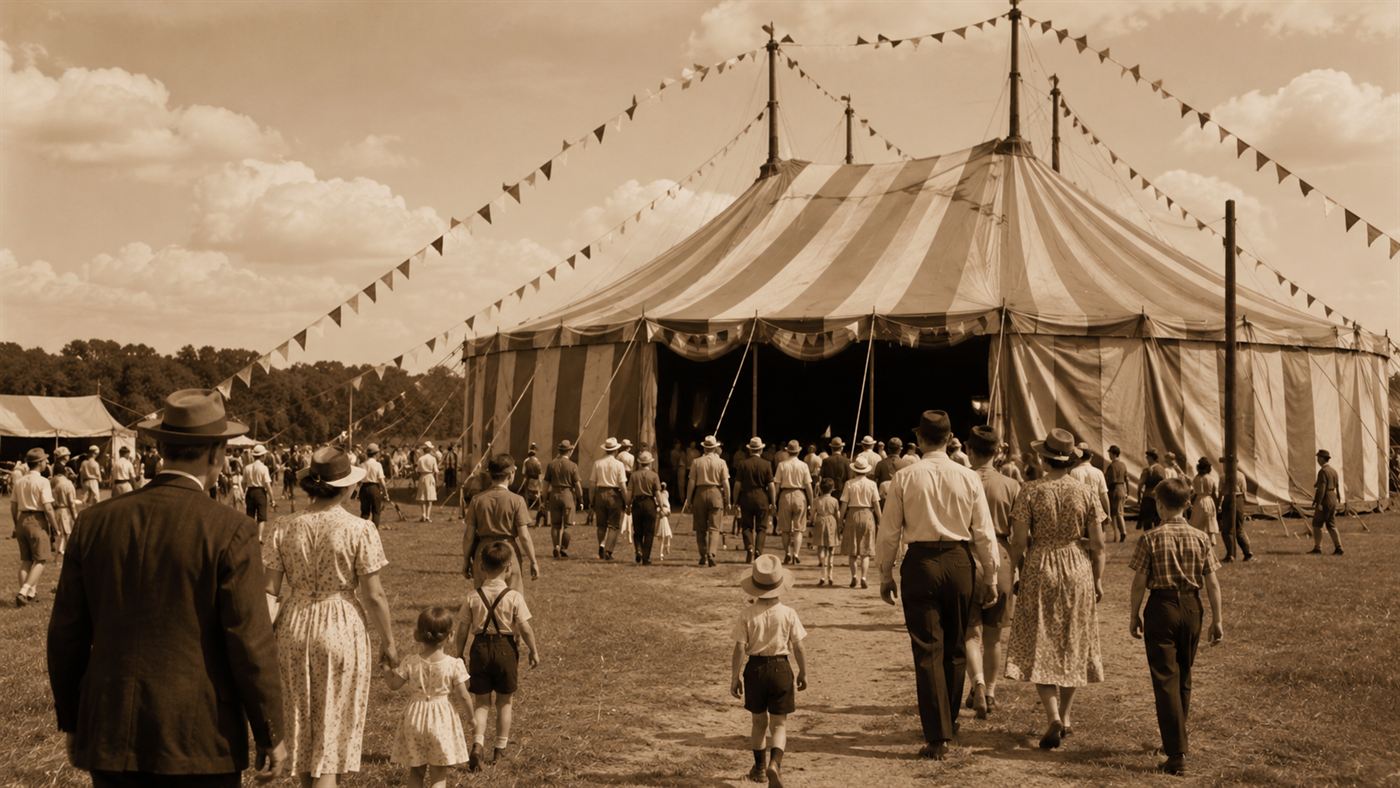
On the afternoon of July 6, 1944, the Ringling Bros and Barnum & Bailey Circus set up its enormous tent in Hartford, Connecticut, and somewhere between six and seven thousand people crowded in for the show. With the country deep in the Second World War and so many fathers away, the audience was overwhelmingly mothers, grandparents and children.
A little way into the performance, a small fire appeared on the sidewall of the tent. In an open field, a patch of burning canvas should have been a manageable thing. Instead, within about ten minutes, the Hartford circus fire had killed roughly 167 people and injured hundreds more, and it remains one of the worst fire disasters in American history.
The short version is that the tent itself was the weapon. What made a stray flame into a mass killing was not bad luck in the crowd but a decision made long before, up in the canvas over everyone's heads.
Why the circus fire spread so fast
To keep the rain out, circuses waterproofed their canvas, and the standard recipe of the day was brutal in hindsight: paraffin wax thinned with gasoline, painted over the whole roof of the big top. It shed water beautifully. It also turned an acre of cotton canvas into something close to a giant candle wick.
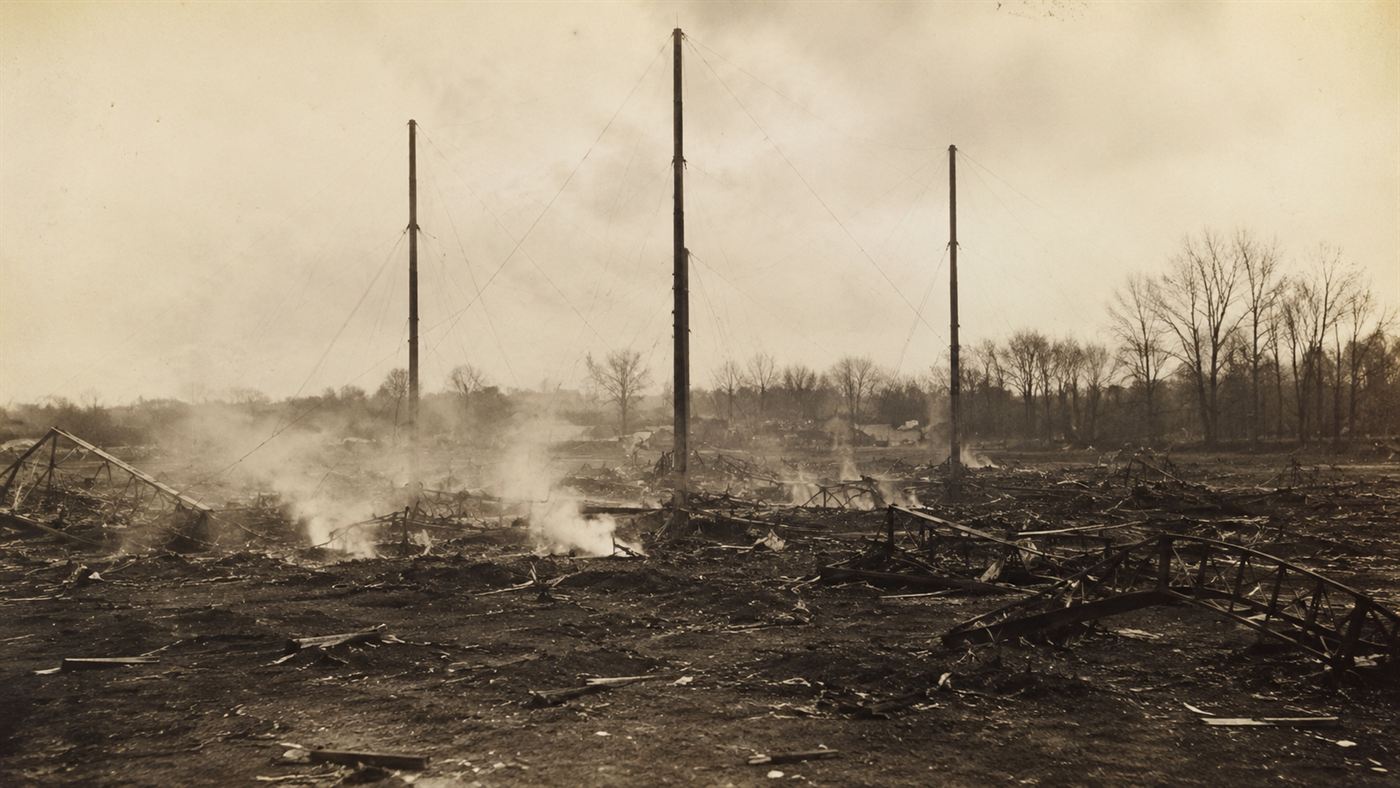
When the flames reached that treated cloth, the fire did not spread so much as detonate across the roof. Burning paraffin dripped down onto the crowd like rain, and the tent that was meant to shelter thousands of people became a ceiling of fire above them, collapsing in flaming sheets while they tried to get out.
The exits that were not there
Escape should have been simple in a tent, but it was not. Several of the exits were partly blocked by the steel chutes used to move the big cats between their cages and the ring, so families running for the open air met a metal wall instead. People piled up against these barriers, and many of the dead were found there.
Others were caught in the crush, knocked down and trampled as thousands tried to funnel through too few gaps at once. In a matter of minutes it was over, and the smooth green field where the big top had stood was left scattered with the belongings of the people who had come to laugh.
The girl who was never named
Among the dead was a little girl, perhaps six years old, whose body was strangely untouched by the flames and whose face looked almost peaceful. No one came to claim her. She was recorded only by her number at the morgue, and she became known as Little Miss 1565.
For decades her identity haunted the city of Hartford. An investigator eventually made a case that Little Miss 1565 was a girl named Eleanor Cook, who had gone to the circus with her family that day, and she was reburied under that name. Yet not everyone was convinced, and some still consider the identification unproven, so the small mystery has never fully closed.
What really started it?
The spark that began it all was never settled. Investigators at the time leaned toward a carelessly dropped cigarette against the sidewall, while years later a man named Robert Segee claimed he had set it deliberately. His confession was full of holes and is widely doubted, and no arson case against him ever really held.
Several circus officials were convicted of involuntary manslaughter for the safety failures, and the Ringling organisation paid out claims to the victims' families for years afterward. But the true origin of the flame remains, officially, an open question.
The honest catch
It is easy to reach for a villain here, an arsonist or a single careless smoker, because a clear culprit is easier to hold than the truth. The harder fact is that the disaster was built into the ordinary way circuses operated. Coating a giant tent in paraffin and gasoline was normal, and wartime shortages of flame retardant meant no one treated the canvas to resist fire. The danger walked in with the families, invisible.
There is a gentler trap too. The story of Little Miss 1565 is genuinely moving, but the romance of a nameless child can quietly crowd out the other 166 people, most of them known, most of them children and their mothers, who died for a reason far less mysterious than her name. A stray flame did not really kill them. A tent soaked in fuel, with its exits fenced off by animal runs, is what turned an afternoon at the circus into one of the deadliest ten minutes in the country's history.
The safest afternoon a family could imagine became a death trap because of a recipe for keeping the rain off. Would you have thought to ask what the roof of a circus tent was painted with? Tell us what you think in the comments.
Related reading: the Iroquois Theatre, sold as fireproof before it became the deadliest building fire in America. See also the Cocoanut Grove nightclub fire that rewrote the rules for crowded rooms, and the Triangle factory fire whose locked doors changed American labour.