A former music producer sketched a rainforest inside a dead Cornish clay pit on a napkin, and it became the Eden Project, the biggest indoor jungle in the world
In 1996, a man with no background in plants or building looked at an exhausted clay quarry in Cornwall and imagined filling it with a tropical jungle under giant glasshouse bubbles. Almost everyone thought he was mad. Today the Eden Project in Cornwall heats that jungle with the heat of the Earth itself.
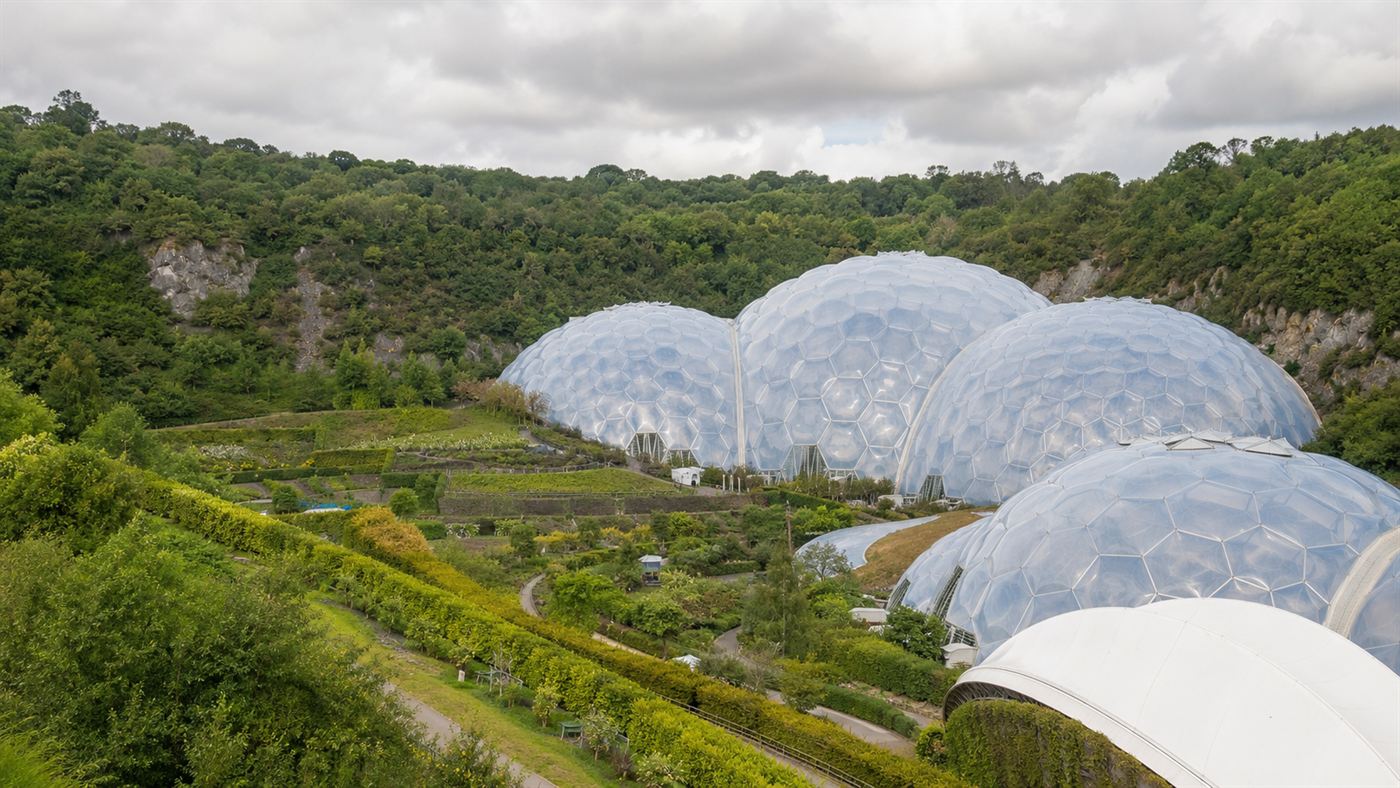
The Eden Project's biome domes sit in the bottom of a worked-out china clay pit in Cornwall. Illustration: Watts & Wild.
In October 1996, a former music producer with no training in horticulture or construction sat in a Cornish pub and sketched, on a napkin, a plan to grow the largest indoor rainforest in the world inside a dead clay pit. His name was Tim Smit, an archaeologist-turned-record-producer who had already restored a famous lost garden in Cornwall, the pit was an exhausted, sterile crater near St Austell, and most of the people he told assumed he had lost his mind.
Five years later, the Eden Project opened. As its public record sets out, the attraction was built in a reclaimed china clay pit and opened to the public on 17 March 2001, with two clusters of vast transparent domes sitting in the bottom of the crater like soap bubbles. And more than two decades on, the dead pit has gone further still. It is now drilling five kilometres into the hot rock beneath itself to heat its jungle with the planet's own warmth.
A hole in the ground and a man with a napkin
The starting point could hardly have been less promising. A china clay pit is what is left when you have stripped a hillside for the white clay used in paper and porcelain, and by the mid-1990s this one was worked out, a grey, steep-sided amphitheatre of waste with nothing growing in it. It was the kind of place people drive past and try not to look at.
Smit, fresh from reviving the overgrown Lost Gardens of Heligan nearby, saw something else. As the Eden Project tells its own origin story, the whole thing began as little more than a twinkle in his eye, with the first designs of the biomes drawn over a drink in a pub in 1996. He had no money, no horticultural credentials and no obvious reason anyone should believe him. What he had was an idea about reconnecting people with the plants they depend on, and the stubbornness to chase it.
Building bubbles in a crater
The engineering problem was almost comic. The pit was still being quarried while the project was being designed, which meant nobody knew exactly what shape the floor would be when building started. The architects answered with geodesic domes built from a honeycomb of hexagonal panels, a structure light and flexible enough to drape over whatever ground it found.
The panels themselves are not glass but a tough, transparent plastic film inflated into pillows, so light that the air-filled domes weigh less than the air they enclose. The result is the giant white bubbles that have become the Eden Project's signature. The biggest of them, the Rainforest Biome, runs about 240 metres long, 110 wide and 50 high, cavernous enough to swallow several cathedrals, all of it raised in a hole that had been left for dead.
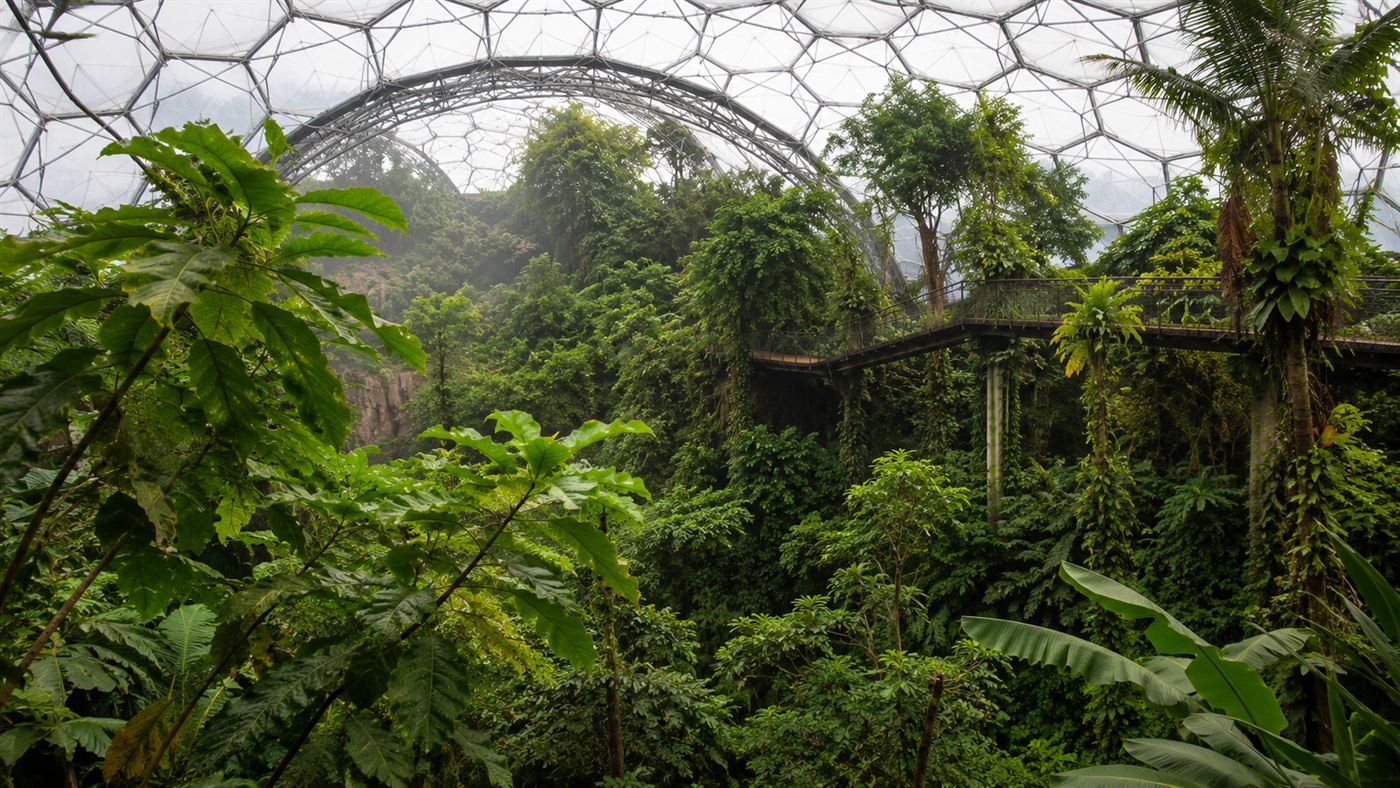
The largest indoor rainforest on Earth
Step inside the big dome and the transformation is total. The air turns hot and wet, a waterfall runs, and more than a thousand tropical plant species climb toward a canopy walkway slung high among the trees. The smaller dome holds a Mediterranean world of olives and citrus. Where there had been a poisoned-looking pit, there is now one of the largest indoor rainforests anywhere.
It was never meant to be just a greenhouse. The whole point was to tell a story about how completely human life leans on plants, for food, medicine, materials and air, and to do it somewhere spectacular enough that people would actually come. They did, in their millions, almost from the day it opened, turning a corner of post-industrial Cornwall into one of Britain's best-loved places.
Now the Eden Project in Cornwall heats itself with the Earth
The newest chapter closes the loop. Keeping a rainforest warm in Cornwall takes a lot of energy, so the Eden Project went looking for it directly underfoot. As the record of the site notes, it drilled a roughly five-kilometre-deep geothermal well into the hot granite beneath Cornwall, becoming home to the UK's first new operational deep geothermal plant since 1986, with the heat warming the biomes and buildings and cutting hundreds of tonnes of carbon a year.
It is a fitting end to the story. A pit dug out for one raw material has become a place that mines a different one, the steady heat of the rock far below, to keep its jungle alive. The crater that was emptied and abandoned is now drawing energy from the very ground it sits in.
The honest catch
The Eden Project is genuinely uplifting, and it is worth keeping a clear head about what it is and is not. It is a constructed paradise, not a wild one, and a hungry one: a tropical dome in a cool, grey climate needs constant heating, which is precisely why the geothermal well matters and why the place was energy-intensive for years before it. The biomes are also wrapped in plastic film, durable and clever, but plastic all the same.
It is a business, too, and not an effortless one. The attraction has had financial wobbles over the years and depends on visitors coming through the gates. And while turning one exhausted pit into a rainforest is a beautiful piece of regeneration, it is a single, lovingly funded showpiece, not a template that quietly heals every scarred quarry on the map. None of that dims the basic miracle. A man drew a jungle on a napkin, built it in a hole in the ground, and then found a way to power it from the heat of the planet. The wonder is real, even with the asterisks attached.
A man with a napkin turned a dead quarry into a rainforest under bubbles, and then taught it to heat itself from the rock below. What other ruined, written-off places do you think could be turned into something like this, if someone stubborn enough came along? Tell us what you think in the comments.
Related reading: A teenager in Assam answered a dying riverbank by planting one tree a day until a bare sandbar became a 550-hectare jungle with tigers and rhinos.