The most dazzling building of the 19th century was designed not by an architect but by a gardener, who copied its skeleton from a giant Amazon waterlily
When Britain needed a vast hall for the Great Exhibition of 1851, the famous architects offered heavy brick palaces. The winning design came instead from a head gardener named Joseph Paxton, and the Crystal Palace he built, a glittering cage of glass and iron, took its structure from the ribbed leaf of a giant waterlily.
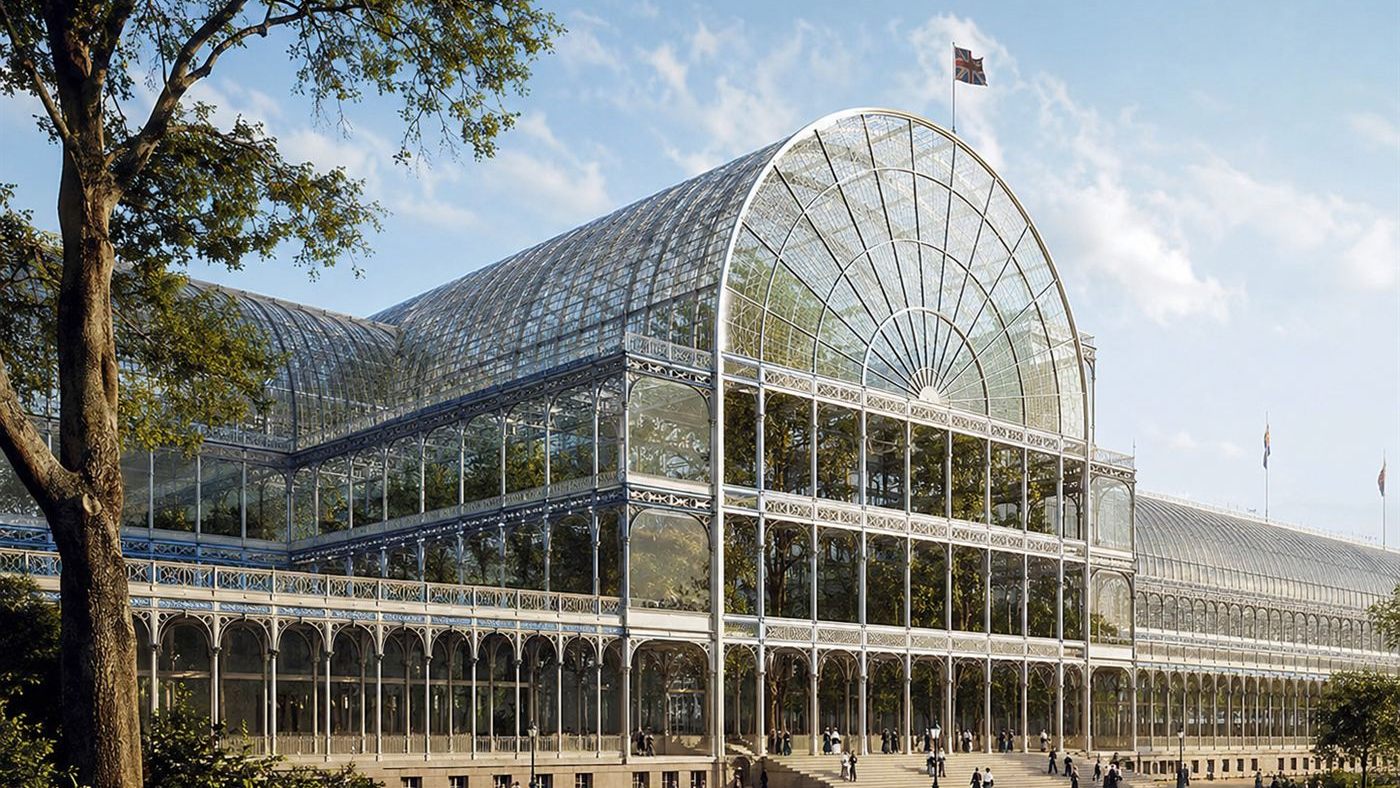
The Crystal Palace, a cathedral of glass raised in months. Illustration: Watts & Wild.
Joseph Paxton was, by trade, a gardener. He had risen to become head gardener to the Duke of Devonshire at Chatsworth, where he built enormous, advanced glasshouses to grow exotic plants. He had no formal training as an architect or an engineer, which in the rigid world of Victorian building should have ruled him out entirely. It did not, because he understood something the architects did not: how to build huge, light structures out of glass and iron.
The committee organising the Great Exhibition was in trouble. It needed to house the world's biggest-ever show of industry, in Hyde Park, and the official design, a giant brick building, was unpopular and slow. Paxton, hearing of the problem, sketched his alternative idea, famously, on a sheet of blotting paper during a railway meeting. It was a building made almost entirely of standardised panes of glass on an iron frame, light, cheap and astonishingly fast to assemble.
How a waterlily shaped the Crystal Palace
The deepest root of the design was not in any drawing office but in a greenhouse pond. A few years earlier Paxton had coaxed a giant Amazon waterlily, Victoria amazonica, into flowering at Chatsworth, the first to bloom in Britain. He was fascinated by its enormous leaves, which could be over a metre across and were stiffened underneath by a web of radiating ribs, a natural piece of structural engineering.
To show how strong that natural design was, as the London Museum recounts, Paxton famously floated his young daughter Annie on one of the leaves, which held her weight on the water. He copied the leaf's trick of bracing a thin surface with slender ribs into his glasshouse roofs, and then scaled it up into the skeleton of the Crystal Palace. A flower had, in effect, taught him how to roof an acre with glass.

The gardener who beat the architects
What turned the idea into a marvel was speed. Because the building was made of repeated, prefabricated parts, identical iron columns and beams and a single standard size of glass pane, it could be mass-produced in factories and bolted together on site like a giant kit. As Britannica notes, the roughly 990,000-square-foot building was completed in just 39 weeks, an almost unthinkable pace for a structure of that size in 1851.
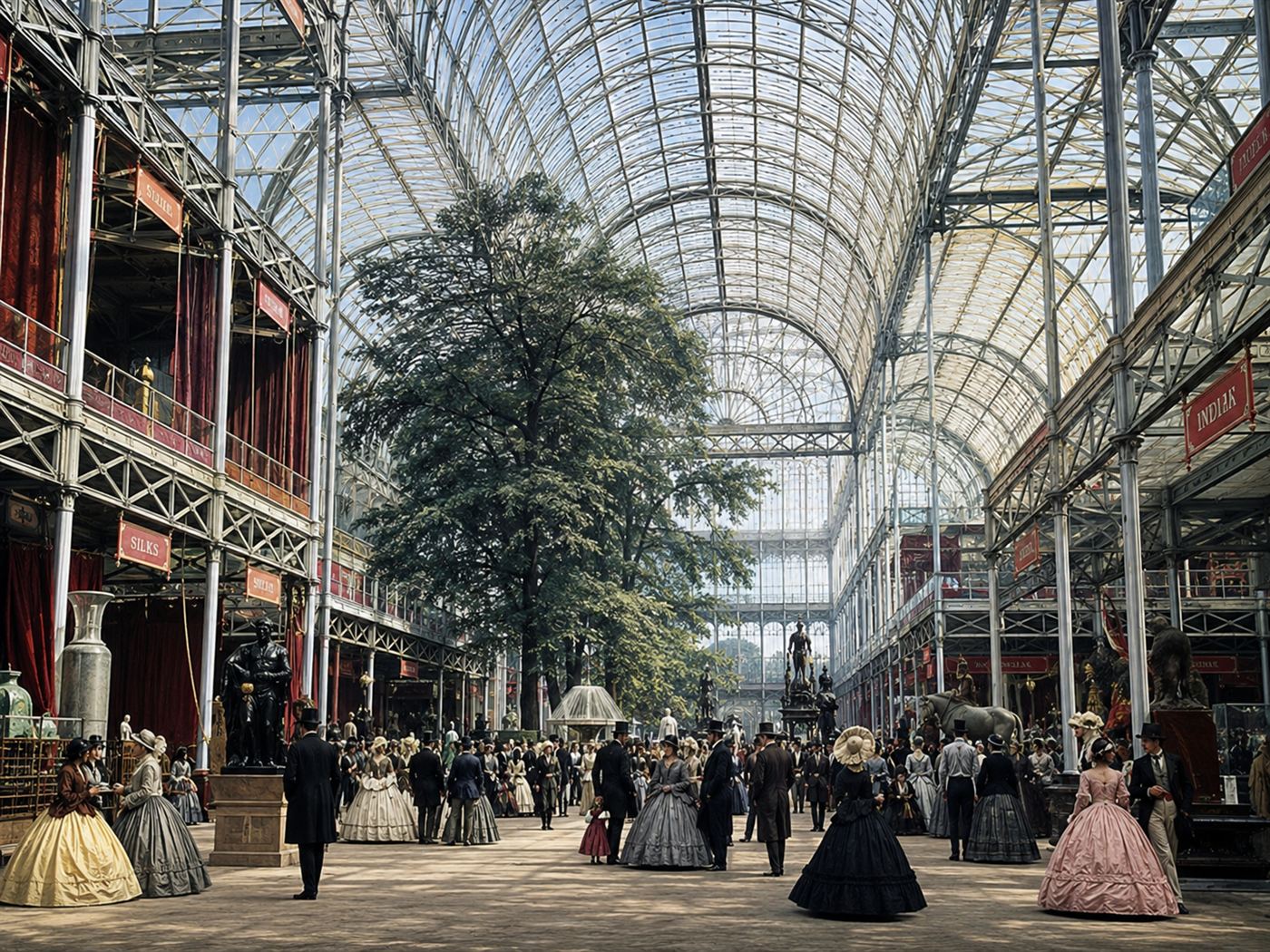
The result enclosed nearly a million square feet under glass, tall enough to keep Hyde Park's elm trees standing inside it. When the Great Exhibition opened, around six million visitors poured through to see the wonders of the industrial age, and the building itself was the greatest exhibit of all. The profits helped found the great museums of South Kensington. A gardener had out-thought the entire architectural profession.
The honest catch
The romance of the lone gardener-genius needs a little trimming. Paxton supplied the brilliant concept, but making it stand up was a team effort, leaning on the engineering firm that detailed and built it and on years of hard-won experience with his Chatsworth glasshouses. The waterlily story is real and Paxton told it himself, but his ridge-and-furrow roof ideas predated the lily too, so the leaf was an inspiration rather than the single secret.
It is also worth remembering what the building was for. The Great Exhibition was a confident showcase of British industry and empire as much as a celebration of human ingenuity, with all the pride and blind spots of its age. And the Crystal Palace did not last. Moved and enlarged at Sydenham after the exhibition, it finally burned to the ground in a spectacular fire in 1936, so the most modern building of its century survives only in pictures.
Why a vanished glass house still matters
Even gone, the Crystal Palace casts a long shadow. Every glass-walled office tower, every airy railway station and shopping arcade, every lightweight prefabricated structure bolted together from standard parts traces its lineage back to that building in Hyde Park. It was the moment architecture realised it could be light, transparent and mass-produced.
And it began with a gardener looking closely at a leaf. Does it change how you see the glass buildings around you to know the whole idea may have started with a waterlily? Tell us in the comments.
Related reading: Paris nearly tore the Eiffel Tower down, until the new science of radio gave the unwanted iron giant a reason to stay, and the original Ferris Wheel, built to out-Eiffel the Eiffel Tower at the 1893 Chicago fair.