Almost turned away at Ellis Island for being a dwarf, this 4-foot immigrant became the wizard who built 120,000-volt lightning for General Electric
In 1888 a penniless German refugee shuffled off the boat at Ellis Island. He stood barely four feet tall, his spine bent by disease, and the inspectors very nearly sent him straight back. That man was Charles Steinmetz, and within a few years he would be the most famous name in American electricity.
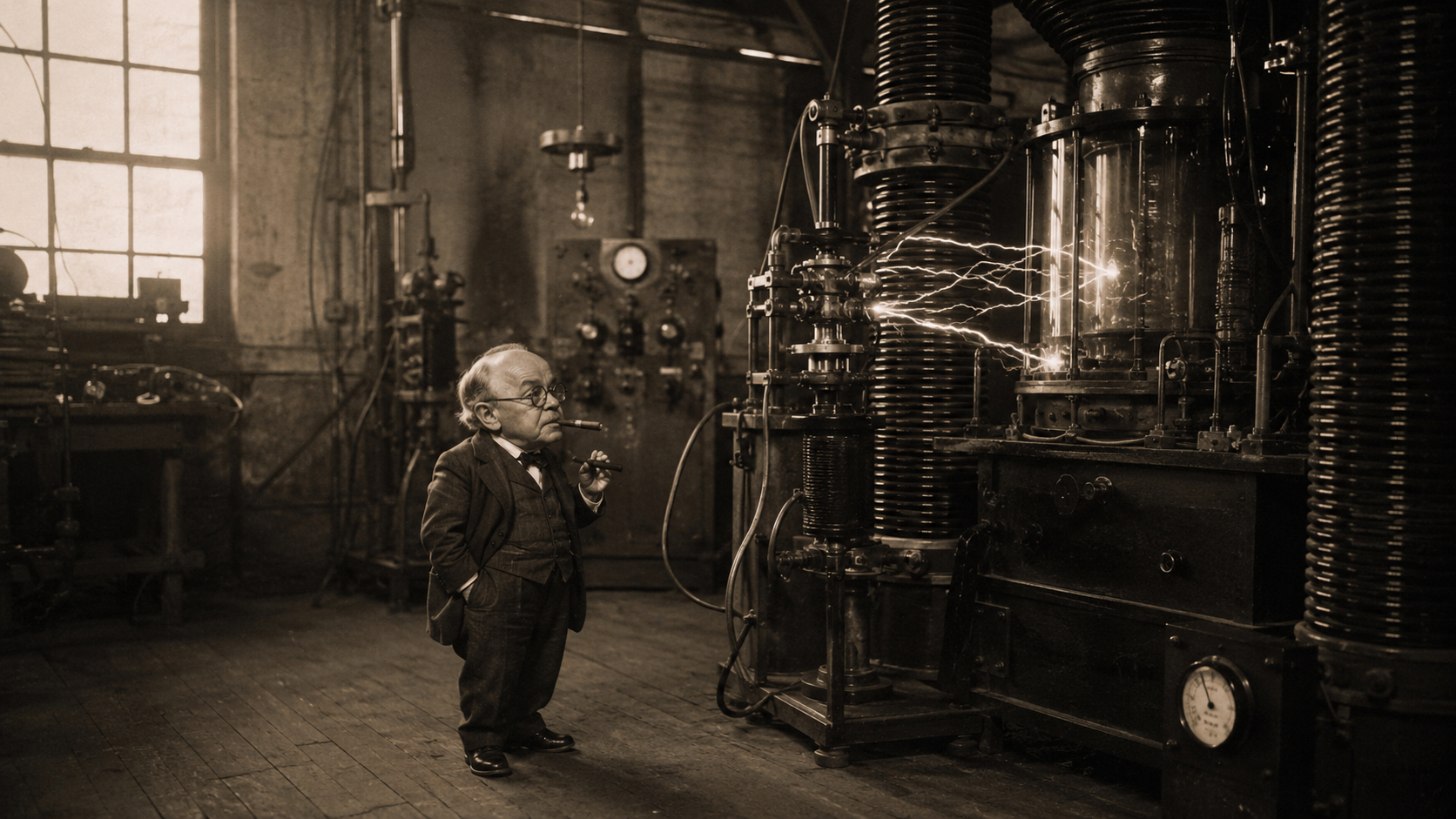
Small in stature, towering in influence: Steinmetz beside the machines he made his life's work. Illustration: Watts & Wild.
For most of us, the people who built the electric age are a blur of bearded inventors and famous patents. The man who arguably did more than anyone to make alternating current usable did not look the part at all. He was tiny, hunched, foreign, and broke, and the country that would come to celebrate him almost refused to let him in.
Charles Proteus Steinmetz was a dwarf with kyphosis, a hereditary curving of the spine that left him about four feet tall with a large head and hands. He had also fled Germany because the police were hunting him for his ties to the Socialist Party. He arrived in 1888 with no money, no English, and a body that immigration officials took one look at and moved to reject.
Almost turned back at the door
The rules at Ellis Island were blunt: the sick, the poor, and the visibly disabled could be sent home, and Steinmetz checked every box that worried an inspector. He was deformed in their eyes, he carried almost no cash, and he spoke no English to explain himself. By the letter of the law, he should have been on the next ship back across the Atlantic.
What saved him was a traveling companion who refused to give up on him. An American friend vouched for the strange little man, insisting to the officials that this was no burden but a genius whose mind would one day repay the country many times over. The inspectors relented. It is hard to think of a wager that aged better.

Who was Charles Steinmetz?
The middle name tells you how his teachers saw him. Back in Germany his professors had nicknamed him Proteus, after the shape-shifting sea god of Greek myth, because the small, awkward student could slip into any problem and come out the other side with an answer. He kept the name for life, proud of it. Charles Steinmetz was, above everything, a mathematician.
That matters, because the electric industry of the 1880s had a maths problem it could barely admit to. Alternating current promised to send power over long distances, but the equations that described it were a tangle that defeated most engineers of the day. The current rose and fell and shifted phase, and nobody had a clean way to predict what a real machine would do.
The maths that made alternating current work
Steinmetz cut through it. He worked out a practical way to handle alternating current using complex numbers, turning a nightmare of shifting waves into something an engineer could write on a single line and actually trust. He took the most frightening maths in the business and made it ordinary, which is exactly why the work mattered far more than any single gadget.
Before that, he had already cracked another puzzle that was costing the young industry a fortune. His law of hysteresis put a number on the energy quietly lost as magnetic cores flipped back and forth inside motors and transformers. Once you could predict that loss, you could design around it, and machines suddenly got smaller, cooler, and far more efficient. It was the kind of breakthrough nobody photographs, and it changed everything downstream.
Work like that is why he was snapped up by the company that became part of the empire reshaping American power. He landed at General Electric and moved to Schenectady, New York, in 1894, and the firm essentially built a research culture around the little man and let him think.
How did Steinmetz make artificial lightning?
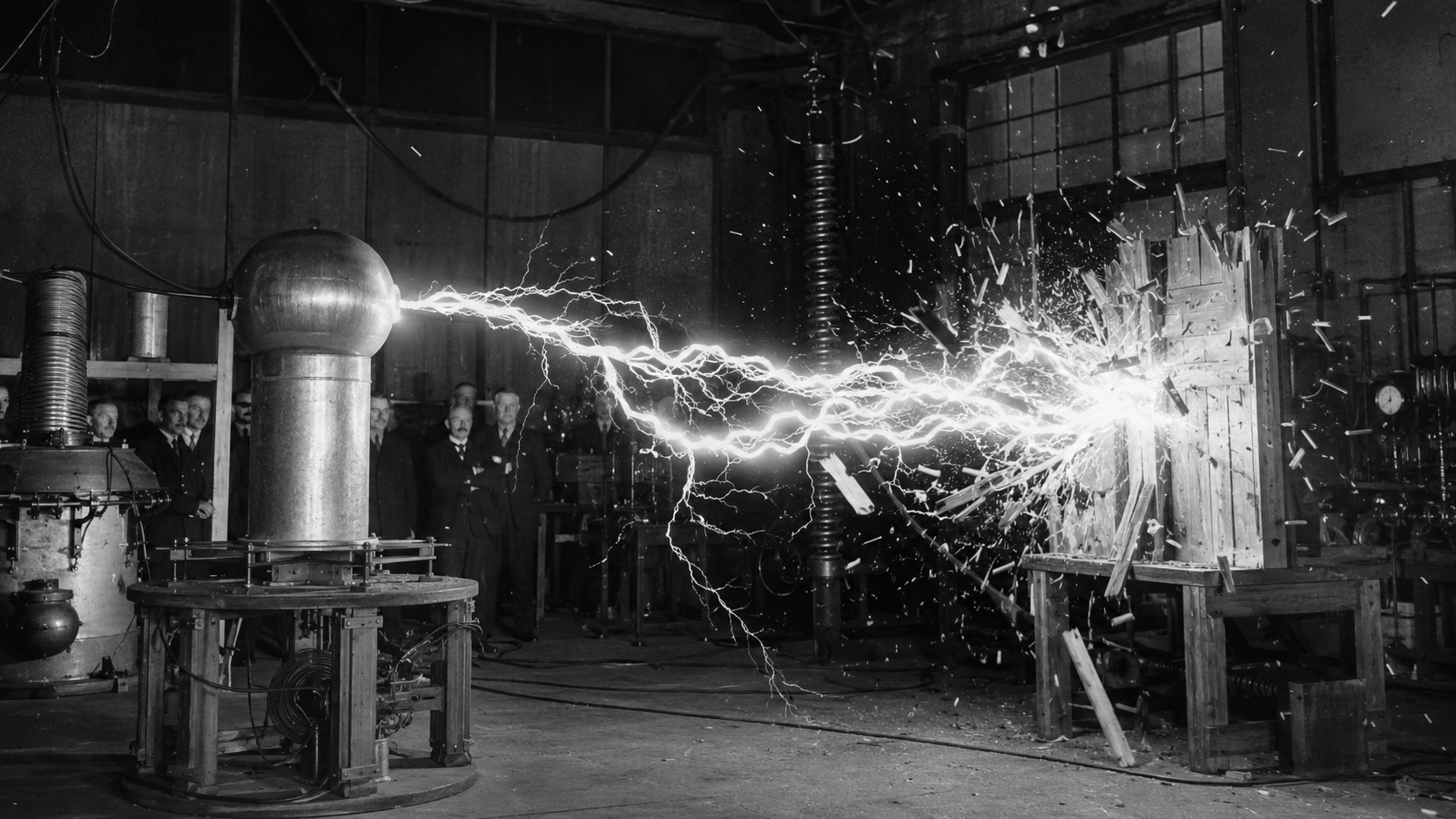
The public, of course, did not fall in love with hysteresis equations. They fell in love with the showman. Late in his life Steinmetz turned his attention to lightning, the one electrical force that still humbled the grid by frying transformers and burning down power lines, and he decided to make his own indoors so he could study it.
In 1922, in front of an audience that included Thomas Edison himself, he threw a switch on a 120,000-volt generator and conjured controlled bolts of lightning across his laboratory. The man-made strikes splintered solid blocks of wood, blew the steeple off a miniature chapel, and split a small tree down the middle. It was theatre, but it had a purpose: the work fed directly into the methods engineers still use to shield power equipment from the real thing.
The $10,000 chalk mark
The most repeated Steinmetz story may be too neat to be wholly true, but it captures him perfectly. Called in to fix a giant generator that had stumped Henry Ford's own engineers, he listened, studied, chalked a single mark on the casing, and told them to rewind the coils at that exact spot. The machine roared back to life.
When Ford balked at the bill of $10,000, Steinmetz is said to have sent back an itemised invoice: one dollar for making a chalk mark, and nine thousand nine hundred and ninety-nine dollars for knowing where to make it. Ford paid in full. Whether or not it happened word for word, everyone who knew Steinmetz agreed it was exactly the sort of thing he would say.
The honest catch
It is tempting to remember Steinmetz only as the cigar-chomping eccentric with the alligator and the cactus garden in his lab, the wizard who summoned lightning to amaze a crowd. He encouraged the legend, and it makes a wonderful story. But it also quietly sells him short.
The lightning show lasted a few seconds; the real contribution was years of dry, patient mathematics that almost nobody outside engineering ever saw. The hysteresis law and the complex-number method for alternating current were not spectacles, and they are precisely why your wall socket works. The spectacle made him famous. The arithmetic made him important, and the two should not be confused.
Why a 4-foot outsider still matters
Steinmetz died in his sleep in October 1923, at just 58, his heart finally giving out. By then the refugee the inspectors had nearly turned away held hundreds of patents and was mourned as one of the architects of the electrical age.
His life is a quiet rebuke to the idea that genius arrives in a tall, healthy, well-funded package. A disabled, penniless political exile who could barely have been less welcome on paper ended up wiring the modern world's nervous system. The country almost sent its greatest electrical mind home before he said a word, and it was talked out of the mistake by a single friend who could see what the rulebook could not.
A penniless, disabled refugee who was almost refused entry went on to make alternating current usable and to forge lightning by hand. Would the modern world have found its electrical mathematics without the friend who vouched for Steinmetz at the door? Tell us what you think in the comments.
Related reading: The war of the currents, when Edison electrocuted animals in public to scare America away from the alternating current that finally won.