Beneath the Antarctic sea ice, a hollow finger of ice called a brinicle grows downward through the water and freezes every slow creature it touches on the seabed
The people who film it call it the icicle of death. A brinicle is a tube of ice that grows downward from the underside of sea ice, racing a plume of supercold brine to the seabed, and freezing solid any starfish or urchin too slow to crawl out of its way.
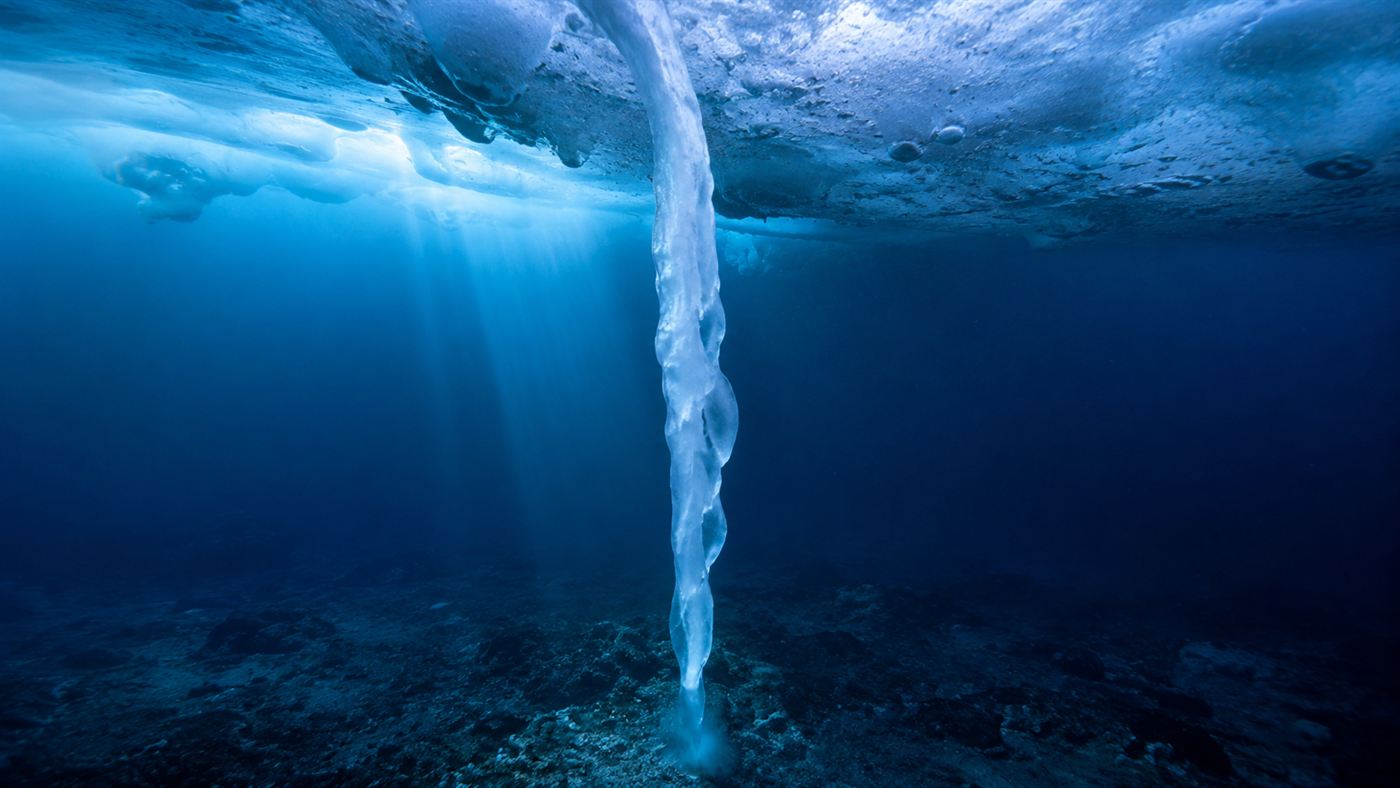
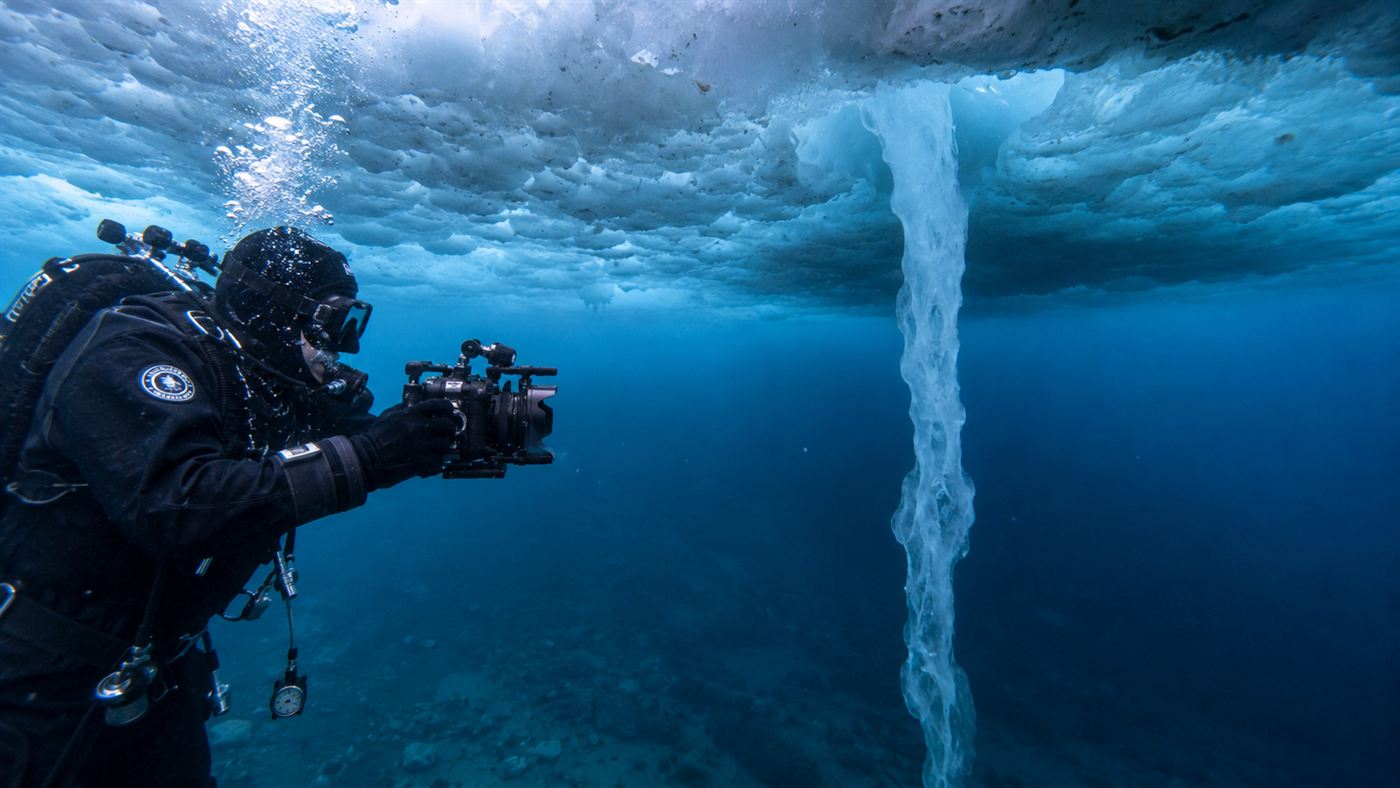
A brinicle, a hollow finger of ice, growing downward beneath the sea ice. Illustration: Watts & Wild.
A brinicle is one of the strangest things the frozen ocean makes. Picture an icicle, but underwater, and growing the wrong way: not melting downward from a roof in the sun, but building itself down through the sea from the underside of the ice, a pale hollow tube reaching for the bottom. Divers who have seen one forming describe something that looks almost alive, a finger of ice feeling its way toward the seabed in the dark.
It has a grim nickname, the icicle of death, and it earns it. As the phenomenon is documented, when a brinicle touches the ocean floor the cold it carries spreads outward and freezes whatever it reaches, including the slow, soft-bodied animals that live there. To understand how a thing like that can build itself, you have to start with what happens when the sea turns to ice.
What is a brinicle? A brinicle is a hollow tube of ice that grows downward beneath sea ice. As seawater freezes, it expels cold, dense, salty brine that sinks and freezes the water around it into an icy finger. Where it reaches the seabed, it can freeze slow creatures solid.
An icicle that grows the wrong way
The first surprise is the direction. Everything about a brinicle runs against the picture of an icicle we carry in our heads. There is no dripping water, no gravity pulling melt into a point. Instead there is a slow downward reach, a tube perhaps a few centimetres across and growing longer by the minute, hanging from the roof of the sea. It is hollow, like a straw, and through that straw runs the cold, heavy liquid that makes the whole thing possible.
What it is not is fast or common. A brinicle needs very particular conditions: bitterly cold air freezing the surface, calm and undisturbed water below, and time. Where those line up, usually in the polar seas, the ocean quietly grows these fragile, lethal columns, most of which no human will ever see. Ice sculpts itself in stranger ways on land too, like the penitentes, fields of ice blades the sun carves high in the Andes.
How freezing seawater builds a brinicle
The trick begins at the surface. When seawater freezes, the ice that forms is almost pure; the salt does not fit into the crystal and gets pushed out. That expelled salt collects into pockets and channels within the new sea ice as a liquid called brine, and this brine is extraordinary stuff: far saltier than the sea, far colder than ordinary water can be while staying liquid, and therefore much denser than the ocean below it.
Being heavier, the brine leaks out of the underside of the ice and sinks. And here is the strange part. The brine is so cold, colder than the freezing point of the more ordinary sea water it falls through, that it chills that surrounding water until it freezes around the descending plume. A sheath of ice forms around the falling stream, and as more brine pours down inside it, the sheath grows downward with it, a hollow tube wrapped around a waterfall of cold. That tube is the brinicle.
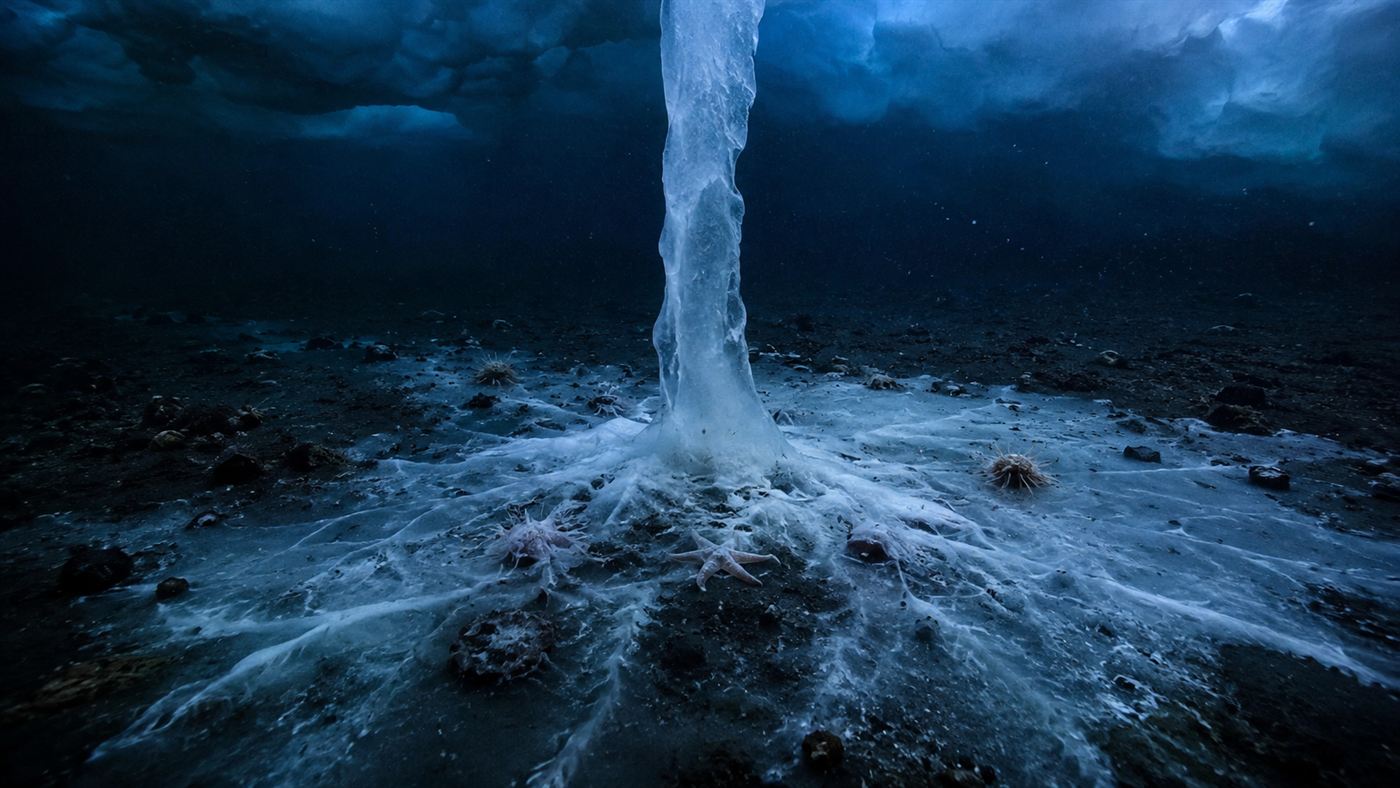
Death on the seabed
If a brinicle reaches the bottom before it stops growing, the descending brine does not pool quietly. It keeps flowing, spreading out across the seabed in a creeping web of freezing cold, and anything too slow to escape is caught. Starfish and sea urchins, animals that move at a crawl at the best of times and slower still in the cold, can be overtaken and frozen where they sit, locked into a spreading sheet of ice.
It is a small, local catastrophe, played out silently in the dark under metres of ice. No one is there to watch it, the creatures involved are simple and slow, and the whole event is over in hours. But it is a genuine glimpse of the ocean doing something that looks less like weather and more like predation, with no predator involved at all.
The crew who finally filmed it
Scientists had known about these ice stalactites for decades; oceanographers working in McMurdo Sound in Antarctica described them back in 1971. But describing a thing and seeing it happen are different, and for forty years no one had captured a brinicle forming. That changed in 2011, when a BBC film crew working on the series Frozen Planet set up time-lapse cameras beneath the sea ice near Little Razorback Island, off Antarctica, and waited in the freezing water as one grew.
The footage they brought back, of a ghostly tube of ice descending and finally touching down to freeze a path across the seabed, took something like five or six hours to play out in real life. Compressed into a few seconds, it became one of the most arresting pieces of natural-history filming of its decade, and the first time most people had ever seen the icicle of death do its work.
A clue to life on other worlds
There is one more twist, and it points far beyond Antarctica. The self-building, tube-shaped structures that brinicles represent, where a chemical difference between two fluids spontaneously raises a thin mineral or icy membrane, fascinate scientists who study the origin of life. Some researchers think similar self-assembling structures could form in the hidden oceans of icy moons like Jupiter's Europa, providing exactly the kind of energy gradients and enclosed spaces in which the first living chemistry might have got started. The humble brinicle, in other words, may be a small, cold rehearsal of something cosmic.
The honest catch
A few cautions keep the wonder honest. A brinicle is not a fast-moving killer; it grows over hours, only in rare, very cold, very still conditions, and only the slowest bottom-dwellers ever get caught. The vast majority form, droop, and break unseen, harming nothing. The dramatic seabed kill is real but uncommon, not a routine massacre.
The link to alien life, too, is a hypothesis rather than a finding. Brinicles are a useful earthly analogue for the kind of self-assembling chemistry that might matter on Europa, but no one has shown that life elsewhere actually began this way. What is solid is the physics: freezing seawater really does spit out cold, heavy brine that can build a hollow finger of ice and freeze a starfish to the ocean floor. That alone is one of the eeriest things our planet does where almost no one can see it.
An icicle that grows downward through the sea, freezing starfish where they sit, and that might whisper something about life on a moon of Jupiter. Does the brinicle strike you as beautiful, sinister, or both? Tell us in the comments.
Related reading: Blood Falls, the Antarctic glacier that bleeds rust-red brine from beneath the ice.