High in the dry Andes stand fields of penitentes, blades of ice taller than a person, carved not by melting or wind but by sunlight turning snow straight into vapour
On the high, dry peaks of the Andes grow strange forests of ice: thousands of tall, leaning blades called penitentes, some taller than a person. Charles Darwin had to push through them in 1835, and giant versions, it turns out, may stand on other worlds.
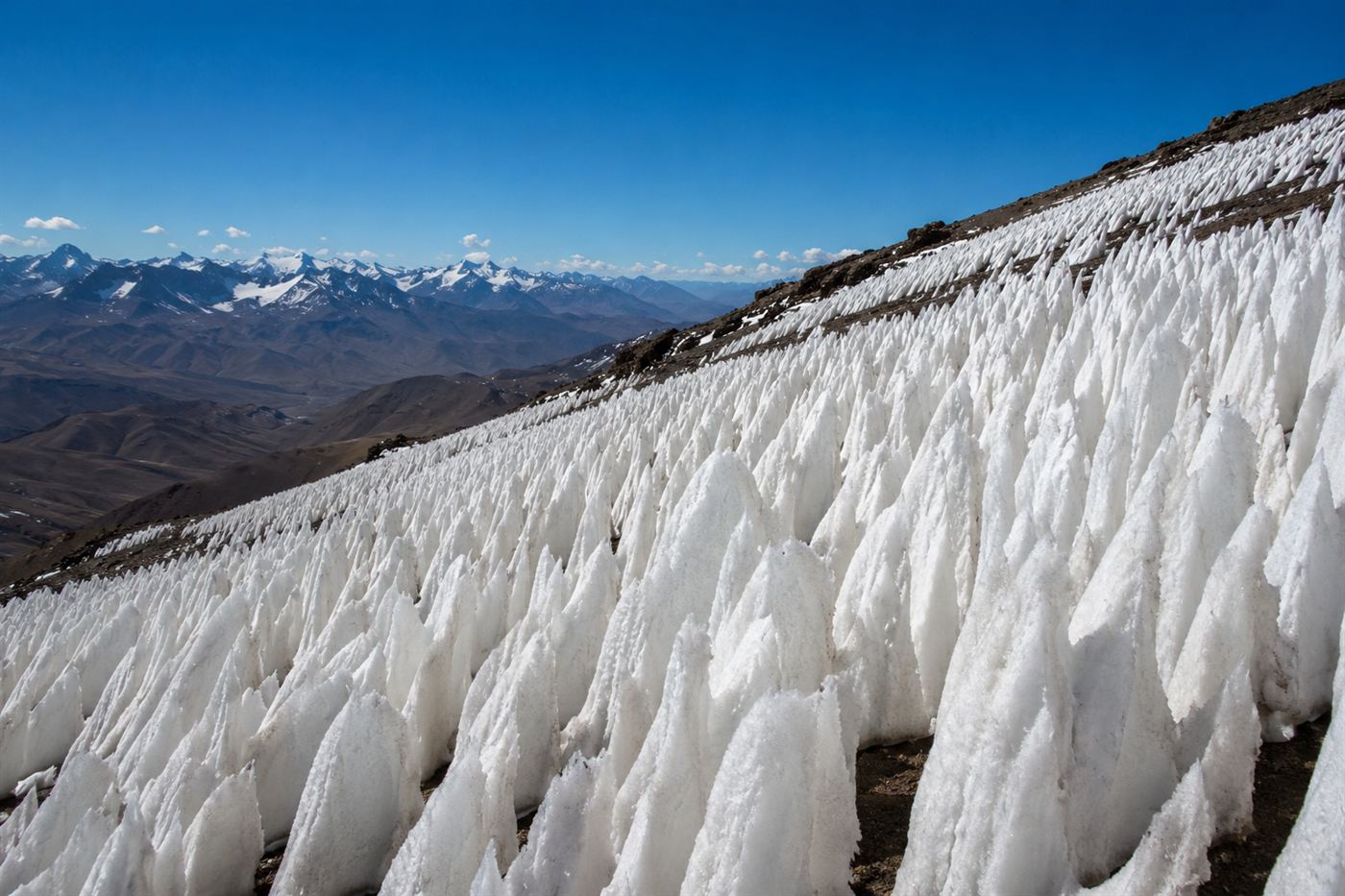
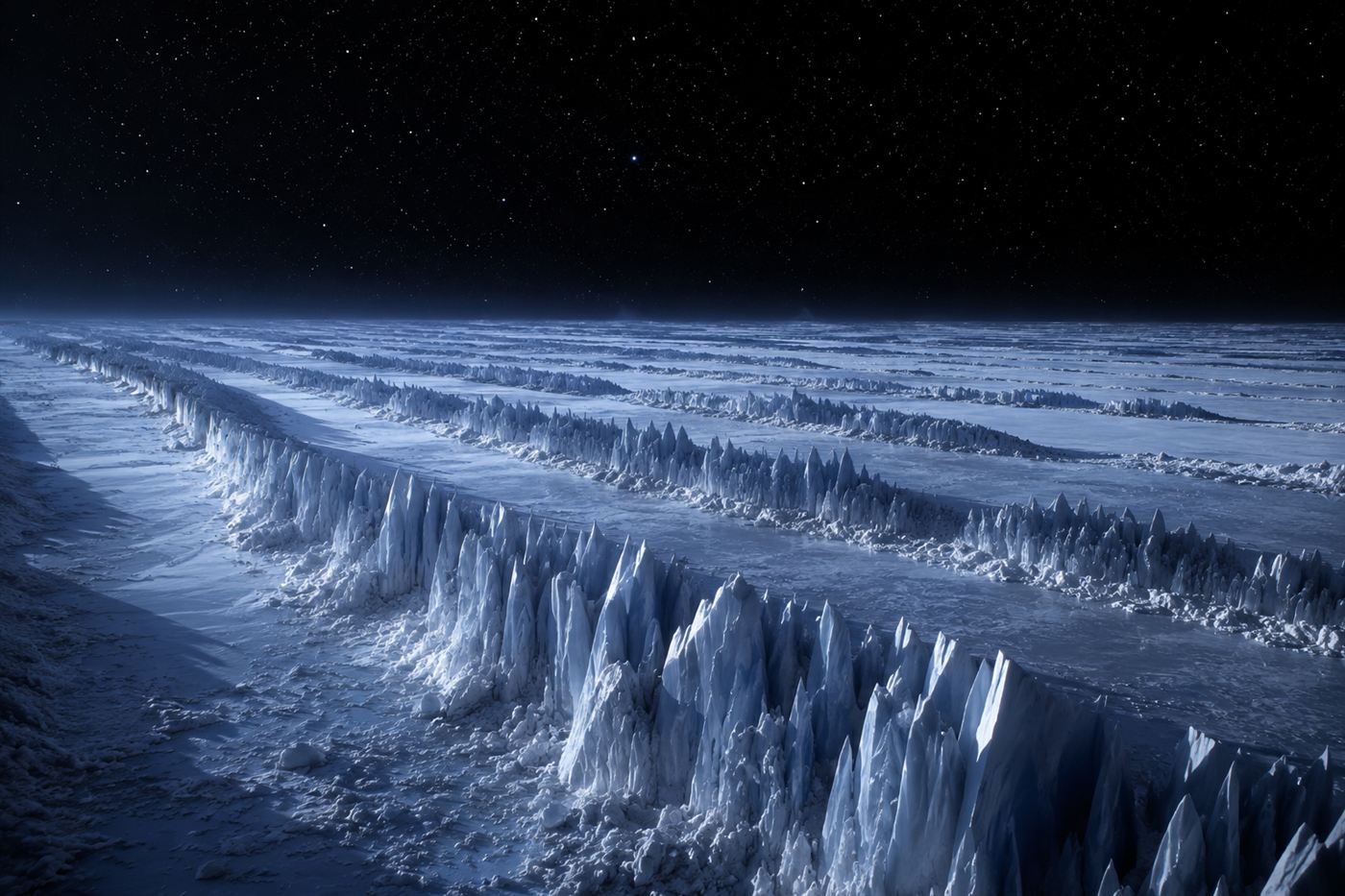
A field of penitentes, tall ice blades, high in the dry Andes. Illustration: Watts & Wild.
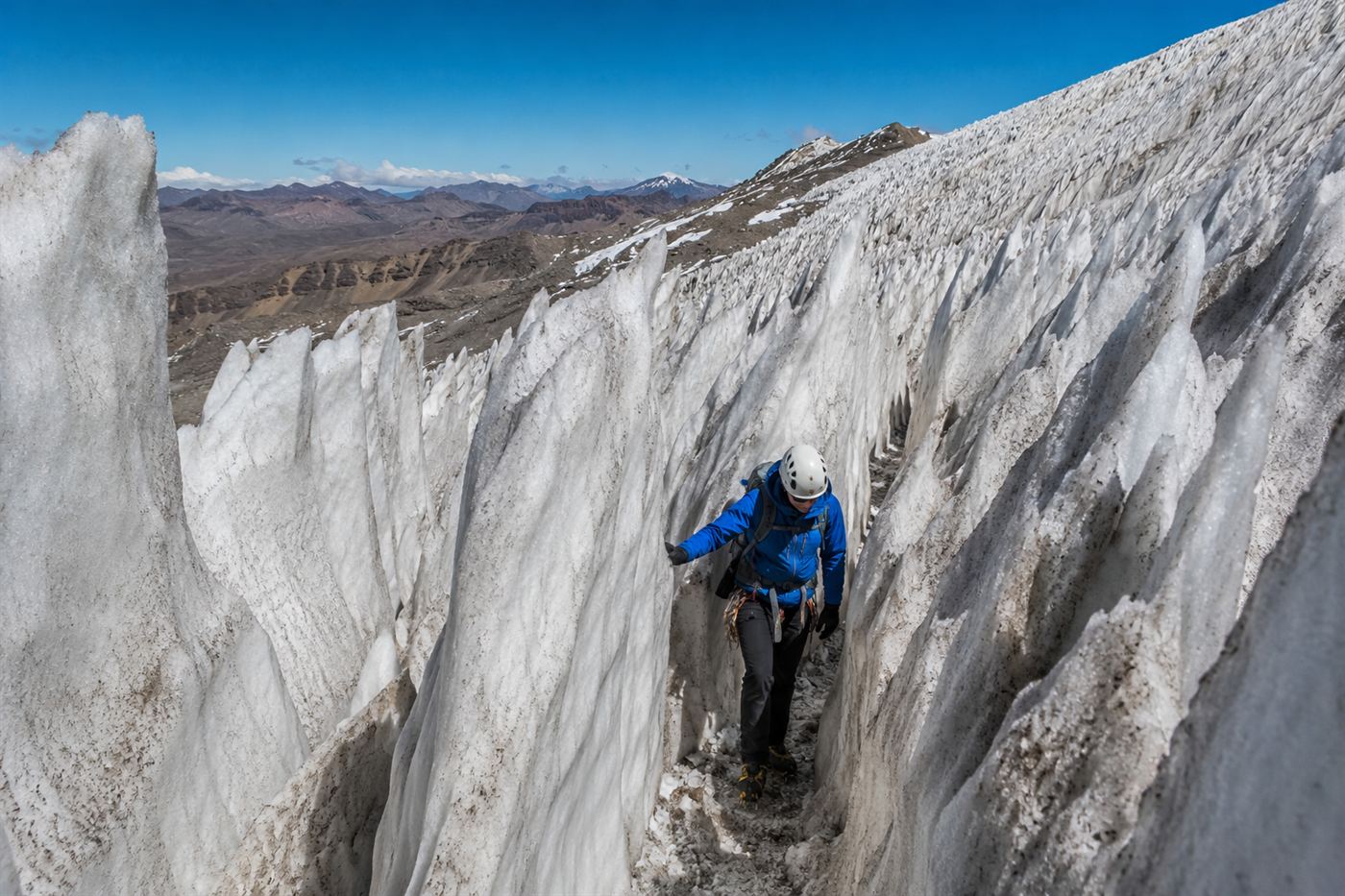
Penitentes are one of the eeriest things ice can do. High in the dry mountains of the Andes, in places where snow should simply lie in smooth sheets, it instead stands up. The snowfield breaks into thousands of tall, narrow blades, all leaning the same way, packed close together like a frozen crowd, and some of them tower over a walking person. The name comes from how they look: ranks of white, hooded shapes bowing toward the sun, like a procession of penitents in a religious parade.
For a long time nobody could agree on what made them, but the explanation turns out to be a strange one. As glaciologists now understand it, penitentes are sculpted not by melting or by wind but by sublimation, the process in which ice turns directly into water vapour without ever becoming liquid. The blades are, in effect, carved out of the snow by sunlight.
What are penitentes? Penitentes are tall, thin blades of hardened snow or ice that form in dense fields in cold, dry, sunny high-altitude places like the Andes. They can stand from a few centimetres to over five metres tall, and they form when intense sunlight turns the snow directly into vapour.
Penitentes, a field of frozen blades
The places where penitentes grow are punishing: high altitude, usually above four thousand metres, where the air is thin, cold and bone dry, and the sunlight is ferocious. There the snow does not behave the way it does in a gentle lowland winter. Instead of slumping and melting, it hardens and rises into these forests of spikes, ranging from little ankle-high spines to monsters more than five metres tall, taller than a giraffe, that a climber has to thread a path through.
Walking across a field of them is slow and strange. The blades are hard and sharp-edged, they all lean toward the midday sun, and they crowd so densely that crossing a slope of mature penitentes can be nearly impossible, a maze of ice that has tripped up travellers for centuries.
Carved by sunlight, not melting
The secret of penitentes is a feedback loop. It begins with a perfectly ordinary snow surface that happens to have tiny random dips in it. In the thin, dry mountain air, sunlight makes the snow sublimate, and the slightly curved bottoms of those dips focus the light a little more strongly, so they sublimate a little faster than the flat areas around them. That makes the dips deepen, which focuses the sunlight more, which deepens them faster still.
Run that runaway process for long enough and the snowfield carves itself apart: the troughs eat downward while the high points between them are left standing, growing into tall blades. The whole eerie forest is self-organising, a pattern that the snow falls into on its own, given enough sun, enough dryness and enough time. The old local belief that the Andean wind sculpted them is wrong; the real sculptor is the sun.
The blades Darwin pushed through
The first scientist to describe penitentes was Charles Darwin. In March 1835, during the voyage of the Beagle, he was crossing the high Andes from Santiago in Chile toward Mendoza in Argentina, and near a high pass he found himself forced to squeeze his way through fields of these ice blades. He noted the explanation the local people gave him, that the strong mountain winds had carved them, and although that turned out to be wrong, his account brought the strange formations to the attention of science. Nearly two centuries later, the spikes that snagged Darwin's mules are still bowing to the same sun.
Why they matter on Earth
Beyond being beautiful and strange, penitentes change how mountains shed their snow. By breaking a smooth white sheet into a field of blades and shaded troughs, they alter how sunlight is absorbed and how the snow turns to water, which affects how much meltwater flows down into the rivers and valleys below. In the dry Andes, where whole cities depend on mountain snow for their water, the behaviour of these ice forests is not just a curiosity but a real piece of the water cycle that scientists need to understand.
Ice spikes on other worlds
The most spectacular twist is that penitentes, or something very like them, are not confined to Earth. When the New Horizons spacecraft flew past Pluto in 2015, it photographed a vast region of "bladed terrain", endless ridges of methane ice standing hundreds of metres tall, far larger than any Andean penitente. Scientists think this Plutonian landscape is carved by a sublimation process closely related to the one that makes penitentes here, which means the same basic trick, sunlight sculpting ice into blades, plays out on a frozen world billions of kilometres away. The humble Andean ice spike has cousins on the edge of the solar system.
The honest catch
A little precision keeps the wonder honest. The basic story of how penitentes form on Earth is well established, though the full physics involves not only sublimation but some melting and trapped moist air down in the troughs, and not every snowfield at altitude produces them; they need a particular, fairly narrow set of conditions. The off-world comparisons need even more care. Pluto's bladed terrain is real and genuinely penitente-like, but it forms under conditions wildly different from a mountain slope, and a popular claim that Jupiter's moon Europa is covered in giant penitentes has been seriously challenged, because the formation seems to need conditions Europa cannot provide.
None of that takes away from the central marvel. On the high, sunlit deserts of ice in the Andes, a smooth blanket of snow quietly organises itself into a forest of leaning blades taller than you are, sculpted by nothing but sunlight and dry air, the same way it did when Darwin struggled through them. The penitentes are a reminder that even something as familiar as snow can, in the right place, do something genuinely otherworldly.
Fields of ice blades taller than a person, carved by sunlight, with giant cousins on Pluto. Would you want to cross a field of penitentes, or admire them from a safe distance? Tell us in the comments.
Related reading: The brinicle, another way ice does something strange and a little sinister.