The wife who stole the first car and drove it into history
One summer morning in 1888, before her husband was awake, a woman rolled his strange three-wheeled machine quietly out of the workshop, loaded her two teenage sons aboard, and set off down the road. She had no driving licence, because no such thing existed. She had no permission, no map for cars, and no garage to call if it broke. She just had a point to prove. Bertha Benz was about to invent the road trip.
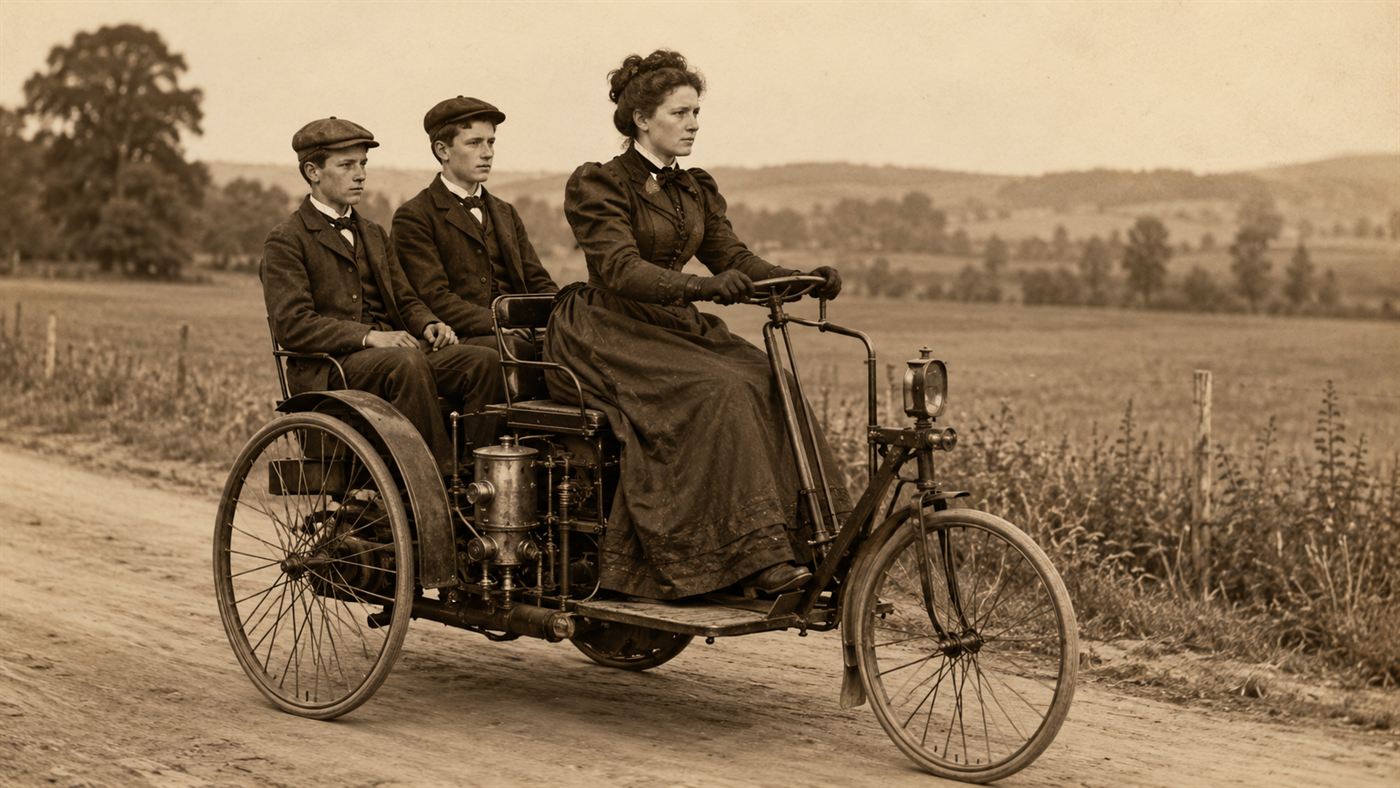
The first long drive in history, made to prove a doubted machine. Illustration: Watts & Wild.
The motorcar is often told as the story of the men who built it. But the machine might have died quietly in a German workshop if not for the woman who decided, without asking anyone, to take it out into the world and show what it could do. Karl Benz designed the first practical automobile, but it was his wife Bertha who proved it was more than a curiosity.
And she did it in the most audacious way imaginable.
A machine the world laughed at
Karl Benz had patented his Patent-Motorwagen, a gasoline-powered three-wheeler, back in 1886. It was a genuine breakthrough, the first car designed from the ground up to be powered by an engine, yet the public dismissed it as a noisy, unreliable toy, and almost no one wanted to buy one.
Benz was a shy, cautious engineer who struggled to sell his own idea, and the venture was running out of money. Bertha had a personal stake in this, in every sense; she had used her own dowry to help fund his work, making her effectively the company's first investor. She was convinced the car only needed to be seen working in the real world, beyond the safe confines of the workshop, and she grew tired of waiting for her husband to make that happen.
How Bertha Benz proved the car worked
So on 5 August 1888 she simply did it herself. Bertha Benz, then 39, set out to drive the Motorwagen the roughly 106 kilometres from Mannheim to Pforzheim to visit her mother, taking her sons Eugen and Richard and leaving only a note for Karl.
No one had ever driven a car that far. There were no petrol stations, no mechanics, no smooth roads built for engines, just rough tracks meant for horses and carts. It was a genuinely risky undertaking, a woman and two boys nursing an experimental machine across the countryside, with every kilometre into the unknown. And almost immediately, things started to go wrong, which turned out to be the most important part of the whole story.
Repairs with a hatpin and a garter
Bertha did not just drive the car. She kept it running by becoming, on the move, its first roadside mechanic. When the fuel line clogged she cleared it with her hatpin, and when a wire shorted out she insulated it with a rubber garter from her stocking.
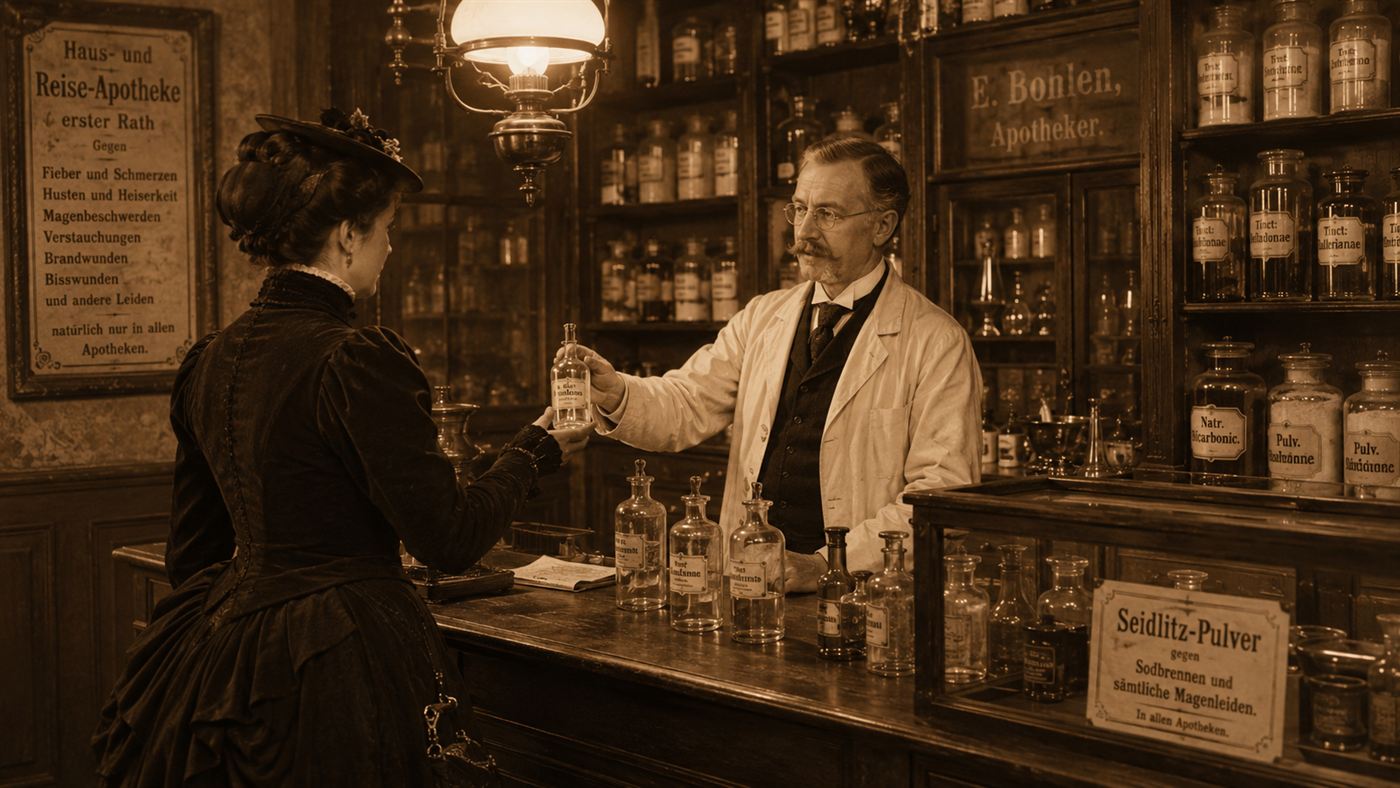
When the engine ran low on its fuel, a cleaning solvent called ligroin, she stopped at a pharmacy in the town of Wiesloch to buy more, making that little shop the first filling station in history. When the wooden brakes began to fail on the hills, she had a cobbler nail strips of leather onto them, inventing the brake lining on the spot. On the steepest slopes she and the boys simply got out and pushed. By the time they arrived, she had not only completed the journey but quietly improved the car, later telling Karl it needed a lower gear for climbing.
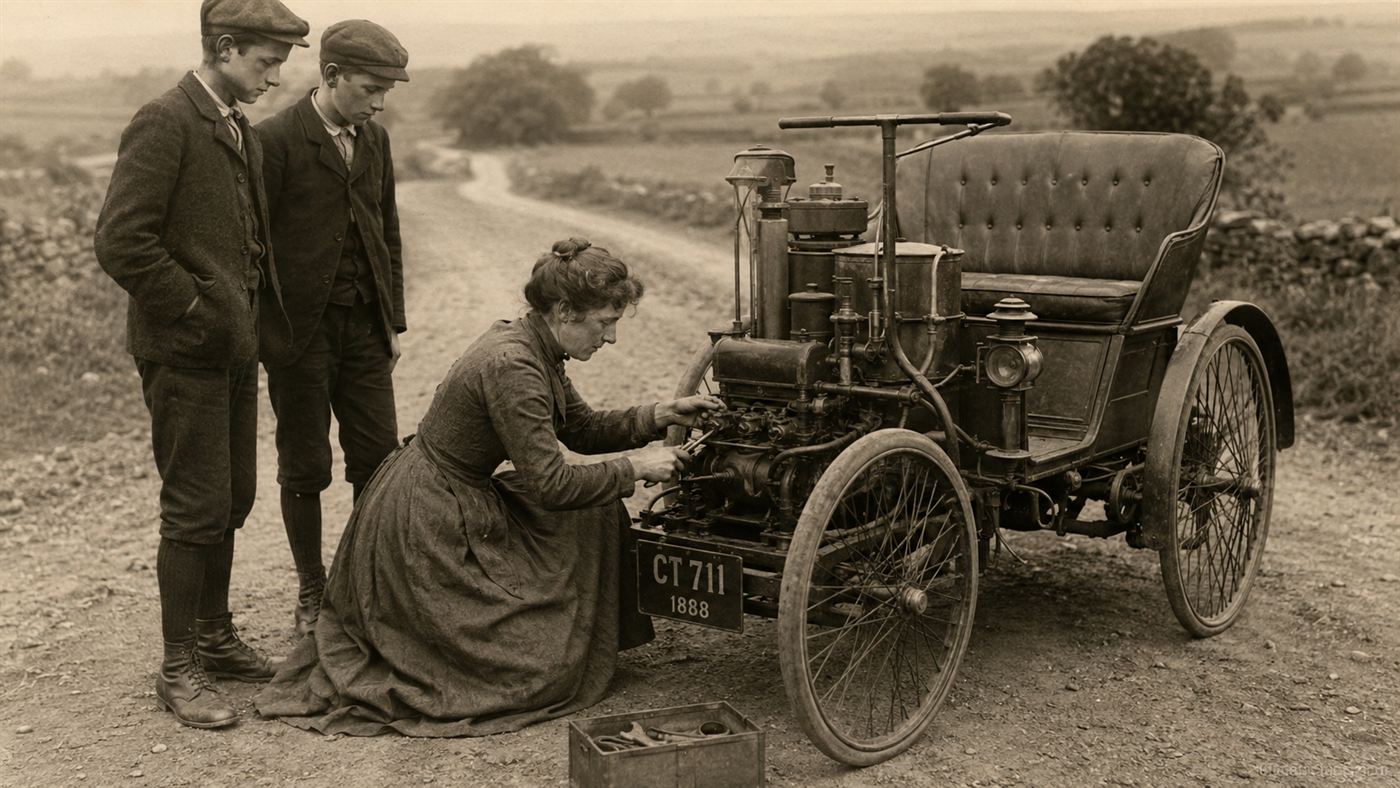
The drive that started the automobile age
The trip was a sensation. Word spread of the woman who had crossed the country in a horseless carriage, and the publicity did exactly what Bertha had gambled it would, turning curiosity into the Benz company's first real sales.
Her drive answered the one question that had been holding the car back: not whether it could move, but whether an ordinary person could actually rely on it to get somewhere. By choosing the messy real world over the tidy workshop, and by fixing every problem as it came, Bertha proved the automobile was practical, sellable, and here to stay. The route she took is now marked across Germany as a memorial in her name, a permanent reminder of the day the car stopped being an experiment and started becoming the future.
What did Bertha Benz do?
She made the first real journey by car. Bertha Benz drove her husband's Motorwagen about 106 kilometres from Mannheim to Pforzheim in 1888, without his knowledge or official permission, in the first long-distance automobile trip ever taken.
It is worth being clear about who did what. Karl Benz invented and patented the car itself, and the engineering was his. What Bertha added was just as vital in its own way: the nerve to test it in the real world, the practical fixes that kept it going, and the marketing instinct her husband lacked. The machine was his. The proof that it mattered was hers.
Why is Bertha Benz important?
Because she turned an invention into an industry. Without her daring drive and the attention it brought, the Benz Motorwagen might have remained an obscure curiosity, and the company that became part of Mercedes-Benz could have failed before the automobile age truly began.
She is remembered now not as a footnote to her husband's patent but as a pioneer in her own right, the world's first long-distance driver and, in a pinch, its first car mechanic. The next time a car simply carries you where you need to go, without drama, remember that someone had to prove it could, and that the someone was a woman who refused to wait for permission.
A woman borrowed the future without asking and drove it sixty-six miles to prove it was real. How many world-changing inventions were saved not by the person who built them, but by the one brave enough to use them? Tell us what you think in the comments.
Related reading: the original Ferris Wheel, another bold gamble that turned a doubted idea into a sensation, and the Iron Bridge, the first great cast-iron span that launched the age of iron and ruined its maker.