The bridge that launched the Industrial Revolution, and ruined its maker
In a wooded gorge in the English countryside stands a bridge that does not look especially remarkable to modern eyes, an elegant arch of dark metal over a quiet river. Yet when it opened in 1781 it was a genuine wonder, the first of its kind anywhere on Earth, and it announced that the world had entered a new age of iron and industry. The Iron Bridge was the moment metal began to build the modern world.
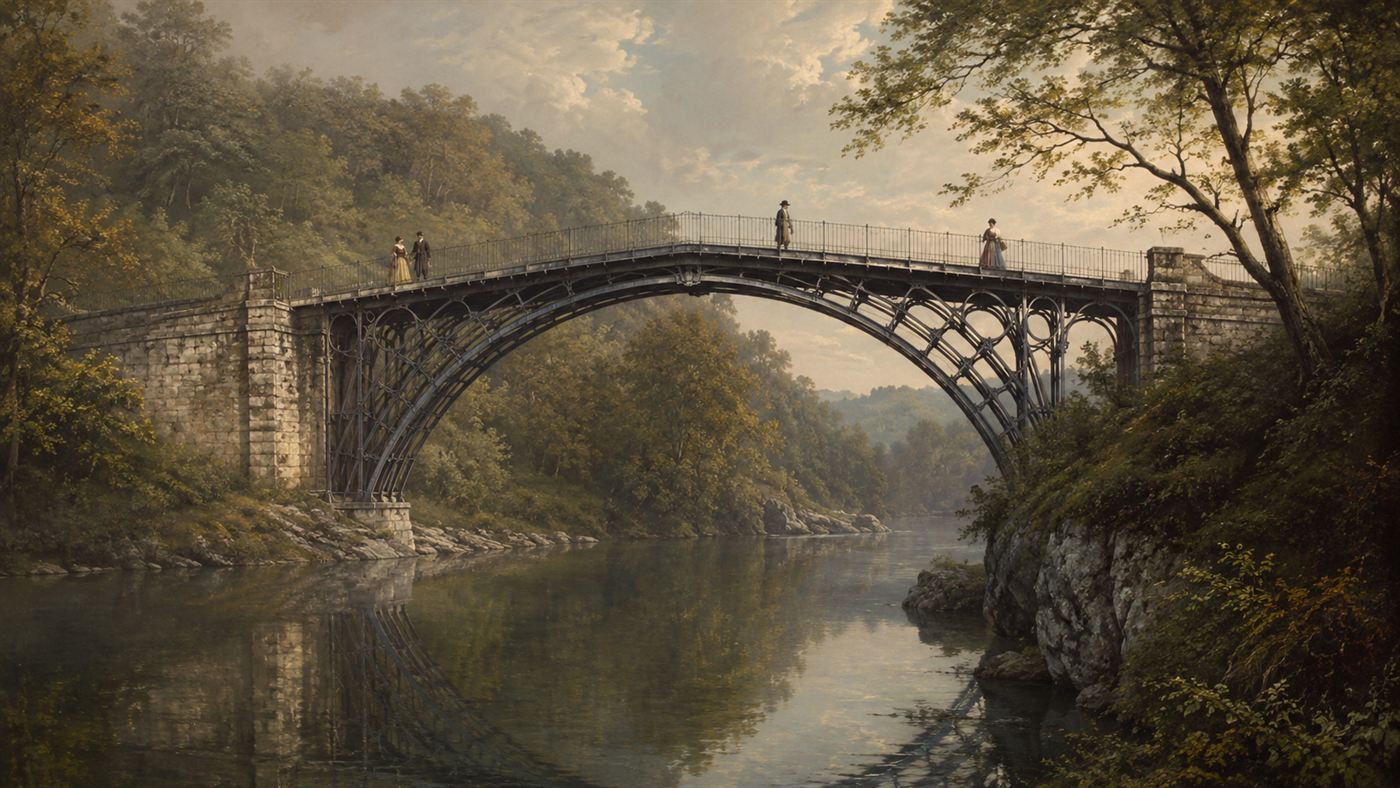
The world's first major cast-iron bridge, arching over the River Severn. Illustration: Watts & Wild.
We are so used to iron and steel holding up our bridges, towers and buildings that it is hard to imagine a time when no one had ever tried it at scale. The Iron Bridge was the bold, risky experiment that proved iron could carry the weight of the future, and it made the place where it stands famous forever.
But behind that triumph is a quieter, sadder story about the man who paid for it.
A new material for a new age
The bridge rose in Coalbrookdale, a valley in Shropshire that had become a beating heart of the early Industrial Revolution. This was thanks to the Darby family, who had pioneered a way of smelting iron using coke made from coal instead of charcoal, making cast iron cheap and plentiful for the first time.
With iron suddenly abundant, the idea arose of using it to do something no one had done before: bridge the River Severn entirely in metal. The design came from a local architect, Thomas Pritchard, though he died only a month or so after work began, leaving others to turn his vision into reality. The man who took it on was the young ironmaster Abraham Darby III, grandson of the family's founder, who would cast the parts, build the bridge, and crucially, pay for it.
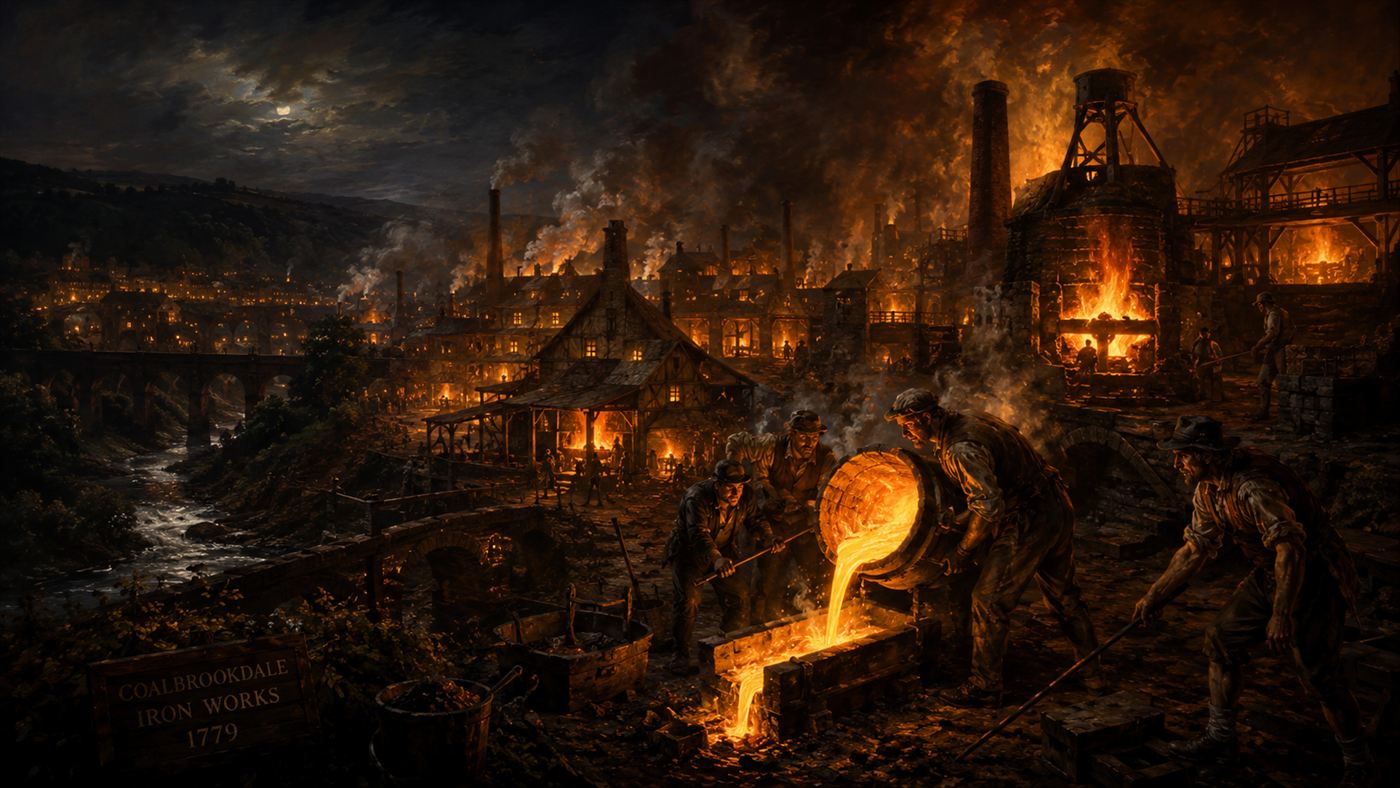
Building with the wrong rulebook
Casting a bridge from iron meant solving problems no one had ever faced. Darby's team used around 378 tonnes of iron to raise a single arch spanning about 30 metres, the largest such casting anyone had attempted.
Fascinatingly, they had no idea how to join iron pieces together, because nobody ever had. So they fell back on the only rulebook they knew, that of the carpenter, fixing the great iron ribs together with joints borrowed from woodworking, like dovetails and wedges, as if the metal were enormous timber. It was a beautiful improvisation, and it worked. The arch held, and it has gone on holding for nearly two and a half centuries, long after everyone learned far better ways to build in iron.
Fame for a place, debt for a man
When it opened on New Year's Day 1781, the bridge was an instant sensation. Artists came to paint it, tourists came to marvel, and the structure became such a symbol of the new industrial world that the whole area took the name Ironbridge.
For Abraham Darby III, though, the glory came at a steep personal price. The bridge cost far more than planned, close to double the original estimate, and Darby carried the resulting debts for years afterwards. He died in 1789, still a young man, having given the world a monument that immortalised his family name while leaving his own finances in ruins. It is worth being fair that the bridge was a collaboration, with Pritchard's design and many hands at the furnaces, but it was Darby who shouldered the risk and the cost, and who paid for the triumph long after the cheering stopped.
Where is the Iron Bridge and when was it built?
It stands where the Industrial Revolution caught fire. The Iron Bridge crosses the River Severn at Coalbrookdale in Shropshire, was cast in 1779, opened in 1781, and is recognised as the world's first major bridge built of cast iron.
The setting is no accident. This was one of the places where modern industry was being invented, where iron was first made cheaply enough to dream of a metal bridge at all. The structure is now a protected World Heritage Site, preserved as the birthplace of an idea, that we could build the world out of iron, that quickly spread across the planet.
Who built the Iron Bridge?
A dead architect's design, raised by an indebted ironmaster. The Iron Bridge was designed by Thomas Pritchard, who died as work started, and was cast, erected and financed by Abraham Darby III, whose family's cheap iron had made it possible.
That division, between the man who imagined it, the family whose furnaces enabled it, and the one who bore its crushing cost, is part of what makes the bridge so human. It was not the work of a single genius but of a place and a moment, and its survival is a quiet memorial to everyone whose effort, and whose ruin, went into the first great structure of the age of iron.
One iron arch over a quiet river opened the door to a world built of metal, and quietly broke the man who made it. How often does the person who takes the first great risk end up paying for everyone who follows? Tell us what you think in the comments.
Related reading: the original Ferris Wheel, another iron marvel that dazzled the world and ruined the engineer behind it.