For 53 years the giant Arecibo dish in Puerto Rico found the first planets beyond our sun and beamed a message to the stars, then in 2020 its 900-ton platform tore loose and crashed into the jungle
For more than half a century, a thousand-foot dish sunk into the hills of Puerto Rico was our sharpest ear on the universe. It found new worlds and won a Nobel Prize. On a December morning in 2020, the whole thing came crashing down, and the country decided not to build it again.
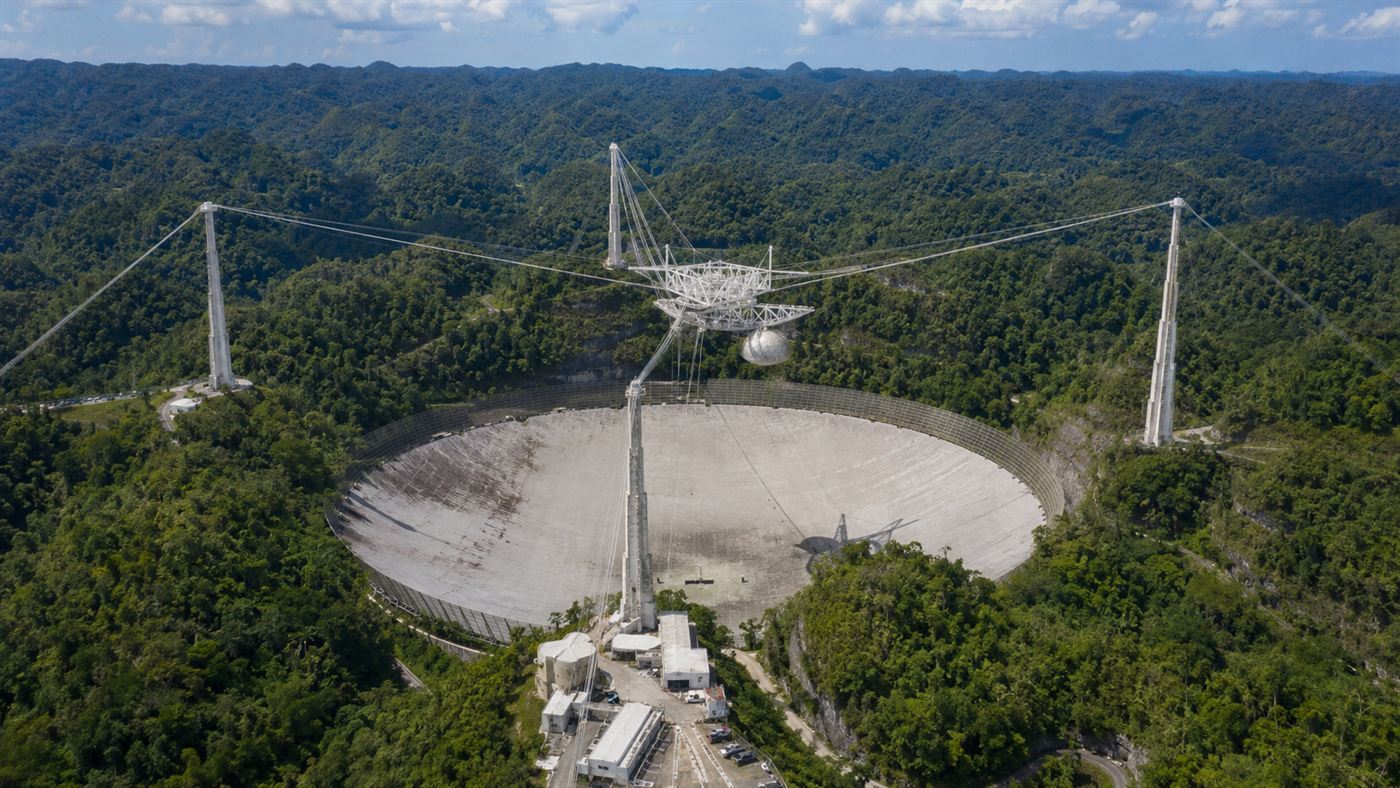
For 53 years the Arecibo dish filled a natural sinkhole in Puerto Rico. Illustration: Watts & Wild.
If you have seen a movie with a giant telescope cradled in a green bowl of jungle, you have seen Arecibo. The 305-meter dish, finished in 1963 and set into a natural sinkhole in the hills of Puerto Rico, was the largest single-dish radio telescope on Earth for 53 years. For generations of astronomers it was not just an instrument but the instrument, the one that could hear the faintest whispers from the far side of the universe.
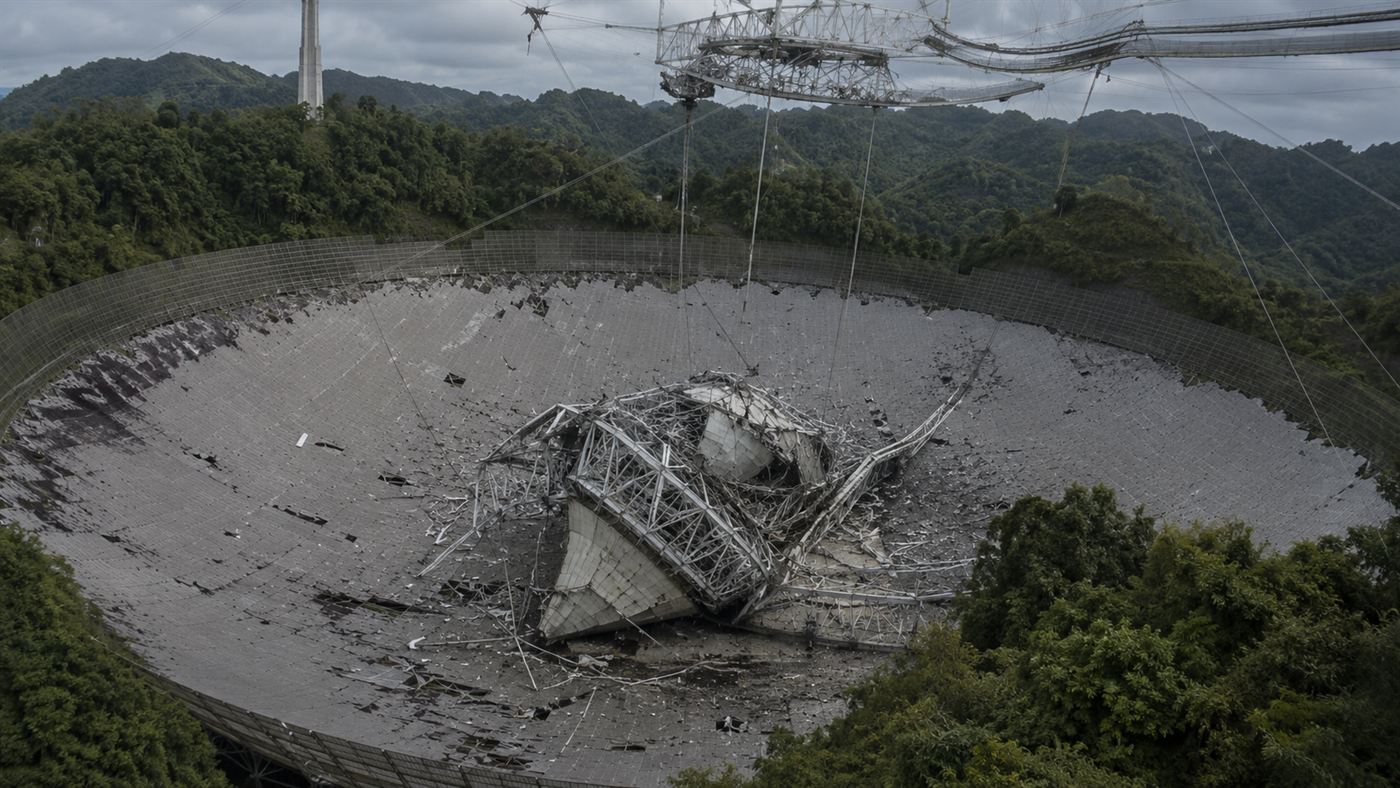
Then, on the morning of December 1, 2020, it fell out of the sky. As Britannica records, the 900-ton platform suspended above the dish broke free and plunged 450 feet, smashing the reflector to pieces. No one was hurt, but a machine that had reshaped astronomy was suddenly a heap of twisted steel. The loss still stings.
The short version: Arecibo was a 305-meter radio telescope in Puerto Rico, the biggest of its kind for over half a century. It discovered the first binary pulsar, helped find the first planets outside our solar system, and sent humanity's first deliberate message to the stars. In December 2020 its support cables failed and the platform collapsed into the dish, ending the observatory for good.
What was the Arecibo Observatory?
The design was a clever cheat. Instead of building a steerable dish, engineers lined a natural limestone sinkhole with nearly 40,000 aluminum panels to make a fixed 1,000-foot reflector, then hung a 900-ton platform of receivers and antennas from cables strung between three towers, about 450 feet overhead. By moving that platform, astronomers could aim the enormous radio telescope at different patches of sky without ever moving the dish itself.
Size was everything. A bigger dish gathers more faint radio energy, and for 53 years nothing else came close, until China finished its larger FAST dish in 2016. Arecibo could also shout as well as listen, firing a powerful radar beam to map the surface of Venus, probe the ice at Mercury's poles, and track the near-Earth asteroids we now practice nudging off course. That radar work made it a quiet backbone of planetary defense.
The discoveries that changed astronomy
Arecibo's list of firsts is staggering. In 1974 a graduate student named Russell Hulse and his adviser Joseph Taylor used it to find the first binary pulsar, two dead stars whirling around each other. Watching that pair slowly spiral inward gave the first solid evidence that gravitational waves are real, exactly as Einstein had predicted, and earned the pair the 1993 Nobel Prize in Physics.
It kept making history. In 1992 astronomers Aleksander Wolszczan and Dale Frail used Arecibo to detect the first confirmed planets outside our solar system, orbiting a pulsar, years before the more famous exoplanet finds around sun-like stars. The dish that most people knew from films was quietly rewriting the textbooks, proving that other worlds and the ripples of gravity itself were out there to be measured.
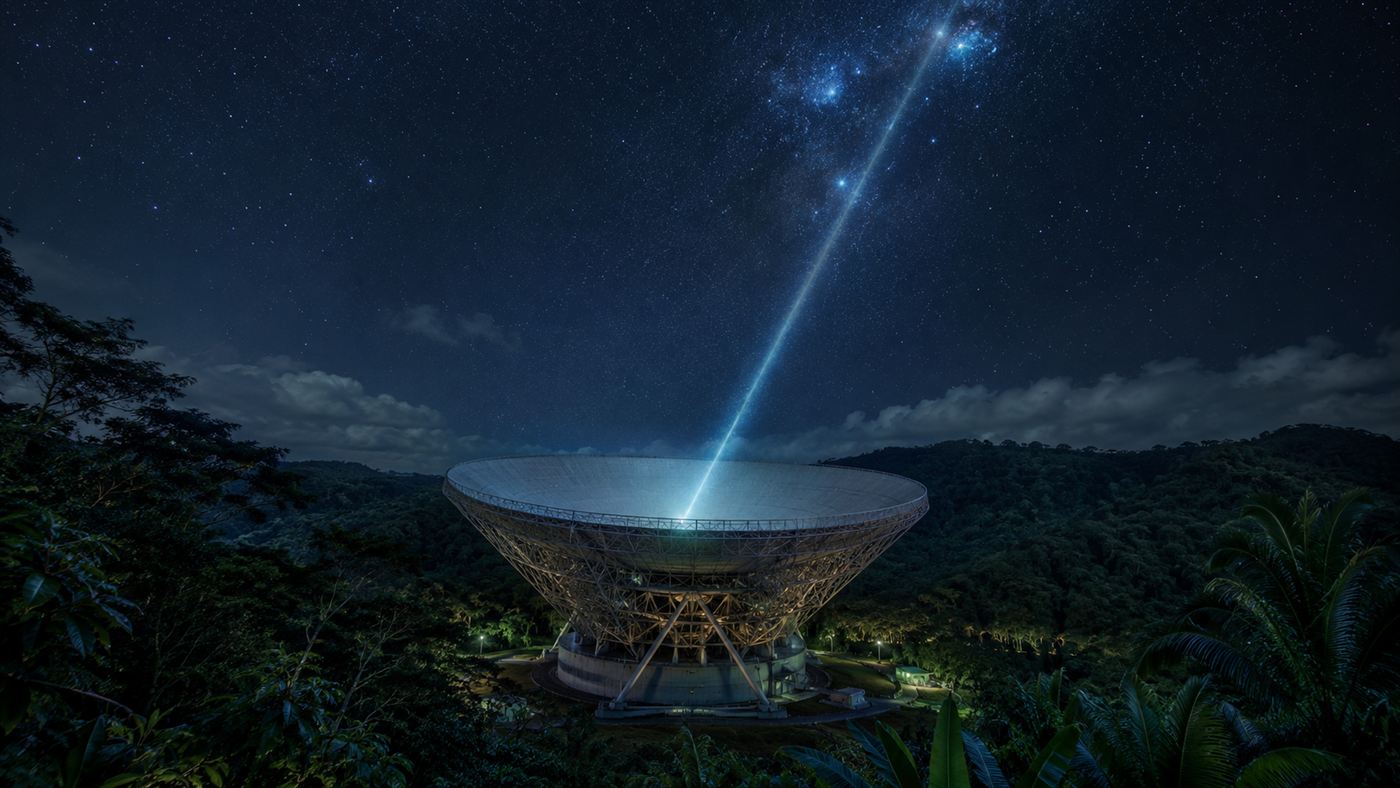
A message to the stars
On November 16, 1974, the observatory did something no one had done on purpose before. Led by astronomers Frank Drake and Carl Sagan, the team used the dish to broadcast the Arecibo message, a 1,679-bit picture aimed at the globular star cluster M13. Decoded, it sketched out our counting system, the atoms of life, the double helix of DNA, a stick figure of a human, and the little dish that sent it.
It was as much art as science. M13 lies about 25,000 light-years away, so the signal will not arrive for 25 millennia, and any reply would take another 25,000 years, which nobody involved mistook for a real conversation. The point was to prove it could be done, and to say, however faintly, that we were here and paying attention. Arecibo remains the closest thing humanity has to a return address.
Why did the Arecibo telescope collapse?
The end came from something small. In August 2020 one of the auxiliary cables slid out of its socket, gouging the dish below. In November a main cable snapped, and engineers realized the whole structure was no longer safe to repair. Before crews could bring the platform down in a controlled way, the remaining cables let go on their own.
As Nature reported, a later engineering review traced the disaster to the slow failure of the zinc-filled sockets that gripped the cables, a breakdown never recorded in more than a hundred years of using that hardware. In other words, Arecibo did not fall because of one careless mistake, but because a trusted piece of engineering failed in a way no one had seen before. It is the kind of humbling surprise that keeps engineers up at night.
The honest catch
It is tempting to frame Arecibo purely as a tragedy that struck from nowhere, but the fuller story is less tidy. The observatory had been underfunded and fighting for its life for years, and the National Science Foundation, which owned it, had been trying to hand off or wind down its share of the costs since well before the cables broke. The collapse was sudden, but the neglect that set the stage was not.
The choice not to rebuild is also more contested than it looks. In 2022 the agency decided against a new telescope on the site, opting for a smaller education center instead, and many astronomers in Puerto Rico and beyond saw that as abandoning both a scientific crown jewel and the island that hosted it. Arecibo's science can be spread among other instruments, but its unique blend of size, radar power and cultural weight has not been replaced, and for now may never be.
A telescope that found new worlds and sent the Arecibo message to the stars is now a field of wreckage in the Puerto Rican hills, and no one has decided to rebuild it. When an irreplaceable scientific instrument falls, should a country rebuild it at any cost or let its work move on to newer machines? Tell us what you think in the comments.
Related reading: how the Green Bank Telescope listens from a valley where WiFi is banned, and how the James Webb Space Telescope now sees the universe from a million miles away. See also how the Hubble Space Telescope launched nearly blind and was saved by astronauts with a pair of glasses.