A boy who nearly drowned in a flooded creek grew up to teach China's cities to drink the rain instead of fighting it, then died chasing that idea across the world
Kongjian Yu spent his life arguing that cities should welcome water rather than wall it out. His sponge city concept became Chinese national policy and spread around the planet. Then the man who survived a childhood flood died on the way to film it.
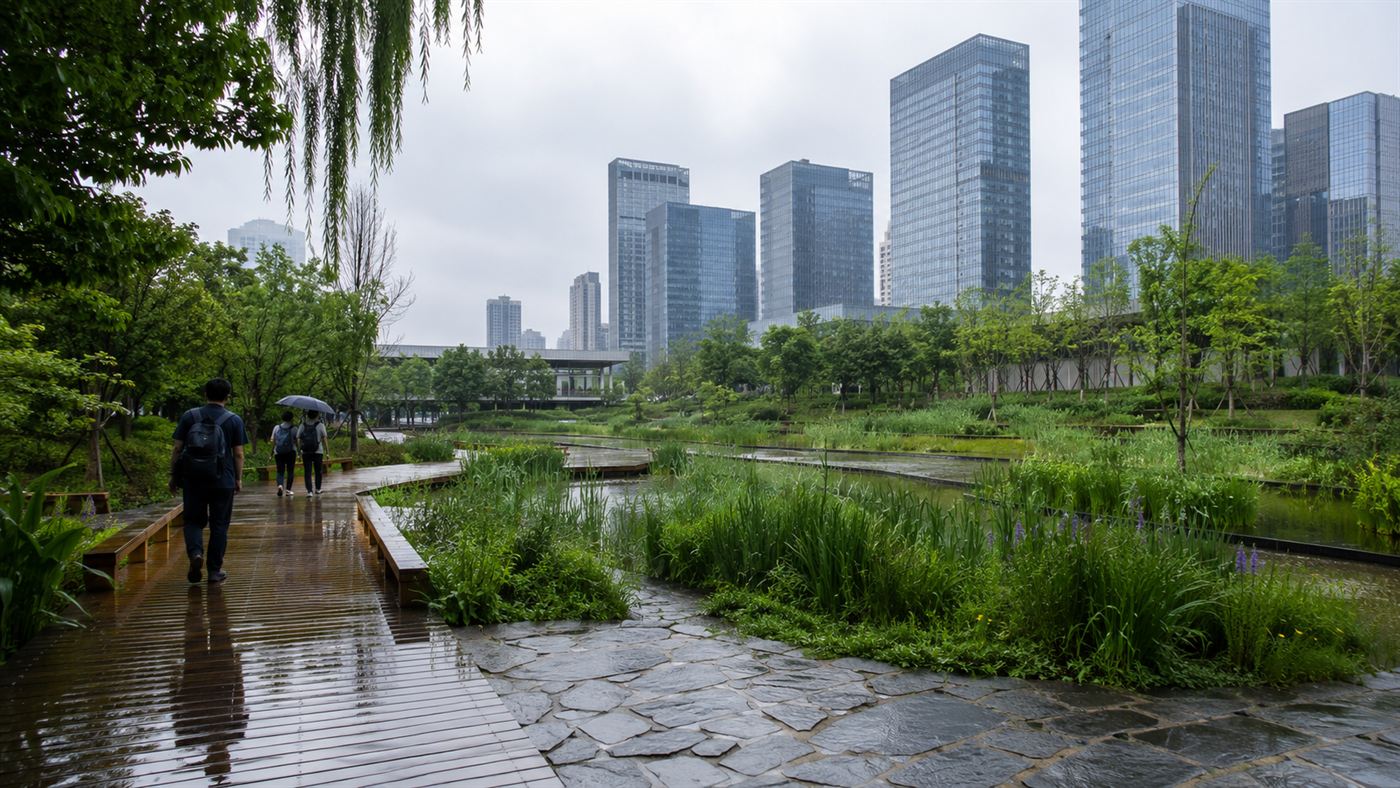
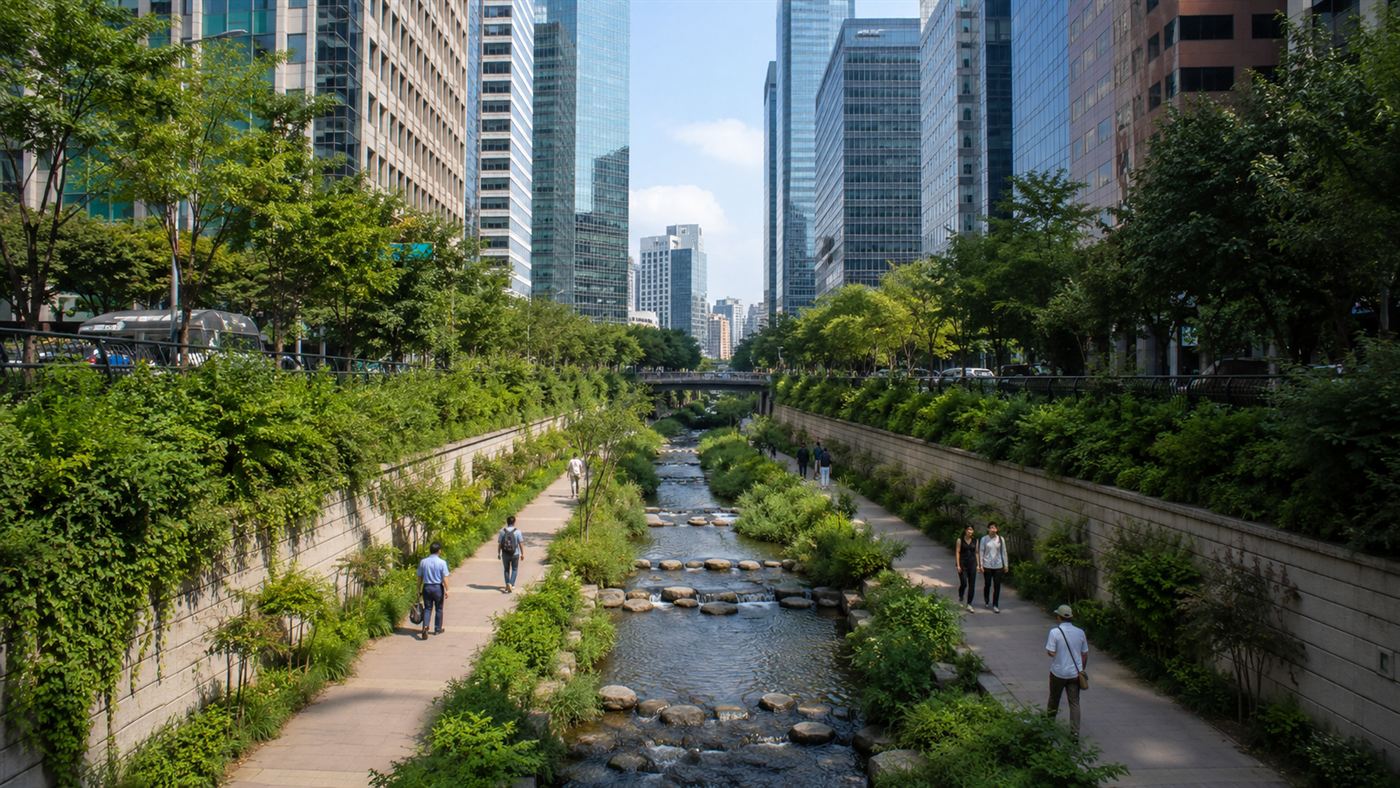
A sponge city park, where ponds, terraces and planted ground are designed to soak up the rain instead of rushing it into drains. Illustration: Watts & Wild.
On September 24, 2025, a small plane went down in the wetlands of Brazil's Pantanal, in the state of Mato Grosso do Sul, and four people died. One of them was Kongjian Yu, a 62 year old Chinese landscape architect who was there to film a documentary, fittingly titled Planeta Esponja, or Planet Sponge. As ArchDaily reported in its obituary, Yu was the founder of the Beijing studio Turenscape and a professor at Peking University, and he was the man who gave the world the sponge city concept. He died chasing the very thing that had defined his life.
His big idea sounds almost too simple to need a famous architect. Stop fighting rain with concrete. Let the city soak it up.
The creek that almost killed him
To understand why one man cared so much about where rainwater goes, you have to go back to a village in Zhejiang Province where he grew up as a peasant's son. A creek called White Sand ran down from the hills through a string of small weirs, lined with willows and wild plants, and it shaped everything he would later believe.
As the writer Josephine Condemi recounted, a young Yu once fell into that creek when it was swollen by the monsoon and nearly drowned, only saving himself by grabbing an overhanging willow branch as the trees and tangled plants slowed the current enough for him to hold on. He was certain of one thing for the rest of his life: if that creek had been straightened into a smooth concrete channel, the way engineers later loved to do, the water would have carried him away.
So when China spent the following decades encasing its rivers in concrete, burying streams in pipes and paving its booming cities, Yu did not see progress. He saw the death of the soft, living edges that had once caught a drowning boy.
From a peasant's son to a national policy
Yu studied landscape architecture, earned a doctorate at Harvard, then came home and founded Turenscape in 1998, building it into a studio of hundreds of designers with hundreds of projects. The name itself is a manifesto: tu for earth, ren for people, the bond between land and human life that he thought modern engineering had severed.
His argument was that the standard playbook of grey infrastructure, the pipes, channels and flood walls meant to move water away as fast as possible, was exactly backwards. The faster you drain a city, the more violently it floods downstream and the more it starves itself of water in a drought. Instead, he wanted cities to behave like the willow-lined creek of his childhood, slowing water down and holding it where it falls.
That idea, which Yu spent years pushing through articles, lectures and built parks, was adopted as official Chinese national policy in 2013. The country would build sponge cities on purpose, at national scale.
What the sponge city concept actually does
A sponge city is less a single invention than a change of attitude made physical. Instead of sealing the ground under concrete and rushing rain into storm drains, it uses what planners now call nature based solutions: wetlands, ponds, rain gardens, green roofs, permeable pavements and parks deliberately built to flood and drain. The ground is allowed to drink.
From 2015, China rolled the approach out through a pilot programme covering dozens of cities, with a national goal that by 2030 eighty percent of urban areas should be able to absorb and reuse at least seventy percent of the rain that falls on them. A captured park that soaks up a storm in the afternoon can release clean water back in a dry spell weeks later. Done well, the same patch of green handles floods and droughts at once, and gives people somewhere pleasant to be in between.
The flood that tested the idea
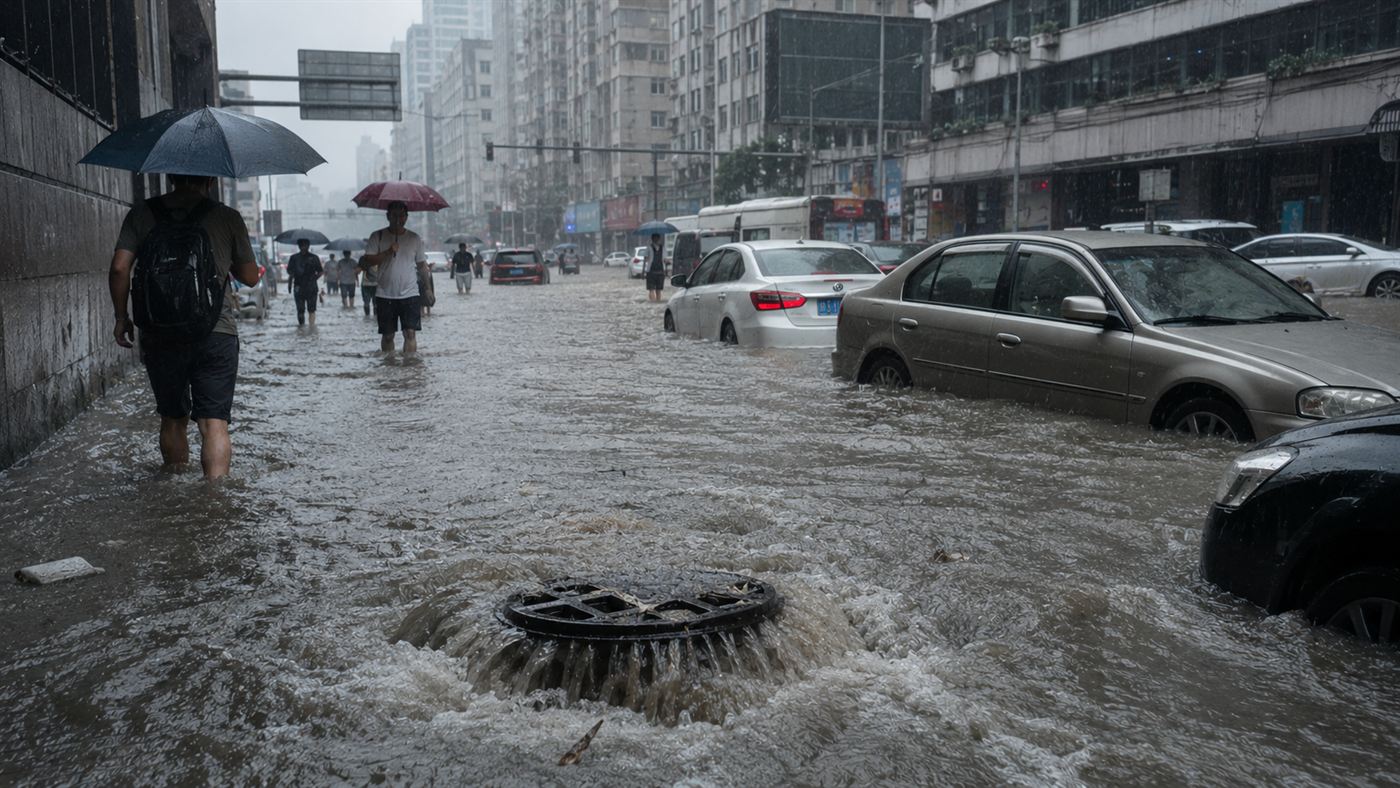
Then came the rain that made the whole concept famous for the wrong reason. In July 2021 the city of Zhengzhou, one of the country's sponge city pilots, was hit by a downpour so extreme that in a single hour it received around 200 millimetres of rain, close to what the city normally gets in a third of a year. The streets and the subway flooded, and more than three hundred people died across the region.
As Voice of America reported afterwards, critics seized on Zhengzhou to argue that sponge cities had been pushed past their limits and were close to useless against this kind of storm. The principle of slowing water down only works up to a point. When rain falls faster than any ground can drink, a sponge simply overflows, and a city designed to hold water can find itself holding far too much.
The honest catch
This is where the comforting version of the story has to stop. A sponge city is not a force field. Yu himself was careful to say the approach was built for the ordinary run of rain, not for a once in a century deluge, and his defenders pointed out that Zhengzhou had been overwhelmed by a genuinely freak event rather than failed by green design. But the limit is real, and pretending otherwise would be a lie.
There are fairer criticisms too. Some Chinese cities slapped the sponge label on projects that were really just ordinary parks, spent the money unevenly, and still left their hardest, most flood prone districts sealed in concrete. A sponge city only works if it is genuinely woven through the whole city, not sprinkled on as a green garnish. And as the climate warms, the freak storms that overwhelm it are arriving more often, which means the soft approach has to be paired with serious traditional drainage, not sold as a replacement for it.
Planet Sponge
None of that erases what Yu got right. For most of the last century the reflex of every growing city was to treat water as an enemy to be channelled, walled and flushed away as fast as possible, and he spent his career arguing, against the engineers, that this was a slow disaster. The sponge city is now studied and copied far beyond China, which is exactly why a documentary crew was flying him over the Brazilian wetlands when he died.
There is a hard symmetry in it. A boy was once saved from a flood by the soft, living edge of a creek, grew up to spend his life teaching cities to keep those edges, and then died in a plane on his way to film the wetlands that proved his point. The idea did not die with him. It is sitting in the ground of dozens of cities, waiting for the next time it rains.
A man who almost drowned as a boy spent his whole life teaching cities to make room for water, and died on his way to film the idea that made him famous. Should our cities keep fighting the rain with concrete, or learn to soak it up the way Kongjian Yu wanted? Tell us what you think in the comments.