To roll its ball of dung away in a straight line, the humble dung beetle looks up at the night sky and steers by the light of the entire Milky Way
It is one of the least glamorous animals imaginable, a beetle that makes its living rolling a ball of manure across the ground. But when night falls and it needs to keep a straight course, the dung beetle lifts its gaze to the heavens and does something no other animal is known to do.
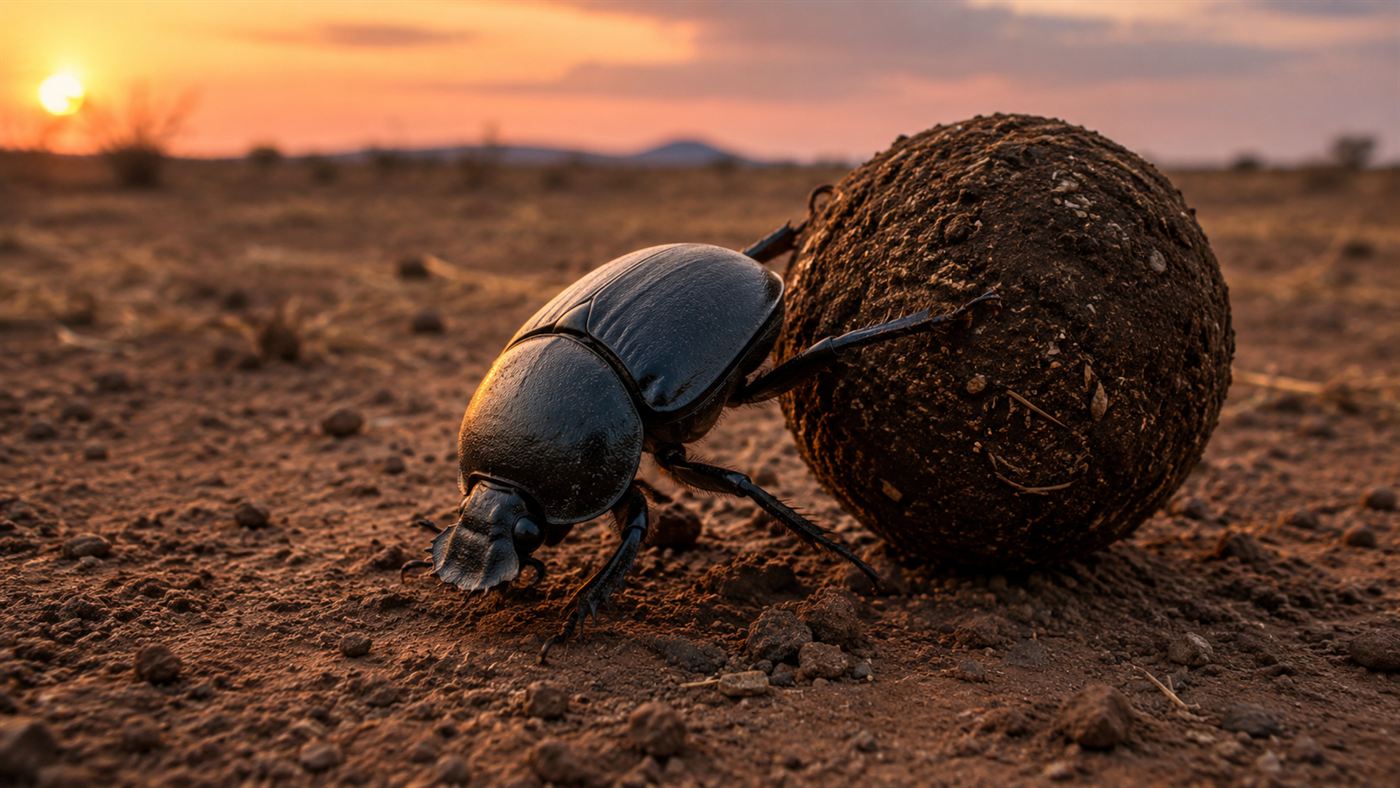
A dung beetle rolling its ball, a journey that depends on holding a perfectly straight line. Illustration: Watts & Wild.
There is a lovely absurdity to it. The mighty Milky Way, a galaxy of hundreds of billions of stars, the grandest thing most of us will ever look at, turns out to have a very practical use for one small insect. The dung beetle uses it as a compass, and in doing so it became, as far as science can tell, the only animal in the world that navigates by the light of the galaxy. A creature that grovels in muck steers by the stars.
As the journal Science reported, researchers found that dung beetles navigate using the Milky Way, the first known example of any animal orienting itself by the galaxy. The finding was so charming and so strange that it delighted scientists and the public alike. But behind the whimsy is a genuinely elegant piece of biology, and a reason this humble beetle needs a compass at all.
The short version: Dung beetles roll balls of dung away from the pile in dead-straight lines to escape rivals who would steal them. To hold that straight course, they use the sky as a compass, and on clear moonless nights African dung beetles orient by the band of the Milky Way. A 2013 study confirmed they are the only animal known to navigate by the galaxy, though they use it as a compass, not a map.
Why a straight line is life or death
To understand the beetle's stargazing, start with its problem. When a fresh pile of dung appears on the African plains, it draws a frantic crowd of beetles, because to them it is food, water and a nursery all at once. Each beetle carves off a chunk, shapes it into a neat ball, and tries to roll it away to bury somewhere safe, where it can eat it or lay an egg inside.
The catch is that everyone else is trying to steal everyone else's ball. In that chaos, the winning move is simple: get away from the pile as fast as possible, in whatever direction, and do not come back. That means rolling in a dead-straight line. A beetle that veers or circles will wander back into the mob and lose its prize. So holding a true, straight bearing is not a nicety for the beetle, it is the difference between keeping its meal and losing it.
Steering by the sky
The problem is that a beetle pushing a ball much bigger than itself, often walking backwards with its head down, has no landmarks to steer by. What it does have is the sky. Dung beetles turn out to be gifted celestial navigators, reading cues in the heavens to keep themselves pointed the same way.
By day, they steer by the sun and by the pattern of polarised light it scatters across the sky, a pattern our eyes cannot see but theirs can. By night, when there is a moon, they use the moon and its own polarised glow. This kind of celestial navigation is impressive enough on its own. But the real puzzle was what the beetles did on clear nights with no moon at all, when the sky held nothing but faint, scattered stars, and yet the beetles still rolled arrow-straight.

The beetle that reads the galaxy
The answer, uncovered by Marie Dacke and her colleagues, was the Milky Way itself. Individual stars are far too dim and point-like for a beetle's simple eyes to use, but the Milky Way is different. It is a broad, bright band of diffuse light stretching across the sky, and that band gives a clear directional line the beetle can lock onto.
The scientists proved it with a wonderfully direct experiment. They took African beetles, of the species Scarabaeus satyrus, into a planetarium, where they could control exactly what appeared overhead. Under a full projected starry sky, the beetles rolled straight. Under a projection of just the Milky Way band and nothing else, they still rolled straight. But under a completely overcast sky, or with tiny cardboard visors taped over their eyes to block the view, they lost their way entirely and wandered in aimless circles. The conclusion was unmistakable: the beetles were reading the galaxy, the first animals ever shown to do so.
How the dung beetle takes its bearing
The way the dung beetle sets its course is oddly charming. Before it starts its journey, and whenever it gets knocked off track, the beetle climbs on top of its dung ball and performs a little rotating dance, turning in place as if scanning the sky. In that moment it seems to take a mental snapshot of the celestial cues around it, fixing a bearing it will then follow.
Having captured that reference, the beetle climbs down and rolls off, keeping its body aligned with the sky pattern it memorised, so that its path stays straight. The dance does a second job too, letting the beetle briefly lift its feet off the scorching ground to cool them. It is a complete little navigation ritual, performed by an animal you would never suspect of looking at the stars at all.

A compass, not a map
It is worth being precise about what the beetle is and is not doing, because the truth is subtler than the headline. The dung beetle is not navigating by the stars in the way a sailor once did, working out where it is and steering toward a destination. It has no map and no target. All it is doing is using the Milky Way as a compass, a fixed reference to hold a single straight direction, any direction, away from the pile.
That might sound like a demotion, but in a way it makes the feat more astonishing, not less. This is an animal with a brain about the size of a grain of rice, no bigger than a pinhead, and it has evolved to use the largest structure in its visible universe for the simplest of tasks, walking in a straight line. It does not understand the galaxy, of course. It just found, over millions of years, that the bright smear across the night is the most reliable ruler in the sky, and it learned to draw a straight line along it.
The honest catch
A couple of clarifications keep the wonder honest. The Milky Way is only one of the beetle's tools, and not usually its main one. On most nights the moon or the sun and their polarised light do the work, and the galaxy comes into its own mainly on clear, moonless nights when nothing else is available. So this is a backup compass as much as a primary one, and the beetle is not gazing at the heavens out of anything like wonder, only reading a bright line.
There is also a quiet sting in the tale. The beetle's galactic compass only works if it can actually see the Milky Way, and across much of the world it no longer can. As EarthSky has noted in covering this research, the growing glow of artificial light is washing the Milky Way out of the night sky for a large share of humanity. The same light pollution that hides the galaxy from our own eyes may be quietly disorienting the creatures that depend on it. A beetle has been steering by the galaxy for millions of years, and in a couple of generations we have started to erase the very sky it reads. Even the humblest wonders, it turns out, can be dimmed by what we do without ever noticing them at all.
A beetle rolling manure turns out to steer by the same galaxy that fills our telescopes. Is the dung beetle's stargazing a delightful reminder of how ingenious nature is, or a warning that we are dimming a sky that living things quietly depend on? Tell us what you think in the comments.
Related reading: Migratory birds, which navigate by a compass of a very different and stranger kind. For another insect that keeps uncanny time, see the synchronous fireflies that flash in unison across the Great Smoky Mountains.
More from Watts & Wild
More in Energy & the Wild →



Maria writes about wildlife, ecology, and the strange places where nature and human history collide. She is based in Brazil.