In 1880 Alexander Graham Bell sent the sound of his own voice through open air on a beam of sunlight, called it the greatest invention of his life, and then watched the world forget it for a hundred years
Everyone knows Alexander Graham Bell invented the telephone. Almost nobody knows that four years later he did something he thought was even more remarkable: he made a ray of light talk. He was so proud of it that he called it his greatest work, and yet it would sit useless and forgotten for the better part of a century.
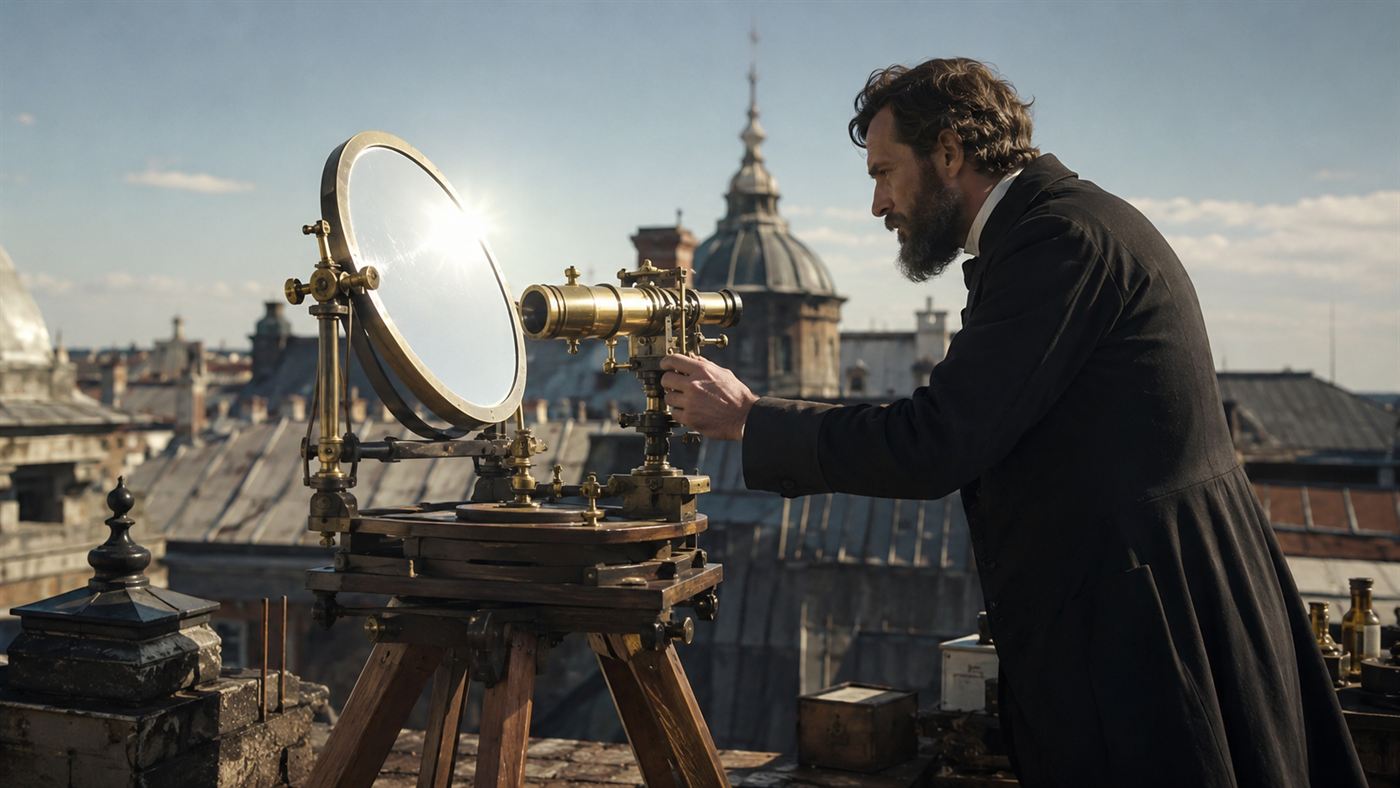
Bell's rooftop apparatus turned a beam of sunlight into a telephone line. Illustration: Watts & Wild.
In the spring of 1880, in a laboratory in Washington, Alexander Graham Bell and his assistant Charles Sumner Tainter were chasing an idea that sounds like magic even now. They wanted to send the human voice not down a wire, but through the empty air, carried on nothing but a beam of light.
The device they built to do it was the photophone, and against all odds, it worked. It is one of the great forgotten inventions of history, partly because it was so far ahead of everything around it that the world simply had no use for it yet. Bell had reached into the future and pulled back something nobody was ready for.
The short version: Bell figured out how to make sound ride on a beam of light, built a working photophone, and transmitted speech through the air with it. It was brilliant and completely impractical in 1880, so it was shelved, only for the same core idea to quietly take over the world a hundred years later.
The invention Bell loved more than the telephone
It is a striking thing to say about the man who gave us the telephone, but Bell himself rated this higher. He wrote that the photophone was the greatest invention he had ever made, greater even than the device that made him famous, and his excitement leaps off the page in his own words about it.
When his first clear transmission succeeded, Bell was almost giddy, declaring that he had heard a ray of the sun laugh and cough and sing. For the inventor of the telephone to be that moved suggests he sensed, correctly, that he had touched on something profound about light and communication, even if he could not yet prove why it mattered.
How does a photophone send sound on light?
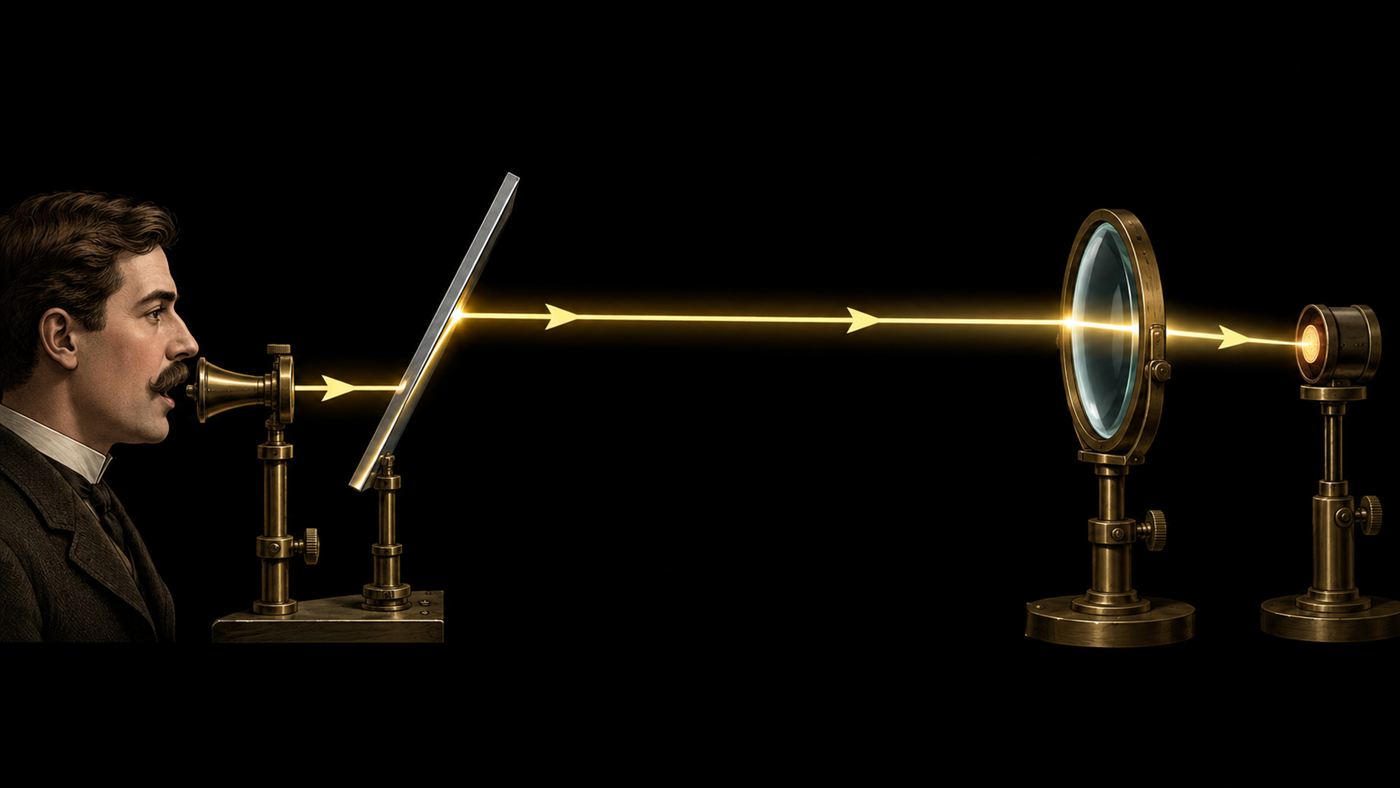
The mechanism is beautifully simple. At the transmitting end, a person spoke into a mouthpiece aimed at a thin, flexible mirror. Their voice made the mirror vibrate, and a beam of sunlight bounced off it, so the reflected light flickered in step with the speech, brightening and dimming to the exact rhythm of the words.
At the receiving end, that trembling beam of light was focused onto a piece of the element selenium, whose electrical resistance changes depending on how much light hits it. Wired into a battery and an ordinary telephone receiver, the selenium turned the flickering light back into a copy of the original voice. The whole conversation crossed the gap on a ray of sun.
The day a sunbeam spoke
On June 3, 1880, Bell put it to the test across the rooftops of Washington. His assistant stood in one building while Bell aimed the beam from another, roughly 200 metres away, and spoke into the apparatus. The words came through clearly, carried entirely on light, the first wireless voice message ever sent.
Think about what that means. Sixteen years before Marconi's famous radio experiments, a voice had already flown through the open air with no wire at all, riding a beam of light between two rooftops. In that moment the photophone became the true ancestor of every wireless conversation humanity has had since.
Why the photophone went nowhere
And then, almost nothing happened. The problem was painfully practical: the photophone needed a clear, straight line of sight and a strong source of light, which in 1880 meant the sun. A passing cloud, a rain shower, fog, or simply nightfall would cut the beam and kill the call stone dead.
There was also no way to boost a fading signal over distance, and no reliable artificial light bright and steady enough to replace the sun. A telephone wire, by contrast, worked in any weather, day or night, rain or shine. Faced with something so temperamental, the world sensibly stuck with wires, and the photophone was quietly packed away.
The honest catch
It is romantic to call this a work of genius the world was too foolish to appreciate, but that is not quite fair. The truth is that Bell had the right idea and none of the tools to make it useful, because the technology it really needed would not exist for generations.
To carry light reliably you need something the atmosphere cannot spoil, and to make it a bright, controllable beam you need a laser, and to detect it cleanly you need far better sensors than a lump of selenium. None of that existed in 1880. The photophone was not ignored out of stupidity, it was simply stranded a hundred years before its supporting cast arrived.

A hundred years ahead of its time
When that supporting cast finally arrived, in the form of the laser and hair-thin glass fibers that trap and guide light, Bell's idea came roaring back to life. Modern fiber optics do exactly what the photophone did, sending voices and data as flickers of light, only now down protected strands of glass where no cloud can ever interrupt them.
Almost every phone call, message and web page you send today travels for at least part of its journey as pulses of light in a fiber, which is the photophone's dream finally fulfilled. Bell was right to be giddy on that rooftop. He had simply arrived, as true visionaries often do, embarrassingly early.
A voice rode a sunbeam across two rooftops in 1880, and the world had to wait a century to understand what it had just seen. How many other inventions do you think are sitting in old notebooks right now, brilliant and useless, just waiting for the rest of technology to catch up? Tell us what you think in the comments.
Related reading: the impossible cable that first carried messages under the whole Atlantic Ocean. See also the self-taught bookbinder who found how to make electricity from a magnet, and the blacksmith who built the first electric motor and died broke.