A poor bookbinder taught himself science and found how to make electricity from a magnet, and now every power plant runs on his idea
The man who arguably did more than anyone to give the world electric power never went to university, never really learned mathematics, and started out gluing books for a living. Michael Faraday was the son of a struggling blacksmith, and by rights he should have vanished into history unknown. Instead he found the secret that turns motion into electricity, and quietly lit up the modern world.
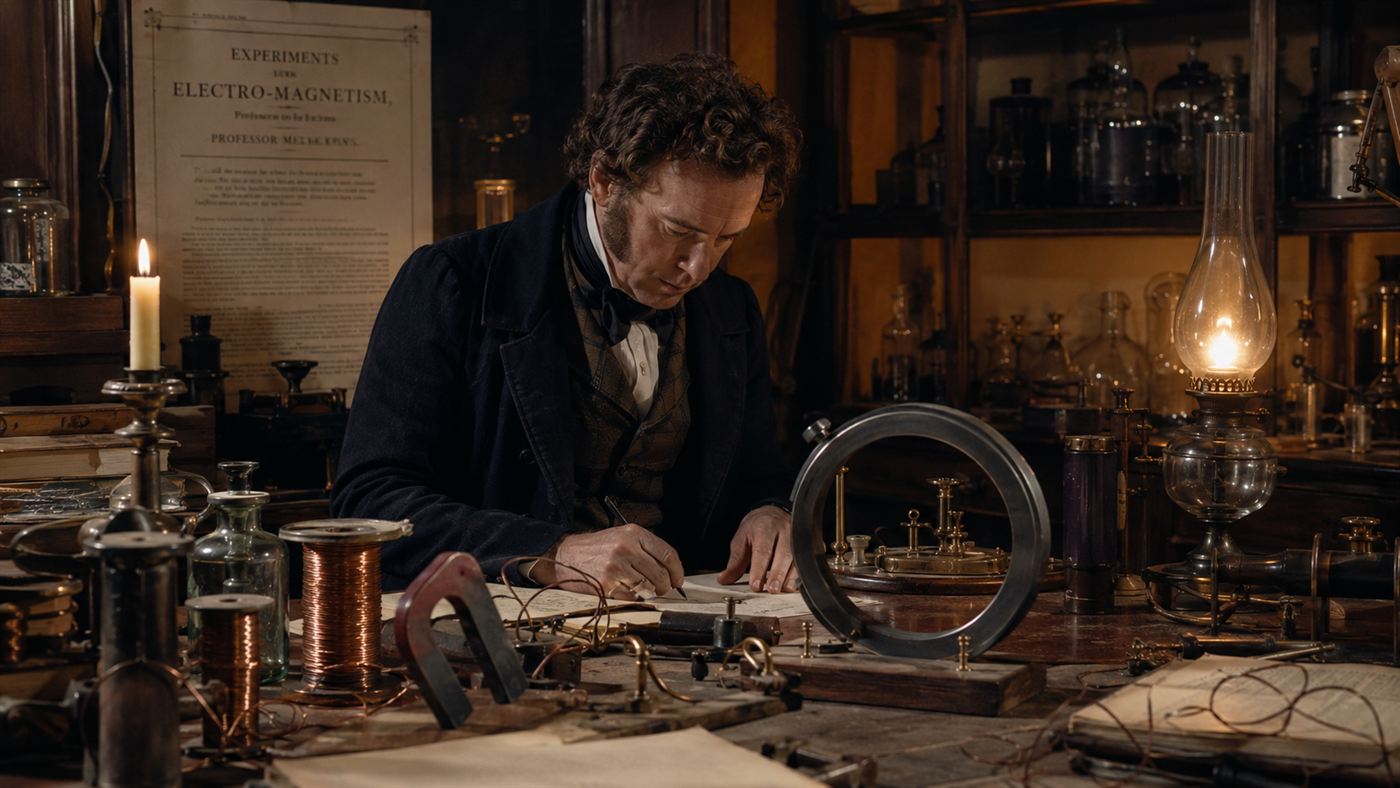
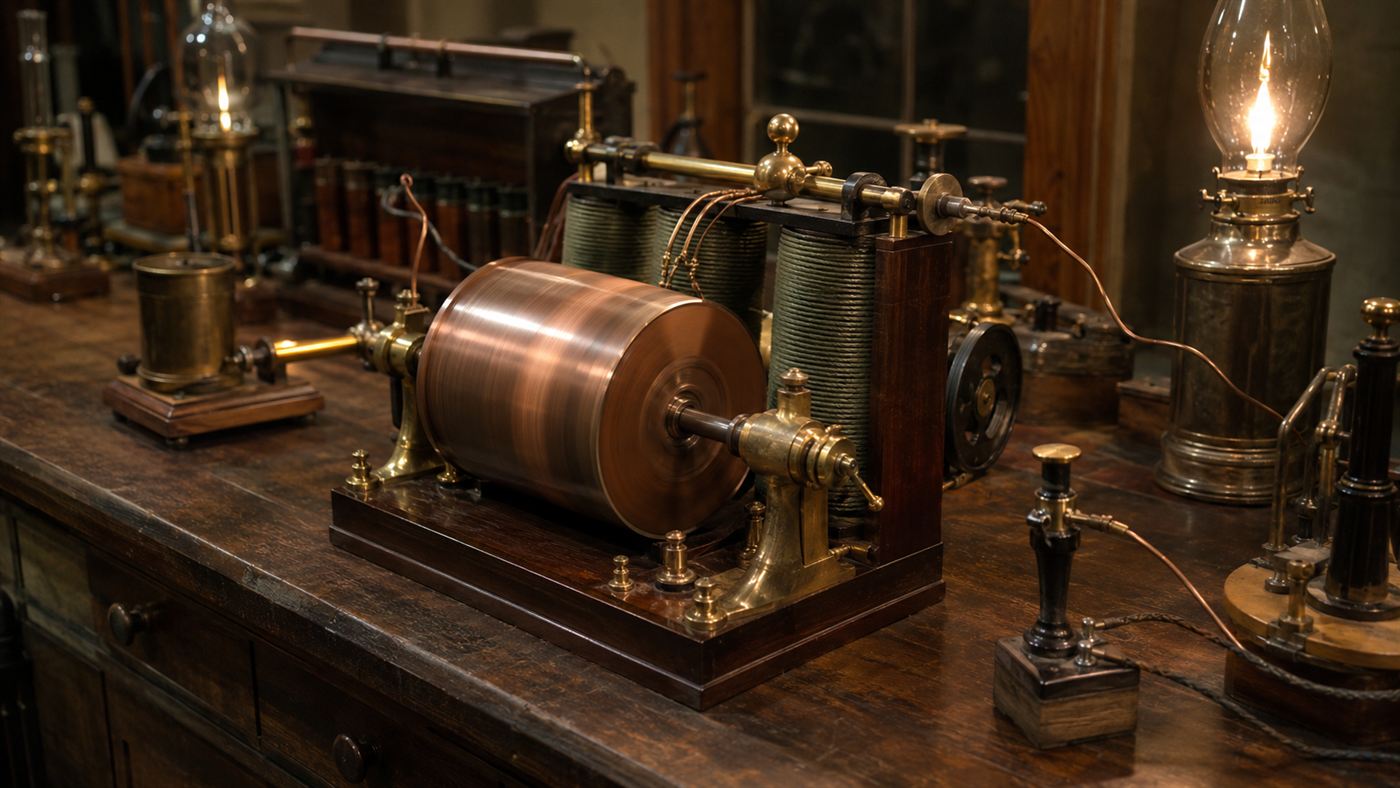
A self-taught experimenter in his lab, where motion first became electricity. Illustration: Watts & Wild.
Michael Faraday was born in 1791 into a poor London family, and his formal schooling barely covered reading, writing, and basic sums. At 14 he was apprenticed to a bookbinder, and that is where the miracle starts. Surrounded by books he was supposed to be stitching and gluing, he began to read them instead, and the ones on science lit a fire in him that seven years of manual work could not put out.
He built his own crude apparatus, joined a society of young men who met to discuss science, and hungered for a way in. His break came when he attended lectures by the famous chemist Humphry Davy, took careful notes, bound them beautifully, and sent them to Davy as a kind of job application. It worked: at 21, the bookbinder became a laboratory assistant at the Royal Institution, and never looked back.
How Michael Faraday made electricity from magnetism
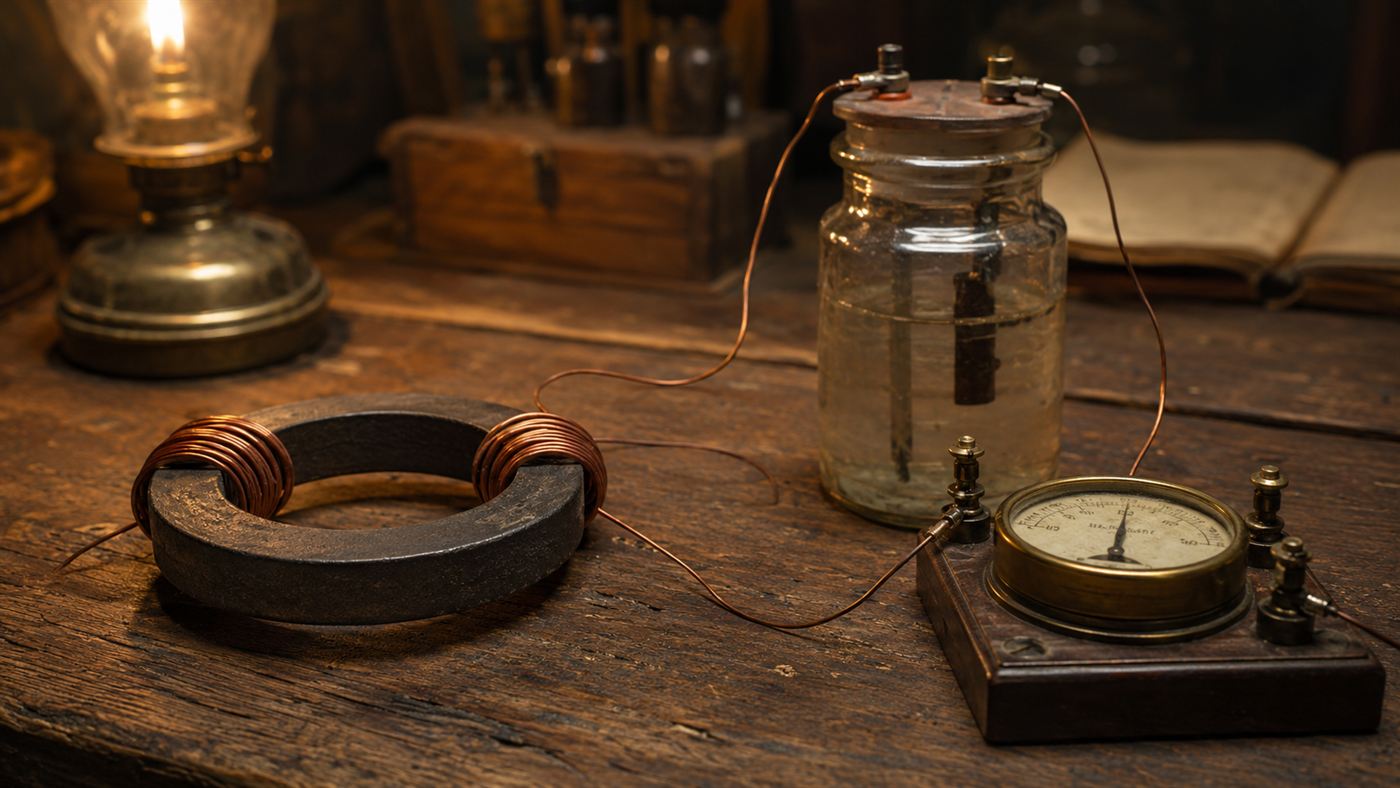
For years scientists knew that electricity could create magnetism, but the reverse, whether a magnet could create electricity, was a stubborn mystery. Faraday chased it for a decade. Then, in 1831, he wound two separate coils of wire onto opposite sides of an iron ring, connected one to a battery, and watched the other through a sensitive needle that detected current.
The needle only twitched at the instant he connected or disconnected the battery, then fell still. That flicker was everything. It meant that a changing magnetic field, not a steady one, was what pushed electricity through the second wire. Faraday had discovered electromagnetic induction, and with it the single most useful fact in all of electrical engineering.
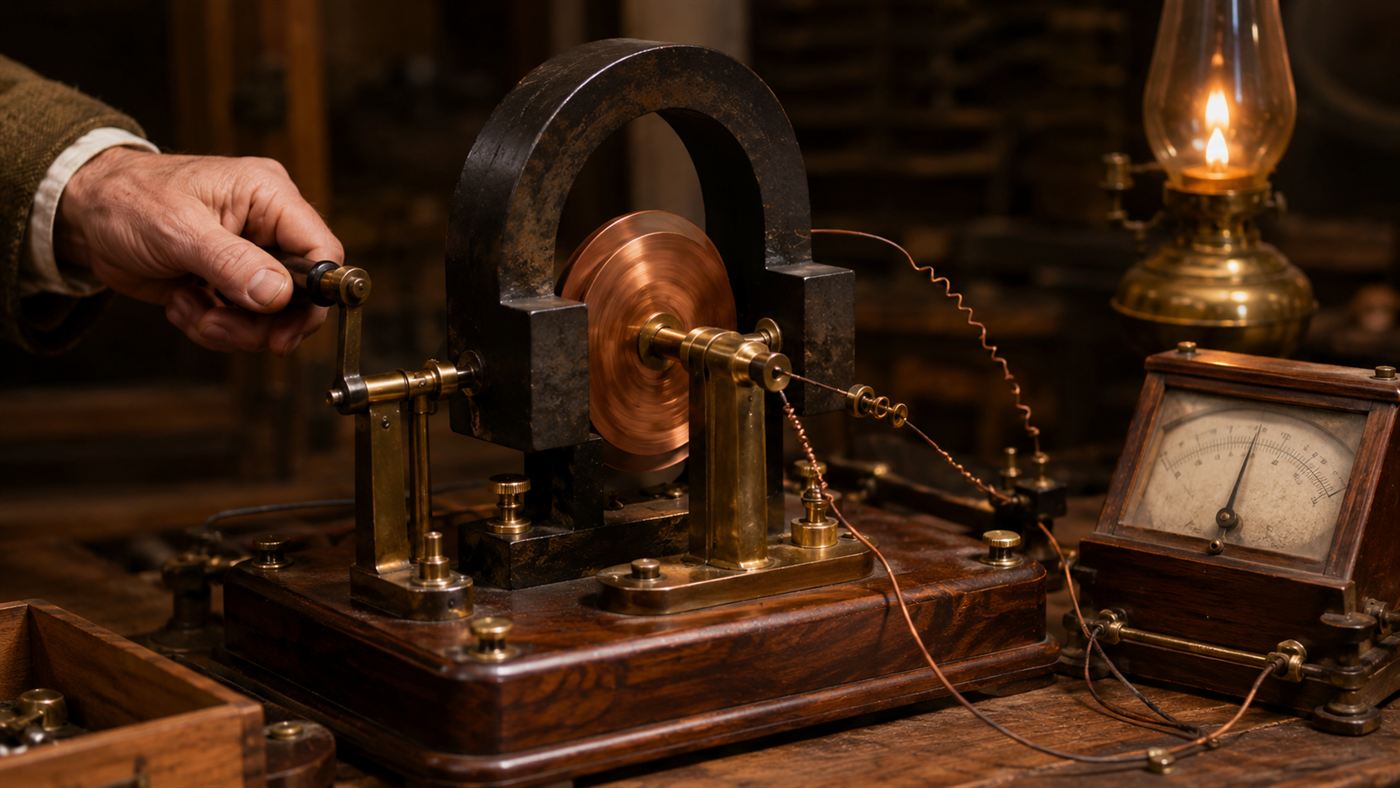
The little machine inside every power plant
Faraday did not stop at the ring. He took a copper disc, spun it between the poles of a magnet, and drew a steady electric current straight out of the motion. It was small and weak, barely enough to nudge a meter, and it was also the first electric generator. Every power station on Earth today, whether driven by steam, water, wind, or a nuclear reactor, is really just a giant, refined version of Faraday's spinning disc.
That is the quiet enormity of what he did. When you flick a switch, the electricity that answers was almost certainly made by spinning magnets past coils of wire, exactly the trick Faraday found in 1831. He did not just discover a law of nature, he handed humanity the method it still uses to power itself. A decade earlier he had also built one of the first electric motors, closing the loop between electricity and motion in both directions.
The man who kept saying no
What makes Faraday rarer still is how little he wanted from it. A deeply religious and modest man, he turned down a knighthood, refused the presidency of the Royal Society not once but twice, and declined a grand burial in Westminster Abbey. He preferred to be plain Mr Faraday, working at his bench, giving public lectures to inspire children, and living simply on a scientist's ordinary means.
He was also, by the standards of physics, mathematically illiterate, and he knew it. He described his discoveries in pictures, imagining invisible "lines of force" curving through space around magnets and wires. It fell to a young mathematician named James Clerk Maxwell to turn those pictures into equations, but the vision was Faraday's. He saw the fields that no one else could see, without a single equation to guide him.
The honest catch
It is tempting to make Faraday the sole inventor of the electrical age, and that overstates it. Others, in America and Europe, were building motors and chasing induction in the same years, and the modern generator is the work of many hands refining a shared idea. Faraday's genius was to isolate the core principle so cleanly, and to prove it beyond doubt, that everything after him could be built on it.
Still, the shape of his life is worth holding onto. A boy with no money and no schooling, who taught himself from the books he was hired to bind, ended up uncovering the rule that powers civilization, and then refused nearly every honor for it. When you next plug something in, it is worth remembering that the current flowing to it traces back to a humble man watching a needle twitch by lamplight.
A bookbinder with no math and no money discovered the rule that runs every power plant on Earth, then turned down the honors. Could someone with almost no formal schooling still change the world that profoundly today? Tell us what you think in the comments.
Related reading: The Vermont blacksmith who built the first electric motor and died broke, decades too early.
More from Watts & Wild
More in Electric →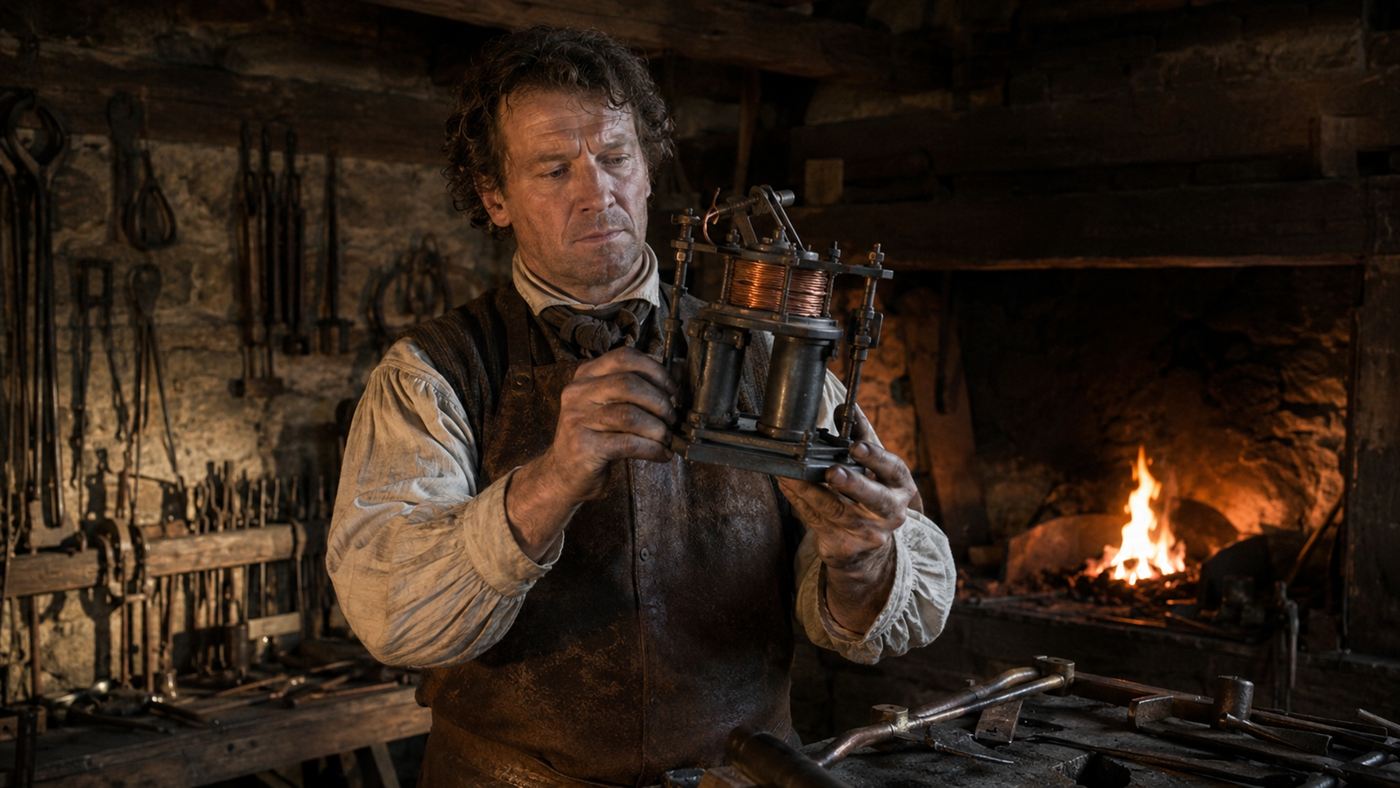

Maria Heloisa Barbosa Borges covers heavy industry, mega-builds, and the places where engineering meets the natural world for Watts & Wild.