The sea stores the sun's heat near its surface, and ocean thermal energy turns the gap between that warm water and the cold depths into round-the-clock electricity
The tropical ocean is the biggest solar collector on Earth, warm on top and cold below. Ocean thermal energy taps the difference between the two to make power day and night. A French inventor proved it could work in 1930, and the sea kept tearing his machine apart.
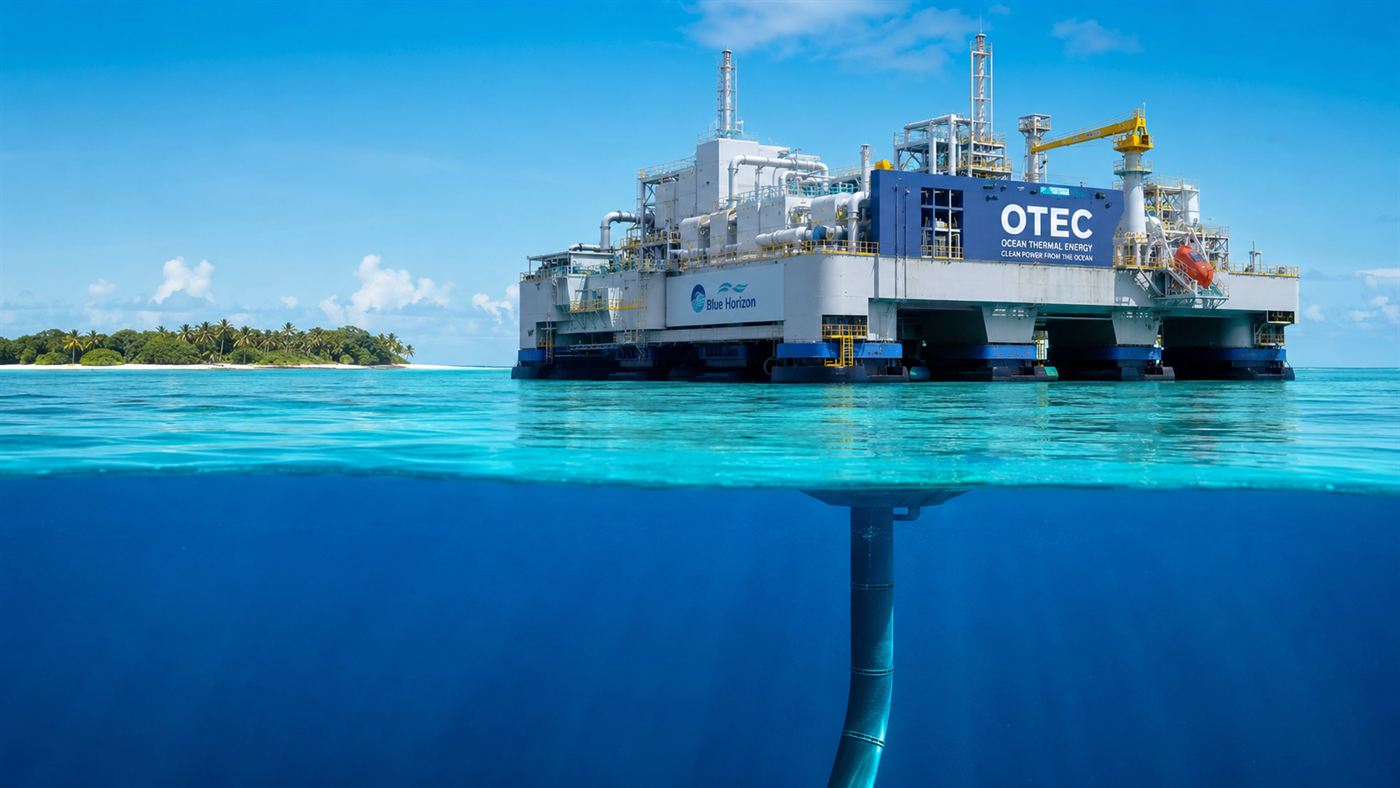
An ocean thermal energy platform draws cold water from the deep through a long pipe. Illustration: Watts & Wild.
Ocean thermal energy is solar power in disguise. Every day the sun pours heat into the tropical seas, warming the top layer of the ocean to a pleasant bathwater temperature while, a kilometre below, the water stays close to freezing in permanent darkness. That difference, warm above and cold beneath, is a vast store of energy just sitting there, and for more than a century engineers have tried to tap it. The idea is simple, the physics is real, and the sea has fought them at almost every turn.
The appeal is easy to see. As the technology, known as OTEC, is described, it draws on a temperature gap of around 20 degrees Celsius between the surface and the deep, a gap that exists across most of the tropical ocean and, crucially, never switches off. Unlike sunshine or wind, the warm sea is there at midnight as surely as at noon.
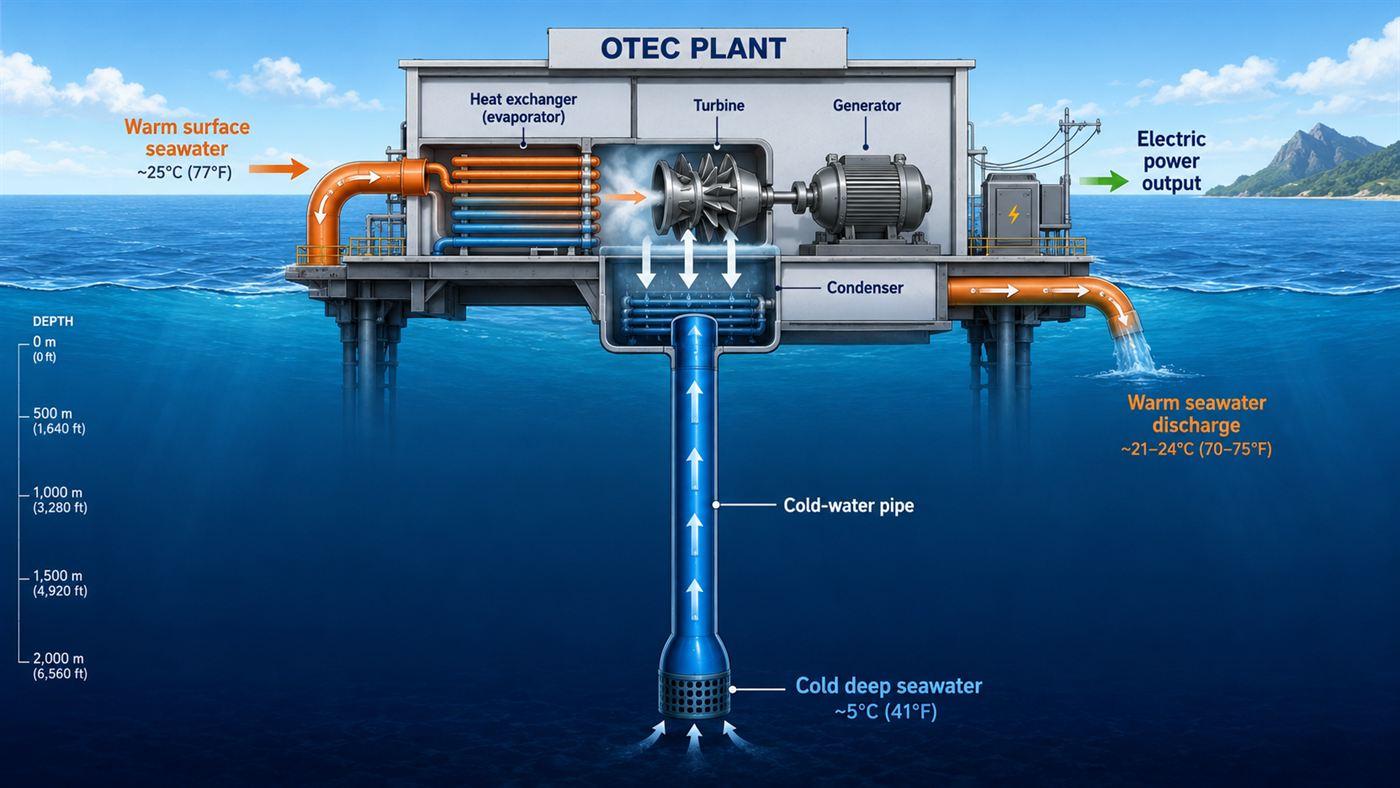
What is ocean thermal energy? Ocean thermal energy, or OTEC, generates electricity from the temperature difference between warm tropical surface water, around 25°C, and cold water pumped up from about a kilometre down, around 5°C. That gap of roughly 20°C is enough to drive a turbine, day and night.
The ocean as a solar battery
To see why ocean thermal energy works, picture the tropical ocean as a giant, slow battery charged by the sun. The surface water sits at perhaps 25 to 29 degrees, warmed continuously from above. Far below, water that sank near the poles and crept along the sea floor stays at four to seven degrees. Between those two layers is a temperature difference that a heat engine can exploit, in just the same way a power station exploits the gap between hot steam and cool surroundings, only gentler.
The great advantage is steadiness. A solar panel stops at dusk and a wind turbine waits for a breeze, but the warm cap of the tropical sea barely changes from day to night or season to season. An ocean thermal plant could, in principle, run flat out around the clock, providing the kind of constant baseload power that renewable sources usually struggle to deliver.
How ocean thermal energy uses a 20-degree gap
The trick is to make something boil at a low temperature. In the open-cycle version, warm seawater is fed into a chamber where the pressure has been dropped so low that the water boils at ordinary sea temperatures, flashing into steam. That steam rushes through a turbine, spinning a generator, and is then condensed back into liquid by the cold water hauled up from the deep. As a bonus, the condensed steam is fresh, so the plant makes drinking water as well as electricity.
A closed-cycle plant does much the same but uses a separate fluid that boils even more readily, such as ammonia, in a sealed loop, with the seawater only providing the heat and the cold. Either way the principle is identical, and so is the catch: because the temperature gap is small, the efficiency is low, and the plant has to pump staggering volumes of water, including cold water drawn up through a pipe reaching as much as a kilometre into the abyss. That pipe is where the dream keeps meeting reality.
Georges Claude and the pipe that would not stay down
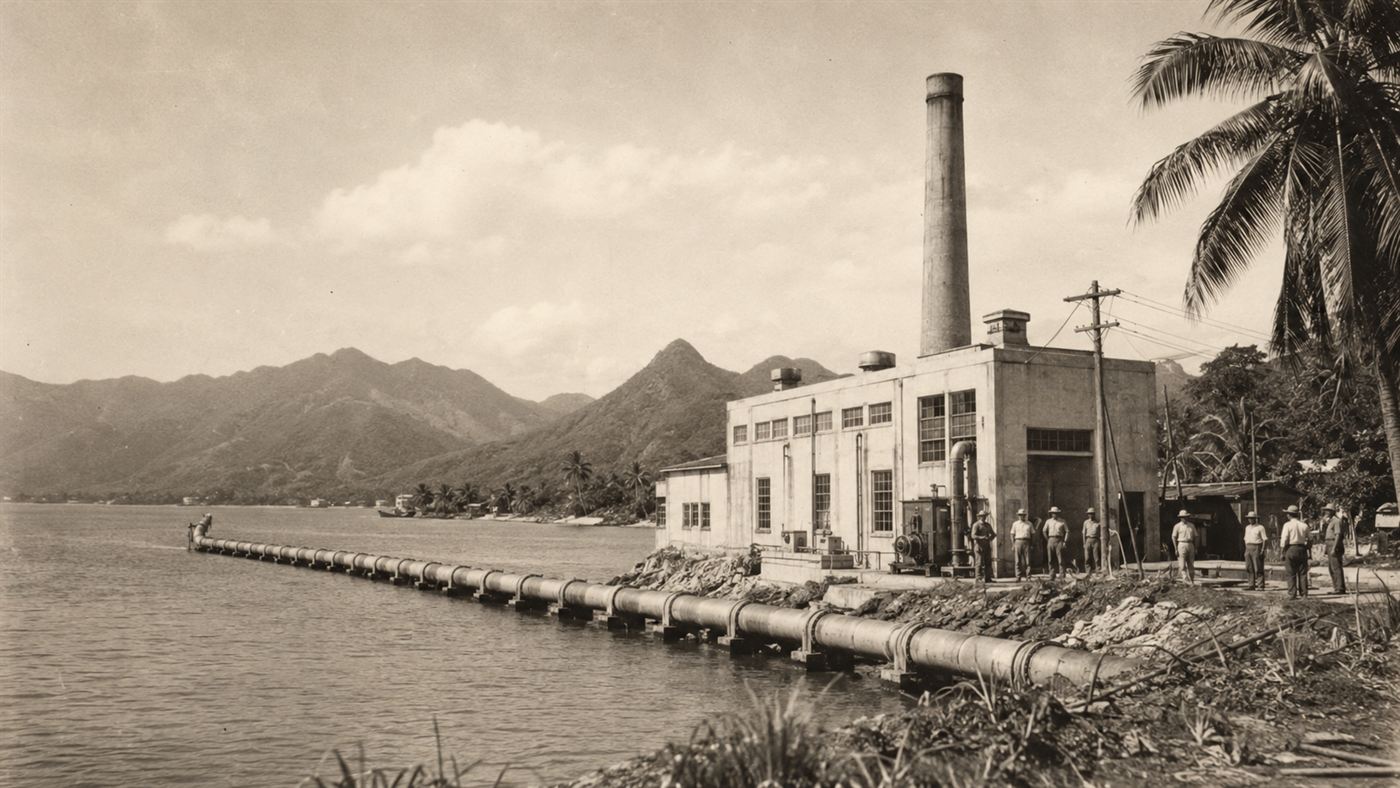
The idea was first floated in 1881 by the French physicist Jacques-Arsène d'Arsonval, but it took one of his countrymen to try to build it. Georges Claude was a brilliant, stubborn inventor, already famous for inventing neon lighting and for producing liquid air, and he became obsessed with proving that ocean thermal energy could be made to work. In 1930, at Matanzas Bay in Cuba, he built a full open-cycle plant on the shore and ran a vast pipe out into the deep water to fetch the cold.
It worked, after a fashion. The plant generated around 22 kilowatts of electricity, enough to prove the principle in front of the world. But it also consumed more power than it produced, swallowed by the pumps, and worst of all the enormous cold-water pipe was a nightmare to lay and keep in place. The sea repeatedly broke and swallowed his pipes, storms wrecked his equipment, and Claude poured much of his fortune into the effort. His plant was eventually destroyed in a storm. He had shown the dream was possible and, at the same time, exactly how hard it would be.
The sea that never sleeps
Almost a century later, the idea has not died, because its promise is too tempting to abandon. A small demonstration plant has run in Hawaii since 2015, and tropical island nations keep returning to ocean thermal energy because they sit beside an inexhaustible, constant resource and pay dearly for imported fuel. The cold deep water brings extras, too: fresh water from the condensers, chilled water that can air-condition buildings without compressors, and nutrient-rich seawater useful for aquaculture. For a small island, an OTEC plant is potentially a power station, a water works and a cold store in one.
The honest catch
Honesty demands admitting that ocean thermal energy has been twenty years away for about a hundred years. The temperature gap it lives on is small, so the efficiency is inherently low, only a few percent, and that means everything has to be built enormous to extract a modest amount of power. The cold-water pipe that defeated Claude is still the central engineering problem, large diameter, kilometres long, and exposed to a sea that wrecks structures for sport. No one has yet built a big OTEC plant and run it profitably for years.
And yet the resource is almost beyond counting. The tropical ocean covers a huge share of the planet, it is recharged by the sun every single day, and it holds its warmth through the night when other renewables fall quiet. The physics that Georges Claude proved on a Cuban shore in 1930 has never stopped being true. Ocean thermal energy may always be difficult, but it remains one of the largest untapped batteries on Earth, waiting for engineering patient enough to plug into it.
A power plant that runs on nothing but the sea being warm on top and cold below, dreamed up in 1881 and still not cracked. Will ocean thermal energy ever scale up, or is the pipe problem just too big? Tell us in the comments.
Related reading: Osmotic power, the energy released where a river meets the sea.