In one of the driest corners of Morocco, where women once walked four hours a day for water, a charity hung giant nets on a mountain to catch drinking water straight out of the fog
There is no river here and the wells are failing, but most mornings the mountain disappears into a thick wet cloud blowing in off the Atlantic. Someone finally looked at that fog and saw not weather, but a reservoir hanging in the air.
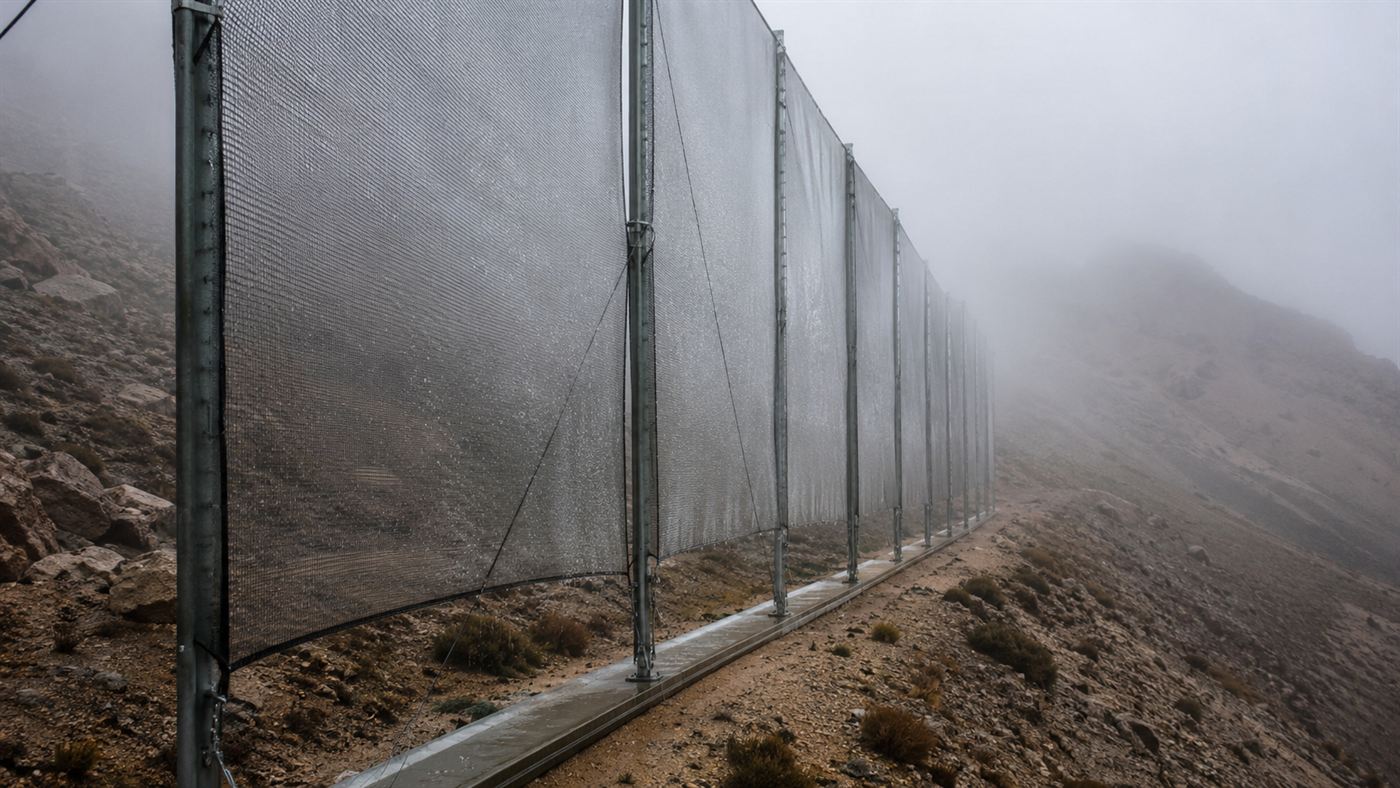
Fog nets on Mount Boutmezguida, combing drinking water out of the cloud that rolls in off the Atlantic. Illustration: Watts & Wild.
Fog harvesting in Morocco is rewriting daily life in the Ait Baamrane region of the south west, near the town of Sidi Ifni, where the land is so dry that fetching water was a job that ate the day. As the Dar Si Hmad foundation, which runs the project, describes it, before the system arrived the women and girls of these Amazigh villages spent as much as four hours a day walking to wells and carrying heavy containers of water home. There is no permanent river to draw from, the groundwater is overused, and the climate keeps getting hotter and drier. But there is one thing this mountain has in abundance, and it is the very thing people normally curse: fog.
For much of the year a dense, soaking cloud rolls in off the cold Atlantic and wraps around the high ground. For generations it was just a damp nuisance. Now it is the water supply.
How fog harvesting in Morocco combs water out of a cloud
The idea is almost childishly simple, which is part of why it is so satisfying. If you hang a big enough net of fine mesh in the path of a moving fog, the tiny water droplets suspended in that fog snag on the threads, run together into bigger drops, and trickle down into a gutter at the bottom. No pump, no power, no drilling, just cloth, gravity and weather. The mountain breathes wet air through the net, and clean water drips out the other side.
What Dar Si Hmad did was take that simple trick and build it at a scale nobody had managed before. As The Climate Tribe reported, the array of large nets strung across the upper slopes of Mount Boutmezguida is now the biggest fog harvesting system in the world, and on a good foggy stretch it pulls tens of tonnes of water a week out of thin air, piping it down the mountain to the homes below.
The woman who reads the clouds
The project is led by the anthropologist Jamila Bargach, who runs the operation high on the mountainside at over 1,200 metres. As Atlas of the Future records, the harvested fog now reaches roughly 16 villages and around a thousand people, plus the nomadic families who pass through to gather argan nuts and prickly pears in season. Critically, the system does not stop at the mountain. The water is treated and run through pipes directly to taps in the villages, so that for the first time many homes simply turn on a tap.
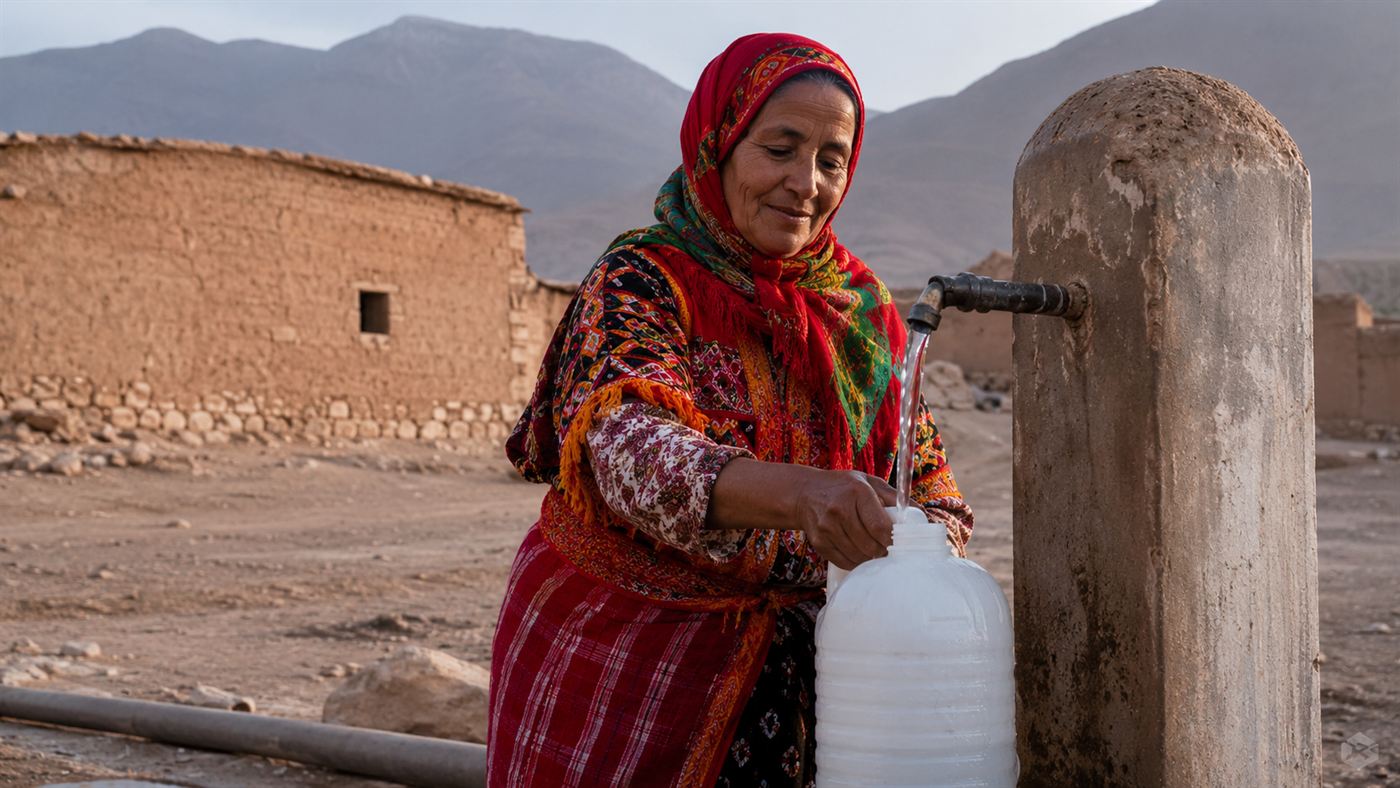
What changes when the water comes home
The technology is the headline, but the real story is what it gives back, and that is time. When a woman no longer spends four hours a day fetching water, she gets four hours of her life back, and girls who were kept home to help carry it can stay in school instead. Dar Si Hmad leaned into exactly this, running literacy and training workshops for the rural Berber women and putting them in charge of running and monitoring the water system, so the fog did not just supply the village, it shifted who held the knowledge and the keys.
That is the quiet reversal at the heart of it. In most water projects the hardware arrives from outside and the locals are passive recipients. Here the people most burdened by the old way, the women, became the ones operating the new one, turning a humiliating daily chore into a piece of infrastructure they run themselves.
The honest catch
For all that, it would be wrong to wave fog nets around as a fix for the world's water crisis, because they are gloriously specific. The whole thing only works where geography conspires to help: you need high ground, a nearby cool ocean and a reliable season of thick fog rolling over it. Most thirsty places on Earth have none of that, so this is a brilliant local answer, not a global one.
There is a deeper irony too. The same warming climate that makes the wells fail and the rains unreliable also threatens the fog itself, because if the weather patterns that feed those clouds shift, the nets have nothing to comb. The earliest nets in the region were also torn apart by the very winds that carry the fog, which is why the design had to be reengineered to survive brutal gusts. Maintenance is constant, the supply rises and falls with the mist, and for most of these households the fog water supplements their needs rather than meeting every drop. None of that diminishes what is happening on that mountain. It just keeps it honest. A community looked at the one resource it had always been told was worthless, the fog, and found a way to drink it, and in doing so handed its women back several hours of every single day.
A village with no river learned to drink the fog, and in doing so handed its women and girls back hours of every day they used to spend hauling water. What everyday thing around you might secretly be a resource, if someone just looked at it the right way? Tell us what you think in the comments.
See also: the clay-pot fridge that keeps food fresh with no electricity.