The twitching frog that gave us the battery and Frankenstein
In a Bologna laboratory in the 1780s, a doctor noticed something that made his skin crawl. The severed legs of a dead frog, lying on his bench, kicked as if alive the instant they touched a piece of metal. He had not zapped them with a machine; they simply jumped. To him it looked like proof of a hidden electric force inside all living things. Luigi Galvani thought he had found the spark of life itself.

Dead frog legs that kicked at a touch of metal. Illustration: Watts & Wild.
It is a small, strange moment that ended up echoing through science and culture for centuries. From those twitching frog legs came one of history's great scientific feuds, the invention of the battery, and the eerie idea that electricity might be able to raise the dead.
And like the best discoveries, it began with someone being gloriously, productively wrong.
The frog that came back to life
Luigi Galvani was a physician and anatomist working in Bologna, and his discovery seems to have happened partly by accident. When he touched the exposed nerves of a dead frog's leg with a metal instrument, the leg twitched sharply, and Galvani became convinced he was watching electricity that lived inside the animal itself.
He called this force animal electricity, imagining it as a kind of vital fluid stored in the nerves and muscles, released by the touch of his tools. It was a thrilling idea, one that seemed to bridge the gap between dead matter and living movement. Galvani spent years studying it, building a whole theory around the notion that the body ran on its own private electricity, and for a while much of Europe was persuaded.
How Galvani's frogs led to the battery
Not everyone was convinced, and one doubter changed the world. The physicist Alessandro Volta repeated the experiments and argued that the electricity came not from the frog at all, but from the two different metals touching its flesh, with the moist tissue simply completing the circuit.
To prove it, Volta did away with the animal entirely. He stacked discs of two different metals, separated by cloth soaked in salty liquid, and found the pile produced a steady flow of electricity all on its own. That device, the voltaic pile, was the first true battery, the ancestor of every cell that now powers our phones and cars. The frog had been a red herring, but chasing it had led Volta straight to one of the most important inventions in history.

The corpses and the monster
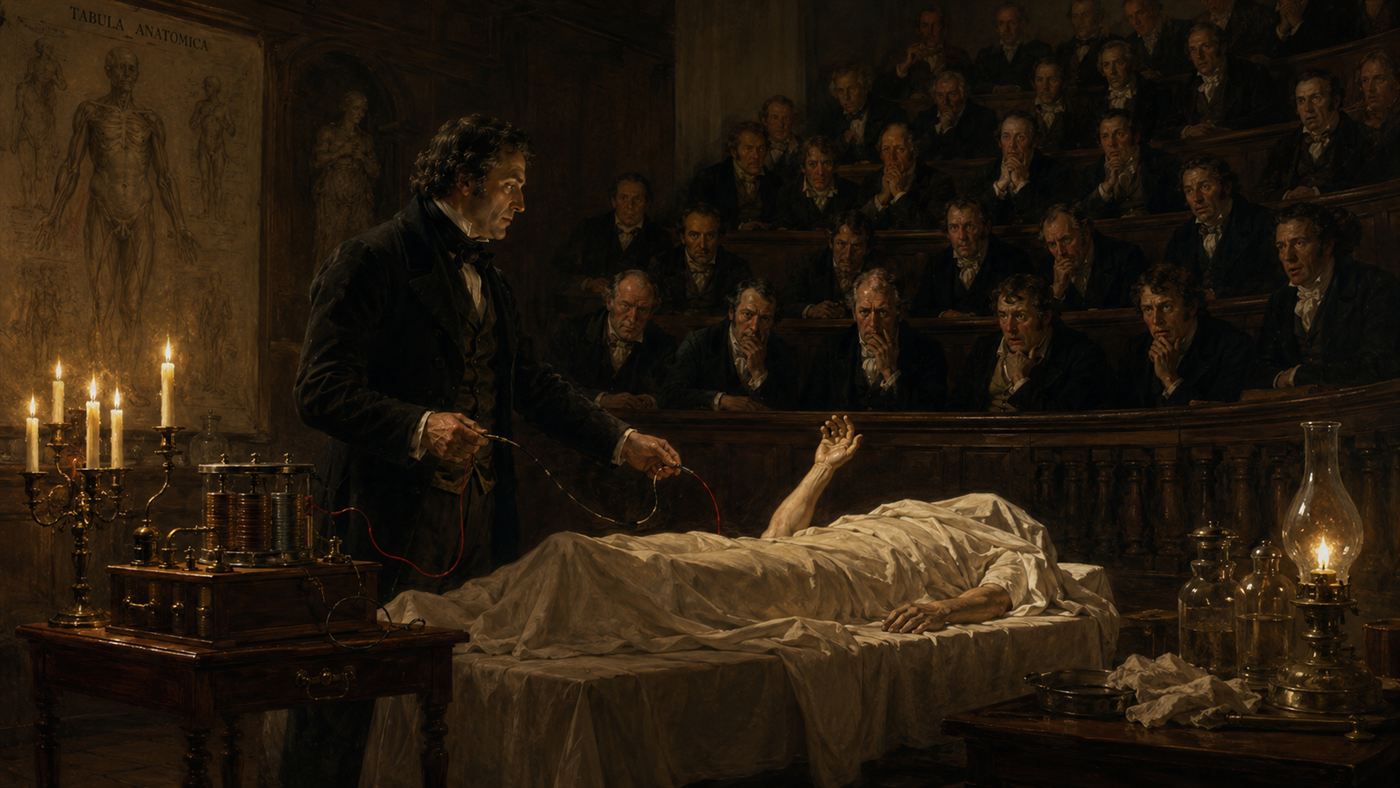
Galvani himself disliked the public quarrel and left the fight to his nephew, Giovanni Aldini, who took the idea in a far more theatrical direction. Aldini staged dramatic demonstrations in which electricity was applied to animal and even human corpses, making the body of an executed criminal grimace, clench its fist and kick before a horrified audience.
These ghoulish shows, lit by sparks and performed on the recently dead, gripped the public imagination. The idea that electricity might animate dead flesh, that a spark could be the difference between a corpse and a living thing, seeped into the culture of the age. It is widely believed to have helped inspire a young writer named Mary Shelley, whose novel Frankenstein imagined a creature jolted into life. Galvani's humble frogs had grown, in the public mind, into a monster.
What did Luigi Galvani discover?
He opened the door to the electricity of life. Luigi Galvani discovered that dead frog legs twitch when touched with metal, and concluded there was a special animal electricity inside living bodies, founding the study of how electricity behaves in living things.
It is worth being fair to both sides of the famous feud, because in a sense they were both right. Volta was correct that the frog's twitch came from the metals, not a mysterious vital fluid, and his battery proved it. But Galvani was also onto something real: our nerves and muscles genuinely do run on tiny electrical signals, the field we now call bioelectricity. He had the right instinct even if he had the wrong explanation, which is often how science lurches forward.
How did Galvani's frogs lead to the battery?
By provoking a rival to prove him wrong. Alessandro Volta set out to show that Galvani's twitching frogs were powered by metals rather than animal electricity, and in doing so he built the first battery, the voltaic pile, in 1800.
So the modern battery, that most practical of inventions, was born out of an argument over a dead frog. It is a perfect reminder that science does not always advance in a straight line of correct answers. Sometimes the most useful thing a person can do is be wrong in an interesting enough way that someone else is driven to find the truth, and changes the world in the process.
A dead frog's kick gave us the battery in our pocket and the monster in our nightmares. How many world-changing ideas started with someone seeing something they could not quite explain? Tell us what you think in the comments.
Related reading: the Bersey electric cabs, London's silent battery taxis that ran a century before the modern electric car.