The north your compass points to is not the real North Pole, and it is sprinting across the Arctic toward Siberia fast enough to break the maps
There are two north poles, and they are not in the same place. The one your compass and your phone follow is the magnetic north pole, and it has been drifting for as long as we have measured it. Lately it has been moving so fast, away from Canada and toward Siberia, that scientists had to rewrite the world's magnetic map ahead of schedule.
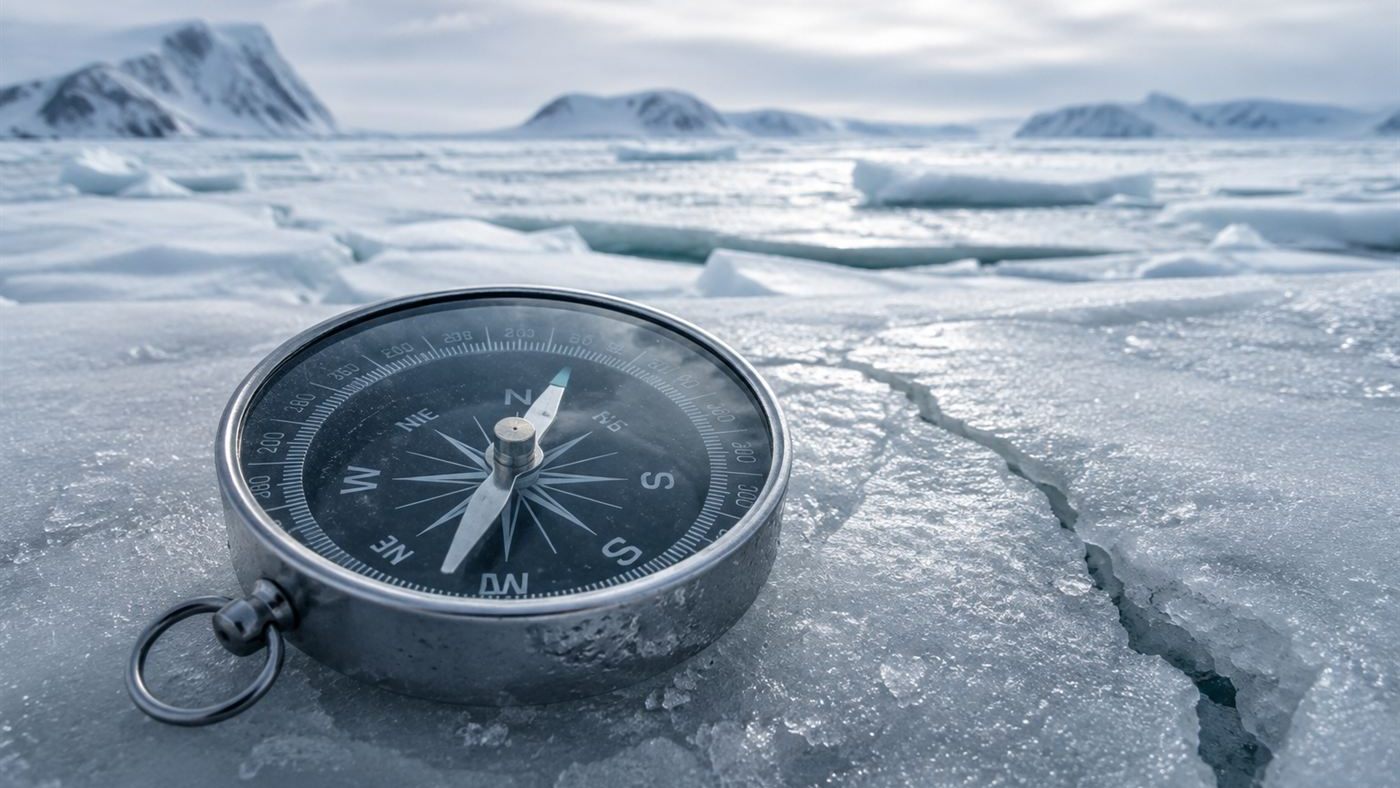
The needle follows the magnetic pole, not the true one. Illustration: Watts & Wild.
Start with the thing almost no one is told clearly: the North Pole on a globe and the place a compass points are different. The geographic North Pole is a fixed point, the top of the axis the Earth spins around. The magnetic north pole is something else entirely, the spot where the planet's magnetic field points straight down, and it has nothing to do with the spin axis. It moves, and it always has.
When the explorer James Clark Ross first pinned it down in 1831, it sat in the Canadian Arctic. For most of the twentieth century it wandered slowly, a lazy ten or fifteen kilometres a year. Then, in recent decades, it put its foot down.
Why the magnetic north pole is on the move
The magnetic field is not made by a bar magnet buried in the Earth. It is generated by oceans of molten iron and nickel churning in the planet's outer core, a vast, slow, electrically conducting storm. Because that flow shifts and swirls, the magnetic field it produces shifts too, and the poles drift with it. There is nothing unnatural about the movement; it is the field breathing.
What changed is the speed. As NPR reported, the magnetic north pole has been racing toward Siberia at around 55 kilometres a year, several times its old pace. Researchers think of it as a tug of war between two patches of magnetic field deep under the planet, one beneath Canada and one beneath Siberia, with the Siberian patch currently winning and dragging the pole its way.

The emergency map update
This is where a piece of planetary physics turns into a very practical problem. The world relies on a thing called the World Magnetic Model, a regularly updated mathematical description of the magnetic field used to convert a compass reading into a true heading. It is normally refreshed on a tidy five-year cycle. But the pole was moving so quickly that the model was drifting out of accuracy before its time was up.
So in early 2019 the keepers of the model did something unusual and issued an emergency, out-of-cycle update. As NOAA's National Centers for Environmental Information explained, the World Magnetic Model underpins navigation for the military, aviation and shipping, as well as the compass in consumer smartphones. The field had wandered enough that the map of it had to be redrawn early to keep all of that pointing the right way.
Does a moving magnetic north pole affect GPS?
It is worth being precise about what is and is not at risk, because this gets exaggerated. Your phone's blue dot, the actual position fix, comes from GPS satellites and has nothing to do with magnetism, so a wandering pole does not make you appear in the wrong place. What it affects is direction. As Smithsonian magazine notes, the model keeps map apps and other compass-based tools showing the right heading as you turn a corner.
The stakes are higher than a phone, though. Ships and aircraft still carry magnetic compasses as backups, submarines navigate partly by the field, and even airport runways are numbered according to their magnetic heading, which occasionally has to be renumbered as the field shifts. A small error in the model, spread across all of that, is exactly the kind of quiet problem worth heading off early.

The honest catch
A few cautions keep this from tipping into doom. First, none of it is new in kind, only in pace: the pole has always wandered, and good navigators have always corrected for the gap between magnetic and true north, a gap called declination. Second, this is not the start of some imminent, catastrophic flip of the poles. The field does reverse over very long timescales, but a fast-moving pole is not evidence that a reversal is beginning, despite how often that link gets made online.
It is also worth noting that the pole is not a runaway. After its recent sprint it has actually eased off its top speed in the 2020s, still heading Siberia's way but a little less frantically. The 2019 emergency update was a sensible piece of housekeeping, not a sign that the sky, or the compass, is falling.
Why a wandering pole still matters
What makes the magnetic north pole worth thinking about is how it connects something almost unimaginable, a storm of molten metal thousands of kilometres beneath our feet, to something utterly everyday, the little arrow on your phone. The deep Earth is not a dead, solid thing. It is alive with motion, and we feel a faint echo of that motion every time we check which way we are facing.
It is humbling that the planet can quietly move the very idea of north, and that we have to keep redrawing our maps of it to keep up. Does it change how you think about your compass to know it points at a target that is always on the move? Tell us in the comments.
Related reading: A solar storm in 1859 set telegraph offices on fire, and a repeat today could cripple the modern grid.