The Large Hadron Collider is the biggest machine humanity has built, a 27-kilometre ring colder than space that smashes protons together to study the smallest things there are
To study the tiniest pieces of matter, physicists built the largest machine in history. The Large Hadron Collider is a 27-kilometre ring under the Swiss-French border, chilled colder than outer space, where protons race at almost the speed of light and collide hundreds of millions of times a second.
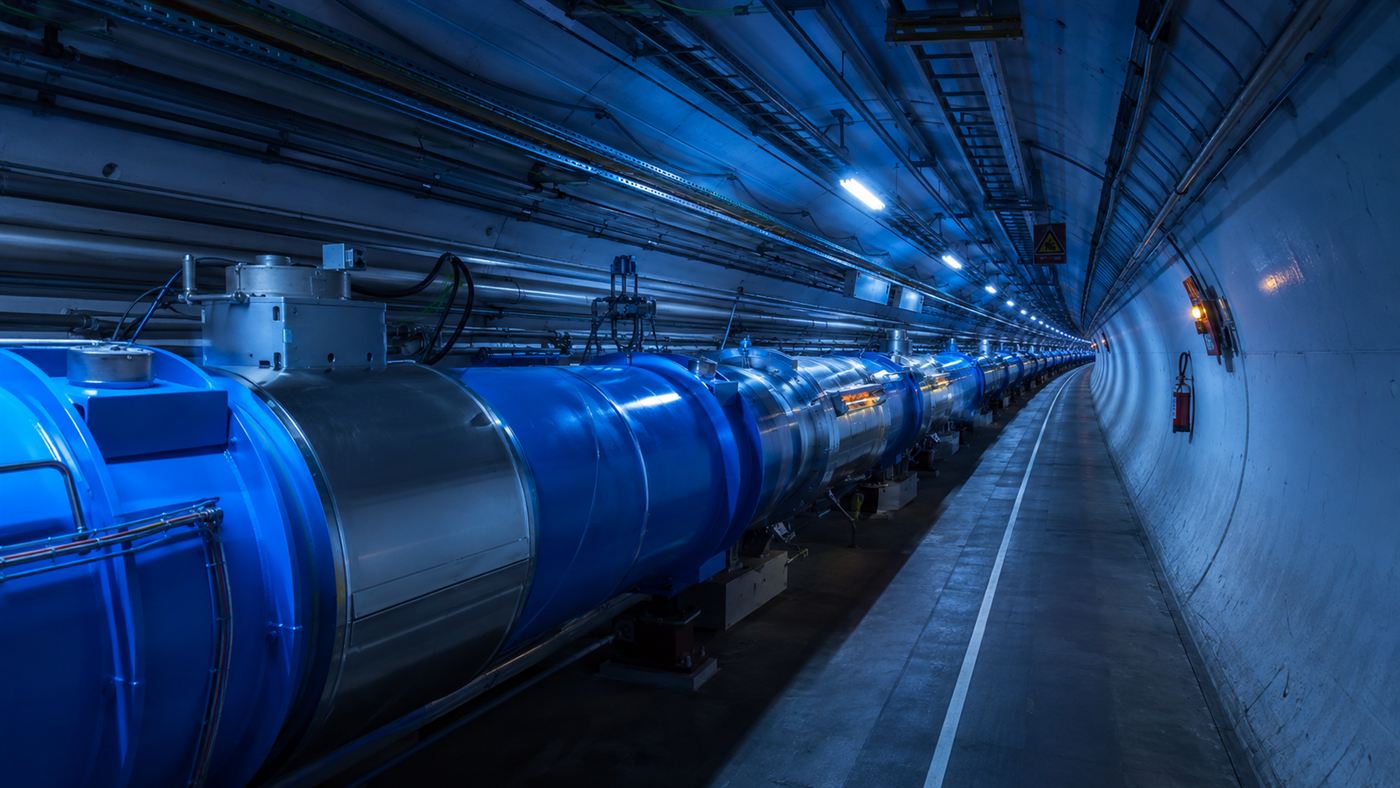
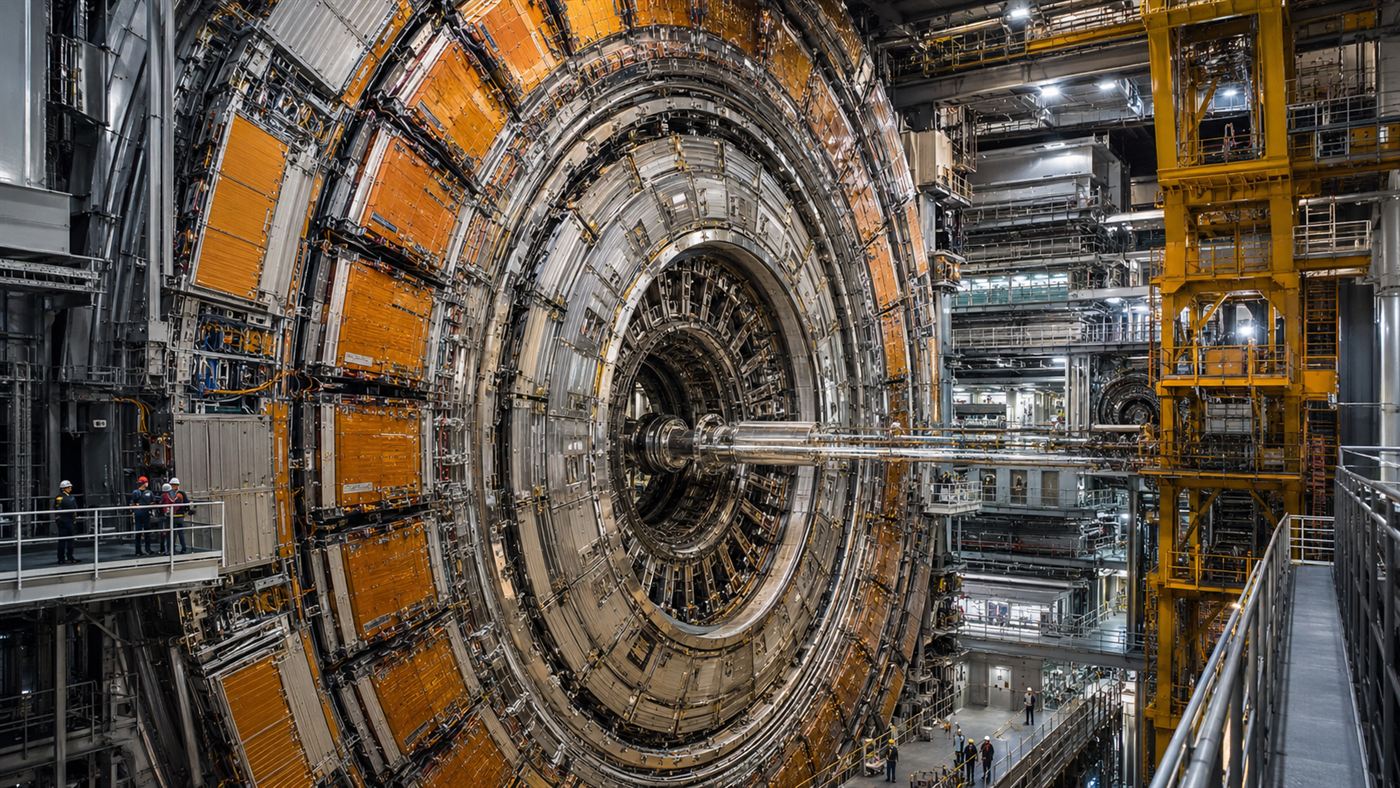
The Large Hadron Collider, a 27-kilometre ring of magnets beneath Geneva. Illustration: Watts & Wild.
The Large Hadron Collider is a machine of superlatives, almost to the point of absurdity. It is the largest single machine ever built. It contains the coldest extended place in the solar system. It accelerates matter to within a hair of the speed of light, and at the points where that matter collides it briefly creates temperatures hotter than the heart of the sun. And it does all of this not to build anything or power anything, but to answer questions about the very smallest pieces of reality.
It sits in a circular tunnel about a hundred metres underground, straddling the border of Switzerland and France near Geneva, at the laboratory known as CERN. As CERN describes it, the collider is a 27-kilometre ring of superconducting magnets that steer two beams of particles in opposite directions and bring them into head-on collision. The numbers involved are difficult to hold in the mind.
What is the Large Hadron Collider? The Large Hadron Collider is the world's largest machine, a 27-kilometre ring of superconducting magnets buried near Geneva. It accelerates protons to 99.9999991% of the speed of light and collides them up to 600 million times a second to study the building blocks of matter.
The Large Hadron Collider, the largest machine ever built
The scale of the Large Hadron Collider is its first shock. Inside its 27-kilometre ring, protons are accelerated until they are looping around the full circuit more than eleven thousand times every second, travelling at 99.9999991 percent of the speed of light, a whisker short of the cosmic speed limit. Two such beams run in opposite directions in tubes held at a vacuum emptier than the space between planets, and where they are steered to cross, they smash into each other as many as 600 million times a second.
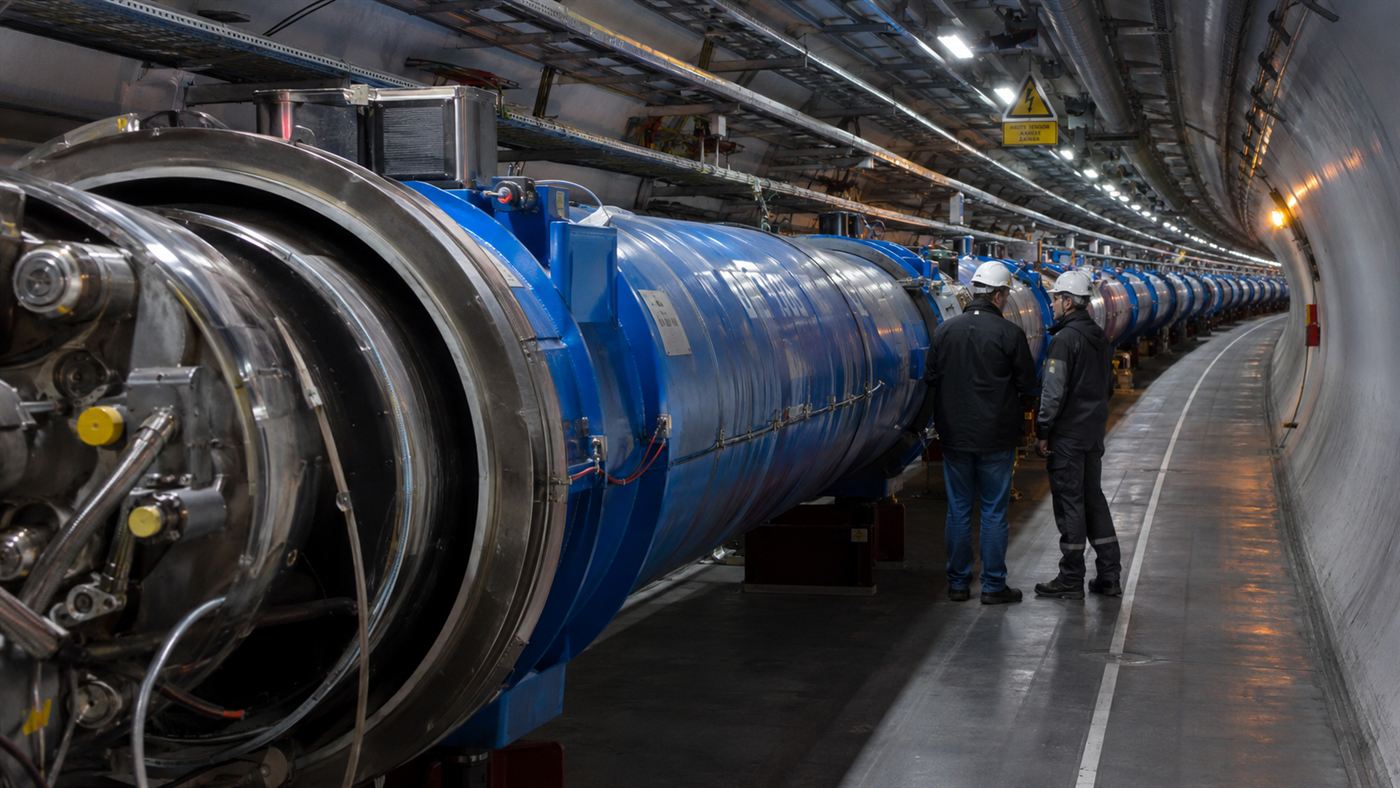
Each of those collisions is a tiny, violent event, and detectors the size of buildings sit around the crossing points to record the spray of particles that bursts out. The whole apparatus, the ring, the magnets, the detectors, the cooling, adds up to the most complex and most expensive scientific instrument humanity has ever assembled.
Colder than space, hotter than the sun
To bend beams moving that fast, the Large Hadron Collider uses superconducting magnets, and superconductors only work when they are extraordinarily cold. So the ring is chilled to 1.9 kelvin, about minus 271 degrees Celsius, which is colder than the background temperature of outer space. Achieving that takes the largest cryogenic system on Earth, thousands of tonnes of liquid nitrogen followed by more than a hundred tonnes of liquid helium, and it makes the collider the coldest large region anywhere in the solar system.
And yet, at the same time, it is briefly one of the hottest. When two protons meet head-on, the energy crammed into that pinprick of space produces, for the tiniest instant, temperatures vastly hotter than the core of the sun. The same machine holds the cold of deep space in its magnets and the fire of the early universe at its collision points, separated by a few metres and a few millionths of a second.
Why smash protons together at all?
The reason for all this violence is captured by Einstein's most famous equation, the one that says energy and mass are interchangeable. When the Large Hadron Collider slams protons together at enormous energy, that energy can turn into mass, momentarily conjuring heavy particles that do not normally exist in the everyday world. By studying the debris, physicists can glimpse particles and forces that were last common a fraction of a second after the Big Bang.
In effect, the collider is a time machine of a sort. It cannot send anyone back, but by recreating the searing energies of the very young universe in a controlled, repeatable way, it lets scientists watch the kind of physics that ruled when the cosmos was newborn, over and over, in a tunnel beneath the Alps.
The particle that waited forty-eight years
The collider's most famous prize came in 2012. Back in 1964, the physicist Peter Higgs and several others had predicted an invisible field filling all of space, and a particle that went with it, that would explain why matter has mass at all. For decades this Higgs boson was the great missing piece of the theory, predicted but never seen. It was one of the main reasons the Large Hadron Collider was built.
In July 2012, two giant experiments at the collider announced they had found it. Peter Higgs, by then in his eighties, was in the audience, and he wept; he had waited almost half a century to learn whether the idea of his youth was real. The following year he shared the Nobel Prize in Physics. A particle imagined with pen and paper in 1964 had finally been caught, in the debris of protons, forty-eight years later.
An instrument the size of a city
None of this is the work of a handful of people. The Large Hadron Collider was built and is run by a collaboration of roughly ten thousand scientists and engineers from more than a hundred countries, at a construction cost of several billion dollars. The ring is bent by well over a thousand giant dipole magnets, each many metres long, and the engineering challenge of keeping two beams the width of a hair aimed precisely at each other around a 27-kilometre loop, for hours at a time, is staggering in its own right. It is as much a triumph of cooperation as of physics.
The honest catch
A few myths are worth clearing away. Before it switched on, some feared the Large Hadron Collider might create a black hole that would swallow the Earth; it did not, and the physics always said it would not, since far more energetic collisions happen naturally in the atmosphere all the time. It is also not literally recreating the Big Bang; it reproduces some of the conditions, at energies that are enormous for a laboratory but minute next to the real event.
And finding the Higgs, triumphant as it was, did not answer everything. The collider confirmed the theory we already had rather than revealing the new physics many hoped for, and the deep mysteries, what dark matter is, how gravity fits in, remain stubbornly open. But that is the nature of a discovery machine. The Large Hadron Collider is the largest, coldest, most precise instrument our species has ever built, and its greatest value may lie in the questions it is still working to answer.
The biggest, coldest machine ever built, run by ten thousand people, to catch a particle imagined on paper in 1964. Is a multi-billion-dollar instrument to study the invisible worth it, in your view? Tell us in the comments.
Related reading: The NASA crawler-transporter, the largest self-powered land vehicle ever built.