Africa's largest wind farm promised clean energy to the continent, but the 1,180 people of Sarima village were each paid $140 and told to leave their land
In northern Kenya, 365 wind turbines turn over 150,000 acres that five indigenous communities call home. The Lake Turkana wind farm sends 310 megawatts to Nairobi along a 428-kilometre line. The people who grazed cattle on that ground for generations were offered about $140 each to leave, and a Kenyan court has since ruled the land titles invalid.
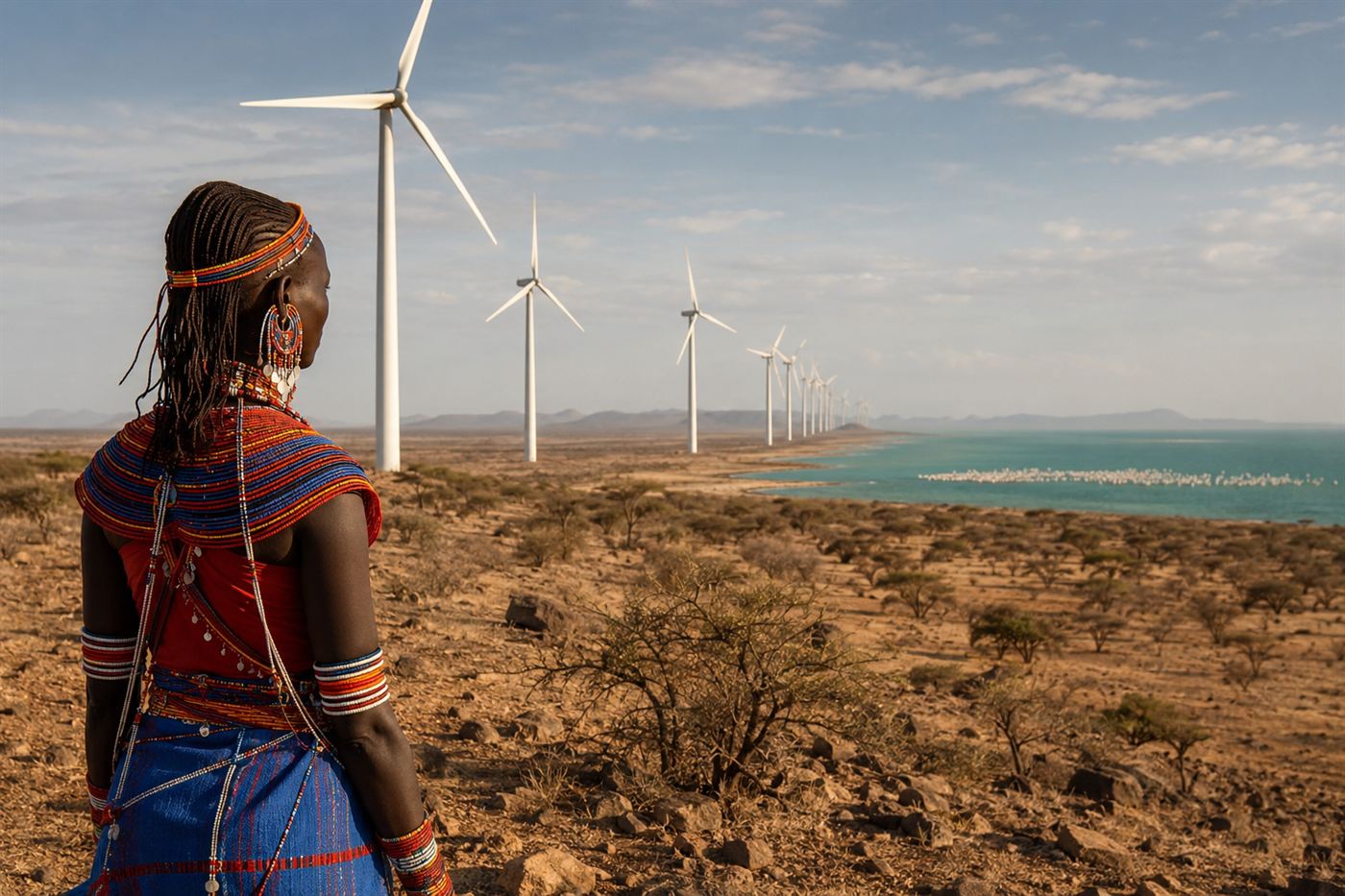
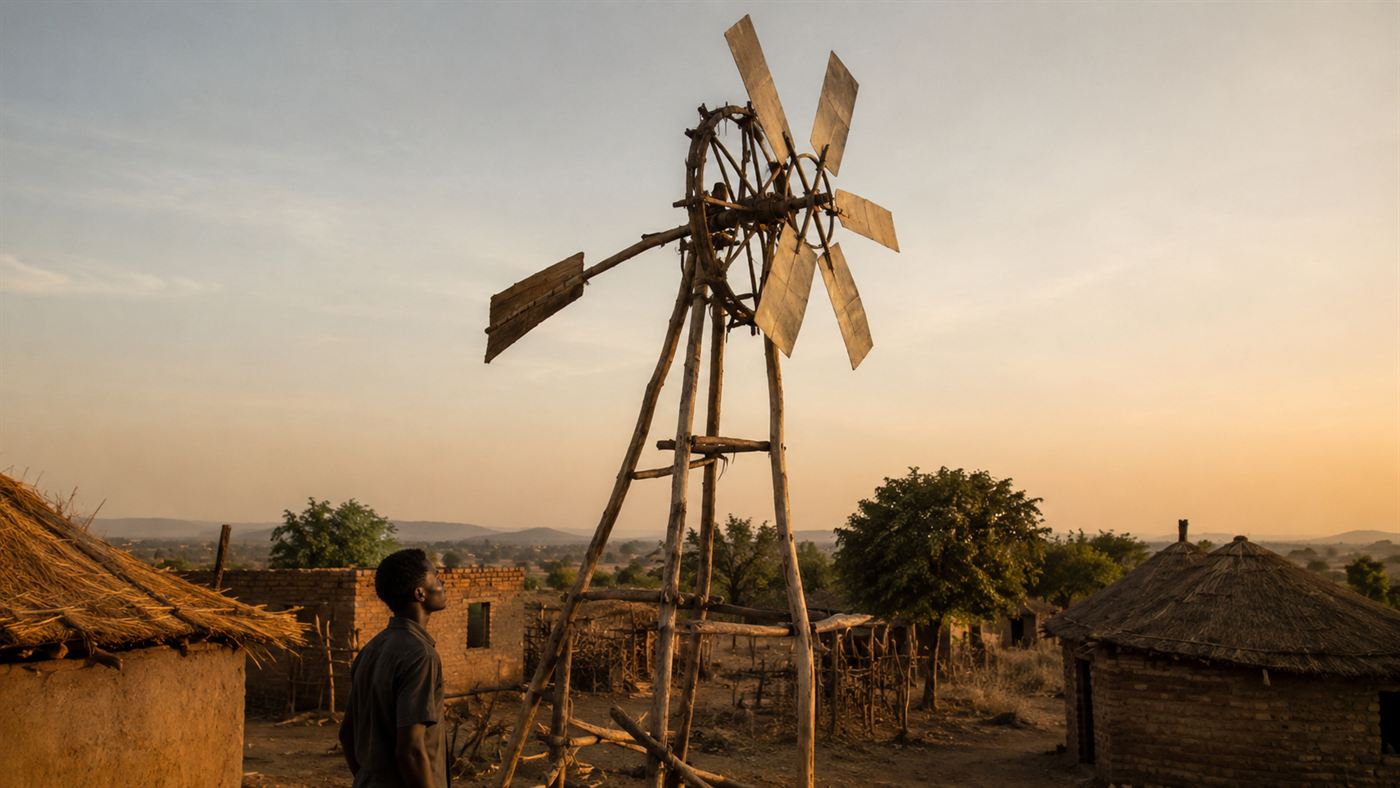
For generations the Rendille, Samburu, and Turkana communities grazed cattle and camels across these plains. Today the turbines of Africa's largest wind farm turn overhead. Illustration: Watts & Wild.
Makambo Lotorobo was born in Sarima, a settlement of Rendille pastoralists on the arid plains north of Lake Turkana in the shadow of what would become the Lake Turkana wind farm. His community had grazed cattle and camels across those 150,000 acres for generations. In 2009, without their knowledge, the Kenyan government signed those acres away to a private consortium. Construction crews began arriving in 2014. When Lotorobo and his neighbours finally learned what was happening, in April of that year, the turbine pads were already being surveyed. Each resident of Sarima village was offered KSh 13,000, then worth about $100 to $140, to leave.
The machine those turbines became is the Lake Turkana wind farm, and on paper it is a landmark achievement in Africa wind energy. As Wikipedia's Lake Turkana Wind Power Station entry documents, its 310 megawatts feed into Kenya's national grid through a 428-kilometre transmission line to Nairobi, supplying roughly 15 percent of the country's total installed capacity. European and East African investors hailed it as proof that the continent could leapfrog fossil fuels. That was the promise of the Lake Turkana wind farm. What happened underneath the turbines is a harder story to tell.
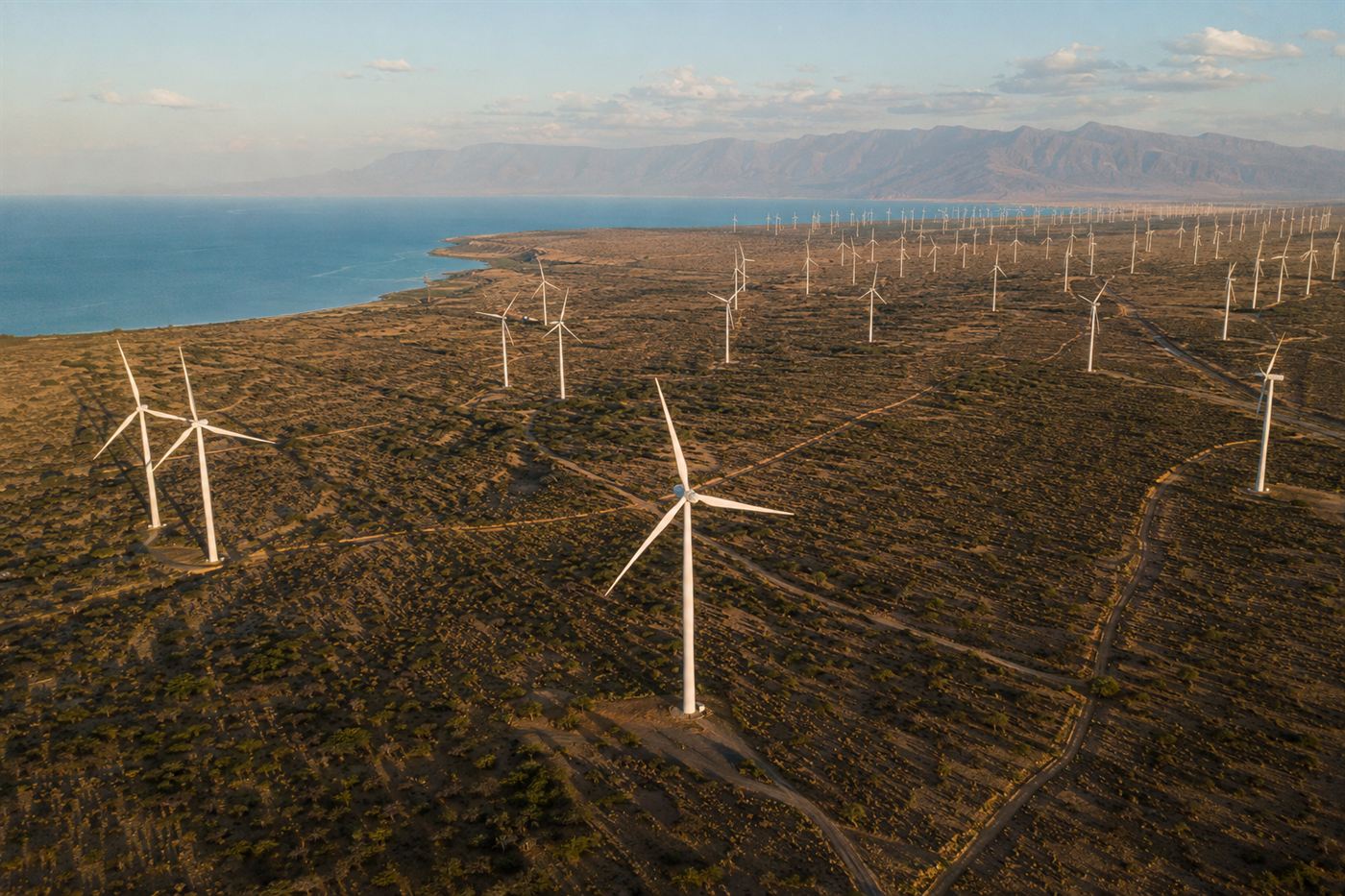
The Lake Turkana wind farm sits about 545 kilometres north of Nairobi in Marsabit County. It is the single largest wind installation on the African continent: 365 turbines, each rated at 850 kilowatts, spread across 160 square kilometres of arid plains. Kenya renewable energy planners had coveted the corridor for years because of its consistently strong trade winds. As a contribution to Africa wind energy, the location was close to ideal. The land on which it was built, however, was not empty, and the people living there were not consulted.
How the Lake Turkana wind farm was built on community land
The 150,000 acres were classified under Kenyan law as trust land.
Under that designation, the Marsabit County government held the ground in trust for the pastoralist communities that depended on it.
In March 2009, those rights were quietly transferred to a private consortium of European and East African investors.
No member of the five affected communities, the Rendille, Samburu, Turkana, El Molo, or any of the other pastoralists using the area, was consulted before the signature went down.
Five years passed.
Community members in Sarima first heard of the transfer in April 2014, the same month construction was announced.
The project broke ground in October 2014.
The first turbines rose in March 2016 and the last were completed exactly one year later.
By July 2017, 365 turbines stood over the lake plains with a combined capacity of 310 megawatts.
Africa wind energy had a new centrepiece, and a legal dispute had been running for three years by the time the lights switched on in Nairobi.
A community offered $140 to leave
The village of Sarima held 1,180 residents when the relocation demand arrived.
Each person was offered a KSh 13,000 payment, framed as resettlement support.
There was no independent valuation of the land, no cultural impact study, and no process to determine what the communities themselves wanted.
Makambo Lotorobo, a pastoralist who co-founded the Sarima Indigenous Peoples' Land Forum (SIPLF) to fight back, later described to human rights investigators how his people had exercised indigenous land rights over those plains for as long as anyone could remember, herding camels and cattle along routes his grandparents had used.
The SIPLF filed suit against the project in October 2014 at the High Court in Meru.
No such consent had been sought.
The turbines went up anyway.
Why does the electricity skip the people who live there?
The transmission line that carries the Lake Turkana wind farm's output runs 428 kilometres south, from the turbines at Loiyangalani to a substation at Suswa on the edge of the Rift Valley.
There are no branches north.
Marsabit County, which gave up 150,000 acres for this slice of Africa wind energy, is not on the route.
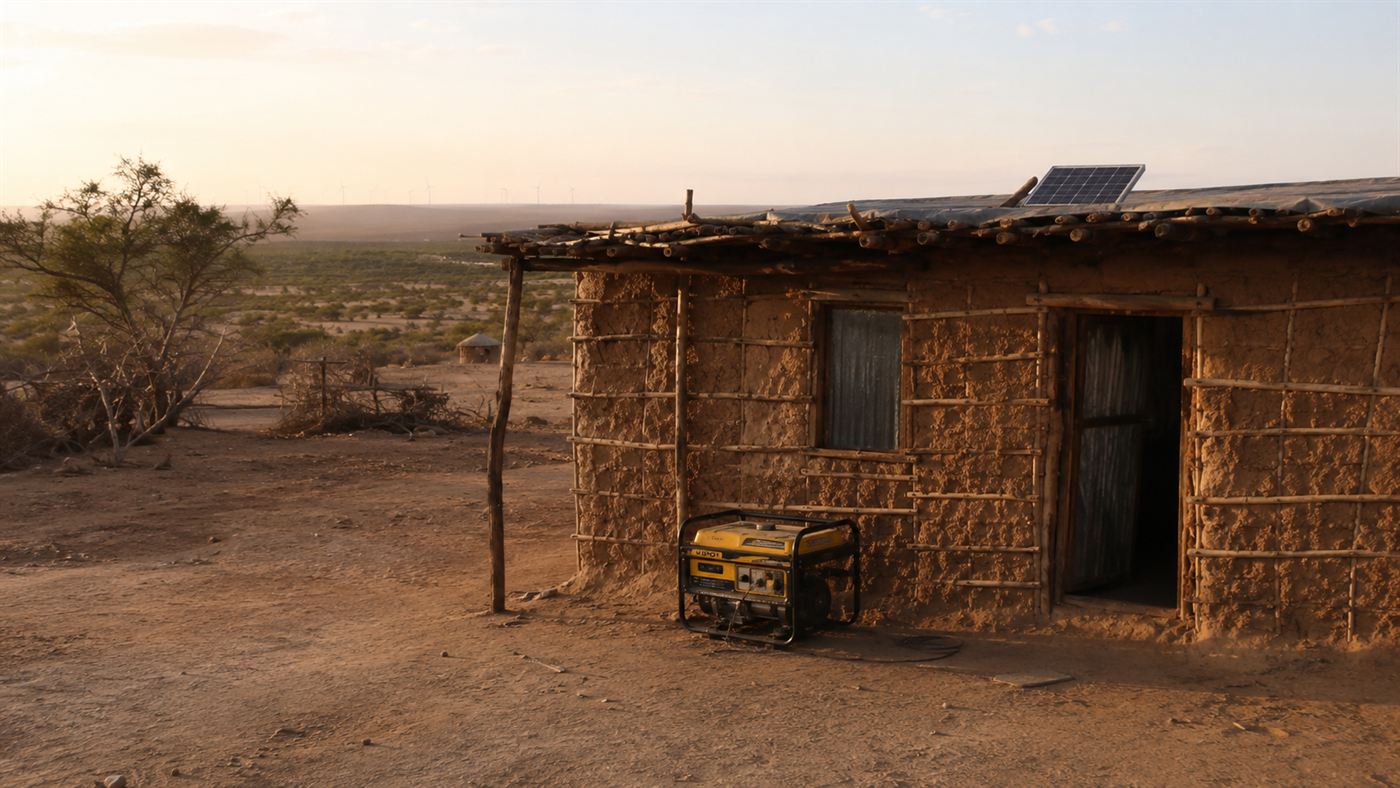
Most residents around Loiyangalani, the town closest to the blades, power their homes and businesses with diesel generators.
The fuel is trucked in from hundreds of kilometres away at considerable cost.
This is the wind farm community impact gap that development economists and indigenous rights advocates have pointed to since the project was first proposed.
Kenya renewable energy planning sold the Lake Turkana investment partly as a development tool for the country's historically neglected north.
The project's environmental and social documents projected local jobs, infrastructure improvements, and an eventual grid connection for the surrounding communities.
The wind farm community in Marsabit County generates roughly 15 percent of Kenya's total installed electricity capacity for cities 545 kilometres to the south.
Its own homes remain off the grid.
What did Kenya's courts decide?
On 19 October 2021, the High Court in Meru ruled that the Lake Turkana wind farm's land titles were "irregular and unlawful."
The judges found that the transfer of community trust land had not followed the procedures required under Kenya's Community Land Act.
The ruling applied to the title deeds for the 150,000 acres, not to the turbines themselves, which kept turning throughout.
The company applied for extra time to regularise the acquisition.
In May 2023, the court rejected that application.
It gave the Marsabit County government, the Attorney General, and the National Land Commission twelve months to correct the process.
The court was explicit: if regularisation was not completed within that period, the title deeds would be automatically cancelled and the land would revert to the communities by right.
That deadline has since expired.
The legal status of the ground the Lake Turkana wind farm stands on remains unresolved as of mid-2026.
Can Africa's wind energy be fair?
The Lake Turkana case is not an argument against wind power or against Kenya renewable energy.
The country has genuine electricity needs, and the Marsabit corridor's winds are among the strongest and most consistent in the region.
The point is that speed and consent cannot keep being treated as opposites in Africa wind energy development.
Projects across East Africa are now being structured with benefit-sharing agreements and genuine free, prior, and informed consent processes built in from the design stage.
Some are structured as partial community ownership models, where the people whose land anchors the infrastructure also hold a share of what it earns.
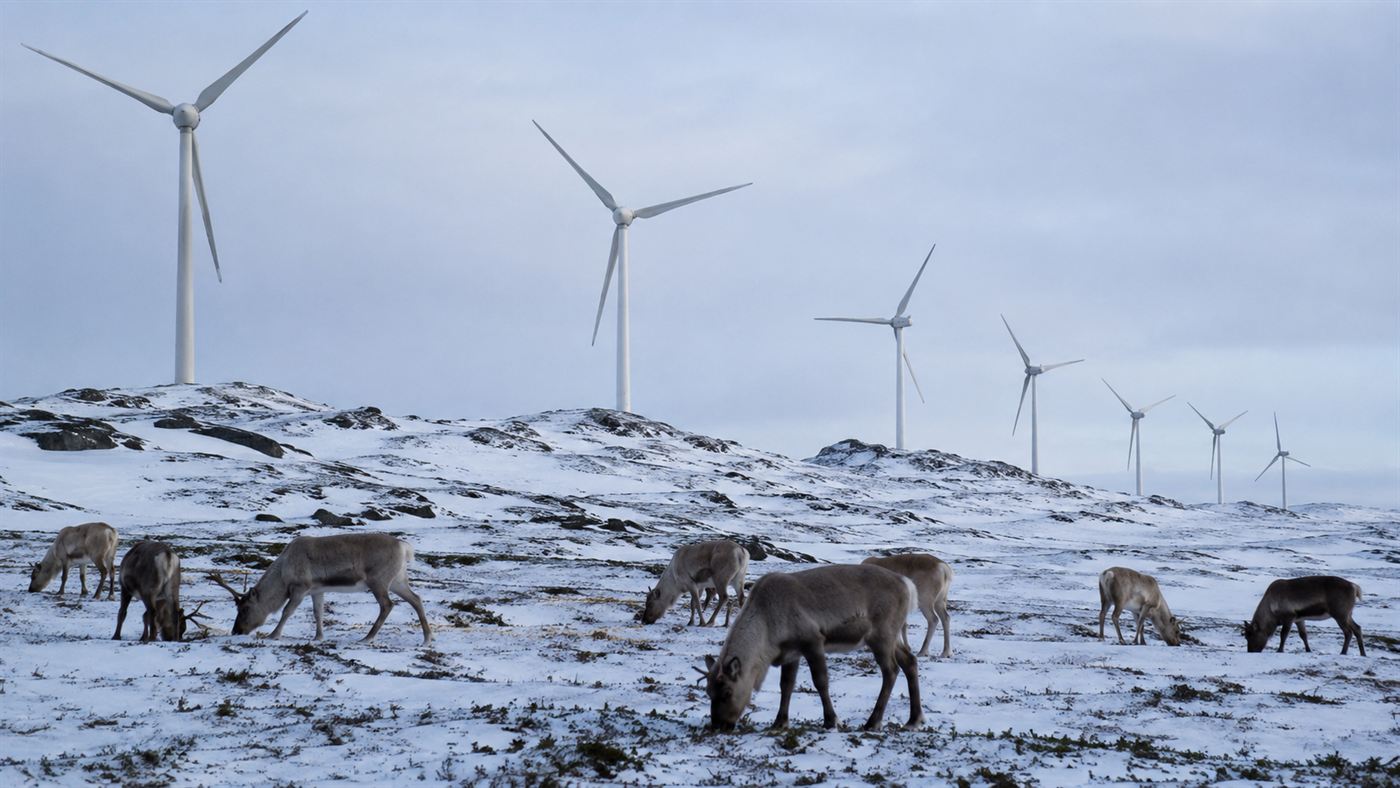
In Norway, Europe's largest onshore wind farm was built on Sami reindeer pastures and ruled an indigenous land rights violation by the Supreme Court, yet the turbines kept turning for years.
The pattern is the same on different continents: the cheapest, windiest land tends to be someone else's land, and the rush to decarbonise can quietly repeat the oldest habits of all.
Africa wind energy cannot afford to inherit that pattern at scale.
The wind farm community at Loiyangalani has been living with the cost of one decade of getting it wrong.
Indigenous land rights are not a bureaucratic obstacle to be sorted out after the fact.
They are the condition under which any project on community land should have been approved in the first place.
When those rights are skipped, the project does not become green, it becomes a new version of the same extractive deal that communities in Kenya's north have been handed for generations, this time dressed in clean-energy language.
The honest catch
The Lake Turkana wind farm produces real electricity that Kenya genuinely needs.
At 310 megawatts it is not symbolic, it is structural, a meaningful piece of a grid that has struggled to keep up with one of Africa's fastest-growing economies.
Kenya renewable energy cannot afford to tear down what works while it learns to build more justly.
None of that changes what happened in Sarima.
A village of 1,180 people was relocated for $140 per person.
A 150,000-acre commons was transferred to private ownership without the consent of the communities that grazed it.
A court ruled the transfer illegal, and the project kept operating.
The absence of meaningful indigenous land rights protections is what made the dispute unavoidable, and it is what makes the whole enterprise legally fragile today.
The wind farm community that gave up its ground still has no grid connection.
In September 2025, Kenya Electricity Transmission Company spent KSh 207 million replacing six collapsed towers on the Loiyangalani-Suswa line and restoring full capacity to evacuate the farm's power south. As Capital FM reported, the transmission line was back at full 300 MW capacity by the end of September 2025.
The turbines are spinning again.
The people of Marsabit County are still on diesel.
A wind farm community can only be called a partner if it was asked to be one.
Africa's largest wind farm sends clean electricity to millions of Kenyans while the communities who gave up their land for it are still running on diesel and fighting in court for their acres back. If a court cancels a wind farm's land titles but the turbines keep spinning, who owes compensation to the people below them, and how much? Tell us what you think in the comments.
Related reading: In Norway, Europe's largest onshore wind farm was ruled a human rights violation by the Supreme Court and the turbines still kept turning.