Tens of thousands of people once lived stacked inside one ungoverned block in Hong Kong, the Kowloon Walled City, the densest place humanity ever built, and it worked far better than its lawless legend suggests
The Kowloon Walled City crammed as many as 50,000 people into a single block the size of a few football fields, with no architect, no master plan, and almost no government. For decades it was the most crowded patch of ground on Earth, and the truth of life inside it is stranger than the horror stories.
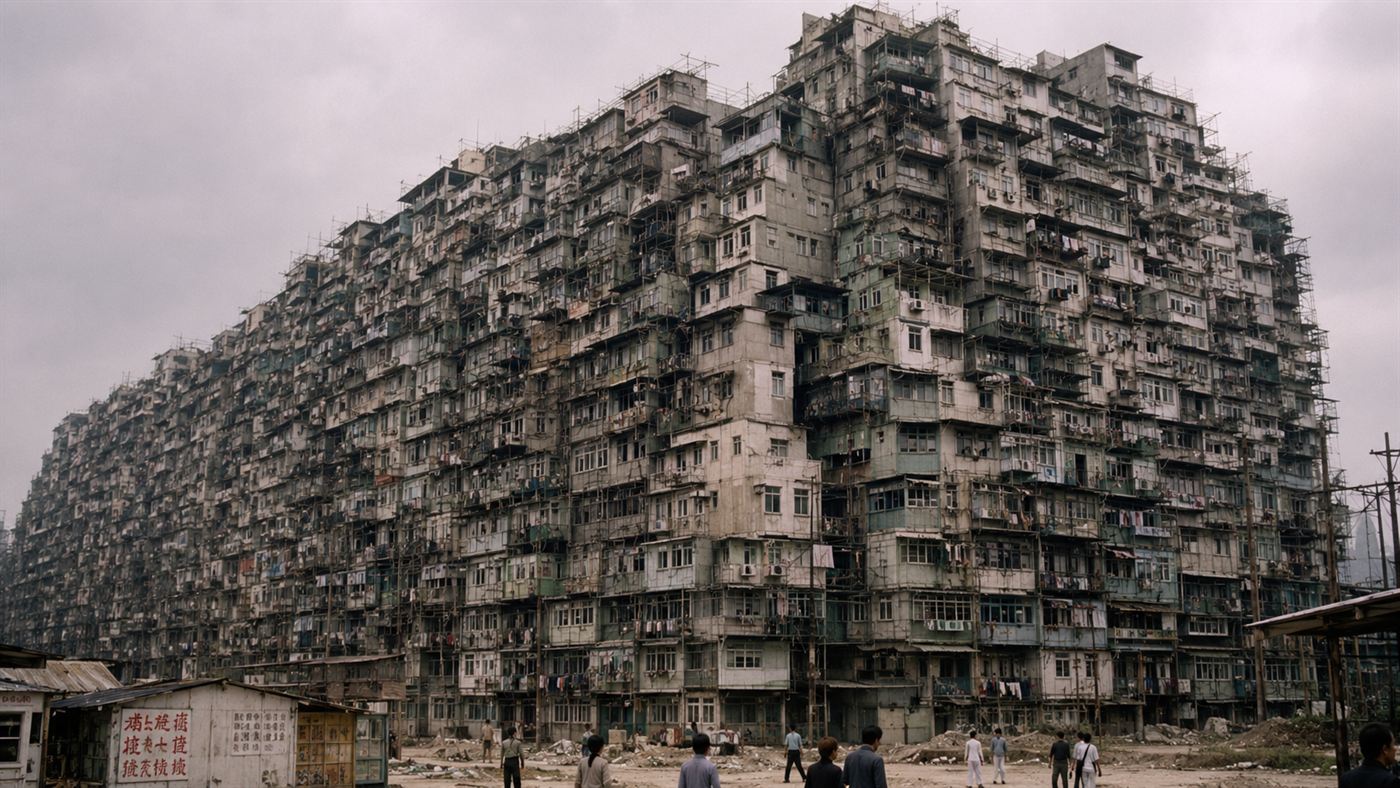
A single block that held a small city. The Kowloon Walled City grew floor by floor, with no one in charge. Illustration: Watts & Wild.
The Kowloon Walled City looked, from the outside, like one impossible building. It was really around 300 separate towers, thrown up without architects and packed so tightly together that they fused into a single concrete mass with no gaps between them. Inside that block, on a footprint of just 2.6 hectares, lived a population that by the late 1980s was estimated at 33,000 and may have peaked near 50,000.
Do the arithmetic and the number stops making sense. As HowStuffWorks lays out, that works out to somewhere between 1.2 and 1.9 million people per square kilometre, which makes this corner of Hong Kong the most densely populated place ever recorded on the planet. Manhattan, by comparison, is not even a rounding error against it. And almost none of it was supposed to exist.
The Kowloon Walled City was an ungoverned enclave in Hong Kong where up to 50,000 people lived inside a single block of roughly 300 interlinked buildings. At about 1.2 to 1.9 million residents per square kilometre, it was the most densely populated place ever recorded, and it was torn down in 1993 and 1994.
How a legal accident created the Kowloon Walled City
None of this was planned, and that is the whole point. The site began as a humble Chinese military fort. When Britain leased the New Territories of Hong Kong in 1898, the treaty quietly left this one walled compound under Chinese control, a tiny island of Chinese soil inside British territory. Neither side wanted the headache of governing it, so for the most part neither side did, a vacuum the Triads would later rush to fill.
That gap is what made the place. Japanese occupiers tore down the old stone wall during the Second World War to build a runway, and after the war squatters and refugees poured into the open ground. With no building codes and no landlord to stop them, they built upward and inward, floor stacked on floor, until the Kowloon Walled City became a self-made vertical slum that answered to no city hall on either side of the border.
The plane that capped the skyline
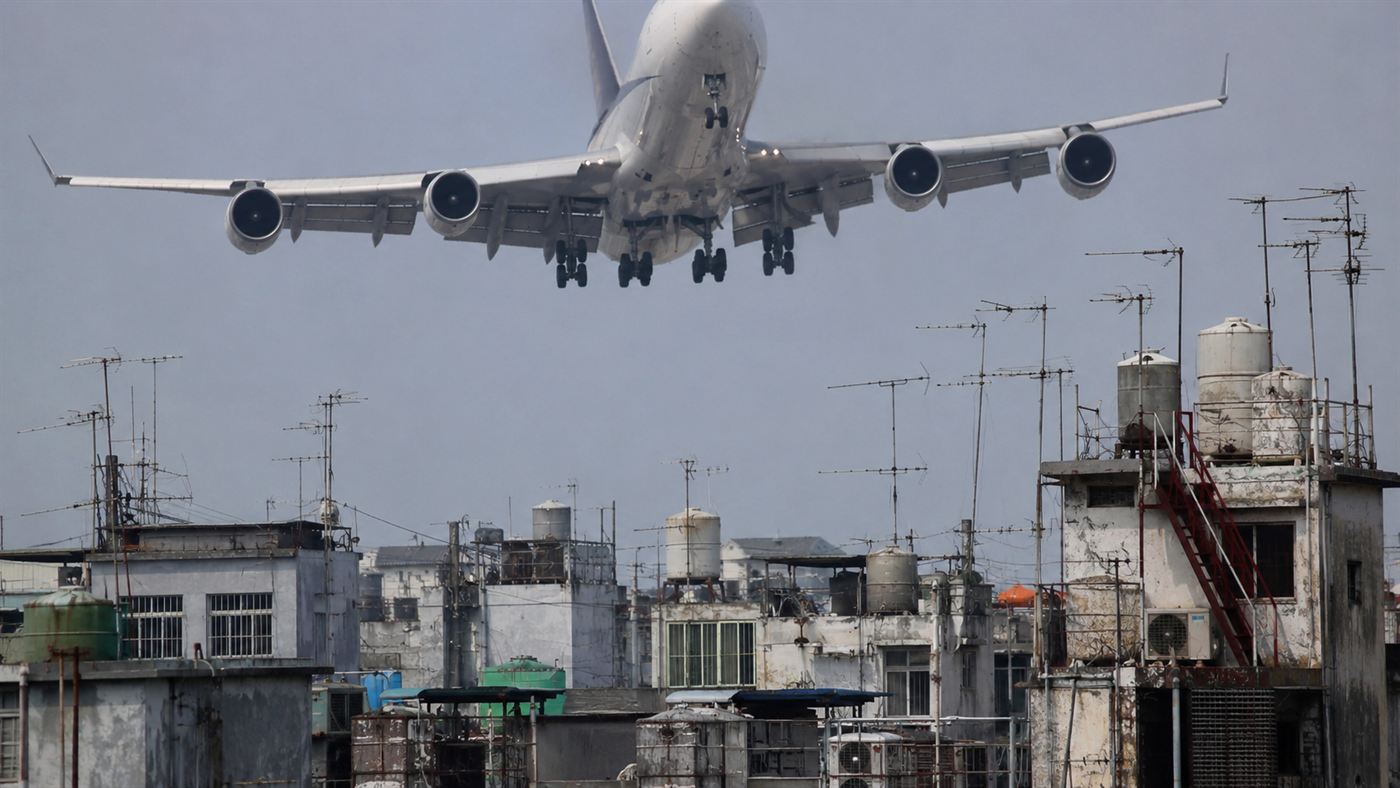
One law did rule the place, and it came from the sky. The block sat directly under the approach to Kai Tak, Hong Kong's old airport, whose single runway jutted into the harbour barely 800 metres away. Jets came in so low over the rooftops that passengers could practically read the laundry tags, and that flight path set a hard ceiling on the city.
Because anything taller would have clipped an airliner, the buildings stopped at around 14 storeys, an invisible line drawn not by a planner but by the underside of a descending Kai Tak plane. So the Kowloon Walled City grew sideways into every centimetre it had instead of up, its towers locked together at the top to hold the same 14-floor line. Residents strung their own water pipes and electrical cables through the gaps, and on the roof, above the gloom, children flew kites as the Kai Tak jets thundered past.
Life in the City of Darkness
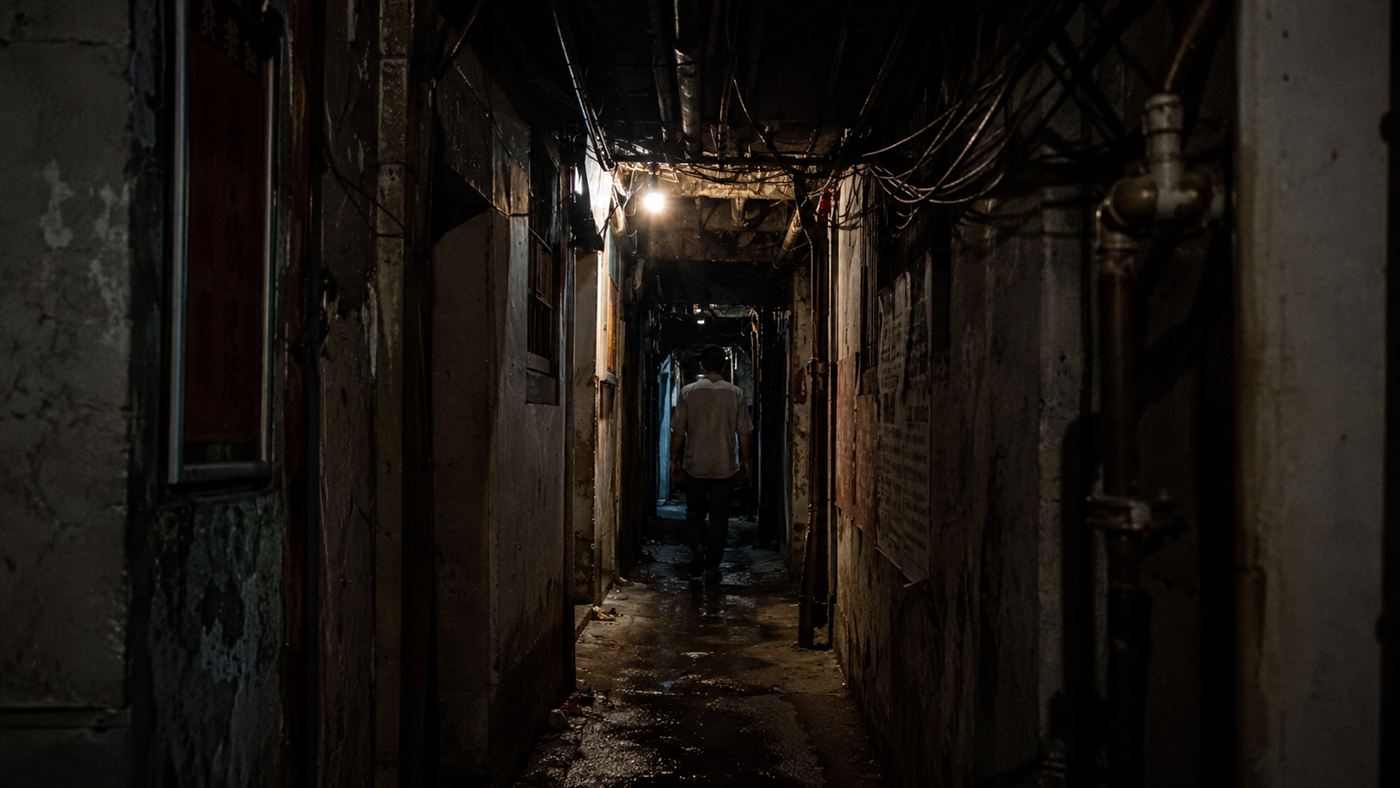
At ground level the sun simply never arrived. The alleys between the towers narrowed to shoulder width and were roofed over by the floors above, so residents walked through a permanent twilight lit by bare bulbs, past a ceiling of dripping pipes and tangled wire. That gloom earned the place its Cantonese nickname, Hak Nam, the City of Darkness, later borrowed for the famous photo book by Greg Girard and Ian Lambot that recorded its final years.
Yet a real city ran in that darkness. Unlicensed dentists and doctors, many trained on the mainland but barred from practising elsewhere in Hong Kong, hung their signs in the alleys and treated patients from across the territory at prices nobody else offered. Tiny factories pressed out fish balls and noodles that fed kitchens far beyond the walls. People raised families, ran shops, and built a community as ordinary as it was crammed, which is the part the City of Darkness name tends to hide.
Were the Triads really in charge?
The lawless reputation was not invented from nothing. In the 1950s and 1960s, with no police willing to enter, Triads like the 14K and Sun Yee On moved in and ran gambling dens, heroin parlours, and brothels in the lightless lanes. For a stretch the gangs were the closest thing the place had to authority, and that era is what fixed the city in the public imagination as a den of vice.
But it did not last. A wave of police raids in 1973 and 1974 broke the worst of the Triads' grip, and the city that emerged afterward was poorer and stranger than the rest of Hong Kong but, by most accounts, no more dangerous. Residents have long insisted they felt safe walking home at night, watched over by neighbours who knew every face in their corridor. The monster of legend had quietly become a working neighbourhood.
The honest catch
It is easy to swing too far the other way and romanticise the place, and that would be a mistake too. Life in the Kowloon Walled City meant raw sewage in some stairwells, water shortages, fire risks, and almost no daylight, conditions no one should have had to live in. The numbers everyone quotes, the 33,000 and the 50,000, are estimates rather than a clean census, since counting a population that governed itself was never going to be exact.
By the late 1980s both governments finally agreed it had to go, and between 1993 and 1994 the block was emptied and demolished, replaced by a quiet park that opened in 1995. What the bulldozers erased was not just a slum but a one-off experiment nobody designed: proof of how much life people will build, and how much order they will improvise, when the state looks away and leaves them to it. That tension between squalor and community is exactly why the place still fascinates architects and city-builders today. Long after the Triads were gone and the City of Darkness was rubble, that paradox is what keeps it alive in films, games, and design studios.
A block with no architect and almost no government became the most crowded place on Earth, and somehow it functioned. Would a self-built city like this be a nightmare to you, or a strange kind of freedom worth understanding? Tell us in the comments.
Related reading: Almost everyone in this Alaskan town lives, shops and goes to school inside a single building.