Slide down the right desert dune on a dry day and the whole mountain of sand hums a deep note you can feel through your feet
Most sand is silent. But in a handful of deserts, if the conditions are exactly right, a sliding dune will let out a long, low groan like a pipe organ or a distant propeller, loud enough to feel in your chest. It sounds like magic, and for centuries people were sure it was something alive.
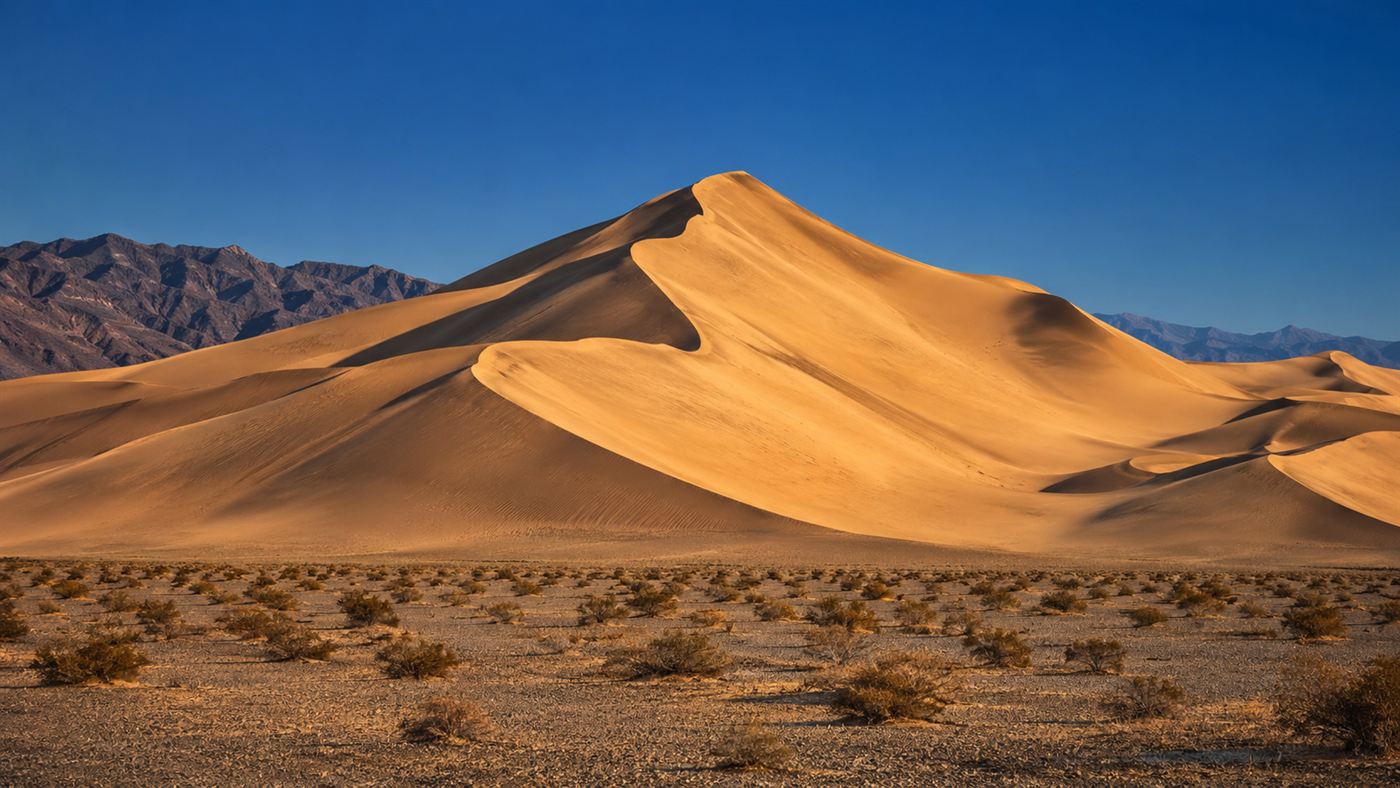
The Kelso Dunes rise about 650 feet from the floor of the Mojave. Illustration: Watts & Wild.
In the Mojave National Preserve in California stand the Kelso Dunes, a great golden pile of sand rising some six hundred and fifty feet above the desert. On the surface they look like any other beautiful dune field, the kind of place people hike up just to run back down. But the Kelso Dunes are among a rare few in the world that can do something startling.
On a hot, bone-dry day, if you climb to the steep upper face and set the sand sliding beneath you, the dune can answer with a deep, resonant boom, a note so low and so large that it seems to come from inside the mountain itself. People describe it as an organ, a foghorn, a drum, or a plane passing far overhead.
The short version is that this booming sand is real, it is one of nature's strangest sounds, and the explanation is stranger and more satisfying than the ghost stories it once inspired.
What it is like to hear the Kelso Dunes sing
The sound is not a squeak or a whistle but a genuine deep tone, sometimes lasting several seconds, that you feel as much as hear. Push a broad sheet of dry sand down the slope and the whole slipface can join in, until it feels as though you are sitting on top of a vast, humming instrument.
It does not happen every day, or for everyone. The dunes only boom when the sand is extremely dry, so plenty of hopeful hikers reach the top after damp weather and are met with nothing but silence. When it does work, though, the effect is unforgettable, a landscape that literally answers back.
Why singing sand baffled people for centuries
The phenomenon is old news to desert travellers. Marco Polo wrote of sands that seemed to fill the air with the sounds of a phantom caravan, and Charles Darwin noted booming dunes as well. Across many cultures, the eerie sound was blamed on spirits, buried cities, or the moaning of the dead, and it is easy to see why.
Even for scientists, singing sand proved genuinely hard to explain, and it was argued over for well more than a century. Early guesses about wind whistling over the crests turned out to be wrong, and it took careful modern study of the grains themselves to get close to an answer.
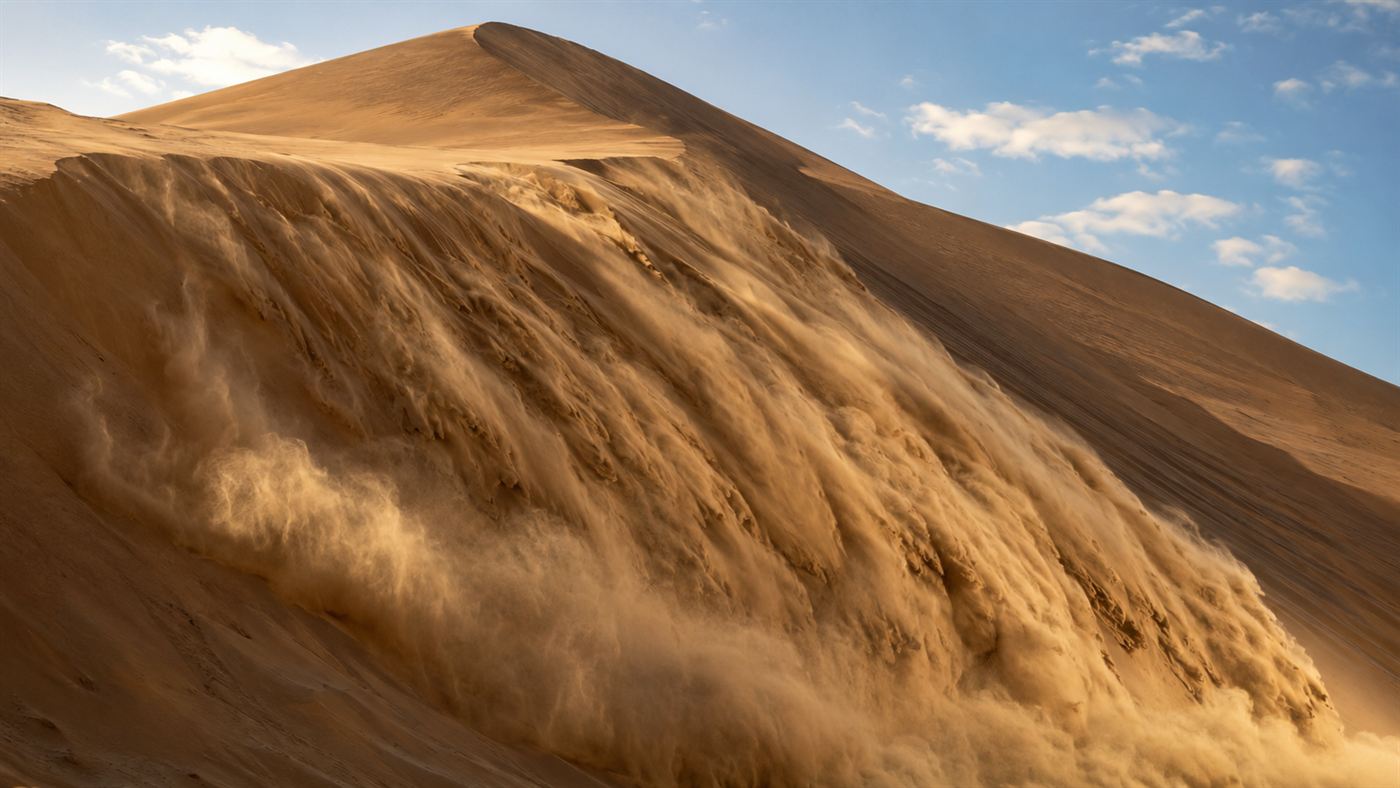
The physics of a booming dune
The secret lies in the grains and in the shape of the dune. Booming sand is made of grains that are unusually rounded, similar in size and smooth, sometimes with a fine polish. When a layer of that sand avalanches, the grains do not tumble at random; they shear past one another in a surprisingly coordinated way, bumping in near-unison.
That coordinated stick-and-slip motion sets up a vibration, and the huge body of dry sand beneath acts like a resonating chamber, reinforcing one deep frequency by resonance and broadcasting it. The pitch is tied to how fast the sand is shearing and to the size of the grains, which is why one dune drones lower than another. It is, in effect, a mountain-sized musical instrument played by gravity.

Why does it need to be so dry?
Moisture is the enemy of the song. Even a little water forms tiny bridges between the grains, gluing them together just enough to spoil the clean, synchronised shearing that makes the sound. Damp sand slumps quietly instead of ringing, which is why the Kelso Dunes fall silent for a while after rain.
That fussiness is part of why booming dunes are so rare, found in only a few dozen places on the whole planet. You need the right grains, a big enough dune, a steep face and a spell of perfect dryness all at once, a combination that most deserts never quite manage.
The honest catch
It is tempting to present the booming as a solved, tidy piece of physics, and in broad strokes it is understood. But scientists still argue over the fine details, such as exactly what sets the pitch and how the resonance is tuned, so the singing sand is not quite as fully explained as a confident tour guide might tell you.
There is a gentler catch too. Because the effect is so finicky, the honest promise of the Kelso Dunes is not a guaranteed marvel but a maybe, a wonder that depends on the weather and your luck. And perhaps that is fitting. A hill of ordinary sand that occasionally sings a note you can feel in your bones is enough of a miracle without pretending it performs on demand.
A mountain of plain sand can hum a deep note you feel in your chest, but only when the desert is perfectly dry. Would you hike hours up a dune for a sound that might refuse to come? Tell us what you think in the comments.
Related reading: the sailing stones of Death Valley that move on their own. See also the beautiful, deadly slot canyon of the desert Southwest, and the Great Salt Lake drying into toxic dust.