A farmer's plough struck the biggest meteorite on Earth, and it had landed without leaving a crater
One day in 1920, a farmer in Namibia was working a field with his oxen when the plough screeched to a halt against something hard buried just below the soil. What he had hit was not a rock or a stump, but the largest meteorite ever found on Earth, sixty tonnes of iron from space, lying exactly where it had quietly come to rest.
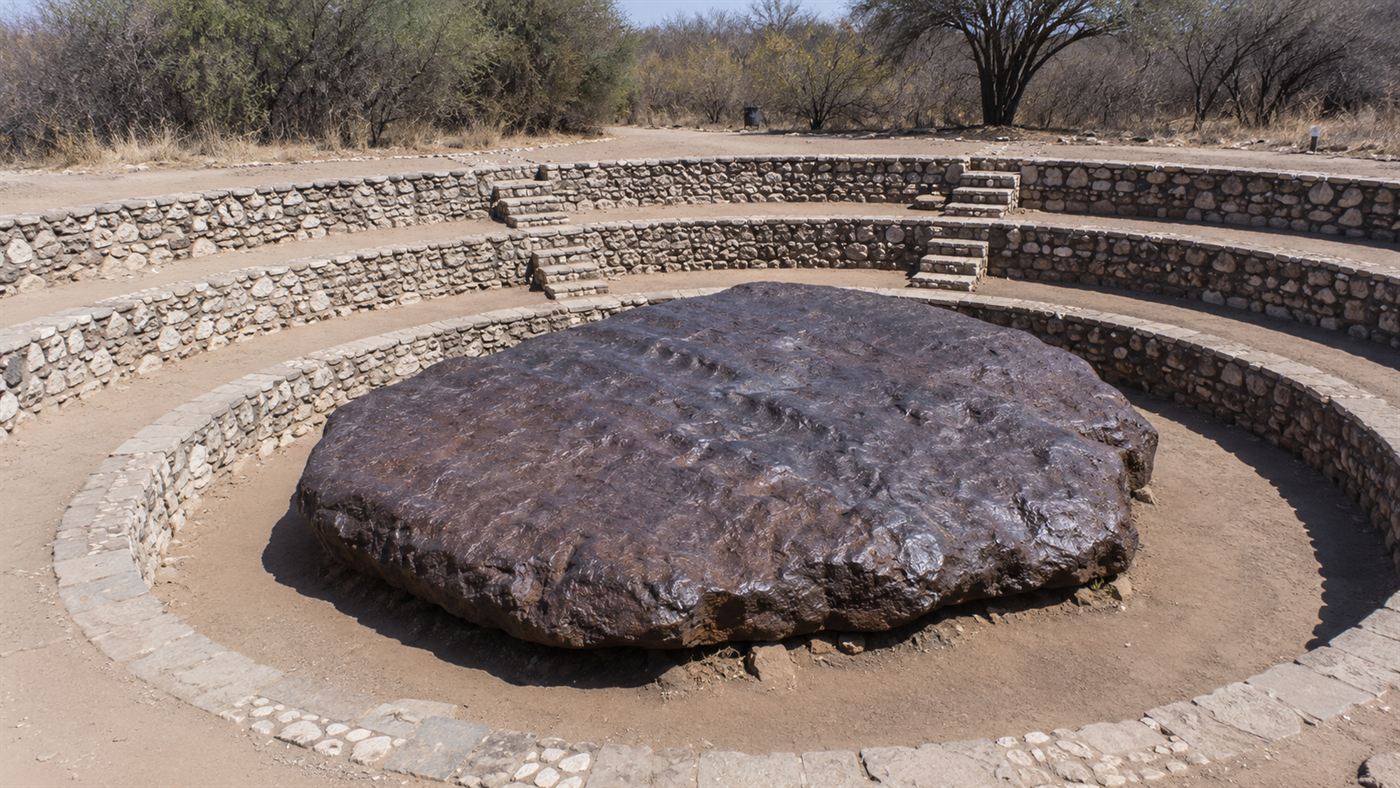
The Hoba meteorite still lies where it fell, a flat tabletop of iron the size of a small car. Illustration: Watts & Wild.
The Hoba meteorite sits on a farm called Hoba West, near the town of Grootfontein. It is a broad, flat slab of metal, roughly 2.7 metres on each side and about a metre thick, and it is made of around 84 percent iron and 16 percent nickel, with a little cobalt mixed in. There is nothing else quite like it on the planet's surface.
It is the largest known single meteorite in the world, and the biggest natural piece of iron sitting near the Earth's surface anywhere. The famous chunks of space iron in the great museums are only about half its size. And yet for tens of thousands of years it lay forgotten in a quiet African field, waiting for a plough to find it.
Sixty tonnes of iron in a farmer's field
The farmer was Jacobus Hermanus Brits, and the story of the discovery is wonderfully ordinary. He was simply ploughing when he heard a loud metallic scraping and felt the plough jam against something solid. Curious, he dug around the obstruction and uncovered a vast, dark, rusted slab of metal that plainly did not belong in a Namibian field.
Scientists later worked out what it was: an iron meteorite, a lump of an ancient broken-up asteroid's metal core, that had fallen from the sky. It is thought to have landed within the last eighty thousand years or so, which on a geological scale is almost yesterday, and the surrounding land bears no scar of a great impact.
The space rock that left no crater
That missing scar is the real puzzle. A sixty-tonne mass of iron falling from space ought to hit the ground hard enough to blast out a sizeable crater, yet Hoba left none at all. An object that should have arrived like a bomb instead seems to have settled into the earth almost gently.
The favoured explanation is its strange shape. Hoba is unusually flat, more like a thick metal tabletop than a ball, and that broad, flat form may have acted like a brake in the atmosphere, slowing it dramatically on the way down. If it came in at a shallow angle and a relatively modest speed, it could have planted itself in the soil rather than exploding into it. It is a rare case of a falling giant that chose, in effect, to land softly.
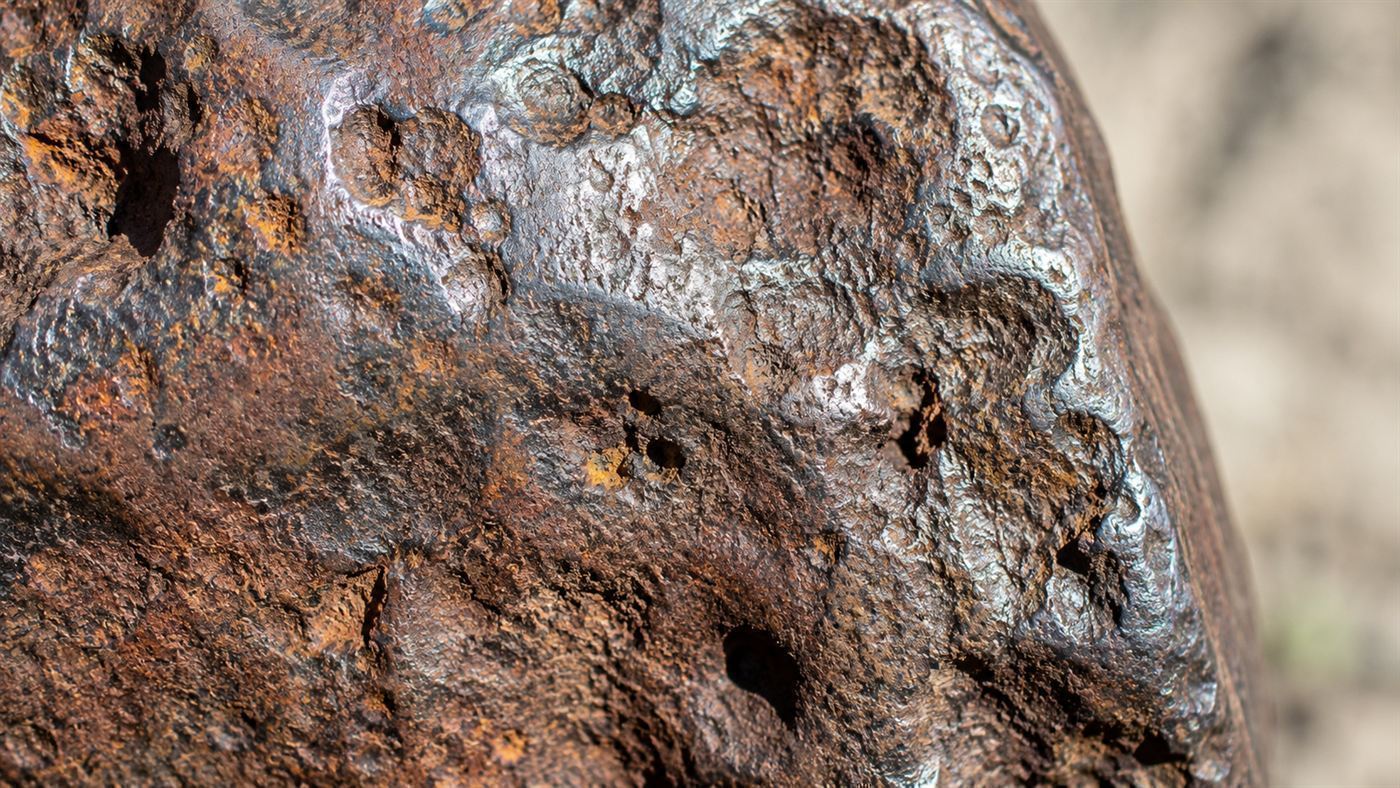
Why the Hoba meteorite never moved
Most prized meteorites end up carted off to a museum, but not this one. Hoba is simply too heavy to shift without enormous effort, so it has never been moved from the spot where it landed. It is one of the very few great meteorites in the world that you can still visit exactly where it came to rest, rather than behind glass in a city far away.
That permanence is part of its charm. Standing beside it, you are standing where a piece of the solar system touched down, on the precise patch of ground it has occupied since before recorded history. The asteroid it came from broke apart long ago, but this fragment of its iron heart is still here, immovable.
Slowly chipped away
Being out in the open came at a cost. For decades Hoba had no real protection, and scientists took samples while sightseers and vandals hacked off pieces to keep or sell. The meteorite slowly shrank, losing several tonnes over the years to chisels and souvenir hunters.
The bleeding was finally stopped in 1955, when the authorities declared Hoba a national monument. Decades later the landowner donated the meteorite and its plot to the state, a small visitor centre and stone seating were built around it, and the great iron slab became a protected attraction. The thing that survived a fall from space had needed saving from people armed with hammers.
The honest catch
A little care is needed with the superlatives. Hoba is the largest known intact meteorite, a single piece you can walk up to and touch, but far bigger objects have struck the Earth over its history. Those larger impacts blasted out craters or vaporised on arrival, which is exactly why no neat slab survives from them. Hoba is the biggest one still lying around in one piece, not the biggest thing ever to hit us.
The no-crater explanation, too, is a strong best guess rather than a proven fact, and the figures for its age and original weight are estimates that shift a little between sources. But the core wonder holds firm. Sixty tonnes of metal forged in the core of a shattered asteroid fell out of the sky, landed without a bang, lay hidden for ages, and was finally betrayed by the scrape of a farmer's plough. Some of the strangest things on Earth are the ones that were simply waiting to be tripped over.
The biggest meteorite on Earth fell without a crater, hid for eighty thousand years, and was found by a man behind an ox. Would you rather see a meteorite in a museum, or stand on the exact spot where it dropped out of the sky? Tell us what you think in the comments.
Related reading: Tunguska, the day something from space flattened a Siberian forest and left no crater either.