The world's largest musical instrument is not an organ or a piano but an entire cave, its ancient stalactites tuned and wired to a keyboard by one man over three years
Deep under the hills of Virginia, in Luray Caverns, sits the largest musical instrument on Earth. The Great Stalacpipe Organ is not housed in the cave; the cave is the instrument. Press a key at its console and a hammer somewhere in the dark taps a stalactite, and the whole cavern quietly sings.
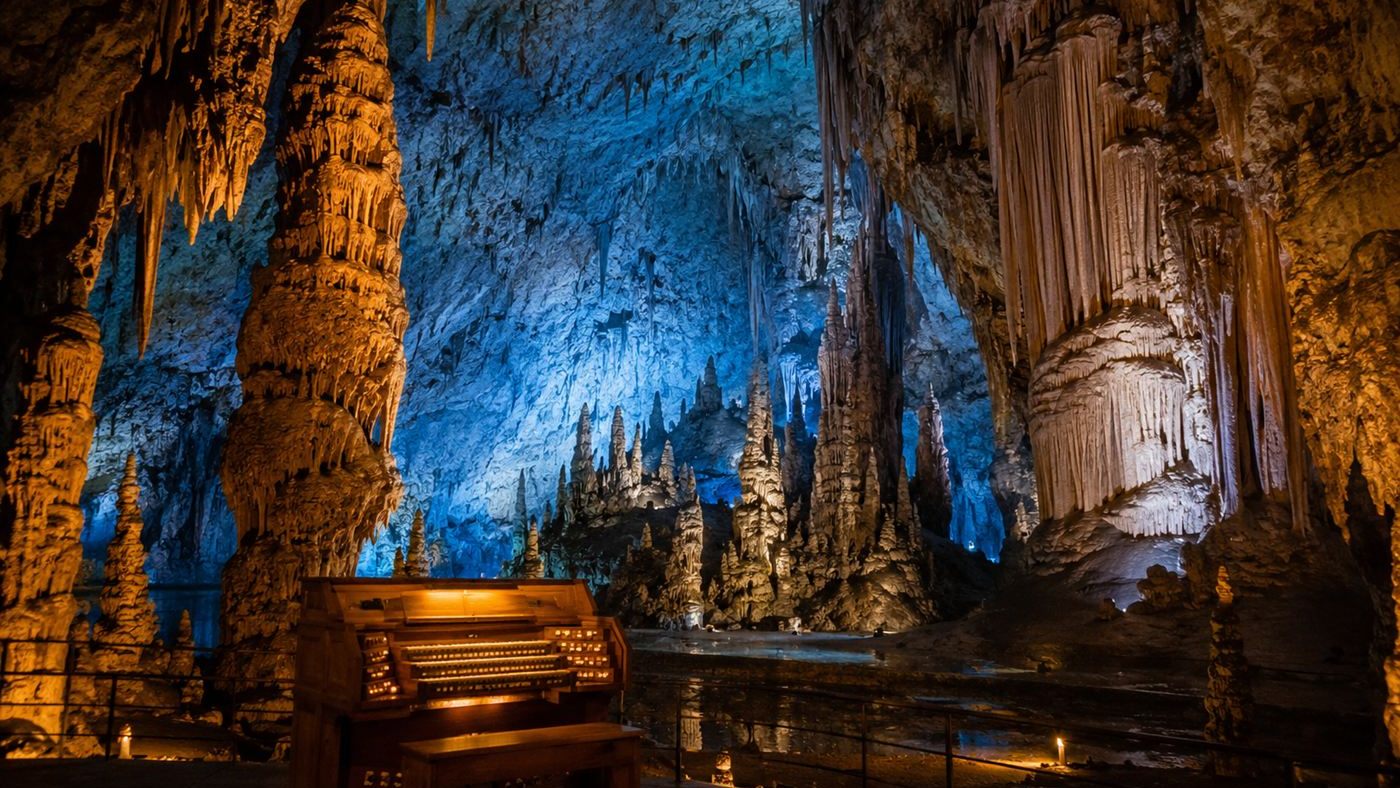
In Luray Caverns, the cave itself is the instrument. Illustration: Watts & Wild.
The idea sounds like something from a fairy tale, but it has a very precise origin. In 1954 a man named Leland Sprinkle took a tour of Luray Caverns, and at one point the guide demonstrated how the cave's formations could ring, tapping a stalactite to make it sound a soft musical note. Most visitors would have smiled and moved on. Sprinkle could not stop thinking about it.
He happened to be exactly the right person to be obsessed by it: a mathematician and electronics specialist who worked at the Pentagon. Where others heard a party trick, he heard the raw material for an organ, if only someone were willing to spend years turning a cave into one. He decided he would be that someone.
A mathematician underground
From 1956, Sprinkle spent around three years on the project. As Luray Caverns tells it, he searched the caverns for stalactites that rang with a usable tone, then carefully ground them down a touch to bring each one exactly to concert pitch. It was painstaking work, hunting through acres of underground rock for the right notes hidden inside formations that had taken hundreds of thousands of years to grow.
The result is officially the largest musical instrument in the world. As Atlas Obscura notes, the organ spreads across about three and a half acres of the cavern, with its sounding stalactites scattered far and wide through the dark. No concert hall could contain it, because it is built into the living rock of the cave.
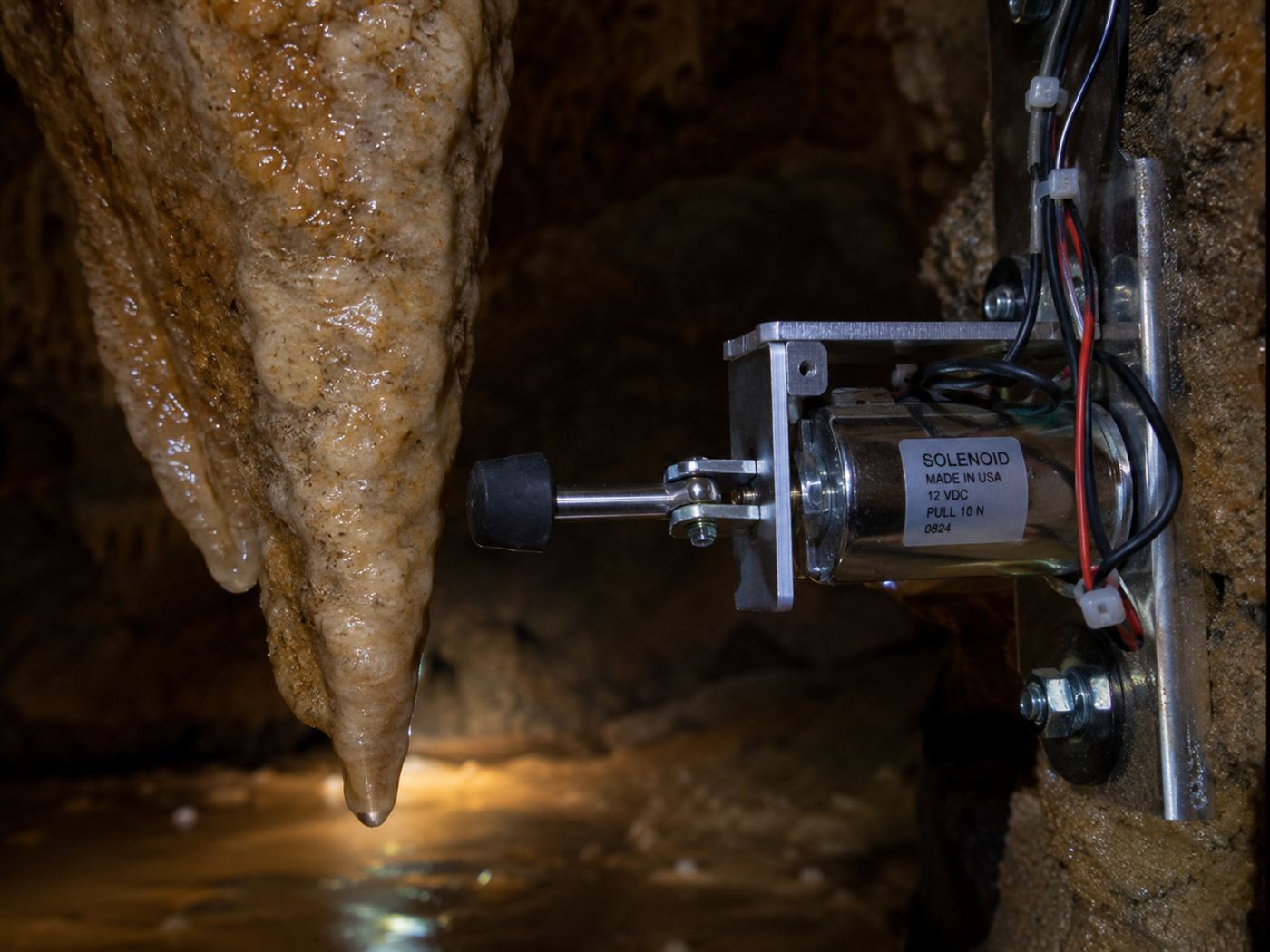
How the Great Stalacpipe Organ works
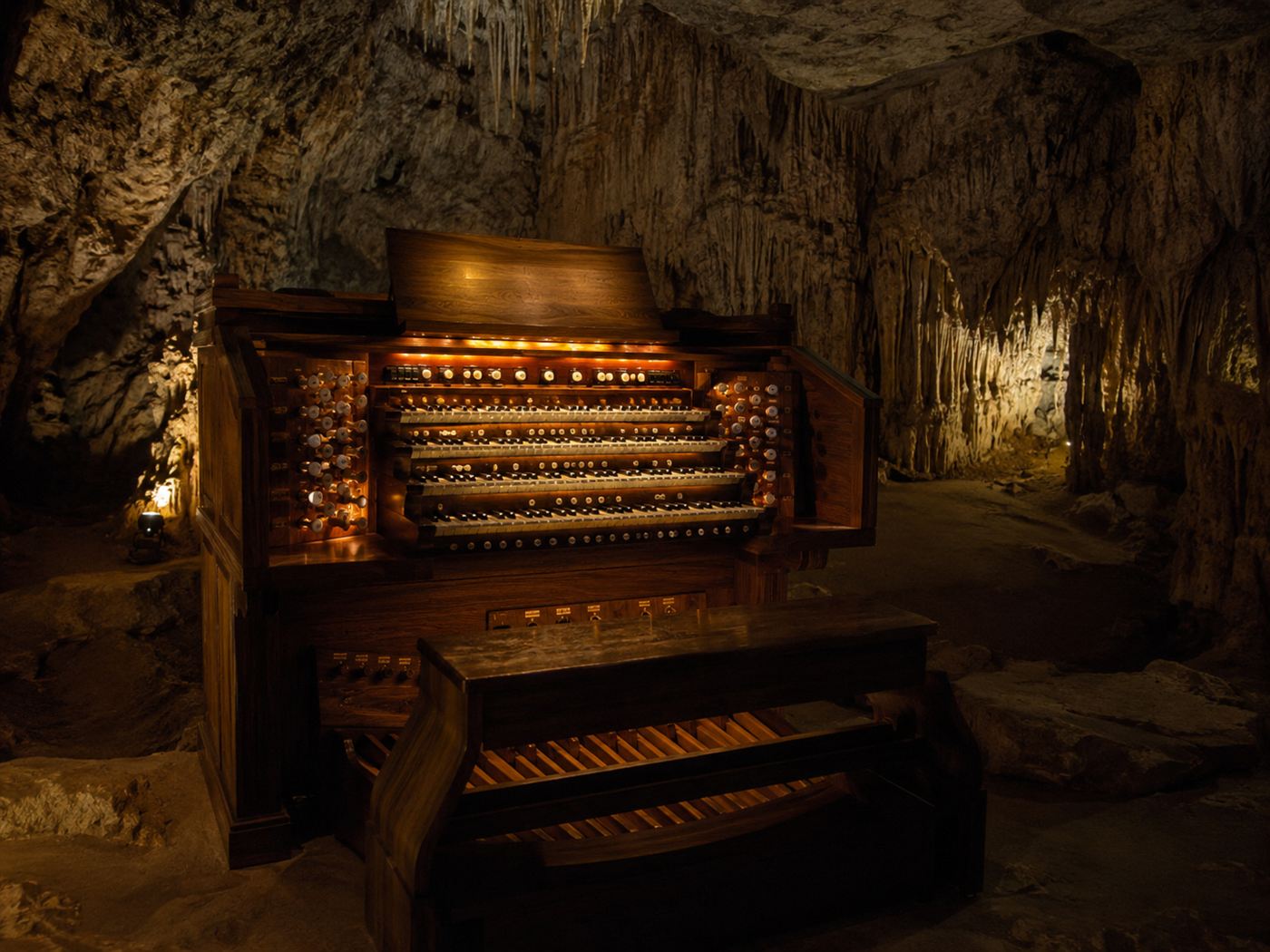
Up close, the magic turns out to be clever electrical engineering. At the heart of it is an ordinary-looking organ console with several keyboards. As a write-up by Stump Cross Caverns explains, each key is wired to a rubber-tipped mallet driven by an electric solenoid, mounted next to a particular stalactite. Press the key, the circuit fires, the mallet swings out and gives the stalactite a gentle tap, and the stone rings.
Because the formations are spread across the whole cavern, the sound does not come from one place but seems to drift out of the rock all around you, soft and bell-like and strange. For years Sprinkle played it himself for visitors. Today it is usually run by an automated system, a little like a giant music box, though it can still be played by hand at the keys.
The honest catch
It is a wonderful thing, and a couple of honest qualifications make it more interesting, not less. The romantic image is of an entire three-and-a-half-acre cave ringing as one, but in practice only a few dozen carefully chosen stalactites are actually wired up and sounding; the "instrument" is that scattered set plus its console and electronics, not literally every formation in the cavern. The size record is really about how far apart those notes are spread.
And the stalactites are not quite playing in their natural voice. Sprinkle ground each one slightly to tune it, and the tapping is done by uniform mechanical mallets, so there is a fair amount of human engineering between the raw rock and the music you hear. It is less a cave singing on its own than a cave that a patient man taught to sing, which is arguably a better story anyway.
Why a singing cave still matters
The Great Stalacpipe Organ is the kind of thing that restores a bit of wonder. It exists for no grand reason, solves no great problem, and makes no one rich. It is simply one person's refusal to let a beautiful idea go, the conviction that if a cave can ring, then a cave can be played, followed by the years of fiddly work to make it true.
There is something lovely about turning hundreds of thousands of years of slow geology into music with the press of a key. Would you rather hear the cave played live by hand, or is there something fitting about it performing to an empty cavern on automatic? Tell us in the comments.
Related reading: A corroded lump pulled from an ancient shipwreck turned out to be a 2,000-year-old geared computer.